
As an engineer engaged in the research and development of marine equipment, I have been deeply involved in addressing the manufacturing challenges of critical components used in deep-sea environments. The planetary carrier in a deep-sea gearbox is one of the most load-bearing parts, and its reliability directly affects the overall performance of the transmission system. In my recent project, we encountered severe internal shrinkage defects in ductile iron castings produced by the sand-lined metal mould process. Through systematic analysis, numerical simulation, and process optimization, we successfully resolved these quality issues. In this article, I share my first-hand experience and technical insights into optimizing the casting process for ductile iron castings, hoping to provide a reference for similar engineering applications.
1. Introduction
Deep-sea planetary gear sets operate under harsh conditions, including high hydrostatic pressure, low ambient temperatures, and variable dynamic loads. The planetary carrier, as the core component, must withstand extremely high torque and fatigue loads. Therefore, the material and manufacturing process must ensure exceptional mechanical properties and internal soundness. The component under investigation is a secondary planetary carrier for a deep-sea gearbox, made of high-strength and high-ductility ductile iron QT1000-5. The casting process selected was sand-lined metal mould casting, which combines the advantages of metal mould cooling with the flexibility of sand moulds. A thin layer of resin-coated sand is applied onto the inner surface of a metal mould, creating a rigid shell that promotes rapid solidification and refined microstructure. However, during initial production trials, about 30% of the castings exhibited internal shrinkage cavities and shrinkage porosity, and some moulds suffered sand breakage. This article describes how I identified the root causes, used ProCAST simulation to optimize the key process parameters, and validated the improvements through production.
2. Analysis of the Original Casting Process
2.1 Material selection and requirements
The planetary carrier must satisfy stringent mechanical property requirements after heat treatment: ultimate tensile strength ≥ 1000 MPa and ultrasonic testing (UT) acceptance level I according to GB/T 7233.1—2023. After comparative evaluation, we chose QT1000-5 ductile iron for its superior tensile strength, fatigue resistance, fracture toughness, and wear resistance compared with austempered ductile iron. The presence of 25%–50% retained austenite provides excellent fatigue performance, which is essential for deep-sea applications. The chemical composition of QT1000-5 is listed in Table 1.
| C | Si | Mn | Mg | P | S | RE | Fe |
|---|---|---|---|---|---|---|---|
| 3.2–3.8 | 2.2–2.8 | 0.2–0.6 | 0.03–0.06 | <0.08 | <0.02 | 0.01–0.04 | Balance |
The sand-lined metal mould process provides high mould rigidity and rapid cooling, which is beneficial for ductile iron castings to utilize graphitization expansion for self-feeding. Nevertheless, the relatively low carbon equivalent of QT1000-5 reduces the amount of graphite precipitation, weakening the self-feeding capacity. This is one of the primary reasons for shrinkage defects.
2.2 Original casting scheme
The original tooling used a horizontally parted sand-lined metal mould. The moulding machine simultaneously produced the cope and drag, each lined with a 5 mm thick layer of resin-coated sand. The pouring temperature was set at 1450 °C, ambient temperature at 26 °C, and gravity pouring was employed. The planetary carrier has overall dimensions of 214 mm × 214 mm × 190 mm, with a maximum wall thickness of 53 mm and a minimum wall thickness of 17.45 mm, and a casting weight of about 20 kg. Figure 1 shows a schematic of the casting and its final product.
During trial production, we observed mould sand breakage (erosion) and internal shrinkage cavities deeper than 10 mm in about 30% of the castings. These defects significantly reduced the fatigue life and pressure integrity of the ductile iron castings, making them unsuitable for deep-sea service.
2.3 Shrinkage criteria and root cause analysis
To understand the formation of shrinkage defects, I applied the well-known Niyama criterion, originally expressed as:
$$ G/\sqrt{R} \le K_r $$
where \(G\) is the temperature gradient in the mushy zone, \(R\) is the cooling rate, and \(K_r\) is a critical constant. When the local value of \(G/\sqrt{R}\) is lower than \(K_r\), shrinkage porosity is expected. Considering the metallostatic pressure and flow, Tian et al. modified the criterion to:
$$ P_r = P_j – K_r \frac{\sqrt{R}}{G} $$
where \(P_r\) is the local pressure in the casting section and \(P_j\) is the metallostatic pressure. Shrinkage occurs when \(P_r \le 0\). This leads to a dimensionless form:
$$ P_j \frac{G}{\sqrt{R}} \le K_r $$
Furthermore, Carlson and Beckermann proposed a dimensionless Niyama criterion accounting for the pressure drop in the mushy zone and material properties:
$$ N_y^* = C_\lambda \frac{G}{\sqrt{R}} \sqrt{\frac{\Delta P_{cr}}{\mu \beta (T_{liq} – T_{sol})}} $$
where \(C_\lambda\) is a material constant, \(\Delta P_{cr}\) is the critical pressure drop in the mushy zone, \(\mu\) is the dynamic viscosity of the liquid, \(\beta\) is the total solidification shrinkage, and \(T_{liq}\) and \(T_{sol}\) are the liquidus and solidus temperatures, respectively. A negative \(N_y^*\) indicates that shrinkage porosity will form.
For QT1000-5 ductile iron castings, the carbon content is lower than conventional ductile iron, and alloying elements like Cu and Mo are added to promote pearlite. This reduces the amount of graphite precipitated during eutectic solidification, thereby decreasing the volume expansion that helps compensate for solidification shrinkage. Moreover, the high magnesium content in ductile iron leads to a higher eutectic temperature, making self-feeding more difficult. The rigid metal mould lining can theoretically constrain the mould wall and promote internal pressure, but if the mould rigidity is insufficient, the graphitization expansion force may cause sand collapse or mould wall movement, leading to both internal porosity and sand breakage.
3. Optimization Measures
Based on the above analysis, I proposed several optimization measures targeting the key process parameters:
- Pouring temperature: Reduce from 1450 °C to 1350–1400 °C. Lower pouring temperature reduces the total heat input, increases the temperature gradient, and accelerates solidification, which helps promote directional solidification and reduces shrinkage porosity.
- Molten metal composition: Increase carbon content to at least 4.3%, increase silicon to 2.6%–2.7%, and control rare earth and magnesium below 0.05%. Higher carbon promotes graphitization expansion, while controlled Mg and RE minimize dross and inclusions that can act as nucleation sites for porosity.
- Sand coating thickness: Reduce from 5 mm to 3 mm. Thinner sand layer enhances the chilling effect, accelerates solidification, and increases the cooling rate, which is beneficial for reducing shrinkage porosity.
- Mould structure: Optimize the mould geometry, reinforce the sand core prints, and increase the rigidity of the metal mould to prevent sand breakage.
The optimized casting process arrangement is shown in Figure 2.
4. Numerical Simulation Using ProCAST
To verify the feasibility of the optimization measures, I conducted a series of numerical simulations using ProCAST software with the Niyama criterion and porosity prediction. The simulation parameters before and after optimization are summarized in Table 2.
| Parameter | Before optimization | After optimization |
|---|---|---|
| Pouring temperature (°C) | 1500 | 1400 |
| Sand coating thickness (mm) | 5 | 3 |
| Carbon content (%) | 3.9–4.1 | ≥4.3 |
| Silicon content (%) | 2.3–2.6 | 2.6–2.7 |
The baseline simulation (original process) showed extensive shrinkage porosity with porosity values ranging from 60% to 82% in the interior of the planetary carrier. The Niyama criterion value was as low as 9 K1/2·s1/2·cm−1. This clearly indicated poor feeding and severe internal defects in the ductile iron castings.
4.1 Effect of pouring temperature
When I reduced the pouring temperature from 1500 °C to 1400 °C, the porosity decreased significantly to about 25%–33%. The location of the largest shrinkage cavity shifted from the interior of the casting to the pouring riser. The Niyama criterion improved to 9.6 K1/2·s1/2·cm−1. This indicates that controlling the pouring temperature is the most effective way to avoid internal shrinkage defects in ductile iron castings.
4.2 Effect of molten metal composition
Next, I increased the carbon content to above 4.3% and the silicon to 2.6%–2.7%, while reducing rare earth and magnesium to below 0.05%. The simulation revealed a reduction in porosity to about 35%–41%, and the Niyama criterion increased to 9.5 K1/2·s1/2·cm−1. This confirms that optimizing the composition of ductile iron castings can help reduce shrinkage defects, though the effect is slightly less pronounced than that of pouring temperature.
4.3 Effect of sand coating thickness
Reducing the sand coating thickness from 5 mm to 3 mm reduced the maximum porosity to about 40%–58% and increased the Niyama criterion to 9.22 K1/2·s1/2·cm−1. The thinner sand layer enhances the cooling rate, but the effect on shrinkage porosity is relatively smaller compared to pouring temperature and composition.
4.4 Overall optimization
After applying all three optimization measures simultaneously, the simulation results showed a significant improvement. The filling process became stable, with the maximum temperature not exceeding 1400 °C and the average temperature around 1365 °C, as shown in Figure 3, indicating a low risk of cold shuts. The solidification time was reduced from 430 s to 344 s, which means less liquid shrinkage and better utilization of graphitization expansion for self-feeding.
The porosity after overall optimization dropped to 10%–20%, and the Niyama criterion improved to 11.2 K1/2·s1/2·cm−1. The shrinkage bands at the center of the casting were substantially reduced, as demonstrated in the simulation. These results confirmed that the proposed optimization is technically feasible.
5. Production Verification
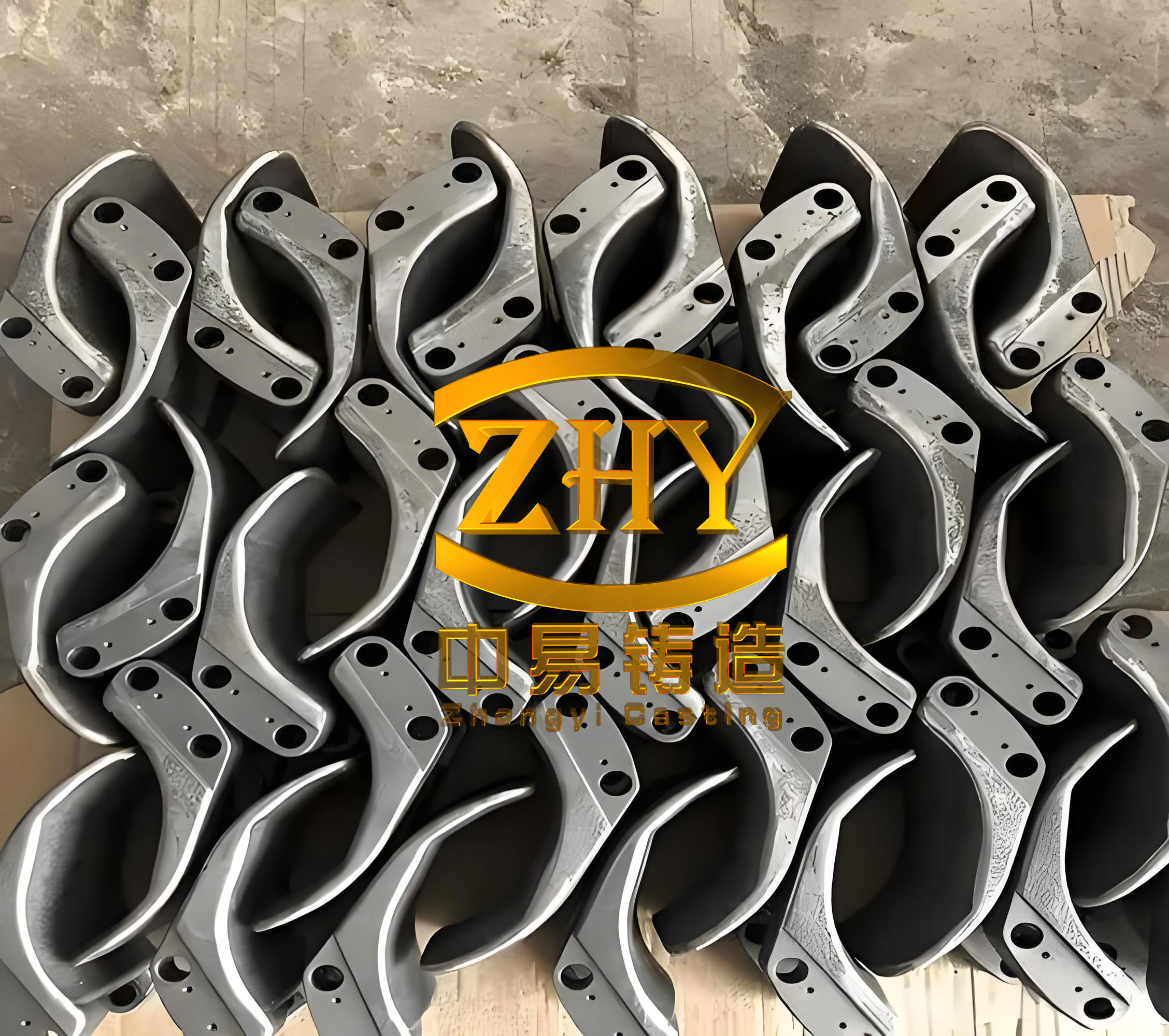
Encouraged by the simulation results, I proceeded to apply the optimized process in actual production. The pouring temperature was controlled between 1350 °C and 1400 °C, the pouring time was 15–20 s, the sand coating thickness was 3 mm, and the ambient temperature was 26 °C. Gravity tilt pouring was used to ensure smooth filling. The castings produced by this optimized process are shown in Figure 4.
In the trial batch, only about 2% of the castings showed small shrinkage cavities with depths of 3–5 mm, which was a 93.3% reduction in shrinkage defect rate compared with the original process. Ultrasonic testing, performed by a third-party inspection agency according to GB/T 7233.1—2023, confirmed that all castings met the level I requirement. The optimized ductile iron castings are now considered suitable for use in deep-sea transmission systems.
6. Conclusions
Based on my experience and the results obtained, I draw the following conclusions:
- The shrinkage porosity in sand-lined metal mould ductile iron castings is closely related to the molten metal pressure, chemical composition, liquidus and solidus temperatures, and the rigidity of the mould. The Niyama criterion, especially its dimensionless form, provides a reliable theoretical basis for defect prediction.
- Process parameter optimization via ProCAST simulation revealed that the pouring temperature has the greatest influence on shrinkage defects, followed by the molten metal composition, while the sand coating thickness has the smallest effect. With the combined optimized parameters, the solidification time was shortened by 25%, the maximum porosity decreased to 10%–20%, and the central shrinkage bands were markedly reduced.
- Production validation demonstrated that the optimized sand-lined metal mould process reduced the shrinkage defect rate by 93.3% and passed ultrasonic testing. Therefore, this approach is effective and reliable for producing high-quality ductile iron castings for deep-sea gearbox applications.
I hope my first-hand experience and simulation-based methodology provide useful guidance for engineers facing similar challenges in the foundry industry, particularly when dealing with high-strength ductile iron castings produced by the sand-lined metal mould technique.