
In my extensive experience with hydraulic systems, the persistent issue of leakage in high-pressure, high-flow gear pumps represents a significant challenge, directly impacting equipment reliability, operational efficiency, and total cost of ownership for end-users. This problem is particularly acute in demanding applications such as loaders, where pumps are subjected to severe pressure shocks, thermal cycles, and contaminated environments. The transition from fixed axial clearance designs to automatically compensated structures using side plates, while improving efficiency and pressure capability, introduces new sealing and structural integrity challenges. This article is based on my first-hand engineering practice and presents a deep, systematic analysis of leakage root causes, followed by a series of validated, fundamental improvements. A core element of the successful solution was the strategic adoption and optimization of the sand coated iron mold casting process, a pivotal change we implemented to enhance material integrity.
1. Introduction: The Leakage Problem in Context
The specific case involved a CBU3 series high-pressure gear pump operating at a nominal pressure of 20 MPa and a speed of 2200 rpm. While the pump demonstrated excellent overall performance characteristics, a recurring failure mode emerged in the field: external leakage, typically manifesting after several hundred hours of operation. This leakage not only led to hydraulic fluid loss and environmental contamination but also signaled potential premature wear and impending catastrophic failure. Our investigation moved beyond simple seal replacement, recognizing that leakage is seldom an isolated event but a symptom of interconnected system failures involving material science, manufacturing processes, structural design, and assembly mechanics.
2. Root Cause Analysis: A Multi-Faceted Investigation
Upon disassembling and inspecting a statistically significant number of failed units returned from the field, we identified two primary, often co-existing, leakage paths. The analysis incorporated both macroscopic observation and microscopic failure analysis.
2.1 Leakage through Pump Body Screw Threads
Leakage was observed weeping or dripping from the threaded holes (e.g., 4-M20) on the pump body. The pump body, being a large, complex casting with significant variations in wall thickness (from 27mm to 45mm), presented a classic casting challenge. Traditional sand casting processes for such geometries often result in non-uniform cooling rates. This thermal gradient leads to internal stresses, promoting the formation of micro-shrinkage porosity, gas entrapment, and even micro-cracks, particularly in thermal “hot spots” or section transitions. These defects create interconnected porosity networks that can extend to the machined surfaces, such as screw holes. Under high system pressure ($$P_{sys}$$), hydraulic fluid migrates through these subsurface defects via capillary action and pressure-driven flow, eventually emerging at the screw threads.
The leakage rate through such a porous path can be modeled simplistically using a form of Darcy’s law for flow through a porous medium:
$$Q_{leak} \approx \frac{A \cdot \kappa}{\mu \cdot L} \Delta P$$
Where:
$$Q_{leak}$$ = Volumetric leakage rate
$$A$$ = Effective cross-sectional area of the porous network
$$\kappa$$ = Permeability of the casting material (highly dependent on micro-porosity)
$$\mu$$ = Dynamic viscosity of the hydraulic fluid
$$L$$ = Effective path length through the material
$$\Delta P$$ = Pressure differential across the path (approximately $$P_{sys}$$)
The original material, QT600-3 ductile iron, while offering high tensile strength, has a pronounced tendency towards shrinkage porosity during solidification due to its graphite morphology, inherently increasing its effective permeability ($$\kappa$$).
2.2 Leakage at the Pump Body to Cover Interface
The second major path was at the sealing interface between the main pump body and the front/rear covers. This was a more complex, system-level failure involving deflection, fastener dynamics, and seal degradation.
Structural Deflection: The pump assembly, under internal pressure, behaves like a pressure vessel. The covers, constrained by long fastener spans (up to 104mm identified), experience bending stress. The resulting deflection ($$\delta$$) can be approximated for a simply supported beam under uniform pressure:
$$\delta_{max} \approx \frac{5 \cdot p \cdot w \cdot L^4}{384 \cdot E \cdot I}$$
Where $$p$$ is the distributed pressure load from the internal fluid, $$w$$ is the width of the cover subject to pressure, $$L$$ is the fastener span, $$E$$ is Young’s modulus of the cover material, and $$I$$ is the area moment of inertia of the cover section. A low $$I$$ (thin cover) and large $$L$$ lead to significant $$\delta_{max}$$, reducing contact pressure on the static seal.
Seal Failure Mechanism: The static seal was a rectangular elastomeric ring housed in a groove. A critical finding was the presence of a 0.5mm deep by 4mm wide vent groove machined from the seal groove to the low-pressure (suction) port, intended to prevent pressure trapping. In practice, under harsh conditions, the suction port could experience transient cavitation or very low absolute pressure. This created a large pressure differential across the seal, with the groove side at near-vacuum and the opposite side at tank or moderate pressure. This differential could cause the seal to extrude into the vent groove, leading to nibbling, cutting, and ultimately, catastrophic seal failure—a phenomenon we observed directly as “pulled-out” or severed seals.
The failure modes are summarized in the table below:
| Leakage Path | Primary Root Cause | Contributing Factors | Observed Symptom |
|---|---|---|---|
| Screw Threads | Micro-porosity & Shrinkage in Casting | Non-uniform cooling; QT600-3 material tendency; Large wall thickness variation. | Seepage from bolt holes; No visible crack on surface. |
| Body/Cover Interface | Cover Deflection & Seal Extrusion | Long fastener spans; Thin cover design; Vent groove to suction port; Contamination accumulation. | Visible oil trail on joint face; Damaged/cut seal; Debris in joint. |
3. A Systemic Improvement Strategy
The solution required a holistic approach, addressing material, manufacturing, and design simultaneously. Incremental changes proved insufficient; fundamental changes were necessary.
3.1 Material and Manufacturing Process Transformation
This was the most critical step to eliminate internal porosity-related leakage.
Material Change from QT600-3 to HT300: We switched to a high-strength gray iron (HT300). While its nominal tensile strength is lower than ductile iron, its solidification characteristics result in a denser, less porous matrix with finer, uniformly distributed Type A graphite flakes, offering superior pressure tightness. To achieve the required strength, the alloy composition was enhanced with 0.5% Chromium (Cr) for pearlite stabilization and hardness, and 0.8% Copper (Cu) to improve strength, hardness, and corrosion resistance without harming machinability.
| Material Property / Element | QT600-3 (Original) | HT300 (Improved) | Impact on Leakage |
|---|---|---|---|
| Tensile Strength (MPa) | > 600 | > 300 | Sufficient for pressure load; not primary factor for leak. |
| Graphite Morphology | Spheroidal (Nodular) | Flake (Type A) | Flake graphite interrupts porosity network, reducing permeability. |
| Shrinkage Tendency | High | Moderate to Low | Directly reduces micro-shrinkage porosity. |
| Damping Capacity | Good | Excellent | Reduces noise and vibration stresses. |
| Key Additives | Mg, Ce (Nodulizers) | Cr, Cu, Si-Ba Inoculant | Cr/Cu increase strength; Inoculant refines structure. |
Implementation of Sand Coated Iron Mold Casting: This was the cornerstone manufacturing improvement. We abandoned traditional resin sand cores for the pump’s internal cavity. Instead, we implemented sand coated iron mold casting. In this process, a thin, precise layer of thermosetting resin-coated sand is applied over a heated metallic core (the “iron mold”). This assembly is then placed into the main mold. During pouring, the thin sand layer ensures dimensional accuracy, while the massive iron core acts as a powerful heat sink.
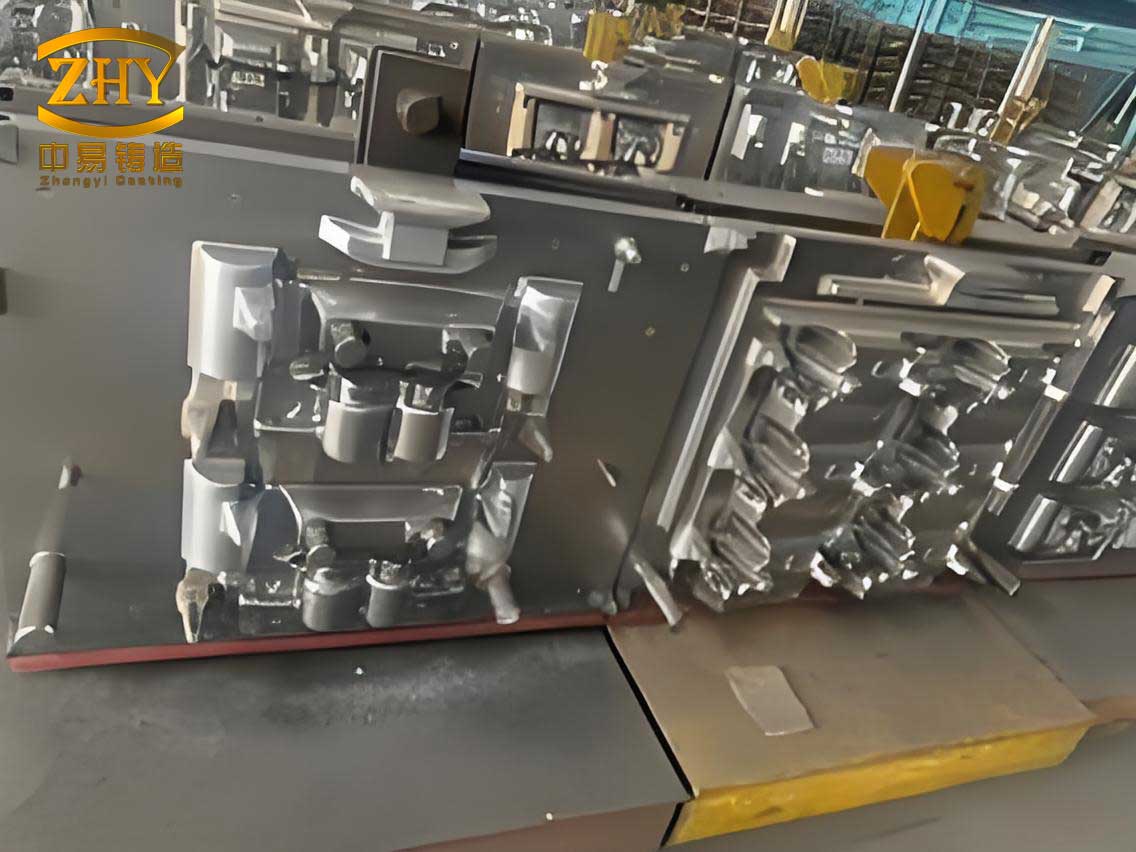
The physics are crucial. The cooling rate ($$V_c$$) of the casting skin adjacent to the core is dramatically increased:
$$V_c \propto \frac{k_{mold}}{\rho C_p} \cdot \frac{\Delta T}{d}$$
Where $$k_{mold}$$ is the thermal conductivity of the iron core (much higher than sand), $$\rho C_p$$ is the volumetric heat capacity of the iron, $$\Delta T$$ is the temperature difference, and $$d$$ is the sand coating thickness. The high $$V_c$$ results in a much finer graphite structure and a significantly deeper “sound” or defect-free layer. Metallographic analysis showed the sound layer depth increased from approximately 3mm with traditional cores to over 8mm with the sand coated iron mold casting process. This provided a robust safety margin against machining operations exposing subsurface porosity.
Advanced Inoculation with Silicon-Barium (Si-Ba): To further refine the microstructure and homogenize properties, we replaced standard FeSi75 inoculant with a high-efficiency Si-Ba compound. Inoculation promotes heterogeneous nucleation during solidification. The effectiveness of an inoculant can be related to the number of potent nucleation sites ($$N$$) it provides:
$$N = N_0 \exp\left(-\frac{\Delta G^*}{k_B T}\right)$$
Where $$\Delta G^*$$ is the activation energy barrier for nucleation, which is lowered by the presence of effective substrates like Ba-containing compounds. The Si-Ba inoculant, added via late stream inoculation, dramatically increased the eutectic cell count per unit area (by a factor of 3 in our analysis), leading to a uniform, fine-grained structure with superior mechanical properties and pressure tightness. The table below contrasts the microstructural outcomes.
| Process Parameter | Traditional Sand Core | Sand Coated Iron Mold + Si-Ba |
|---|---|---|
| Cooling Rate at Cavity Surface | Slow | Very Fast |
| Graphite Flake Size | Coarser, Type D/E possible | Fine, Uniform Type A |
| Sound (Dense) Layer Depth | ~3 mm | > 8 mm |
| Eutectic Cell Count | Baseline (X) | ~3X (Refined) |
| Predicted Permeability ($$\kappa$$) | Higher | Substantially Lower |
3.2 Structural Design Enhancements
Concurrent with material changes, we optimized the design to manage loads and ensure seal integrity.
1. Addition of Preload Screws: To combat cover deflection, we added two M12 high-tensile screws symmetrically on each cover within the critical 104mm span. This reduced the effective span length ($$L$$ in the deflection formula) and increased the clamping force. The total clamping force ($$F_{clamp}$$) must counteract the separating force ($$F_{sep}$$) from internal pressure:
$$F_{sep} = P_{sys} \cdot A_{seal}$$
$$F_{clamp} = n \cdot T / (k \cdot d)$$
Where $$n$$ is the number of screws, $$T$$ is the applied torque, $$k$$ is a friction coefficient factor, and $$d$$ is the screw diameter. Increasing $$n$$ directly increases $$F_{clamp}$$, ensuring a positive contact pressure on the seal throughout the pressure cycle.
2. Seal Groove and Vent Redesign: We eliminated the problematic vent groove connecting the seal groove to the suction port. Instead, we relied on the inherent micro-leakage paths of a properly compressed static seal to prevent pressure trapping—a calculated risk that favored seal stability over ideal thermal management. The seal compression ratio was carefully recalculated to ensure optimal performance without extrusion.
3. Reinforcement of Covers and Ribs: The cover thickness was increased, and the connecting ribs were widened from 20mm to 60mm. This geometrically increased the area moment of inertia ($$I$$), which is proportional to the cube of the thickness for a rectangular section ($$I = \frac{w t^3}{12}$$). Doubling the rib’s effective thickness increases its bending stiffness by a factor of eight. Furthermore, fillet radii were optimized, and transitions were made smoother to reduce stress concentration factors ($$K_t$$).
4. Results and Validation
The combined implementation of these measures—spearheaded by the shift to HT300 and the sand coated iron mold casting process—produced transformative results. A batch of pumps manufactured with the new specifications underwent rigorous qualification testing, including:
- Extended Pressure Cycling: Between 5% and 125% of rated pressure for >1 million cycles.
- High-Pressure Dwell Test: Sustained operation at 25 MPa (125% of rating) for extended periods.
- Thermal Shock Tests: Rapid cycling between low and high fluid temperatures.
Post-test inspection revealed zero incidents of leakage from screw threads or body/cover interfaces. More importantly, field deployment in the original application demonstrated a complete elimination of the premature leakage failures that had previously occurred. The pumps showed sustained, reliable performance over thousands of operating hours. The success validates a core engineering principle: solving persistent leakage issues in high-performance hydraulic components requires a systems engineering approach that integrates material science, advanced manufacturing like sand coated iron mold casting, and precision mechanical design.
5. Conclusion and Generalization
The journey from chronic leakage to robust reliability for this high-pressure gear pump underscores several universal lessons. First, leakage often originates from subsurface material defects invisible to the naked eye; therefore, material selection and foundry process control are paramount. The sand coated iron mold casting technique proved to be an exceptionally effective method for achieving the necessary dense, defect-free microstructure in complex castings. Second, static seal failure is frequently a symptom of excessive component deflection or inappropriate groove design, not merely a seal quality issue. Structural FEA (even simplified calculations) during design is crucial. Finally, solutions must be synergistic. The advanced material process (sand coated iron mold casting with HT300 and Si-Ba inoculation) provided the foundational integrity, while the design modifications (added fasteners, removed vent grooves, increased stiffness) created the stable mechanical environment necessary for the seals to function as intended. This holistic methodology forms a reliable blueprint for addressing similar leakage challenges across a wide range of high-pressure hydraulic components.