
In the realm of manufacturing, metal casting stands as a foundational process that transforms molten metal into solid shapes, enabling the production of complex components across industries. From automotive engines to heavy machinery, cast parts are ubiquitous, and understanding the underlying principles is crucial for optimizing quality and efficiency. As I delve into this topic, I aim to provide an in-depth exploration of casting characteristics, solidification behaviors, and the pervasive methods of sand casting, with a particular emphasis on the value offered by professional sand casting services. This article will incorporate tables and formulas to summarize key concepts, ensuring a thorough technical perspective.
Metal casting, essentially a liquid-to-solid transformation, offers unique advantages and challenges. The process involves pouring molten metal into a mold, where it cools and solidifies to form a desired part or blank. In mechanical engineering, castings constitute 60% to 80% of ordinary machine tools and over 80% in heavy and mining machinery, highlighting its industrial significance. Through this analysis, I will dissect the features, classifications, and solidification modes, ultimately focusing on sand casting as a predominant method, often leveraged by specialized sand casting services for cost-effective production.
Characteristics and Classification of Casting
From my perspective, casting’s appeal lies in its versatility and economic benefits, albeit with some limitations in microstructure and properties. Let’s break down these aspects.
Key Characteristics:
- Formation Convenience and Adaptability: Casting accommodates virtually any shape and size, from intricate geometries to massive structures. It supports a wide range of materials, including cast iron, steel, aluminum alloys, copper alloys, and even non-metallics like polymers and ceramics. This makes it ideal for initial shaping of complex or large components, especially in small to medium batch production.
- Cost-Effectiveness: The near-net-shape capability reduces material waste and machining time. Raw materials are abundant, often incorporating scrap metal, promoting resource efficiency. Equipment investments are generally modest compared to other processes, lowering overall costs—a point frequently emphasized by sand casting services to attract clients.
- Microstructural and Performance Limitations: As-cast structures typically exhibit coarse grains and chemical inhomogeneity, leading to inferior mechanical properties. Thus, castings are best suited for parts under static or low-stress loads, such as housings, frames, and supports. Enhancing these properties often requires post-casting treatments.
To categorize casting methods, I distinguish between two broad groups: sand casting and special casting processes. The table below summarizes this classification, underscoring the prevalence of sand casting services in industry.
| Category | Subtypes | Description | Typical Applications |
|---|---|---|---|
| Sand Casting | Hand Molding | Manual operations for single pieces or small batches; suitable for complex and large castings. | Prototypes, custom machinery parts. |
| Machine Molding | Automated processes for mass production; involves sand filling, compaction, and pattern removal. | Automotive components, pipe fittings. | |
| Special Casting | Metal Mold Casting | Uses permanent metal molds for better surface finish and dimensional accuracy. | Aluminum alloy wheels, engine blocks. |
| Pressure Die Casting | Injects molten metal under high pressure into metal dies; ideal for high-volume, thin-walled parts. | Zinc alloy housings, consumer electronics. | |
| Centrifugal Casting | Utilizes centrifugal force to distribute metal in rotating molds; enhances density for cylindrical shapes. | Pipes, rings, bushings. | |
| Investment Casting | Employs wax patterns and ceramic shells for high-precision, intricate designs. | Aerospace turbines, jewelry. | |
| Low-Pressure Casting | Fills molds under controlled low pressure; reduces turbulence and improves quality. | Aluminum automotive parts. |
As evident, sand casting remains the most widely used method globally, accounting for over 90% of castings, thanks to its flexibility and the robust infrastructure of sand casting services that cater to diverse needs.
Solidification Modes of Castings
The quality of castings is intrinsically linked to solidification—the phase transition from liquid to solid, often termed crystallization in metals. I observe that the mechanical properties depend heavily on the grain structure, specifically the ratio of columnar to equiaxed crystals. Solidification modes are defined by the width of the mushy zone, which comprises solid and liquid phases coexisting. Based on this, I classify solidification into three primary modes: directional (layer-by-layer), mushy (pasty), and intermediate.
To quantify solidification, consider the thermal gradient \( G \) and growth rate \( R \), which influence the interface stability. The solidification time \( t_s \) for a simple shape can be estimated using Chvorinov’s rule:
$$ t_s = k \cdot V^n $$
where \( V \) is the volume of the casting, \( k \) is a mold constant dependent on material properties and mold conditions, and \( n \) is an exponent typically around 2. This formula underscores the importance of geometry in solidification control, a factor meticulously managed by sand casting services to prevent defects.
1. Directional (Layer-by-Layer) Solidification: This mode occurs in pure metals, eutectic alloys, and those with narrow freezing ranges, such as gray cast iron, aluminum-silicon alloys, and low-carbon steel. The solid-liquid interface is planar and distinct, with crystals growing perpendicular to the mold wall. Mathematically, the interface position \( x(t) \) can be described by:
$$ x(t) = \sqrt{2 \alpha t} $$
where \( \alpha \) is the thermal diffusivity. This leads to columnar grains that advance inward, often trapping residual liquid and impurities at the center.
2. Mushy (Pasty) Solidification: Alloys with broad crystallization ranges, like aluminum-copper alloys, tin bronze, and ductile iron, exhibit this mode. Here, nuclei form throughout the volume, resulting in a mushy zone where solid and liquid intermingle. The grain size \( d \) can be related to cooling rate \( \dot{T} \) by:
$$ d = a \cdot \dot{T}^{-b} $$
with \( a \) and \( b \) as material constants. This yields coarse equiaxed grains, which can compromise strength but enhance feeding characteristics. Sand casting services often adjust pouring temperatures to modulate this effect.
3. Intermediate Solidification: Medium-carbon steel, white iron, and some brass alloys display a hybrid behavior. The solidification zone width \( \delta \) is moderate, producing a mix of columnar and equiaxed crystals. It can be expressed as:
$$ \delta = \frac{T_L – T_S}{G} $$
where \( T_L \) and \( T_S \) are the liquidus and solidus temperatures, respectively. Process parameters like mold material (e.g., switching from sand to metal molds) can reduce \( \delta \), altering the mode—a technique exploited in advanced sand casting services to refine microstructure.
The table below contrasts these solidification modes, highlighting their implications for sand casting services.
| Solidification Mode | Typical Alloys | Grain Structure | Defect Tendencies | Control Strategies in Sand Casting Services |
|---|---|---|---|---|
| Directional | Pure Al, Gray Cast Iron | Columnar grains | Centerline shrinkage, segregation | Use of chills to promote directional cooling; optimized gating design. |
| Mushy | Al-Cu Alloys, Ductile Iron | Equiaxed grains | Porosity, hot tearing | Low pouring temperatures; inoculation to refine grains; riser placement. |
| Intermediate | Medium-Carbon Steel, White Iron | Mixed columnar/equiaxed | Cracking, inhomogeneity | Adjustment of sand permeability; controlled cooling rates via mold coatings. |
Understanding these modes enables sand casting services to tailor processes, ensuring sound castings with desired properties.
Methods of Sand Casting
Sand casting, as a cornerstone of foundry operations, involves creating molds from sand-based materials. I will elaborate on its process, materials, and techniques, consistently referencing the role of professional sand casting services in implementing these methods efficiently.
3.1 Sand Casting Process Flow: The typical sequence includes pattern making, mold preparation, core making, mold assembly, melting and pouring, cooling, shakeout, cleaning, and inspection. Not all steps are mandatory; for instance, dry sand molds may skip drying, and simple shapes might not require cores. The core steps are:
- Mold Making: Crafting the cavity using patterns.
- Core Making: Forming internal geometries with core sands.
- Drying: Baking molds/cores to enhance strength (for dry sand molds).
- Assembly: Combining mold halves and cores—critical for precision in sand casting services.
- Pouring: Introducing molten metal into the mold.
- Shakeout and Cleaning: Removing sand and finishing the casting.
- Inspection: Ensuring quality through non-destructive or dimensional checks.
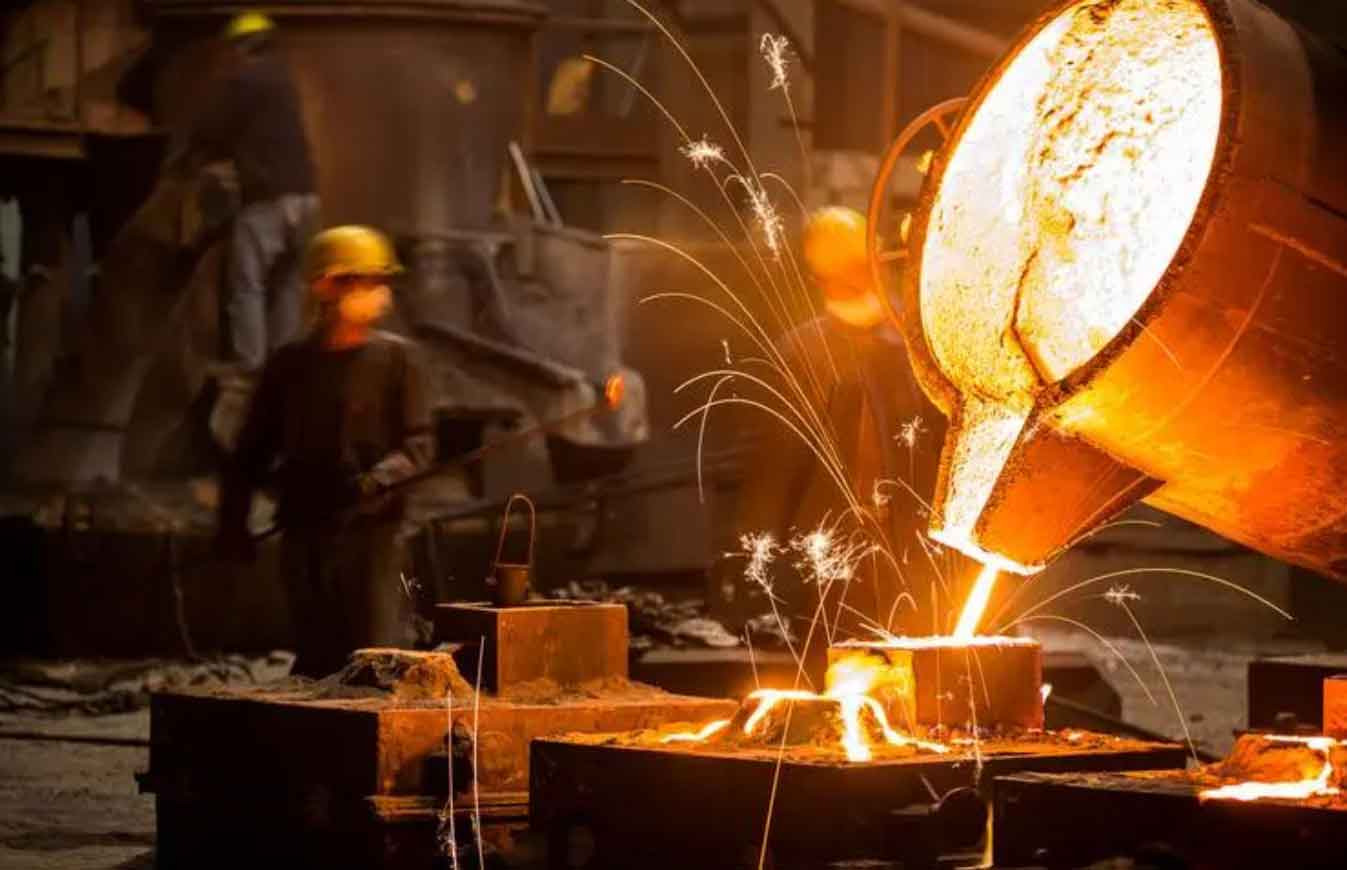
This image illustrates a typical sand casting setup, showcasing the intricate mold systems often managed by sand casting services. The visual emphasizes the practicality and scale of operations in modern foundries.
3.2 Molding Materials: The performance of sand castings hinges on the properties of molding sands, which comprise base sand, binders (e.g., clay, resins), and additives. Key properties include:
- Plasticity: Ability to retain shape after molding, ensuring accurate cavity reproduction.
- Strength: Resistance to erosion and deformation during pouring, preventing defects like sand inclusions.
- Refractoriness: Withstanding high temperatures without fusion, avoiding burn-on or sticking.
- Permeability: Allowing gas escape to minimize porosity, quantified by Darcy’s law for flow through porous media:
$$ Q = \frac{k A \Delta P}{\mu L} $$
where \( Q \) is gas flow rate, \( k \) is permeability coefficient, \( A \) is area, \( \Delta P \) is pressure drop, \( \mu \) is gas viscosity, and \( L \) is sand thickness. Sand casting services optimize this to reduce gas-related defects. - Collapsibility: Easing mold removal during casting shrinkage, mitigating stress and cracking.
The table below summarizes these properties and their impact, as monitored by sand casting services.
| Property | Definition | Ideal Value Range | Consequences of Deficiency | Testing Methods in Sand Casting Services |
|---|---|---|---|---|
| Plasticity | Deformability under stress | High for complex shapes | Poor detail replication | Hand squeeze test, standard specimen molding. |
| Strength | Resistance to mechanical failure | 0.5–1.5 MPa (green sand) | Mold collapse, erosion | Compressive, tensile, or shear tests. |
| Refractoriness | Thermal stability | >1500°C for ferrous metals | Sand fusion, surface defects | Pyrometric cone equivalent (PCE) test. |
| Permeability | Gas flow capacity | 50–200 units (standard scale) | Blowholes, pinholes | Permeability meter using air flow. |
| Collapsibility | Ease of mold breakdown | Controlled degradation | Hot tears, residual stress | High-temperature deformation tests. |
3.3 Molding Techniques: Sand casting methods split into hand and machine molding, each with distinct advantages.
- Hand Molding: Involves manual operations like ramming, pattern drawing, and gate cutting. Techniques include whole-pattern molding, sweep molding, split-pattern molding, loose-piece molding, and three-part molding. It’s flexible for low-volume production but labor-intensive and less consistent—often used by sand casting services for prototypes or custom orders.
- Machine Molding: Automates sand filling, compaction, and pattern withdrawal. It employs patterns mounted on plates for efficiency. The compaction stress \( \sigma_c \) can be modeled as:
$$ \sigma_c = \frac{F}{A} $$
where \( F \) is the applied force and \( A \) is the platen area. This ensures uniform density, crucial for high-output sand casting services. Common machines include jolt-squeeze, impact, and pressure wave molders.
To illustrate the economic benefits, consider the cost per unit \( C \) for sand casting services, which can be approximated by:
$$ C = C_m + C_l + C_e + \frac{C_f}{N} $$
where \( C_m \) is material cost, \( C_l \) is labor, \( C_e \) is energy, \( C_f \) is fixed tooling cost, and \( N \) is batch size. This shows why sand casting services are cost-effective for large runs.
Advanced Considerations and Future Trends
Beyond basics, I must address emerging trends in sand casting. Computational simulations, such as finite element analysis (FEA), are now integral to predicting solidification and optimizing designs. The heat transfer during cooling follows Fourier’s law:
$$ q = -k \nabla T $$
where \( q \) is heat flux, \( k \) is thermal conductivity, and \( \nabla T \) is temperature gradient. Sand casting services utilize such models to minimize trial-and-error, reducing lead times and improving yield.
Additionally, environmental sustainability is gaining focus. Sand reclamation systems recycle used sand, lowering waste and costs. The recycling efficiency \( \eta_r \) can be expressed as:
$$ \eta_r = \frac{m_r}{m_t} \times 100\% $$
with \( m_r \) as reclaimed sand mass and \( m_t \) as total sand mass. Leading sand casting services adopt these practices to meet green manufacturing standards.
In summary, sand casting, with its adaptable nature and continuous innovations, remains a vital manufacturing process. By mastering solidification modes and refining methods, sand casting services deliver high-quality components across sectors. As I conclude, it’s clear that the synergy of theoretical knowledge and practical expertise—embodied in professional sand casting services—drives the evolution of casting technology forward.