
As a design engineer specializing in foundry systems, I have been deeply involved in the planning and execution of numerous resin sand casting projects. The transition from traditional green sand methods to chemically-bonded systems represents a significant technological leap, offering superior dimensional accuracy, surface finish, and flexibility for complex castings. The following discourse details the core principles, systematic design considerations, and practical engineering insights gleaned from the complete design of a dedicated, modern resin sand casting production line, from conceptual layout to operational commissioning.
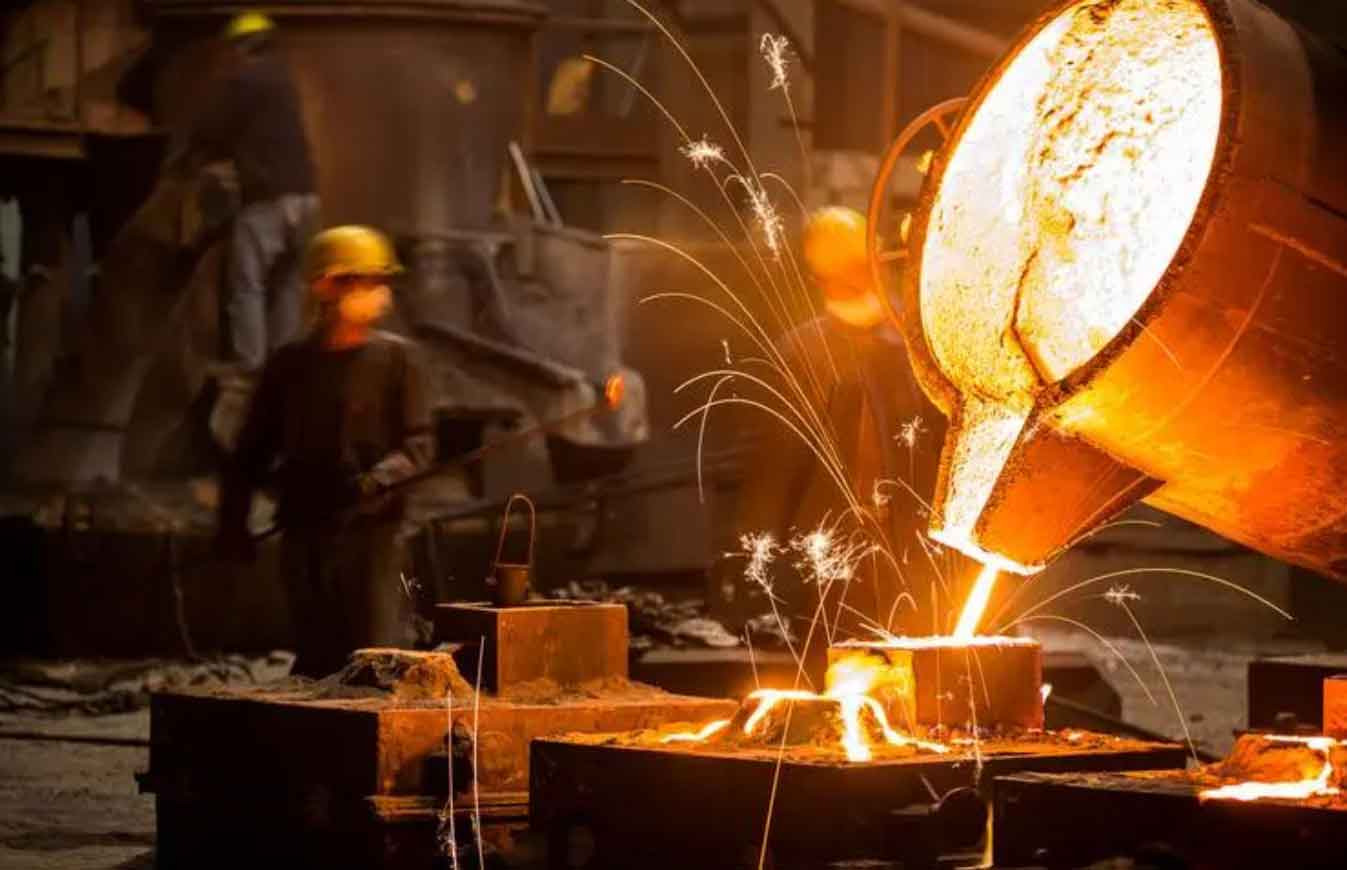
The fundamental advantage of resin sand casting lies in its use of a cold-setting chemical binder, typically a furan resin catalyzed by a sulfonic acid. Unlike clay-bonded greensand, which relies on physical moisture and clay plasticity, the resin system forms a rigid, three-dimensional network upon curing at room temperature. This grants the mold exceptional strength and stability, allowing for the production of castings with minimal draft angles, thinner walls, and more intricate internal geometries defined by cores made from the same resin sand mixture. The core chemical reaction for a typical furan resin system can be simplified as:
$$ \text{Resin (Furan)} + \text{Acid Catalyst} \xrightarrow{\text{Mixing}} \text{Cross-linked Polymer Network} + \text{Heat} $$
The heat released (exotherm) during this polycondensation reaction accelerates the cure, with the final strength $S$ being a function of resin content $R_c$, catalyst ratio $C_r$, and environmental conditions (temperature $T$, humidity $H$):
$$ S = k \cdot f(R_c, C_r) \cdot g(T, H) $$
where $k$ is a material constant. This predictable and controllable curing process is the cornerstone of repeatable quality in resin sand casting.
The design of a dedicated resin sand casting facility must holistically integrate several key subsystems: melting and metal treatment, mold and core production, sand preparation and reclamation, pouring and cooling, and environmental control. A successful layout optimizes material flow—minimizing distances for hot metal, finished molds, and returned sand—while ensuring operational safety and maintenance access. The following table outlines the primary functional zones and their interrelationships.
| Functional Zone | Key Processes | Critical Interfaces |
|---|---|---|
| Melting & Metal Treatment | Cupola/Electric Furnace Duplexing, Desulfurization, Alloying | Provides molten metal to the Molding/Pouring zone. |
| Sand Reclamation & Preparation | Sand Reclamation, Cooling, Additive Mixing | Supplies prepared sand to Molding/Core Making; receives used sand from Shakeout. |
| Molding & Core Making | Pattern Setup, Resin Sand Molding, Core Assembly | Receives sand and patterns; outputs finished molds to Pouring. |
| Pouring & Solidification | Metal Pouring, Mold Cooling | Receives molds and molten metal; outputs cooled castings-in-molds to Shakeout. |
| Shakeout & Initial Processing | Castings Separation, Sand Reclamation Feed | Receives cooled molds; separates castings (to cleaning) and returns sand lumps to Reclamation. |
A critical subsystem that distinguishes a resin sand casting operation from a conventional one is the integrated sand reclamation plant. Unlike green sand, which is continuously recycled with water and binder additions, resin-bonded sand undergoes a thermal and mechanical degradation of the binder during the casting process. Efficient reclamation is not optional but essential for economic and environmental sustainability. The goal is to remove the spent binder coating (the “char”) from the sand grains to restore their properties for reuse. The efficiency of a reclamation system $\eta_r$ can be defined as the mass fraction of reclaimed sand $m_r$ suitable for reuse relative to the total sand input to the process $m_t$, adjusted for system losses $m_l$:
$$ \eta_r = \frac{m_r}{m_t – m_l} $$
Modern systems often employ a multi-stage approach. A typical process flow includes:
1. Primary Treatment (Shakeout & Crushing): Lumps from shakeout are broken down.
2. Primary Reclamation: Often using mechanical methods like vibration or attrition to remove the majority of the degraded binder.
3. Secondary Reclamation: A more intensive process (e.g., mechanical scrubbing, thermal) to further clean the grains.
4. Classification & Cooling: Removal of fines and critical reduction of sand temperature.
Selecting the right combination of reclamation technologies is paramount. For the project under discussion, a hybrid system was chosen for its balance of performance, reliability, and energy efficiency. The table below compares the key characteristics of common reclamation methods relevant to resin sand casting.
| Reclamation Method | Working Principle | Key Advantages | Typical LOI* Reduction |
|---|---|---|---|
| Mechanical Vibration | Sand lumps are subjected to controlled vibration and friction against screens/mass. | Low energy, reliable, good grain integrity preservation. | Moderate to High |
| Mechanical Attrition (Rotary) | Sand is scrubbed between rotating elements and a static lining. | Compact, high efficiency in binder removal. | High |
| Pneumatic (Shot Blast) | High-velocity sand grains impact a target or each other. | Excellent for brittle resin removal. | High |
| Thermal | Sand is heated to ~800°C to combust organic binders. | Produces sand with properties closest to virgin sand. | Very High |
*LOI (Loss on Ignition): A key metric for reclaimed sand quality, indicating the residual combustible material (binder char).
Sand temperature control is a non-negotiable aspect of a robust resin sand casting operation. Hot sand returned from shakeout, often exceeding 60-80°C, severely disrupts the curing kinetics of the cold-set resin. If mixed while hot, the working time (strip time) becomes unpredictably short, and the final strength is compromised. Therefore, an effective cooling system is integrated into the reclamation loop. The cooling load $Q_{cool}$ that must be extracted can be approximated by:
$$ Q_{cool} = \dot{m}_s \cdot c_{p,s} \cdot (T_{in} – T_{target}) $$
where $\dot{m}_s$ is the sand mass flow rate, $c_{p,s}$ is the specific heat capacity of silica sand (~0.8 kJ/kg·K), $T_{in}$ is the inlet sand temperature, and $T_{target}$ is the desired mixing temperature (ideally 25-35°C). In the designed system, a three-stage cooling strategy was implemented for resilience, especially in warm climates:
Stage 1 (Primary Cooling): Passive cooling in storage hoppers with integrated water panels.
Stage 2 (Active Fluidized-Bed Cooling): Sand is fluidized by air while in contact with internal water-cooled tubes. This stage provides efficient heat transfer and simultaneous dedusting.
Stage 3 (Final Temperature Conditioning): A vertical tower cooler using counter-current air flow for precise temperature adjustment before the sand enters the mixing hopper.
The heart of the mold-making process is the continuous mixer. Its function is to uniformly coat each sand grain with precise amounts of resin and catalyst at a high throughput. The choice between horizontal (screw-type) and vertical (turbo-type) mixers depends on factors like available headroom, required output, and desired mixing homogeneity. For this project, a horizontal screw mixer was selected, with a critical specification being the use of high-precision, positive displacement pumps for binder and catalyst delivery. The mixing efficiency $\eta_m$ and the critical “no-tail-sand” requirement depend on the precise volumetric dosing rates $V_{res}$ and $V_{cat}$, the sand flow rate $V_s$, and the dynamic cleaning of the mixing chamber. The relationship is governed by:
$$ \text{Binder Addition (wt%)} = \frac{\rho_{res} \cdot V_{res}}{\rho_s \cdot V_s} \times 100\% $$
where $\rho$ denotes density. Advanced control systems synchronize these flows to ensure the first and last sand out of the mixer during start/stop cycles has the correct ratio, eliminating waste and ensuring consistent mold quality throughout the production run in resin sand casting.
Modern foundry control transcends individual machine operation. For a resin sand casting line to be reliable and efficient, a centralized, programmable logic controller (PLC)-based system is essential. The design philosophy should emphasize subsystem modularity. The entire line can be divided into logical blocks (e.g., Shakeout & Primary Reclamation, Secondary Reclamation & Cooling, Sand Mixing & Molding). Each subsystem can run independently or in a fully synchronized sequence. This architecture offers tremendous operational flexibility. For instance, core production can continue using reclaimed sand even if the molding line is down for pattern change. The control system manages not only sequential start-stop but also critical safety and fault-condition interlocking. Vibration equipment like shakeouts and reclaimers are equipped with anti-jamming logic and controlled braking. Crucially, an emergency stop on any single machine halts only its parent subsystem, preventing unnecessary full-line shutdowns and associated production delays.
Comprehensive dust extraction is integral to the design, affecting both environmental compliance and the longevity of machinery. Dust in a resin sand casting facility originates from sand handling, shakeout, reclamation, and mixing points. The strategy involves localized capture at major emission sources—like fully enclosable shakeout stations with air-curtain assisted hoods—combined with centralized bag-filter dust collectors for grouped smaller points. The design airflow $Q_{dust}$ for a hood is based on capturing velocity $v_c$ at the open face of area $A$:
$$ Q_{dust} = A \cdot v_c $$
Proper filtration ensures that recycled air within the building remains clean and that discharged air meets regulatory standards, protecting worker health and the surrounding environment.
Quality assurance in resin sand casting is built on process control. Beyond the PLC managing mechanical operations, dedicated analytical instruments are deployed. For metal quality, a direct-reading optical emission spectrometer provides rapid, precise analysis of molten iron chemistry, enabling real-time corrective actions. For sand control, a suite of testing equipment is necessary to monitor the condition of both reclaimed and newly mixed sand. Key parameters and their test methods include:
Tensile/Compressive Strength: Measures the cured strength of standard test specimens.
Loss on Ignition (LOI): Indicates the amount of combustible residues (burnt binder) in reclaimed sand.
Grain Size Distribution: Analyzed via sieving to ensure the sand matrix remains within specification.
Acid Demand Value (ADV): For furan systems, measures the sand’s pH-related consumption of catalyst.
Regular monitoring of these parameters allows for proactive adjustments to reclamation efficiency, binder addition rates, and catalyst ratios, closing the loop on process control.
In conclusion, the design of a contemporary resin sand casting facility is a sophisticated engineering endeavor that synthesizes metallurgy, mechanical engineering, chemistry, and industrial automation. The success of such a project hinges on a deep understanding of the resin sand process itself and a systems-engineering approach to integrating all components—from the robust mechanical design of shakeouts and reclaimers to the intelligent software logic of the PLC. The ultimate goal is to create a production line that is not only capable of producing high-integrity, complex castings with excellent surface finish but is also reliable, energy-efficient, and adaptable to varying production demands. The continuous evolution of binder technologies, reclamation equipment, and control systems promises even greater efficiency and quality in the future of resin sand casting.