
The reliable operation of rotating machinery is fundamentally dependent on the integrity of its support structures. Among these, the bearing housing plays a pivotal role, tasked with accurately locating and supporting bearings, ensuring effective lubrication, and providing a robust seal against contaminants. The shift towards larger and more powerful equipment places increasing demands on these components, necessitating gray iron castings of significant size and superior quality. Producing such castings free from internal defects like shrinkage porosity presents a considerable challenge, especially when the component geometry features severe variations in wall thickness. This detailed account chronicles the systematic design and optimization of the casting process for the upper half of a front bearing housing, demonstrating how traditional foundry principles coupled with modern simulation tools can converge to achieve a robust and reliable manufacturing solution.
The component in question is the upper section of a split housing for a turbine application. Its primary functions are to encase the bearing assembly, serve as a structural link to adjacent components, and act as a reservoir for lubricating oil. Consequently, it must possess high strength, stiffness, dimensional accuracy for proper assembly, and exceptional resistance to thermal distortion and vibration. The geometry, as defined by the machined part, is inherently complex. The conversion from the finished part to the casting model involves adding machining allowances, specifying draft angles, and deciding which intricate features (like small holes or narrow channels) will be more economically produced by post-casting machining rather than directly in the mold.
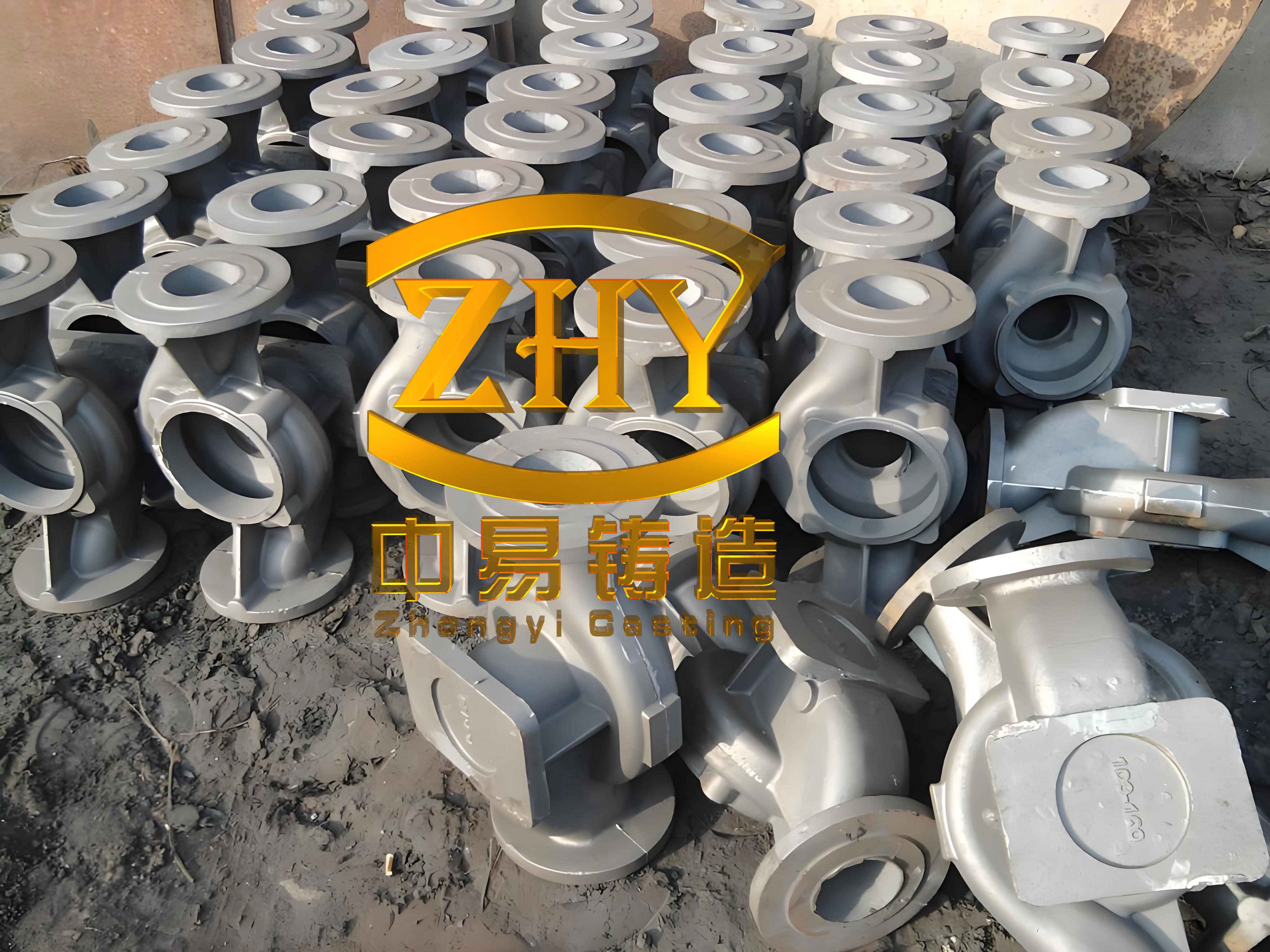
The resulting casting envelope measures approximately 1095 mm x 910 mm x 380 mm, with a net weight of 573 kg. A critical analysis of its castability reveals several challenges intrinsic to large gray iron castings with non-uniform sections. The wall thickness varies dramatically, from a minimum of 20 mm to a maximum of 153 mm in localized boss and flange areas—a ratio exceeding 7:1. These thick sections become isolated thermal nodes or “hot spots” during solidification, acting as potential sites for macro-shrinkage and micro-porosity. Internally, the housing features deep recesses and partitioned cavities formed by bearing pedestals, which obstruct straightforward pattern withdrawal. Furthermore, side access windows and an internal,蜿蜒 oil gallery complicate the molding process. The material specified is grade HT250, a flake graphite iron whose solidification characteristics—particularly the expansion associated with graphite precipitation—must be strategically harnessed in the feeding system design.
The foundational decisions in any casting process are the selection of the pouring position and the parting plane. After evaluating several options, the position shown was selected. This orientation places the large, flat top surface horizontally, which is advantageous for positioning feeding risers. More importantly, it ensures that critical functional surfaces—those which will be in contact with or aligned to the bearings—are facing downward or vertically. This minimizes the risk of slag inclusion or gas porosity on these crucial areas, as any buoyant impurities will tend to float towards the non-critical top surface. Determining the parting line followed logically. A curved parting surface was adopted, cleverly tracing the contour of the housing’s internal cavity. This strategic choice maximized the use of the mold itself to form the majority of the internal void, dramatically reducing the number of required sand cores to just two. This simplification directly translates to lower tooling cost, reduced complexity in mold assembly, and improved dimensional consistency.
The gating system is the conduit through which molten metal fills the mold cavity. Its design governs the fill rate, temperature distribution, and flow tranquility, all of which influence the final quality of gray iron castings. For this housing, a pressurized, bottom-gating system was designed. In such a system, the total cross-sectional area decreases from the sprue base to the ingates ($$A_{\text{sprue}} > \sum A_{\text{runner}} > \sum A_{\text{ingate}}$$), ensuring the system remains full of metal soon after pouring begins. This promotes a quiescent, non-turbulent fill from the bottom of the cavity upward, preventing mold erosion and air entrainment. The chosen area ratio was:
$$\sum A_{\text{Sprue}} : \sum A_{\text{Runner}} : \sum A_{\text{Ingate}} = 1.4 : 1.2 : 1.0$$
The pouring time (\(t\)) is a critical parameter calculated based on the casting weight (\(G\)) and its minimum wall thickness (\(\delta\)). Using an empirical formula common for gray iron castings:
$$t = S \sqrt[3]{G_{\text{casting}}}$$
where \(S\) is a coefficient dependent on wall thickness. For a 20 mm wall and a weight of 573 kg, the calculated pouring time was approximately 35 seconds. The pouring temperature was set at 1350°C. The key parameters of the initial gating system are summarized in the table below:
| Gating Element | Quantity | Cross-Sectional Shape | Total Area (cm²) | Dimensions (mm) |
|---|---|---|---|---|
| Sprue | 1 | Circular (Bottom) | 37.0 | Ø ~69 |
| Runner | 2 | Trapezoidal | 32.0 (16.0 each) | Top: 40, Bottom: 30, H: 35 |
| Ingate | 8 | Trapezoidal | 26.4 (3.3 each) | Top: 45, Bottom: 35, H: 8 |
To assess the efficacy of this initial design, a numerical simulation of the “naked” casting (with only the gating system) was performed using ProCAST software. The model was meshed with over 1.1 million volume elements, and appropriate boundary conditions for heat transfer between the HT250 metal, furan resin sand mold, and any chills were applied. The filling sequence confirmed a calm, bottom-up fill over the intended 35-second period, with no significant turbulence. However, the solidification analysis revealed the anticipated problems. Significant surface sink and internal shrinkage porosity were predicted in all major hot spots: the large central boss, the side bosses, and the areas around the window openings. This confirmed that the inherent feeding capability of the gray iron castings was insufficient to compensate for the volumetric shrinkage in these massive sections, necessitating an external feeding system.
The design of risers (feeders) is paramount for sound gray iron castings. The objective is to establish directional solidification, where the sections farthest from the riser solidify first, and the riser itself solidifies last, thereby feeding the shrinkage in the casting. The modulus method, where the riser’s modulus (Volume/Surface Area ratio) must exceed that of the casting section it feeds, was employed. A combination of riser types was used to address different needs. An open-top, necked riser was placed on a prominent elliptical boss. Its open nature allows for visual confirmation of filling and facilitates the addition of exothermic topping compounds. Two insulating sleeve risers were positioned on the thickest central mass. These risers, with their low thermal conductivity linings, significantly slow down the cooling rate of the stored molten metal, enhancing its feeding efficiency over a prolonged period. Additionally, four small vent risers were placed at the highest points of the mold to allow air and gases to escape and to provide a pressure relief path. The key riser dimensions based on modulus calculations are shown below:
| Riser ID | Type | Function | Key Dimensions (mm) | Approx. Modulus (cm) |
|---|---|---|---|---|
| #1, #2 | Vent | Gas Escape | Ø50 x 80 H | 1.0 |
| #3 | Open Top | Feeding Boss | Ø120 x 180 H, Neck: 60×80 | 2.2 |
| #4, #5 | Insulating | Feeding Main Body | Ø150 x 200 H | 3.0 |
A subsequent simulation of the casting with this riser configuration showed dramatic improvement. The major sink on the central boss was eliminated, and shrinkage in the main body was greatly reduced. However, residual porosity was still predicted in the secondary hot spots: the side circular bosses and the regions adjacent to the side windows. This indicated that while the risers were effectively feeding the primary thermal centers, the solidification sequence needed further refinement to pull liquid metal through these subsidiary junctions. This is a common refinement step in the process design of heavy-section gray iron castings.
To complete the establishment of a controlled thermal gradient, chills are introduced. Chills are masses of high thermal conductivity material (typically the same cast iron or steel) placed in the mold adjacent to casting sections that need to solidify faster. They act as heat sinks, accelerating cooling locally and effectively extending the “feeding range” of a riser by creating a steeper temperature gradient. Based on the residual defect map from the previous simulation, five external chills were designed and placed strategically.
- One large contoured chill was placed against the thick central hub from below.
- Two contoured chills were applied behind the side window openings.
- Two smaller cylindrical chills were positioned beneath the side circular bosses.
The use of contoured chills ensures intimate contact and efficient heat extraction. The thickness of the main chills was designed to be substantial (150 mm) to provide sufficient thermal mass without being completely saturated before the casting section solidified. The interaction between a chill and the casting can be conceptually understood by considering the enhanced heat flux (\(q\)). The heat transfer across the casting-chill interface is governed by:
$$q = h_{c-c} (T_{\text{casting}} – T_{\text{chill}})$$
where \(h_{c-c}\) is the interface heat transfer coefficient (set at 2000 W/(m²·K) in the model), significantly higher than that between the casting and sand. This rapid heat extraction locally increases the solidification rate, modifying the isotherm progression.
The final simulation, incorporating the optimized gating system, the combination of risers, and the strategically placed chills, yielded the desired outcome. The solidification progression clearly demonstrated directional solidification. Thin walls and chilled areas solidified first, followed progressively by the heavier sections. The liquid metal pathways remained open, with the two insulating risers on the central mass being the last points to solidify. The shrinkage porosity was successfully displaced entirely from the casting body and into the risers. The final predicted soundness of the casting was excellent, validating the complete process design. A summary of the thermal management strategy is presented below:
| Region | Thermal Challenge | Solution Applied | Intended Effect |
|---|---|---|---|
| Central Massive Hub | Largest Thermal Mass, Primary Hot Spot | Two Insulating Riser + Bottom Chill | Create last-to-freeze reservoir with prolonged feeding; steepen gradient from bottom. |
| Elliptical Top Boss | Isolated Secondary Hot Spot | Open Top Necked Riser | Provide direct, observable feeding and pressure relief. |
| Side Circular Bosses | Small, Isolated Thermal Nodes | Cylindrical External Chills | Accelerate local solidification to eliminate isolated hot spots. |
| Areas around Side Windows | Local Thickening, Junction Effects | Contoured External Chills | Extend feeding influence from main risers by accelerating cooling in these junctions. |
| General Thin Sections | Rapid Solidification | Sand Mold Only | Solidify first to establish the foundation for directional solidification. |
This project underscores a highly effective methodology for engineering complex gray iron castings. The process began with a thorough castability analysis, leading to strategic decisions on orientation and parting to minimize complexity. An initial gating system was designed using empirical rules to ensure a non-turbulent fill. The core of the optimization lay in the iterative use of numerical simulation. Starting with a bare model, the simulation accurately identified defect-prone zones, guiding the rational placement of risers. A second simulation round assessed the riser performance and pinpointed residual problem areas, which were then addressed with targeted chilling. This closed-loop, simulation-driven approach allowed for the virtual testing and refinement of the thermal gradients—the cornerstone of sound casting. The final integrated system, employing a bottom-gate, a hybrid riser scheme (open, insulating, and vent), and conformal chills, successfully enforced a controlled directional solidification pattern. This ensured that the volumetric shrinkage inherent in the solidification of even these gray iron castings was continuously fed from the risers, resulting in a predicted casting free from shrinkage defects. The methodology significantly de-risks the physical trial stage, reduces development time and cost, and provides a deep, predictive understanding of the solidification dynamics for heavy-section components, contributing directly to enhanced manufacturing reliability for critical industrial equipment.