
In our extensive study, we focused on the development and optimization of high chromium white cast iron for critical wear-resistant components. This type of white cast iron is pivotal in industries requiring durable parts such as shot blasting machine blades, impact crusher hammer bars, and ball mill liners. The economic benefits are substantial when the material is properly applied, as these components are numerous and in high demand. Through material testing, field assessments, and comparative trials, we successfully developed high carbon high chromium white cast iron for blades and medium carbon high chromium white cast iron for hammer bars, achieving remarkable performance enhancements. The versatility of white cast iron, particularly in its high chromium variants, underscores its importance in abrasive environments.
The design of chemical composition for high carbon and medium carbon high chromium white cast iron is foundational to achieving desired properties. Both types primarily utilize chromium and molybdenum as key alloying elements, imparting excellent wear resistance. Building on the base composition of white cast iron with approximately 15% chromium, we tailored the remaining elements based on operational conditions for specific applications.
Carbon content plays a crucial role in white cast iron. Higher carbon increases the volume of carbides, enhancing wear resistance but significantly reducing mechanical properties, especially impact toughness. Generally, when carbon exceeds the eutectic point, coarse primary carbides form, drastically lowering toughness and wear performance due to easy spalling under abrasive stress. Thus, we controlled carbon below the eutectic level: high carbon white cast iron at 2.8–3.2% and medium carbon white cast iron at 2.4–2.8%. The effect of carbon on impact toughness is summarized in Table 1.
| Carbon Content (%) | Impact Toughness (J/cm²) | Notes |
|---|---|---|
| 2.4–2.8 | 8–12 | Medium carbon range |
| 2.8–3.2 | 5–9 | High carbon range |
| Above 3.2 | <5 | Excessive primary carbides |
Chromium is the primary alloy in high chromium white cast iron, lowering the eutectic carbon content. From the Fe-Cr-C ternary phase diagram, with 10% Cr, the eutectic carbon is about 3.6%, and with 15% Cr, it is approximately 3.3%. To prevent coarse primary carbides and ensure all carbides are of the hard, isolated M7C3 type—ideal for wear resistance—the chromium-to-carbon ratio (Cr/C) must be optimized. For Cr ≥ 15%, this ratio is typically maintained between 4 and 8. Chromium not only forms carbides but also dissolves in austenite, strengthening the matrix and enhancing hardenability. Table 2 illustrates the influence of carbon and chromium on mechanical properties in white cast iron.
| Sample ID | C (%) | Cr (%) | Hardness (HRC) | Impact Toughness (J/cm²) | Tensile Strength (MPa) |
|---|---|---|---|---|---|
| A1 | 2.5 | 14 | 58–60 | 10–12 | 450–480 |
| A2 | 2.8 | 15 | 60–62 | 8–10 | 420–450 |
| A3 | 3.0 | 16 | 62–64 | 6–8 | 400–430 |
| A4 | 3.2 | 17 | 64–66 | 5–7 | 380–410 |
Hardenability is a critical factor, especially for thicker sections like hammer bars. Plain high chromium white cast iron has limited hardenability, with a maximum half-cooling time of about 20 minutes, equivalent to air-cooling for a 100 mm thick casting. This suffices for thin-walled parts like blades but not for heavier components. Molybdenum significantly improves hardenability in white cast iron, with greater effect at higher Cr/C ratios. Additionally, molybdenum aids in forming M2C-type eutectic carbides, refining the microstructure. To further enhance hardenability, copper is added in medium carbon white cast iron, typically 0.5–1.0%. Copper modifies the distribution of chromium and molybdenum between carbides and the matrix, as shown in electron probe analysis in Table 3.
| Sample ID | Cu Addition (%) | Mo in Matrix (%) | Cr in Matrix (%) | Notes |
|---|---|---|---|---|
| B1 | 0 | 0.8–1.0 | 8–10 | Base composition |
| B2 | 0.8 | 1.2–1.5 | 10–12 | Enhanced dissolution |
Minor elements like vanadium and titanium strengthen the matrix by forming stable carbides and oxides, improving hardness and mechanical properties. Vanadium carbide, for instance, has a hardness up to 2800 HV. These elements also act as nucleants, refining the structure and optimizing carbide distribution. For thick-section castings, vanadium is controlled at 0.1–0.3% and titanium at 0.05–0.15% in white cast iron.
Silicon behavior in high chromium white cast iron is influenced by carbon content. In our tests, for carbon around 2.8%, silicon at 0.4–0.8% yields higher impact toughness; for carbon at 2.4–2.8%, silicon at 0.6–1.0% shows a peak in toughness. Thus, selecting appropriate silicon levels is essential based on component requirements. Manganese can partially substitute molybdenum in white cast iron. With 0.5% Mo, adding manganese achieves similar effects as 1.0% Mo alone. Manganese’s impact on as-cast toughness in medium carbon white cast iron varies: below 0.8%, toughness increases with Mn; from 0.8% to 1.2%, it decreases; above 1.2%, it rises again but less sharply. After heat treatment, toughness often peaks at 1.0% Mn.
Summarizing, the optimal compositions for white cast iron are: high carbon type for blades—C: 2.8–3.2%, Si ≤ 0.8%, Cr: 14–16%, Mo: 0.5–1.0%, Mn: 0.5–1.0%, P and S as low as possible; medium carbon type for hammer bars and liners—C: 2.4–2.8%, Si ≤ 1.0%, Cr: 14–16%, Mo: 0.8–1.2%, Cu: 0.5–1.0%, V: 0.1–0.3%, Ti: 0.05–0.15%, Mn: 0.8–1.2%, P and S minimized.
The microstructure and properties of high chromium white cast iron are profoundly affected by composition and processing. Comprehensive modification treatments refine carbide morphology and distribution, enhancing mechanical properties. Table 4 lists the properties after such treatments for both white cast iron types.
| Type | As-Cast Hardness (HRC) | Heat-Treated Hardness (HRC) | Impact Toughness (J/cm²) | Microstructure Description |
|---|---|---|---|---|
| High Carbon | 58–62 | 62–66 | 6–9 | Martensite matrix with M7C3 carbides |
| Medium Carbon | 56–60 | 60–64 | 8–12 | Austenite-martensite matrix with M7C3 carbides |
When the Cr/C ratio exceeds 4.0, eutectic carbides in both white cast iron types are predominantly M7C3, with hardness around 1500–1800 HV, uniformly embedded in the matrix. This carbide content ranges from 20% to 30%, serving as an ideal wear-resistant phase and reinforcing skeleton. The matrix structure is equally vital: pearlite, with low hardness (~300 HV), wears easily under abrasion, undermining carbide support; martensite, with high hardness (800–1000 HV) and toughness, resists wear and firmly anchors carbides. For low-stress abrasion like blades, martensite is optimal; for impact-loaded hammer bars, an austenite-martensite mix provides better toughness. Thus, the ideal microstructure for high carbon white cast iron is a tough martensite matrix with isolated M7C3 carbides, while medium carbon white cast iron benefits from an austenite-martensite matrix with similar carbides. Annealed white cast iron exhibits good machinability, with curling chips during cutting.
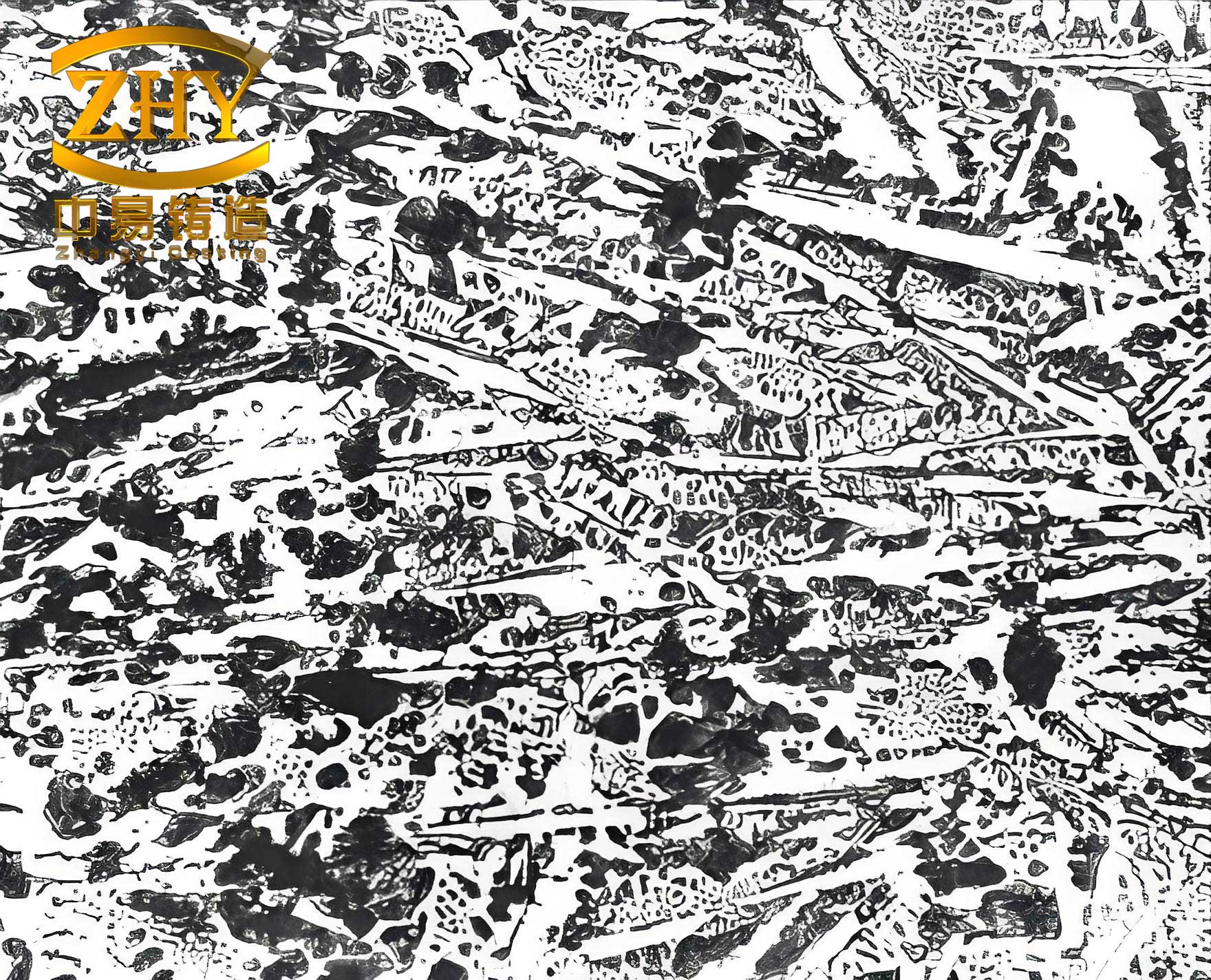
Heat treatment is crucial for optimizing the performance of high chromium white cast iron. We determined critical transformation temperatures through experimentation and used high-temperature metallography to observe microstructural changes during heating and cooling. Alloy element distribution was analyzed to inform heat treatment protocols.
For high carbon white cast iron blades, the as-cast matrix is austenitic; after heat treatment, it transforms to martensite with precipitation of fine, dispersed M23C6 carbides. For medium carbon white cast iron hammer bars, the as-cast matrix is mainly austenite, sometimes with transformation products; heat treatment yields an austenite-martensite mix with similar carbide precipitation. The heat treatment cycles involve heating to 950–1000°C, holding for austenitization, followed by air cooling or controlled cooling to achieve desired matrix phases. The transformation kinetics can be modeled using equations like the Avrami equation for phase change: $$ X(t) = 1 – \exp(-kt^n) $$ where \(X\) is the transformed fraction, \(k\) is a rate constant, \(n\) is the Avrami exponent, and \(t\) is time, applicable to white cast iron transformations.
The wear resistance and field performance of these white cast iron grades were evaluated across multiple sites. Table 5 shows results for shot blasting machine blades, and Table 6 for impact crusher hammer bars.
| Test Site | Previous Material | White Cast Iron Type | Service Life (hours) | Life Improvement (times) | Relative Weight Loss (%) |
|---|---|---|---|---|---|
| Site A | Standard White Iron | High Carbon | 400–500 | 2.0–2.5 | 30–40 |
| Site B | Low Alloy Steel | High Carbon | 350–450 | 3.0–3.5 | 25–35 |
| Site C | Traditional Cast Iron | High Carbon | 500–600 | 2.5–3.0 | 20–30 |
| Test Site | Previous Material | White Cast Iron Type | Service Life (days) | Life Improvement (times) | Relative Weight Loss (%) |
|---|---|---|---|---|---|
| Site X | High Manganese Steel | Medium Carbon | 30–40 | 3.0–4.0 | 15–25 |
| Site Y | Carbon Steel | Medium Carbon | 25–35 | 4.0–5.0 | 10–20 |
| Site Z | Alloy Cast Iron | Medium Carbon | 35–45 | 2.5–3.5 | 20–30 |
Results indicate that high carbon high chromium white cast iron blades last 2–3 times longer than conventional materials, and medium carbon high chromium white cast iron hammer bars outperform high manganese steel by 3–5 times. This demonstrates the superior wear resistance and economic viability of white cast iron in demanding applications.
Further analysis involves mathematical modeling of wear behavior. The wear rate \(W\) in white cast iron can be expressed as: $$ W = k \cdot H^{-m} \cdot \sigma^n $$ where \(k\) is a material constant, \(H\) is hardness, \(\sigma\) is stress, and \(m\) and \(n\) are exponents. For high chromium white cast iron, with high carbide volume, \(m\) typically ranges from 1.5 to 2.0, indicating strong hardness dependence. The carbide spacing \(\lambda\) affects toughness, approximated by: $$ \lambda = \frac{1}{\sqrt{N}} $$ where \(N\) is the number density of carbides per unit area, optimized through modification in white cast iron.
In conclusion, our research on high carbon and medium carbon high chromium white cast iron reveals that precise composition control, tailored heat treatment, and microstructural optimization are key to enhancing performance. White cast iron, with its unique combination of hard carbides and tough matrix, offers exceptional wear resistance for industrial components. The field tests confirm significant life extensions, making white cast iron a cost-effective solution for abrasive environments. Future work could explore novel alloying additions or advanced processing techniques to further push the boundaries of white cast iron applications.