
The pursuit of enhanced wear resistance in grinding media has long been anchored in the development of chromium-alloyed cast irons. While effective, the performance of these chromium series balls, with a typical surface hardness ranging from HRC 45 to 62, is fundamentally tied to the proportion of costly alloying elements. Fluctuations in the prices of ferroalloys render the production costs of such balls consistently high. Forged steel balls, though achieving a high surface hardness of HRC 58-62, suffer from a significantly softer core (HRC 42-48), leading to rapid wear and performance degradation, and their economics are equally vulnerable to the volatile prices of steel bar stock.
This context has driven the exploration of Carbidic Austempered Ductile Iron (CADI) as a high-performance, cost-effective alternative for grinding ball applications. The unique austempering heat treatment imparts a remarkable combination of high hardness (typically HRC 50-55 post-treatment) and toughness to the ductile iron casting, creating the desirable “hard shell, tough core” characteristic. Furthermore, the inherent presence of spheroidal graphite in the ductile iron casting matrix, being a non-metallic phase, results in a lower density—approximately 7.3 t/m³ compared to 7.7-7.8 t/m³ for chrome alloy and forged balls. This density reduction translates directly into a lighter mill charge, reducing the startup and operational torque of grinding mills and leading to estimated energy savings of 5-8%. The compelling synergy of wear performance, impact resistance, and operational economy has spurred significant R&D efforts within the industry. Our practice, based on systematic development using a 1-ton medium-frequency induction furnace and rigorous process optimization in molding, chemistry, treatment, and heat treatment, has successfully yielded high-quality CADI grinding balls.
Foundry Practice for Grinding Ball Production
Molding and Pattern Design
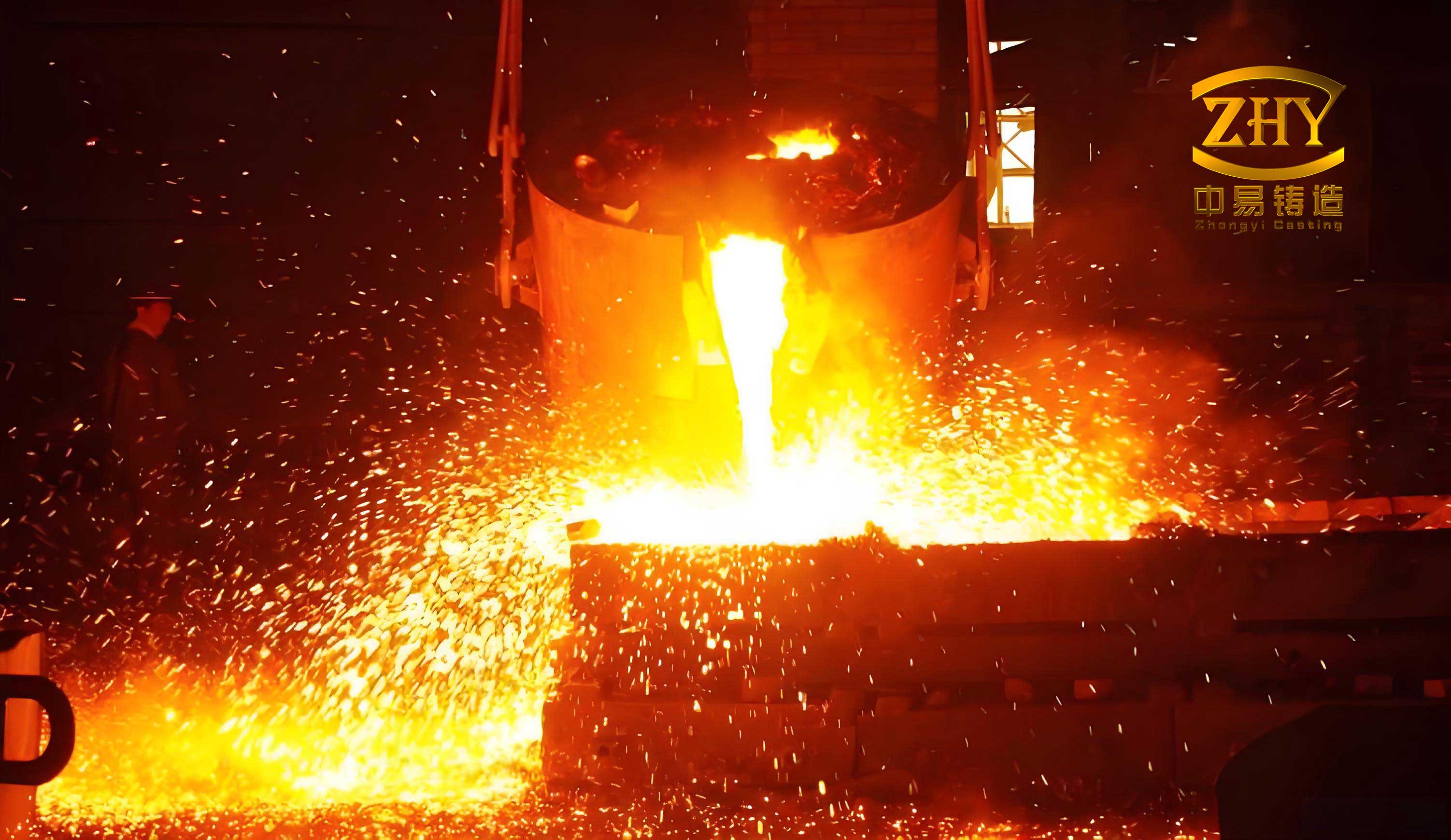
The production of ductile iron casting grinding balls employs metal permanent molds. A typical mold configuration, as illustrated in the figure below, produces four balls per casting. The gating system is formed using sodium silicate-bonded sand in designated areas of the metal mold. The high chilling capacity of the rigid metal mold promotes rapid solidification, resulting in a fine and uniformly distributed graphite structure. Prior to pouring, the metal molds are preheated to a temperature between 250°C and 300°C to prevent thermal shock and improve metal flow. Strategic venting is achieved by inserting small steel bars (e.g., 4.5 mm x 4.5 mm x 10 mm) into vent holes; these bars allow gases to escape while preventing molten iron leakage.
Chemical Composition Design
The design of the chemical composition is paramount, as it governs both the graphite morphology and the matrix structure, which are the primary determinants of the final CADI properties. Carbon and silicon are the principal graphitizing elements. While a higher Carbon Equivalent (CE) promotes graphite formation, excessive levels can lead to graphite degradation in the presence of trace harmful elements or inadequate inoculation. Elevated C and Si also promote ferrite formation at the expense of pearlite, affecting strength and hardness. Therefore, precise control is essential. Phosphorus and sulfur are detrimental impurities, promoting embrittlement and interfering with graphite spheroidization. Their content in the base iron must be minimized. Manganese is added to enhance hardenability, a critical factor for through-thickness properties, especially in larger-diameter balls. However, as a strong positive segregation element, its content must be carefully limited. Chromium is a potent carbide former; increasing Cr content raises hardness but can severely impair impact toughness. For larger balls requiring greater hardenability, alloying elements like Molybdenum, Copper, and Nickel are incorporated.
The target composition for a φ110 mm CADI grinding ball is summarized in Table 1.
| C | Si | Mn | P | S | Cr | Cu | Mo | Ni |
|---|---|---|---|---|---|---|---|---|
| 3.6 | 2.4 | 0.8 | < 0.01 | < 0.01 | 1.2 | 0.5 | 0.3 | 0.3 |
The Carbon Equivalent can be calculated using the standard formula:
$$ CE = \%C + \frac{\%Si}{3} $$
For our target composition, this yields:
$$ CE = 3.6 + \frac{2.4}{3} = 4.4 $$
This value is within an acceptable range for producing sound ductile iron casting with a high nodule count.
Nodularization and Inoculation Treatment
This is the most critical stage in producing a high-quality ductile iron casting. For CADI, a nodularity rating greater than 80% (corresponding to a graphite shape classification of 3 or better) and a small graphite nodule size (finer than 0.05 mm, or Size 6 or higher) are essential prerequisites for obtaining excellent mechanical properties after austempering. The practice involves:
- Charge Material Selection: Using high-purity pig iron and selected steel scrap to minimize the intake of anti-nodularizing elements like Ti, Sb, Pb, and Bi. Target base iron sulfur is kept below 0.06%.
- Pre-treatment: Performing a pre-deoxidation step on the molten iron before tapping to improve the efficiency of the subsequent nodularizing treatment and resistance to fade.
- Treatment Practice: Employing the sandwich method (pour-over technique) for treatment. A 6-8% rare earth magnesium ferrosilicon alloy is used as the nodularizer, covered with a pre-inoculant (e.g., FeSi75) and topped with steel punchings. The amount of covering material is proportional to the iron weight and temperature. The iron is tapped at approximately 1480°C, and the treated metal must be poured within 10 minutes to prevent nodularization fade.
The key parameters for the treatment process are summarized in Table 2.
| Parameter | Target / Value |
|---|---|
| Base Iron Sulfur (S) | ≤ 0.06% |
| Tapping Temperature | ~1480 °C |
| Nodularizer Type | RE-Mg-FeSi (6-8% Mg) |
| Inoculant Type | FeSi75 |
| Covering Material | Steel Punchings (~0.3% of Fe weight) |
| Maximum Pouring Delay | 10 minutes |
Austempering and Tempering Heat Treatment
The heat treatment cycle is what transforms the as-cast ductile iron casting into the superior CADI material. The objective of austempering is to produce a matrix of acicular ferrite (bainite) and high-carbon, thermally stabilized austenite, known as “ausferrite.” This structure provides the optimal blend of hardness, strength, wear resistance, and toughness.
Austempering Process
The specific thermal cycle used in our practice for φ110 mm balls is as follows and illustrated in Figure 1:
- Preheating: The cast balls are slowly heated to 490°C over 220 minutes in a box furnace to reduce thermal stresses.
- Austenitization: The temperature is then raised to 920°C. A two-step heating (e.g., 780°C hold) can be used for uniformity. At 920°C, the balls are held for 300 minutes. During this stage, the as-cast matrix fully transforms to austenite, and carbon from the graphite nodules diffuses into this austenite, raising its carbon content. The final carbon content of the austenite ($C_{\gamma}$) is a function of time ($t$), temperature ($T$), and initial nodule characteristics. A simplified kinetic relationship can be expressed as:
$$ C_{\gamma}(t) = C_{sat} – (C_{sat} – C_0) \cdot e^{-k(T) \cdot t} $$
where $C_{sat}$ is the saturation carbon content in austenite at temperature T, $C_0$ is the initial carbon in austenite, and $k(T)$ is a temperature-dependent rate constant. - Quenching and Isothermal Holding: After austenitization, the balls are rapidly quenched into a salt bath maintained at 250°C. They are held at this temperature for 150 minutes. During this isothermal hold, the high-carbon austenite decomposes into the ausferritic structure (acicular ferrite + high-carbon austenite) and, in the case of CADI, controlled amounts of carbides. The transformation follows the kinetics of bainite formation.
- Cooling and Cleaning: After the isothermal hold, the balls are air-cooled to below 80°C and then cleaned to remove salt residues.
Figure 1: Schematic of the Austempering Thermal Cycle.
$$
\text{Temperature}
\begin{cases}
\quad \\
920^\circ C \quad\ \text{(300 min Hold)}\\
\quad \\
\quad \\
490^\circ C \quad\ \text{(220 min)}\\
\quad \\
250^\circ C \quad\ \text{(150 min Hold)}\\
\end{cases}
\longrightarrow \text{Time (min)}
$$
Tempering Process
Following austempering, a tempering or stress-relief treatment is conducted. The balls are heated to 230°C and held for 300 minutes (see Figure 2). This step further stabilizes the microstructure, relieves residual stresses from quenching, and can slightly adjust the mechanical properties without significantly altering the ausferrite matrix.
Figure 2: Tempering Cycle after Austempering.
$$
\text{Temperature}
\begin{cases}
\quad \\
230^\circ C \quad\ \text{(300 min Hold)}\\
\quad \\
\end{cases}
\longrightarrow \text{Time (min)}
$$
The complete set of heat treatment parameters is consolidated in Table 3.
| Process Step | Temperature | Time | Purpose/Note |
|---|---|---|---|
| Preheat | 490 °C | 220 min | Reduce thermal shock |
| Austenitize | 920 °C | 300 min | Full austenitization & carbon enrichment |
| Isothermal Quench | 250 °C | 150 min | Formation of ausferrite + carbides |
| Temper | 230 °C | 300 min | Stress relief and stabilization |
Microstructural and Mechanical Property Evaluation
Metallographic Analysis
Microstructural examination confirms the success of the ductile iron casting and heat treatment processes. Samples are prepared by sectioning, grinding, polishing, and etching with 5% nital. Analysis reveals:
- Graphite Morphology: A high nodularity rating (Grade 2) with a fine, uniform distribution of graphite nodules (Size 6 or finer).
- Carbide Distribution: A uniform dispersion of carbides within the matrix, contributing to the hardness and wear resistance without forming deleterious networks.
- Matrix Structure: The characteristic ausferritic matrix consisting of dark-etching, acicular ferrite laths surrounded by films of light-etching, high-carbon stabilized austenite.
This microstructure is the direct result of the precise chemical control and optimized austempering cycle applied to the ductile iron casting.
Mechanical Property Testing
Standard test specimens (10 mm x 10 mm x 55 mm, unnotched) are machined from randomly selected balls. Care is taken to avoid sampling from areas with casting defects like shrinkage porosity. The properties are measured as follows:
- Hardness: Rockwell C hardness (HRC) is measured at multiple points on the sample cross-section.
- Impact Toughness: Unnotched Charpy impact tests are conducted to evaluate toughness.
The test results are presented in Table 4.
| Property | Measured Values | Average |
|---|---|---|
| Hardness (HRC) | 51.0, 51.8, 52.8, 54.2, 55.5, 51.5, 52.0, 53.0 | 52.7 |
| Impact Toughness (J/cm²) | 12.0, 12.2, 13.0 | 12.4 |
Analysis of Results
The technical specification for the CADI balls typically requires a minimum hardness of HRC 50 and an impact toughness of at least 8 J/cm². The achieved averages of HRC 52.7 and 12.4 J/cm² significantly exceed these minimums. This demonstrates the successful production of a material with both excellent wear resistance (indicated by high hardness) and good fracture resistance (indicated by high impact energy). The high nodularity observed metallographically is directly correlated with these superior mechanical properties, as it ensures a uniform and favorable matrix transformation during austempering. The relationship between carbide volume fraction ($V_c$), hardness, and toughness can be conceptually modeled. Hardness often follows a rule of mixtures, while toughness is inversely affected by brittle phases:
$$ HV \approx H_{af} \cdot (1-V_c) + H_{c} \cdot V_c $$
$$ K \propto \frac{1}{\sqrt{V_c}} $$
where $HV$ is Vickers hardness, $H_{af}$ and $H_c$ are the hardness contributions of the ausferrite and carbides respectively, $V_c$ is the carbide volume fraction, and $K$ is a toughness-related parameter. Our compositional control keeps $V_c$ at an optimal level to balance these properties.
Key Factors for Success and Concluding Remarks
The production of high-performance CADI grinding balls hinges on several interdependent factors rooted in ductile iron casting science. First, the as-cast microstructure of the ductile iron casting is the foundational blueprint. A high nodularity rating (Grade 1-3) and fine graphite size (≥ Size 6) are non-negotiable prerequisites that enable the subsequent development of a uniform and high-performance ausferritic matrix.
Second, the austempering heat treatment is the transformative process that unlocks the potential of the ductile iron casting. The precise control of austenitizing temperature and time, quench rate, and isothermal holding temperature/time dictates the phase transformations, ultimately determining the final proportions and characteristics of ferrite, high-carbon austenite, and carbides. The process must be meticulously adjusted based on the specific chemical composition (e.g., a reduction in Cr by 0.5% may necessitate a 5°C increase in austempering temperature) and the section size of the casting.
Third, achieving consistent quality requires a holistic and rigorously controlled process chain. This encompasses:
- Careful charge selection and melting practice to achieve low baseline sulfur and phosphorus.
- Optimized and repeatable nodularization/inoculation procedures to guarantee high and consistent nodularity.
- Precise thermal profiling during heat treatment, often requiring sophisticated furnace controls.
- Comprehensive quality checks, including spectral analysis, microstructural evaluation, and mechanical testing.
The successful practice of manufacturing CADI grinding balls, therefore, is not merely a sequence of steps but a deeply integrated system. It demands a thorough understanding of the metallurgy of ductile iron casting, precise engineering of the casting and heat treatment processes, and stringent operational discipline. This systematic, detailed, and controlled approach is what ensures the stability, consistency, and superior performance of CADI products, ultimately strengthening the competitive edge in the demanding market for grinding media. The transition from a standard ductile iron casting to a premium CADI component exemplifies how advanced processing can extract exceptional properties from a versatile and cost-effective material base.