
As an engineer deeply involved in the development and optimization of railway components, I have long been fascinated by the unique properties of high manganese steel and its critical role in manufacturing frogs, or crossings, for railway tracks. The ability of this material to work-harden under impact makes it indispensable, yet the persistent issue of spalling and premature failure poses a significant challenge to modern, high-speed rail networks. Through extensive research and practical experience in a manganese steel casting foundry, I have explored various avenues to enhance the hardness and strength of high manganese steel, thereby extending the service life of frogs and reducing performance variability. This article delves into the fundamental principles and practical methods of strengthening high manganese steel, emphasizing the integration of multiple techniques to achieve superior performance.
High manganese steel, characterized by its fully austenitic structure after water toughening, exhibits remarkable toughness and work-hardening capability. However, its initial hardness is relatively low, typically around HB200, which makes it susceptible to early-stage wear and contact fatigue under the extreme stresses exerted by rolling wheels. The contact stress between wheel and rail can exceed 1200–1400 MPa, far beyond the yield strength of untreated high manganese steel. This leads to plastic deformation exhaustion and sub-surface crack initiation, resulting in spalling—a major failure mode accounting for up to 60% of frog failures. To address this, strengthening the steel both intrinsically and on the surface is paramount. In a manganese steel casting foundry, the focus must extend beyond traditional casting and heat treatment to incorporate advanced strengthening methods that elevate the material’s “hardness-strength” combination, or what I term “strong hardness.”
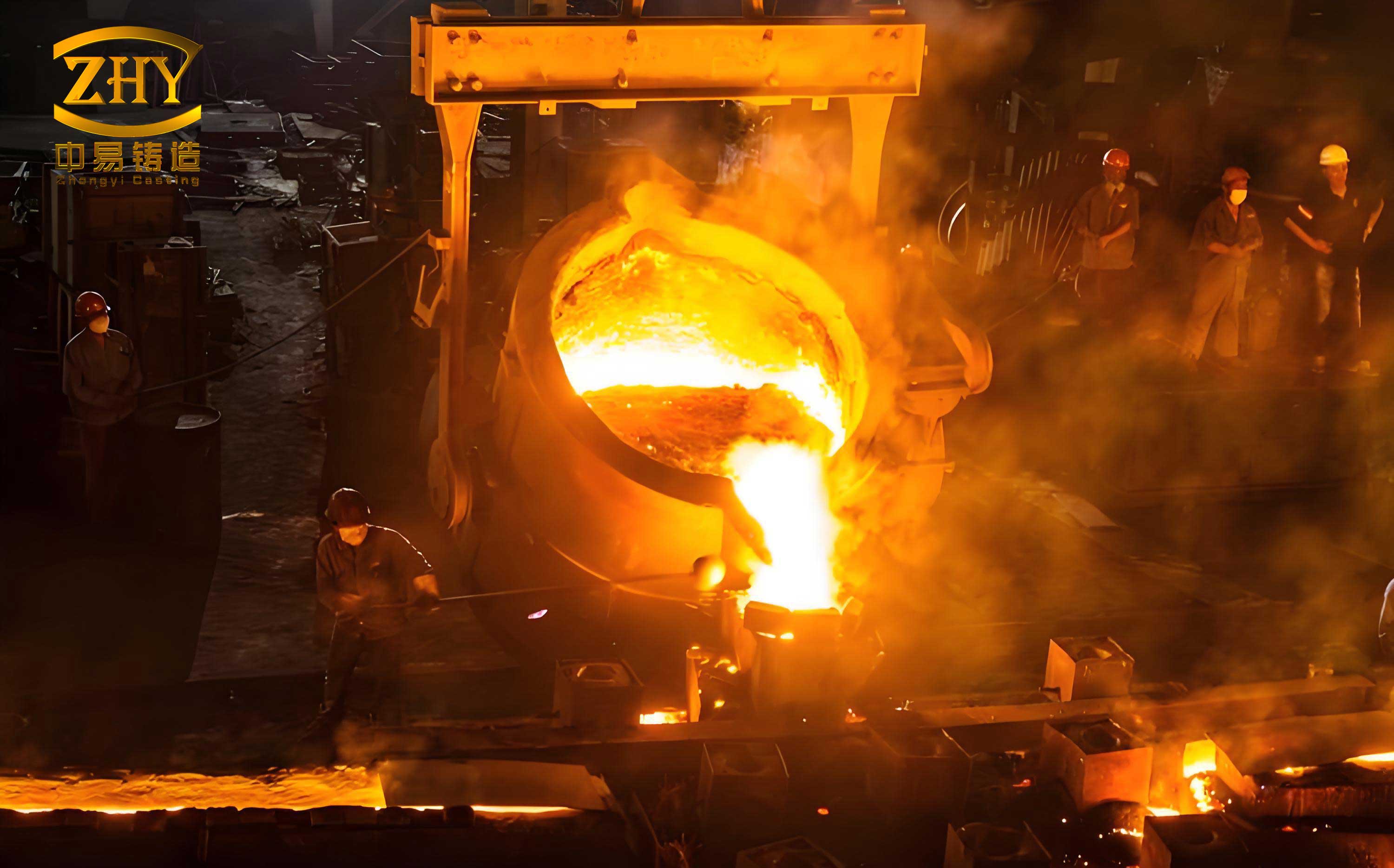
The journey toward improved frog longevity begins with understanding the metallurgical basis of high manganese steel. The classic composition, typically with 1.0–1.4% carbon and 11–14% manganese, forms a single-phase austenite after solution treatment. The work-hardening behavior is governed by dislocation dynamics and strain-induced phase transformations. The surface hardness after work-hardening can reach HB500 or more, but the rate and depth of hardening depend on initial properties. The relationship between applied stress and hardening depth can be approximated by:
$$ \sigma_y = \sigma_0 + K \varepsilon^n $$
where \(\sigma_y\) is the yield stress, \(\sigma_0\) is the initial yield strength, \(K\) is the strength coefficient, \(\varepsilon\) is the strain, and \(n\) is the work-hardening exponent. For high manganese steel, \(n\) is relatively high, but increasing \(\sigma_0\) through strengthening methods can accelerate hardening and improve wear resistance. This is crucial in a manganese steel casting foundry where performance consistency is key.
Let’s explore the primary strengthening techniques in detail, starting with surface treatments that directly enhance the frog’s running surface.
Carburizing Strengthening: A Surface Enhancement Technique
Carburizing strengthening involves the infiltration of atomic carbon into the wear-prone surfaces of high manganese steel frogs using a carbon arc generated under direct current (DC) with reverse polarity. This process forms hard carbides such as Fe₃C and Mn₃C along austenite grain boundaries, significantly boosting surface hardness and耐磨性. The technique is versatile, applicable both to newly manufactured frogs and those already in service, making it a valuable maintenance strategy for railway operators.
The operational parameters are critical. Typically, a 6 mm carbon electrode (non-copper coated) is used with a DC power source set at 150–160 A, positive polarity on the carbon electrode. The arc is struck at predefined points on the frog’s critical areas—specifically, the top surface of the nose rail from 20–60 mm cross-section and the corresponding wing rail surface from 250 mm before the throat to the 40 mm section of the nose rail. Each carburizing point is maintained for 2–4 seconds, resulting in a spot diameter of 8–10 mm with a depth of about 1.5 mm. The spots are arranged in a staggered pattern, like a plum blossom, with edges rising 0.5–0.7 mm above the surface, which are later ground smooth. This creates a textured surface that enhances initial wear resistance without compromising the underlying toughness.
The effectiveness of carburizing strengthening can be quantified by the increase in surface hardness and wear resistance. Studies indicate that this method can improve frog service life by at least 30%. For a manganese steel casting foundry, implementing this post-casting treatment adds value without requiring major capital investment. The table below summarizes key parameters and outcomes:
| Parameter | Value/Range | Effect |
|---|---|---|
| Current | 150–160 A DC | Ensures sufficient energy for carbon diffusion |
| Electrode | 6 mm carbon rod | Source of carbon atoms |
| Spot Duration | 2–4 seconds | Controls carbide formation depth |
| Spot Diameter | 8–10 mm | Optimizes coverage area |
| Hardness Increase | HB200 to HB350+ | Enhances wear resistance |
| Life Improvement | ≥30% | Reduces replacement frequency |
The mechanism involves carbon diffusion into the austenite lattice, where it occupies interstitial sites, causing lattice strain and forming carbides. The carbon concentration profile can be modeled using Fick’s second law:
$$ \frac{\partial C}{\partial t} = D \frac{\partial^2 C}{\partial x^2} $$
where \(C\) is carbon concentration, \(t\) is time, \(D\) is the diffusion coefficient, and \(x\) is depth. In practice, the process is non-isothermal, but for short durations, it provides a reasonable approximation for case depth. This technique is a testament to how targeted surface engineering in a manganese steel casting foundry can yield substantial performance gains.
Explosive Strengthening: Harnessing Shock Waves for Hardness
Explosive strengthening utilizes the high-energy shock waves from controlled detonations to plastically deform the surface layer of high manganese steel frogs, inducing work-hardening and residual compressive stresses. This method, pioneered in the 1960s, can significantly increase surface hardness and hardening depth, thereby reducing initial wear and extending service life.
The process involves placing a sheet explosive, such as plastic or rubber-based compositions containing RDX (cyclotrimethylenetrinitramine), onto the frog’s running surface. The explosive is ignited using an electric detonator, generating a shock wave that propagates through the metal. The rapid deformation causes dislocation multiplication and grain distortion, leading to hardening. Key parameters include explosive type, thickness, and standoff distance. For instance, plastic sheet explosives about 4 mm thick, tailored to match the frog’s contour, are commonly used. The frog is typically placed on a thick steel plate (e.g., 50 mm) to minimize distortion during explosion.
Results from explosive strengthening are impressive. A single treatment can raise surface hardness from HB200 to HB270 with a hardening depth of 3–6 mm, while a double treatment can achieve HB350 with depths up to 16 mm. This translates to a service life improvement of over 30%. The table below compares single and double explosive treatments:
| Treatment | Surface Hardness (HB) | Hardening Depth (mm) | Life Improvement |
|---|---|---|---|
| Single Explosion | 270 | 3–6 | ~30% |
| Double Explosion | 350 | up to 16 | >30% |
| Base Material | 200 | N/A | Reference |
The underlying physics can be described by the Hugoniot equations for shock waves, which relate pressure, particle velocity, and material properties. The pressure generated by the explosive can be estimated as:
$$ P = \rho_0 U_s u_p $$
where \(P\) is pressure, \(\rho_0\) is initial density, \(U_s\) is shock velocity, and \(u_p\) is particle velocity. For high manganese steel, this pressure induces plastic strain \(\varepsilon_p\), which correlates with hardness increase via empirical relationships like:
$$ HV = HV_0 + \alpha \varepsilon_p^\beta $$
where \(HV\) is Vickers hardness, \(HV_0\) is initial hardness, and \(\alpha\), \(\beta\) are material constants. Explosive strengthening is a powerful tool for a manganese steel casting foundry to pre-harden components before service, mitigating early spalling. However, it requires careful handling and safety protocols due to the use of explosives.
Solid Solution Strengthening: Intrinsic Alloying for Enhanced Properties
Solid solution strengthening involves the addition of alloying elements that dissolve in the austenite matrix, causing lattice strain and thereby increasing yield strength and hardness. This is a foundational approach in metallurgy that can be seamlessly integrated into the melting process at a manganese steel casting foundry. By selecting elements with atomic radii significantly different from iron, we can achieve substantial strengthening effects.
Common alloying elements for high manganese steel include tungsten (W), molybdenum (Mo), tantalum (Ta), zirconium (Zr), and titanium (Ti). These elements have high melting points and large atomic radii, leading to pronounced lattice distortion when in solid solution. The strengthening effect can be quantified using the Labusch-Nabarro model:
$$ \Delta \sigma_{ss} = G \varepsilon^{3/2} c^{1/2} $$
where \(\Delta \sigma_{ss}\) is the increase in yield stress due to solid solution, \(G\) is the shear modulus, \(\varepsilon\) is the misfit parameter (related to atomic size difference), and \(c\) is the concentration of solute atoms. For instance, adding 0.5% Mo can increase tensile strength by 50–100 MPa while maintaining adequate toughness.
The choice of elements also considers their impact on other properties. For example, molybdenum enhances high-temperature strength and creep resistance, which is beneficial for frogs subjected to repeated thermal cycles from wheel friction. The following table lists key alloying elements and their effects:
| Element | Atomic Radius (pm) | Effect on Strength | Typical Addition (%) |
|---|---|---|---|
| Molybdenum (Mo) | 139 | High solid solution strengthening | 0.2–0.8 |
| Tungsten (W) | 139 | Similar to Mo, improves creep resistance | 0.1–0.5 |
| Titanium (Ti) | 147 | Also forms carbides (precipitation) | 0.05–0.2 |
| Zirconium (Zr) | 160 | Grain refinement and solid solution | 0.05–0.15 |
In practice, these elements are added during the ladle treatment stage in a manganese steel casting foundry. It is crucial to control their levels to avoid detrimental phases or excessive cost. Solid solution strengthening provides a homogeneous improvement in mechanical properties, making the frog more resistant to deformation and crack initiation throughout its volume. This method synergizes with surface treatments to deliver comprehensive performance enhancement.
Precipitation Strengthening: Utilizing Fine Dispersoids for Hardness
Precipitation strengthening involves the formation of fine, hard particles within the austenite matrix that impede dislocation motion, thereby increasing strength and hardness. This is achieved by adding micro-alloying elements such as titanium, vanadium, niobium, and aluminum, which form carbides, nitrides, or intermetallic compounds during solidification or subsequent heat treatment.
In high manganese steel, carbides like TiC, V₄C₃, and NbC are particularly effective due to their high hardness and thermal stability. These precipitates act as obstacles to dislocation glide, following the Orowan bypass mechanism:
$$ \Delta \tau = \frac{G b}{L} $$
where \(\Delta \tau\) is the increase in shear stress, \(G\) is shear modulus, \(b\) is Burgers vector, and \(L\) is inter-precipitate spacing. By controlling the size and distribution of precipitates through heat treatment, we can optimize strengthening. For instance, adding 0.1% Ti can form TiC particles with diameters below 100 nm, providing significant hardening without compromising toughness.
The kinetics of precipitation can be described by the Johnson-Mehl-Avrami-Kolmogorov (JMAK) equation:
$$ f = 1 – \exp(-k t^n) $$
where \(f\) is the fraction transformed, \(k\) is a rate constant, \(t\) is time, and \(n\) is the Avrami exponent. In a manganese steel casting foundry, this requires precise control over cooling rates and aging treatments to ensure fine, uniform precipitation.
The benefits of precipitation strengthening are multifold: it not only increases hardness but also refines grain structure by pinning grain boundaries during solidification. This dual action enhances both strength and toughness. The table below summarizes common precipitation-hardening elements in high manganese steel:
| Element | Precipitate Formed | Hardness of Precipitate (HV) | Effect on Frog Life |
|---|---|---|---|
| Titanium (Ti) | TiC | ~3000 | Improves wear resistance by 20–40% |
| Vanadium (V) | V₄C₃ | ~2800 | Enhances strength and fatigue life |
| Niobium (Nb) | NbC | ~2400 | Refines grains, reduces spalling |
| Aluminum (Al) | AlN (if N present) | ~1200 | Improves toughness and hardenability |
Implementing precipitation strengthening in a manganese steel casting foundry involves careful alloy design and process control. For example, titanium addition must be balanced with carbon content to avoid excessive coarse carbides that could act as stress raisers. Combined with solid solution strengthening, precipitation hardening offers a robust method to elevate the intrinsic properties of high manganese steel, making frogs more resilient to the harsh operating conditions of railways.
Integrated Strengthening Strategy: Synergizing Methods for Optimal Performance
The most effective approach to enhancing high manganese steel frog longevity lies in combining multiple strengthening techniques. This integrated strategy addresses both surface and bulk material properties, leveraging synergies between methods. For instance, solid solution and precipitation strengthening improve the base metal’s强硬性, while carburizing or explosive strengthening provide a hardened surface layer resistant to initial wear and spalling.
In a manganese steel casting foundry, the production workflow can be optimized to incorporate these methods sequentially. The process might begin with alloying during melting to achieve solid solution and precipitation strengthening, followed by water toughening to obtain a uniform austenitic structure. Subsequently, explosive strengthening could be applied to pre-harden the running surfaces, and for frogs in service, carburizing strengthening might be used as a maintenance intervention. This holistic approach ensures that frogs meet the demanding requirements of high-speed rail, where load cycles exceed hundreds of millions.
To quantify the combined effects, we can use a rule-of-mixtures model for hardness or strength. For example, the overall yield strength \(\sigma_{total}\) might be expressed as:
$$ \sigma_{total} = \sigma_0 + \Delta \sigma_{ss} + \Delta \sigma_{ppt} + \Delta \sigma_{wh} $$
where \(\sigma_0\) is the base strength, \(\Delta \sigma_{ss}\) is from solid solution, \(\Delta \sigma_{ppt}\) is from precipitation, and \(\Delta \sigma_{wh}\) is from work-hardening (enhanced by surface treatments). Similarly, wear resistance can be correlated with surface hardness and toughness. The following table illustrates a hypothetical performance comparison for frogs treated with different strengthening combinations:
| Strengthening Combination | Surface Hardness (HB) | Core Toughness (J/cm²) | Estimated Life (MGT) | Discreteness Reduction |
|---|---|---|---|---|
| Base (none) | 200 | 200 | 80–100 | High |
| Solid Solution Only | 220 | 180 | 100–120 | Moderate |
| Explosive + Carburizing | 350 | 200 | 130–160 | Low |
| Full Integration (All methods) | 400+ | 170 | 160–200+ | Very Low |
Note: MGT = Million Gross Tons (a measure of passed traffic). Discreteness refers to the variability in service life.
The integration also involves economic considerations. While some methods like alloy addition increase raw material costs, they may reduce overall lifecycle costs by extending service intervals. For a manganese steel casting foundry, investing in these technologies can enhance competitiveness and meet stringent railway standards. Moreover, the use of advanced simulation tools, such as finite element analysis (FEA) for stress distribution and computational thermodynamics for alloy design, can optimize the strengthening processes. For example, FEA can model the contact stresses on a frog:
$$ \sigma_{contact} = \frac{P}{\pi a^2} \sqrt{1 – \frac{r^2}{a^2}} $$
for a Hertzian contact, where \(P\) is load, \(a\) is contact radius, and \(r\) is radial distance. This helps identify critical areas for targeted surface treatment.
Future Directions and Concluding Remarks
As railway systems evolve toward higher speeds and heavier loads, the demand for durable frogs will only intensify. The strengthening methods discussed—carburizing, explosive, solid solution, and precipitation strengthening—offer proven pathways to elevate high manganese steel performance. However, ongoing research is essential to refine these techniques and explore new avenues, such as laser surface hardening, cryogenic treatment, or nano-structured coatings.
In a manganese steel casting foundry, innovation should focus on process automation and quality control to ensure consistency. For instance, real-time monitoring during explosive strengthening or robotic application of carburizing could improve repeatability. Additionally, sustainability aspects, such as recycling of alloying elements and energy-efficient treatments, are becoming increasingly important.
Ultimately, the key to success lies in a deep understanding of material science and a commitment to continuous improvement. By embracing an integrated strengthening strategy, we can significantly extend the service life of high manganese steel frogs, reduce maintenance costs, and support the safe and efficient operation of railways worldwide. The journey from molten metal to a robust frog involves meticulous craftsmanship in the manganese steel casting foundry, where every step—from alloying to surface treatment—contributes to a component that withstands the test of time and traffic.
In conclusion, the strengthening of high manganese steel frogs is not merely a technical exercise but a multidisciplinary endeavor that combines metallurgy, mechanical engineering, and practical foundry expertise. Through the diligent application of these methods, we can unlock the full potential of this classic material, ensuring its relevance in the future of rail transportation.