
Improving installation quality and reducing structural errors in large gearless drive ball mills is critical for mineral processing, building materials, and chemical industries. This study develops optimized installation protocols and real-time quality control methods to enhance operational stability. Through systematic benchmarking, precision alignment, and continuous monitoring, installation errors are minimized, significantly boosting ball mill reliability and lifespan.
1. Gearless Drive Ball Mill Installation Technology
1.1 Establishing Benchmark Points
After cylinder placement, restricted measurement angles necessitate setting centerline markers and elevation benchmarks. Key steps include:
- Identify critical points: Equipment center, elevation references, and component locations.
- Use corrosion-resistant markers (stainless steel/brass) with clear identifiers.
- Fix markers permanently and verify positions using laser rangefinders/theodolites.
- Install centerline plates for spatial reference during stator/rotor alignment.
Precision is validated using:
$$\Delta P \leq 0.5\ \text{mm}\ \text{(Deviation tolerance)}$$
where $\Delta P$ is positional error.
1.2 Bearing Shell Adjustment
Axial clearance between trunnion and bearing shells directly impacts ball mill vibration. Two adjustment methods:
| Method | Procedure | Tolerance |
|---|---|---|
| Manual | 1. Remove motor/coupling 2. Measure axial gap ($G_a$) 3. Adjust shims 4. Hand-rotate to verify |
$G_a \leq 0.05\ \text{mm}$ |
| Automatic | 1. Install gap sensors 2. Real-time monitoring 3. Control system auto-adjusts |
1.3 Stator Installation
Segmented stator assembly ensures balanced hoisting:
- Lower bottom stator onto skid, align baseplate/fasten with dowels.
- Hoist top stator, support temporarily with hydraulic jacks.
- Position stators symmetrically using opposite electrodes; maintain 5 mm airgap to rotor:
$$A_g = 5 \pm 0.1\ \text{mm}$$ - Measure/compare feed/discharge end clearances before final positioning.
Pre-installation tests: Voltage withstand, insulation resistance, and core bolt torque verification.
1.4 Stator Winding and Rotor Electrode Installation
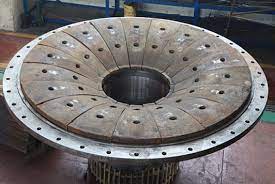
Joint windings are assembled on-site while prefabricating other sections:
- Test Roebel bars and stator voltage before insulation wrapping.
- Mount rotor electrodes via high-strength bolts using frictional torque transmission.
- Measure flange runout ($R_f$) with dial indicators:
$$R_f \leq 0.02\ \text{mm}\ \text{(Radial)}$$
$$R_f \leq 0.03\ \text{mm}\ \text{(Axial)}$$ - Clean surfaces, align electrodes, and install via controlled mill rotation.
1.5 Anchor Bolt Installation
L-shaped bolts hook onto embedded rebars for stability:
- Pour grout; cure until strength ≥75% design value.
- Tighten nuts symmetrically in stages.
- Install steel shims (≤5 plates) near bolts (spacing: 500–1,000 mm):
- Thickness: ≥2 mm
- Arrange thick-thin-thick; overlap ≥66% length.
- Weld shims to ball mill base.
2. Installation Quality Control
2.1 Foundation Flatness Control
Post-cleaning, verify flatness with precision levels:
$$\frac{\Delta F}{L} \leq 0.04\ \text{mm·m}^{-1}$$
where $\Delta F$ is deviation and $L$ is measured length. Grind surfaces if out-of-tolerance.
2.2 Main Bearing Base Plate Levelness
After foundation prep, ensure:
$$\Delta L \leq 0.17\ \text{mm·m}^{-1}\ \text{(Any direction)}$$
using machined leveling pads and alignment tools.
2.3 Anchor Bolt Verticality and Spacing
Critical for ball mill stability:
$$\text{Verticality} \leq \frac{1}{100}$$
$$\text{Hole clearance} \geq 15\ \text{mm}$$
Adjust via jacking/shims; verify uniformity.
2.4 Bearing and Cylinder Positioning
| Parameter | Requirement | Control Method |
|---|---|---|
| Bearing center distance | ±1 mm | Laser alignment |
| Feed-end elevation | +0.5 mm (vs discharge) | Precision leveling |
| Trunnion concentricity | Runout ≤0.8 mm | Dial indicators |
| Cylinder position | ±5 mm | Theodolite survey |
2.5 Cylinder-End Cover Assembly
- Clean joints; apply rust inhibitor/sealant.
- Align using match marks/dowels.
- Laser-verify position; bolt sequentially (cross-pattern) to specified torque.
3. Quality Inspection
A 28 MW gearless drive ball mill was installed using these methods. Post-installation measurements confirmed compliance:
| Parameter | Standard (mm) | Result (mm) | Compliance |
|---|---|---|---|
| Foundation flatness | ≤0.05 | 0.02 | Yes |
| Base plate levelness | ≤0.17 | 0.00012 | Yes |
| Bolt verticality | ≤1/100 | 0.006 | Yes |
| Bolt-hole clearance | ≥15.00 | 15.36 | Yes |
| Motor-bearing alignment | ≤0.50 | 0.23 | Yes |
| Cylinder position | ≤±5.00 | 2.58 | Yes |
All errors remained within limits, proving the method’s effectiveness for ball mill installation quality enhancement.