
In this extensive investigation, we delve into the intricate world of ductile iron crankshaft manufacturing, focusing on the synergistic effects of casting methodologies and heat treatment protocols. As a critical component in internal combustion engines, the crankshaft endures complex cyclic loading, necessitating exceptional mechanical properties such as high tensile strength, good ductility, and superior impact resistance. Our research aims to elucidate how alloy composition and thermal processing can be optimized to enhance these characteristics while meticulously mitigating potential heat treatment defects that often compromise component integrity. The pursuit of superior performance drives us to explore every facet of production, from the initial casting to the final thermal cycle, always with an eye on avoiding common pitfalls like distortion, residual stresses, and microstructural anomalies that fall under the umbrella of heat treatment defects.
The foundational step in crankshaft fabrication is the casting process. We employed the iron mold coated sand (iron type sand casting) technique, renowned for its ability to produce dense, high-quality castings with excellent dimensional accuracy and surface finish. This process involves several critical stages: mold assembly, sand coating and shaping, curing, pattern removal, core setting, mold closing, pouring, cooling, mold opening, and casting cleaning. Each stage must be precisely controlled to prevent initial flaws that could exacerbate later heat treatment defects. For instance, improper cooling rates during casting can lead to non-uniform microstructures, making the subsequent heat treatment more susceptible to issues like cracking or warping. The parameters we utilized included a phenolic resin-coated sand with a grain size of 50/100, a tensile strength of 0.6 MPa, and a melting point of 100°C. The iron mold thickness was set at 30 mm with a sand coating layer of 6 mm. During pouring, the mold temperature was maintained between 200–250°C, the sand shooting pressure at 0.4–0.7 MPa for 3–7 seconds, and the curing time, monitored via color observation, at approximately 120 seconds. These parameters are crucial; deviations can introduce casting imperfections that interact negatively with heat treatment, leading to compounded heat treatment defects such as stress concentration points or inhomogeneous phase transformations.
Our experimental matrix comprised eight distinct ductile iron crankshaft compositions, prepared via vacuum melting to ensure purity and consistency. The chemical compositions, determined using plasma emission spectrometry, are summarized in Table 1. These variations in carbon, silicon, manganese, sulfur, phosphorus, rare earth elements, magnesium, and copper were designed to probe their individual and combined influences on the final microstructure and properties, especially after heat treatment. It is well-known that minor elemental shifts can dramatically alter phase stability and transformation kinetics during thermal processing, thereby influencing the propensity for heat treatment defects like excessive ferrite formation or pearlite coarseness.
| Group | C | Si | Mn | S | P | RE | Mg | Cu |
|---|---|---|---|---|---|---|---|---|
| 1 | 3.85 | 1.70 | 0.31 | 0.009 | 0.004 | 0.032 | 0.039 | 0.34 |
| 2 | 3.83 | 1.93 | 0.31 | 0.008 | 0.006 | 0.024 | 0.035 | 0.34 |
| 3 | 3.73 | 1.91 | 0.26 | 0.007 | 0.007 | 0.034 | 0.034 | 0.36 |
| 4 | 3.80 | 1.74 | 0.26 | 0.007 | 0.005 | 0.028 | 0.033 | 0.33 |
| 5 | 3.84 | 1.90 | 0.31 | 0.008 | 0.004 | 0.031 | 0.036 | 0.40 |
| 6 | 3.76 | 2.10 | 0.31 | 0.009 | 0.006 | 0.027 | 0.037 | 0.47 |
| 7 | 3.75 | 1.95 | 0.45 | 0.006 | 0.008 | 0.028 | 0.039 | 0.45 |
| 8 | 3.60 | 1.84 | 0.35 | 0.006 | 0.005 | 0.029 | 0.032 | 0.37 |
Following casting and initial machining (such as cutting and milling), we subjected the crankshafts to a two-stage heat treatment process. This thermal regimen is pivotal in developing the desired mechanical properties and must be executed with precision to avoid heat treatment defects. The first stage involved normalizing at $(850 \pm 25)\,^\circ\text{C}$ for $(2 \pm 0.5)\,\text{h}$. Normalizing aims to homogenize the microstructure, refine grain size, and dissolve undesirable phases. However, if not controlled properly, it can lead to heat treatment defects like grain growth or incipient melting. The second stage consisted of tempering at $(580 \pm 20)\,^\circ\text{C}$ for $(2 \pm 0.5)\,\text{h}$. Tempering relieves internal stresses induced during normalizing and enhances toughness, but inappropriate temperatures or times can result in over-tempering or under-tempering, both classic heat treatment defects that degrade strength or ductility. After heat treatment, we employed a rotational spray cooling technique to ensure uniform temperature distribution across the crankshaft, a critical step to prevent thermal gradients that cause distortion—a prevalent heat treatment defect.
The microstructural evolution post-heat treatment was examined metallographically. All groups exhibited matrix structures comprising pearlite and ferrite, with graphite spheroids dispersed throughout. Variations in alloying elements influenced the relative amounts and morphologies of these phases. For instance, Groups 1 and 3 showed higher pearlite content with minor amounts of fragmented ferrite, while Group 6 displayed a distinctive “bull’s-eye” ferrite surrounding graphite nodules. The graphite morphology itself, characterized by spheroidization grade and size, is heavily influenced by both inoculation practices during casting and the thermal history during heat treatment. Imperfect spheroidization or graphite degeneration are potential heat treatment defects if the thermal cycle adversely affects graphite stability. We quantified the microstructural features, and the data, alongside mechanical properties, are consolidated in Table 2.
| Group | Spheroidization Grade | Graphite Grade | Pearlite Content (%) | Tensile Strength (MPa) | Elongation (%) | Impact Energy (J) |
|---|---|---|---|---|---|---|
| 1 | 2 | 5 | 94 | 925 | 5.5 | 70 |
| 2 | 2 | 5 | 94 | 965 | 5.7 | 55 |
| 3 | 2 | 5 | 94 | 910 | 5.1 | 71 |
| 4 | 2 | 5 | 92 | 885 | 6.5 | 59 |
| 5 | 2 | 5 | 93 | 895 | 6.1 | 59 |
| 6 | 3 | 4 | 95 | 955 | 5.3 | 56 |
| 7 | 2 | 5 | 91 | 935 | 5.1 | 61 |
| 8 | 2 | 5 | 94 | 915 | 5.1 | 63 |
The mechanical properties were outstanding: tensile strengths exceeded 885 MPa, elongations were above 5.1%, and impact energies surpassed 55 J. These results underscore the efficacy of our heat treatment protocol. However, achieving such performance requires vigilant avoidance of heat treatment defects. For example, Group 6, despite its highest tensile strength, exhibited relatively lower elongation and impact energy, which we attribute to its higher pearlite content and specific ferrite morphology. This trade-off highlights how subtle microstructural changes, potentially stemming from minor heat treatment defects like non-optimal phase distribution, can affect the property balance.
To further understand the fracture behavior, we analyzed the fracture surface of Group 6. The macroscopic appearance was gray with radiating tear ridges, indicative of plastic deformation before failure. The fracture origin was at the side, with an uneven surface, suggesting that stress concentrators—possibly remnants of casting imperfections amplified by heat treatment defects—played a role. The presence of dispersed ferrite allowed slip deformation, contributing to ductility, but any inhomogeneity could initiate cracks, a risk heightened if heat treatment defects like residual stresses are present.
The interplay between microstructure and properties can be modeled using established materials science principles. For instance, the yield strength $\sigma_y$ of ferritic-pearlitic ductile iron can be approximated by a rule-of-mixtures approach combined with Hall-Petch strengthening:
$$ \sigma_y = f_\alpha \sigma_\alpha + f_p \sigma_p + \frac{k}{\sqrt{d}} + \sigma_{\text{SS}} $$
where $f_\alpha$ and $f_p$ are the volume fractions of ferrite and pearlite, $\sigma_\alpha$ and $\sigma_p$ are their intrinsic strengths, $k$ is the Hall-Petch coefficient, $d$ is the average grain size, and $\sigma_{\text{SS}}$ accounts for solid solution strengthening from alloying elements. Heat treatment directly influences $f_\alpha$, $f_p$, and $d$. Improper heat treatment can lead to defects such as coarse grains (large $d$), reducing strength, or undesirable phase fractions, degrading overall performance. Moreover, the kinetics of phase transformations during heat treatment can be described by Avrami-type equations:
$$ X(t) = 1 – \exp(-k t^n) $$
where $X(t)$ is the transformed fraction, $k$ is a rate constant dependent on temperature, and $n$ is an exponent. Deviations from ideal kinetics due to uneven heating or cooling can cause incomplete transformations or mixed microstructures, which are essentially heat treatment defects that compromise mechanical uniformity.
Another critical aspect is the management of thermal stresses during heat treatment to prevent heat treatment defects like distortion or quench cracking. The temperature gradient $\nabla T$ within the part during cooling generates stresses $\sigma_{\text{thermal}}$ proportional to the material’s coefficient of thermal expansion $\alpha$, Young’s modulus $E$, and the gradient:
$$ \sigma_{\text{thermal}} \propto \alpha E \nabla T $$
Our rotational spray cooling minimized $\nabla T$, thereby reducing the risk of such heat treatment defects. Additionally, the tempering stage is crucial for stress relief via dislocation recovery and precipitation processes. The tempering parameter, often expressed as the Hollomon-Jaffe parameter, helps predict the extent of tempering:
$$ P = T (\log t + C) $$
where $T$ is temperature in Kelvin, $t$ is time in hours, and $C$ is a constant. Using an inappropriate $P$ can lead to under-tempering (retaining excessive hardness and brittleness) or over-tempering (excessive softening), both categorized as heat treatment defects.
In our study, the careful selection of normalizing and tempering parameters ensured that heat treatment defects were minimized. However, it is instructive to consider common heat treatment defects that could arise if controls lapse. These include oxidation and decarburization due to inadequate atmosphere control, which surface degradation; overheating causing grain coarseness; underheating leading to incomplete austenitization; and quench cracking from overly rapid cooling. Each of these heat treatment defects would detrimentally affect the crankshaft’s fatigue life and dynamic performance. For instance, decarburization creates a soft surface layer prone to wear, while quench cracks act as stress risers, drastically reducing fatigue strength.
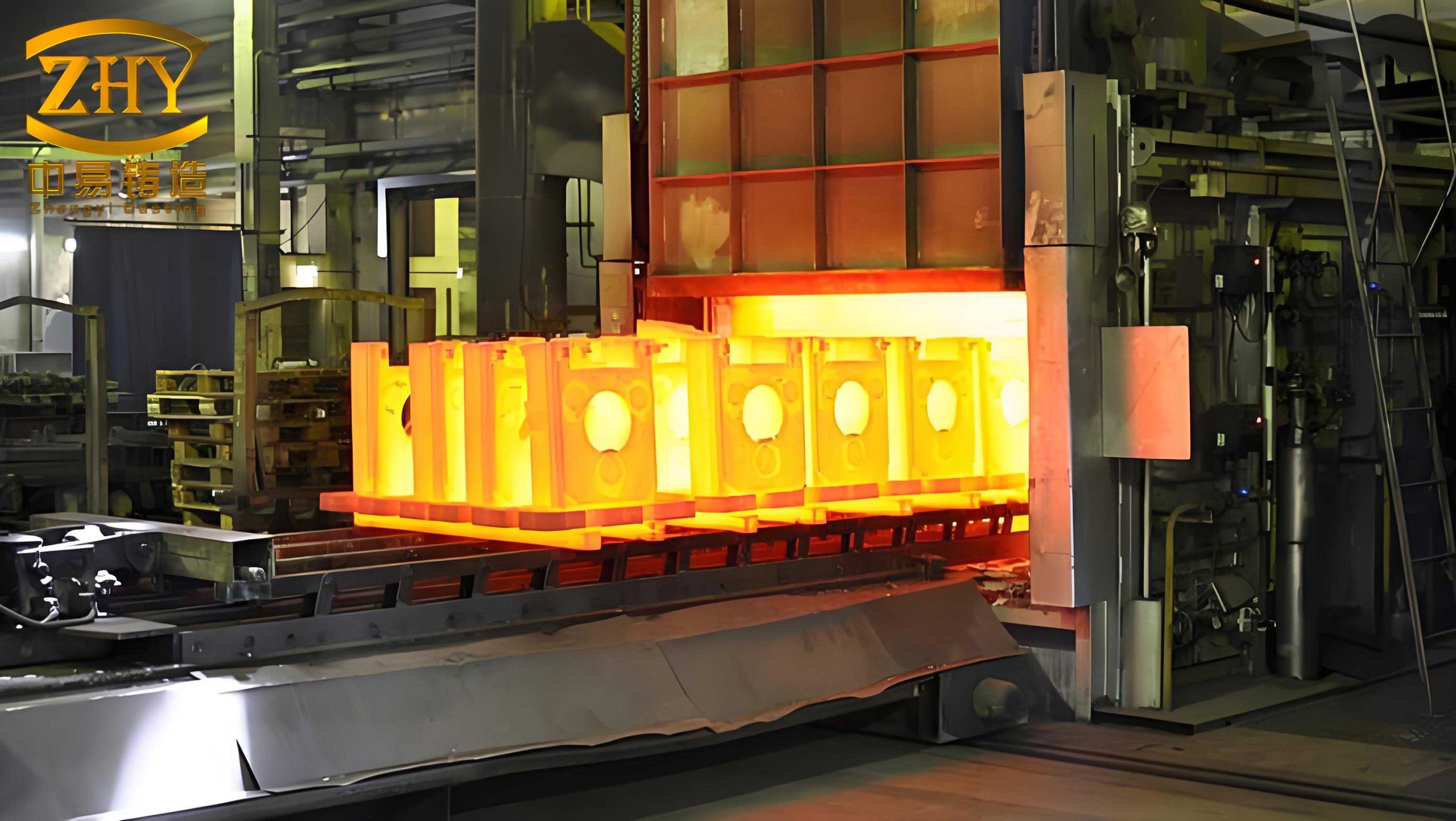
The image above illustrates typical manifestations of heat treatment defects, underscoring the importance of precise thermal management. In our process, by maintaining tight temperature and time tolerances, we avoided such defects, thereby achieving consistent microstructures. The graphite spheroidization, crucial for ductility, is particularly sensitive to heat treatment. Rare earth and magnesium additions promote spheroidization, but excessive temperatures during heat treatment can cause graphite degeneration, a severe heat treatment defect that impairs mechanical properties. Our compositional design, with controlled RE and Mg, coupled with the defined heat treatment cycle, preserved graphite integrity.
Further analysis of the data reveals correlations between composition, microstructure, and properties. For example, copper and manganese are pearlite promoters; higher contents generally increase strength but may reduce ductility if not balanced by proper heat treatment. Silicon enhances ferrite formation and solid solution strengthening. The optimal combination, as seen in Groups 1-8, resulted in a pearlite content range of 91–95%, graphite grades of 4–5, and spheroidization grades of 2–3. These narrow ranges indicate good process control, minimizing heat treatment defects that could cause scatter. To quantify the effect of heat treatment parameters on final properties, we can use response surface methodology or empirical equations. For instance, a multiple linear regression model for tensile strength $\sigma_t$ might take the form:
$$ \sigma_t = \beta_0 + \beta_1 T_N + \beta_2 t_N + \beta_3 T_T + \beta_4 t_T + \beta_5 [\text{Cu}] + \cdots $$
where $T_N$ and $t_N$ are normalizing temperature and time, $T_T$ and $t_T$ are tempering temperature and time, and $[\text{Cu}]$ is copper content. Such models help in optimizing processes to avoid heat treatment defects by identifying sensitive parameters.
In conclusion, our comprehensive study demonstrates that through meticulous control of the iron mold coated sand casting process and a two-stage heat treatment comprising normalizing at $(850 \pm 25)\,^\circ\text{C}$ for $(2 \pm 0.5)\,\text{h}$ followed by tempering at $(580 \pm 20)\,^\circ\text{C}$ for $(2 \pm 0.5)\,\text{h}$, ductile iron crankshafts with excellent comprehensive mechanical properties can be reliably produced. The tensile strengths all exceeded 885 MPa, elongations were above 5.1%, and impact energies surpassed 55 J. These outcomes were achieved by diligently avoiding heat treatment defects that commonly plague such components. Key microstructural features included pearlite contents of 91–95%, graphite grades of 4–5, and spheroidization grades of 2–3. The interplay between alloy design and thermal processing is delicate; any deviation can introduce heat treatment defects, degrading performance. Future work should focus on real-time monitoring during heat treatment to further mitigate heat treatment defects, perhaps using advanced sensors and adaptive control systems. Ultimately, this research provides a robust framework for manufacturing high-performance crankshafts, emphasizing that preventing heat treatment defects is paramount to ensuring reliability and longevity in demanding engine applications.