
In the mining industry, the central trough is a critical component of scraper conveyors, accounting for over 70% of the total mass and being the most frequently used and consumed part. Traditional manufacturing methods involve welding cast channel sides, middle plates, and base plates, which often lead to prolonged production cycles, poor wear resistance, and welding failures. To address these issues, our research focuses on adopting an integrated sand casting approach for the central trough. This method eliminates machining and welding processes, reduces manufacturing costs, and mitigates the drawbacks of traditional welded structures. This article analyzes the challenges of integral sand casting for the central trough and presents a detailed casting process design using ester-cured sodium silicate sand molding to achieve successful trial production.
The original structure of the central trough, with maximum dimensions of 750 mm × 1330 mm × 377 mm, was complex, featuring uneven wall thickness and multiple thermal nodes, which contributed to issues like local sand burning, cracks at transitions, and deformation of the middle and base plates. To improve castability, we modified the local structure as follows: (1) Simplified certain areas to reduce cracking risks and enhance feeding channels; (2) Reduced mass and minimized thermal nodes while maintaining strength; (3) Thickened transition zones to prevent casting cracks. These adjustments ensure better performance in sand casting applications.
For the casting material, we selected a modified ZG30MnSi steel alloy to meet the dual requirements of strength for the channel sides and wear resistance for the middle and base plates. The composition includes Si and Mn as primary alloying elements, with carbon content w(C) ≤ 0.35%, and the sum of silicon and manganese w(Si+Mn) ≤ 2.5%. Micro-alloying elements such as Re, B, Ti, Zr, and V were added to enhance strength and wear resistance. The carbon equivalent (CE) is controlled to ≤ 0.68% to ensure weldability and reparability, while maintaining adequate toughness and plasticity. The carbon equivalent can be calculated using the formula: $$ CE = C + \frac{Mn}{6} + \frac{Si}{24} $$ This formulation is optimized for sand casting processes to achieve a balance of properties.
| Element | Content (wt%) | Role in Sand Casting |
|---|---|---|
| C | ≤ 0.35 | Controls strength and weldability |
| Si | 0.5-1.0 | Enhances fluidity in sand casting molds |
| Mn | 1.0-1.5 | Improves hardenability and toughness |
| Re, B, Ti, Zr, V | Trace amounts | Refines grain structure in sand casting |
In terms of molding materials, we employed ester-hardened sodium silicate sand due to its excellent performance, dimensional accuracy, and surface quality, which are comparable to alkaline phenolic resin sand. Additionally, this sand casting method reduces tendencies for cracks and gas holes, emits no pungent gases, and allows for green recycling of used sand after dry regeneration and washing, making it environmentally friendly. The key parameters for the sand mixture in sand casting include: quartz sand temperature controlled at 10–35°C, modified sodium silicate addition of 2.0–3.0%, and organic ester curing agent added at 13–15% of the sodium silicate weight. The 24-hour tensile strength of the mold should be 0.2–0.5 MPa for the mold and 0.4–0.6 MPa for the core to meet quality standards in sand casting. To prevent sand burning, we applied chromite sand with a thickness of 30–40 mm in prone areas such as groove roots and thick sections, followed by ester-hardened sodium silicate sand molding. Before closing the mold, the surface was coated three times with alcohol-based zirconium powder paint.
| Parameter | Value | Importance in Sand Casting |
|---|---|---|
| Sand Temperature | 10–35°C | Ensures proper curing in sand casting molds |
| Sodium Silicate Addition | 2.0–3.0% | Provides binding strength for sand casting |
| Ester Curing Agent | 13–15% of silicate | Controls hardening rate in sand casting |
| Mold Tensile Strength (24h) | 0.2–0.5 MPa | Maintains mold integrity during sand casting |
| Core Tensile Strength (24h) | 0.4–0.6 MPa | Prevents core failure in sand casting |
For the riser design, we identified four thermal nodes at the dumbbell connection points of the channel ends. The riser face was set on the bottom surface of the central trough to facilitate feeding of the middle and base plates. Open risers and top risers were designed using the modulus method, ensuring the riser modulus M_riser exceeds the modulus of the casting section M_casting by the relation: $$ M_{riser} = 1.2 M_{casting} $$ Considering the sandbox specifications and tilting pouring issues, we designed four risers with dimensions ø240 mm × 400 mm. Solidification simulation using casting CAE software confirmed that these risers meet feeding requirements, though potential shrinkage porosity in the dumbbell socket areas was noted and requires further validation.
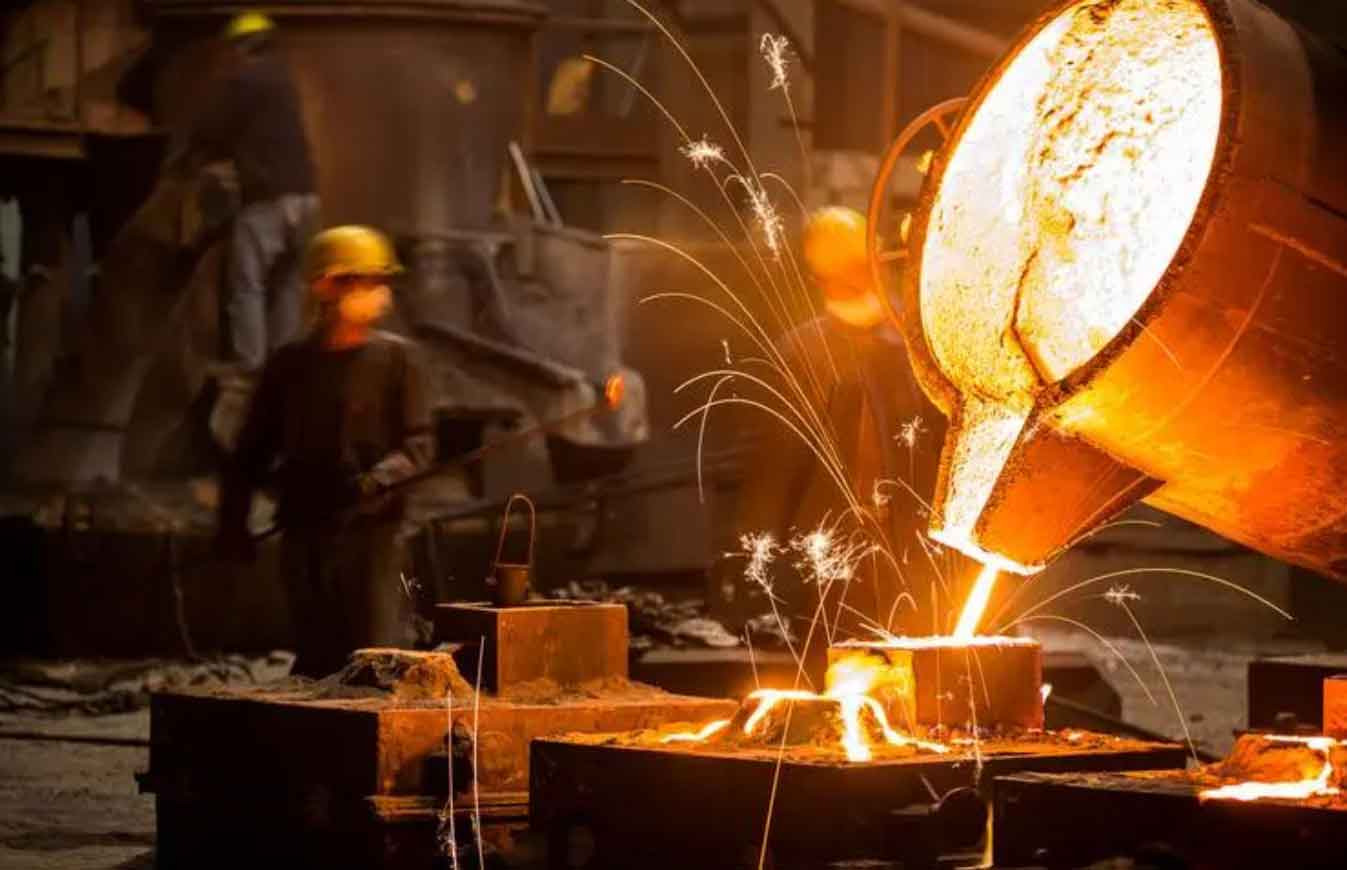
The gating system was constructed using refractory ceramic tubes to prevent sand erosion. A vertical sprue with ø80 mm tubes and two horizontal runners with ø60 mm tubes were arranged to inject molten metal from the bottom of the convex end face. To avoid sand expansion cracks caused by thermal radiation on large planar structures like the middle and base plates, the mold was placed on an inclined platform with the concave end raised by 8° for tilting pouring. The pouring temperature was maintained at 1560–1590°C to prevent cold shut defects. The fluid flow in sand casting can be described by the Bernoulli equation for in-gate velocity: $$ v = \sqrt{2gH} $$ where v is the velocity, g is gravity, and H is the metallostatic head. This ensures proper filling in sand casting molds.
The heat treatment process involved using a car-bottom electric furnace. First, normalizing pretreatment was conducted at 920°C for 240 minutes, followed by air cooling. Then, quenching was performed at 920°C for 240 minutes, with cooling in water at 15–30°C. Finally, tempering was carried out at 560–600°C for 360 minutes, followed by air cooling. The tempering parameter can be expressed as: $$ P = T(\log t + 20) \times 10^{-3} $$ where T is temperature in Kelvin and t is time in hours, to optimize the microstructure and mechanical properties for sand casting components.
| Stage | Temperature (°C) | Time (min) | Cooling Method | Purpose in Sand Casting |
|---|---|---|---|---|
| Normalizing | 920 | 240 | Air | Refines grain structure after sand casting |
| Quenching | 920 | 240 | Water (15-30°C) | Enhances hardness in sand casting part |
| Tempering | 560-600 | 360 | Air | Relieves stresses from sand casting |
Through production trials and inspections including sectioning, dimensional checks, and performance tests, we identified main issues such as local deformation, cracks, and insufficient wear resistance. Improvements included: (1) Adding three 16 mm × 50 mm ribs at the center between the middle and base plates to prevent bulging; (2) Installing 10 mm thick triangular ribs on each side at the junction of the base plate and channel sides to avoid cracks; (3) Placing ample chromite sand in the dumbbell socket areas to prevent shrinkage porosity through chilling effects; (4) Applying wear-resistant overlay welding on the chain passage areas of the middle plate to locally enhance durability. These measures refine the sand casting process, ensuring that the final sand cast central trough meets all dimensional, mechanical, and quality requirements.
In conclusion, our study demonstrates that the integral sand casting method using ester-hardened sodium silicate sand offers an economical and environmentally friendly solution for producing central troughs. By overcoming challenges such as structural complexity and thermal management, this sand casting approach provides a viable alternative to traditional welded structures, enabling technical upgrades in mining equipment manufacturing. The success of this sand casting process underscores its potential for broader applications in heavy-duty components.