
In the context of the global “dual carbon” strategy and the escalating demand for lightweight, high-performance components in advanced transportation and energy sectors, Austempered Ductile Iron (ADI) has emerged as a pivotal engineering material. Characterized by a unique microstructure of bainitic ferrite (acicular ferrite) and carbon-enriched retained austenite, ADI offers an exceptional combination of high strength, good ductility, and wear resistance, making it ideal for critical applications such as high-speed train brake discs, heavy-duty gears, and automotive components. The cornerstone of this superior performance lies in the precisely controlled heat treatment of spheroidal graphite cast iron, involving austenitization followed by isothermal quenching (austempering) in a bainitic transformation range. However, the traditional, empirically-driven development of ADI faces significant bottlenecks. The final microstructure and mechanical properties result from a complex, nonlinear interplay between multiple alloying elements (e.g., C, Si, Mn, Cu, Ni) and process parameters (primarily austempering temperature and time). This strong parameter coupling makes systematic optimization through conventional trial-and-error methods both time-consuming and economically prohibitive.
To overcome these challenges, a paradigm shift towards computational materials design is essential. The CALPHAD (CALculation of PHAse Diagrams) method, integrated with high-throughput computational frameworks, provides a powerful tool for such tasks. By leveraging assessed thermodynamic and kinetic databases, CALPHAD enables the prediction of phase equilibria and transformation behavior in multi-component systems with the accuracy required for engineering applications. This work employs a CALPHAD-based high-throughput simulation strategy to systematically map the compositional and processing landscape of ADI. The primary objectives are to: (1) construct and validate a three-stage phase transformation model capturing the key microstructural evolution steps during ADI processing; (2) perform thousands of virtual experiments to quantify the influence of composition and austempering temperature on the final phase fractions; and (3) establish intelligent optimization criteria to identify the most promising alloy and process combinations for superior mechanical performance, thereby paving a new, computation-driven path for the development of next-generation spheroidal graphite cast iron.
The Three-Stage Phase Transformation Model
The heat treatment of spheroidal graphite cast iron to produce ADI is conceptually modeled as a sequence of three distinct stages, each governed by specific thermodynamic and kinetic principles. A high-throughput computational workflow was developed using the Thermo-Calc software and its TC-Python interface to automate calculations across this sequence for vast arrays of input parameters.
- Austenitization: The as-cast material is heated to a temperature typically between 840°C and 950°C and held for 1-2 hours. This stage aims to achieve a homogeneous, carbon-saturated austenitic matrix. In this model, it is assumed that equilibrium is attained. For a given composition, a standard equilibrium calculation at the austenitizing temperature (e.g., 900°C) determines the fractions of austenite and graphite, as well as the carbon content in the austenite ($C_{\gamma}$). This provides the initial state for the subsequent transformation.
- Isothermal Quenching (Austempering): The component is rapidly cooled to an isothermal holding temperature ($AT$) in the range of 230°C to 400°C to avoid pearlite formation. During the isothermal hold, part of the austenite transforms to bainitic ferrite via a displacive mechanism. A critical feature of this transformation is the rejection of carbon into the surrounding untransformed austenite. The reaction is assumed to cease when the carbon concentration in the residual austenite reaches the $T_0$ curve boundary ($C_0$), the theoretical limit for diffusionless transformation. The model calculates the amount of bainitic ferrite formed, the fraction and the significantly enriched carbon content ($C_{RA}$) of the remaining austenite at the specified $AT$.
- Cooling to Room Temperature: After the austempering hold, the component is cooled to room temperature. The stability of the carbon-enriched retained austenite determines whether it remains or partially transforms to martensite. Using the calculated carbon content $C_{RA}$ and the nominal composition of the austenite, the model assesses its martensite start temperature ($M_s$). If the $M_s$ is above room temperature, a portion of the austenite transforms to martensite. The final microstructure thus comprises graphite, bainitic ferrite, retained austenite, and potentially martensite.
The automated workflow for high-throughput screening is illustrated below:
[Input: Composition, Aust. Temp (T_aus), Austempering Temp (AT)]
        |
        V
Stage 1: Austenitization at T_aus (Equilibrium Calc)
        |-> Output: Graphite fraction (f_G), Austenite fraction (f_γ), C in γ (C_γ)
        |
        V
Stage 2: Isothermal Quenching at AT (Property Calc)
        |-> Output: Bainitic Ferrite fraction (f_BF), Retained Austenite fraction (f_RA), C in RA (C_RA)
        |
        V
Stage 3: Cooling (Ms Calculation & Martensite Estimation)
        |-> Output: Martensite fraction (f_M), Final f_RA
        |
        V
[Output: Complete Phase Fractions for the (Composition, AT) pair]
High-Throughput Calculation Results and Analysis
An extensive computational campaign was executed to explore the multi-dimensional parameter space. The initial focus was on the primary elements C, Si, and Mn, with their ranges and the austempering temperatures detailed in Table 1. A total of 864 distinct (Composition, AT) combinations were calculated.
| Variable | Min (wt.%) | Max (wt.%) | Step (wt.%) | Austempering Temp. (AT) |
|---|---|---|---|---|
| C | 3.0 | 4.0 | 0.2 | 230, 260, 290, 320, 350, 370, 390, 400 °C |
| Si | 2.0 | 3.0 | 0.2 | |
| Mn | 0.2 | 0.6 | 0.2 | |
| Count | 6 × 6 × 3 × 8 = 864 combinations | |||
A correlation analysis (Figure 2 in the original work) unequivocally identified the austempering temperature ($AT$) as the most dominant factor influencing all microstructural features, far outweighing the individual effects of the alloying elements within the studied ranges. The phase fractions of bainitic ferrite, retained austenite, and its carbon content showed a positive correlation with $AT$, while martensite content exhibited a strong negative correlation. The influence of composition was found to be highly dependent on the $AT$ regime. To elucidate this, results from two characteristic temperatures, 290°C (lower $AT$) and 370°C (upper $AT$), are compared in detail.
Effect of C, Si, and Mn at Low (290°C) and High (370°C) Austempering Temperatures
The following tables summarize the key trends and Pearson correlation coefficients for the major phases with respect to C, Si, and Mn at these two temperatures.
| Microstructural Feature | Correlation with C | Correlation with Si | Correlation with Mn | Dominant Trend |
|---|---|---|---|---|
| Graphite (f_G) | +0.99 | +0.16 | -0.02 | Controlled almost exclusively by C content. |
| Bainitic Ferrite (f_BF) | -0.09 | -0.85 | -0.68 | Decreases with increasing Si and Mn. |
| Martensite (f_M) | +0.02 | +0.89 | +0.66 | Increases with increasing Si and Mn. |
| Retained Austenite (f_RA) | +0.07 | -0.79 | -0.60 | Decreases with increasing Si and Mn. |
| C in RA (C_RA) | -0.01 | -0.80 | -0.65 | Decreases with increasing Si and Mn. |
| Microstructural Feature | Correlation with C | Correlation with Si | Correlation with Mn | Dominant Trend |
|---|---|---|---|---|
| Graphite (f_G) | +0.99 | +0.16 | -0.02 | Controlled almost exclusively by C content. |
| Bainitic Ferrite (f_BF) | +0.02 | +0.01 | -0.99 | Decreases sharply with Mn; Si has negligible effect. |
| Martensite (f_M) | -0.05 | -0.96 | -0.14 | Decreases sharply with increasing Si. |
| Retained Austenite (f_RA) | +0.03 | +0.94 | +0.34 | Increases sharply with increasing Si. |
| C in RA (C_RA) | -0.05 | +0.06 | -1.00 | Decreases sharply with Mn; almost perfect negative correlation. |
The analysis reveals a profound shift in mechanism. At low $AT$ (290°C), both Si and Mn strongly inhibit the bainitic transformation, leading to less bainitic ferrite, less but lower-carbon retained austenite, and consequently more unstable austenite that transforms to martensite upon cooling. At high $AT$ (370°C), Si plays a drastically different role: it significantly stabilizes austenite against martensite formation (reducing $f_M$) and increases the amount of retained austenite ($f_RA$). Mn, on the other hand, becomes the primary inhibitor of bainite formation and drastically reduces the carbon enrichment ($C_RA$) of the untransformed austenite.
Effect of Cu and Ni Additions
Subsequently, the effects of the common alloying elements Cu and Ni were investigated for five fixed base compositions of C, Si, and Mn. The calculation matrix involved 480 combinations (Table 4).
| Variable | Min (wt.%) | Max (wt.%) | Step (wt.%) | Base Compositions (C-Si-Mn, wt.%) | Austempering Temp. (AT) |
|---|---|---|---|---|---|
| Cu | 0.5 | 1.5 | 0.5 | 3.6-2.6-0.6, 3.6-2.6-0.4, 3.6-2.6-0.2, 3.6-2.8-0.2, 3.8-2.2-0.2 |
Same 8 temperatures as Table 1 |
| Ni | 0.0 | 2.0 | 0.5 | ||
| Count | 3 × 4 × 8 × 5 = 480 combinations | ||||
The influence of Cu and Ni is more subtle and secondary compared to C, Si, Mn, and $AT$, but notable trends were observed and are summarized in Table 5 for a representative low $AT$ of 290°C.
| Element | Effect on Bainitic Ferrite (f_BF) | Effect on Martensite (f_M) | Effect on Retained Austenite (f_RA, C_RA) | Relative Potency vs. other element |
|---|---|---|---|---|
| Cu | Tends to increase slightly. | Tends to decrease. | Complex, often slight increase in f_RA. | Stronger effect on reducing f_M than Ni. |
| Ni | Tends to decrease. | Tends to increase. | Tends to decrease both f_RA and C_RA. | Stronger effect on graphite, f_BF, and C_RA than Cu. |
These results underscore the complex coupling between alloying elements and processing temperature. Ni generally exhibited a stronger correlation with key microstructural parameters than Cu under the studied conditions.
Microstructural Evolution and Key Feature Parameters
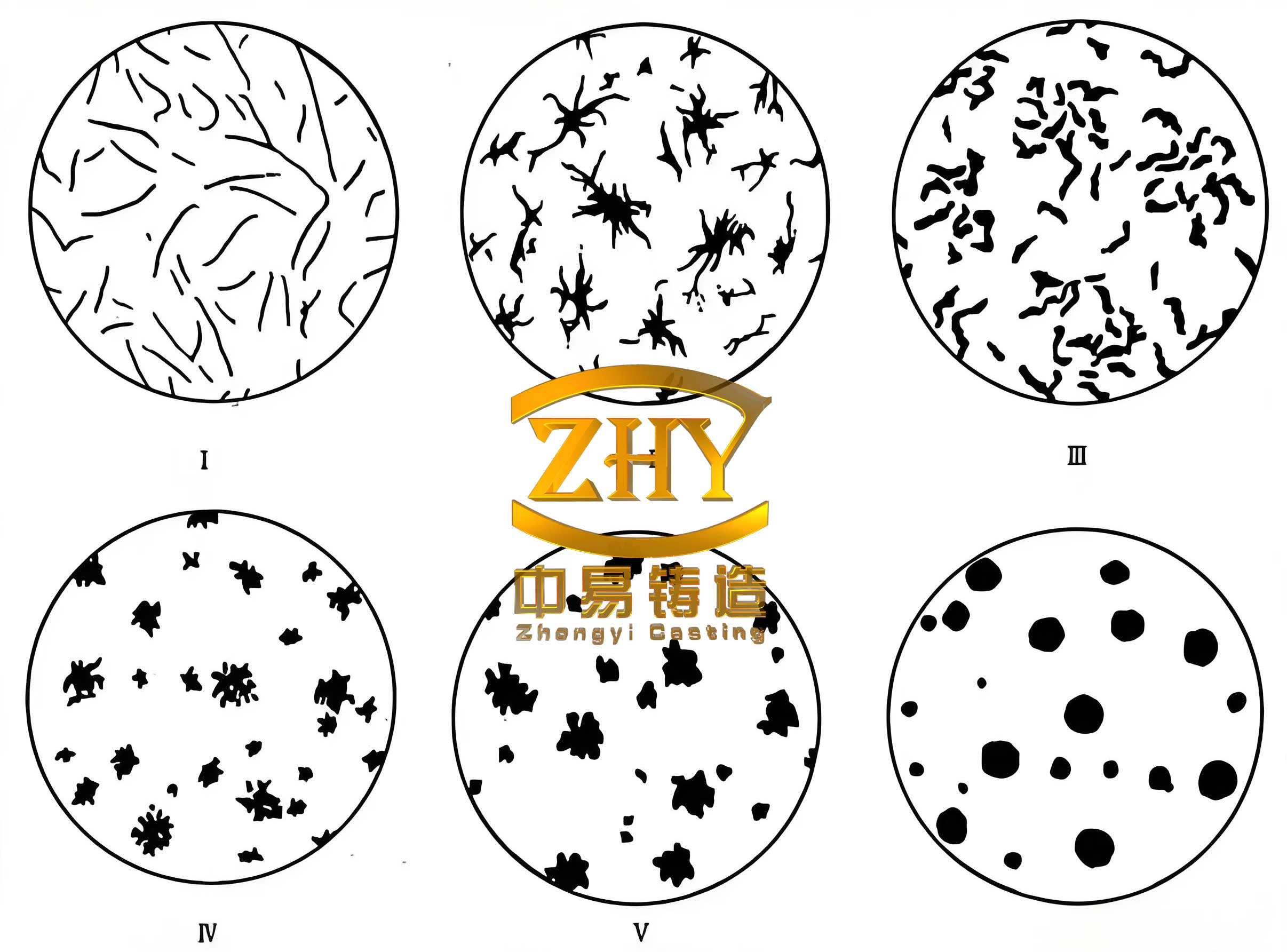
The final microstructure of high-performance spheroidal graphite cast iron after austempering is a critical determinant of its properties. Based on physical metallurgy principles, three key feature parameters were extracted from the high-throughput dataset to serve as proxies for assessing potential mechanical performance.
- Carbon Equivalent (CE): Governs the castability and graphite formation quality of the initial iron. An optimum near the eutectic point (~4.5) is desired to minimize casting defects like shrinkage porosity or graphite flotation. The simplified equation used is:
$$CE = C + \frac{1}{3}Si – 0.03Mn$$
A target value $CE_{target} = 4.5$ was set. Therefore, the first feature parameter $F_1$ measures the deviation:
$$F_1 = |CE – 4.5|$$
Lower $F_1$ is better. - Retained Austenite Stability: The stability of the carbon-enriched retained austenite is paramount for achieving the Transformation Induced Plasticity (TRIP) effect, which enhances ductility and toughness. Stability can be qualitatively assessed by the product of the retained austenite volume fraction ($f_{RA}$) and its carbon content ($C_{RA}$). A higher product indicates greater stability. Thus, the second feature parameter $F_2$ is defined as:
$$F_2 = \frac{1}{f_{RA} \times C_{RA}}$$
Lower $F_2$ indicates higher austenite stability, which is better. - Martensite Content ($f_M$): The presence of brittle, untempered martensite is generally detrimental to ductility and impact toughness. While it may increase strength, for a balanced performance, its content should be minimized. Therefore, the third feature parameter is simply:
$$F_3 = f_M$$
Lower $F_3$ is better.
To enable a unified optimization across these three distinct objectives, the individual parameters were normalized and combined into a single Comprehensive Criterion ($CC$):
$$CC = \sqrt{(F_1^*)^2 + (F_2^*)^2 + (F_3^*)^2}$$
where $F_i^*$ represents the normalized value of $F_i$. A lower $CC$ value signifies a composition and process combination that is closer to the ideal target: a eutectic carbon equivalent, highly stable retained austenite, and minimal martensite.
Composition and Process Optimization
Partial correlation analysis of the $CC$ with respect to all input variables was performed. The analysis confirmed that the austempering temperature ($AT$) was the most influential factor on the comprehensive criterion, followed by the carbon content. This highlights the overriding importance of process control in ADI manufacturing. By sorting the entire high-throughput dataset (comprising 864 + 480 = 1344 virtual experiments) based on the $CC$ value, the optimal combination identified was:
Optimal Composition: Fe – 3.6C – 2.6Si – 0.6Mn – 1.0Ni – 0.5Cu (wt.%)
Optimal Austempering Temperature: 320°C
This composition and process window are predicted to yield a microstructure with a near-eutectic carbon equivalent, a favorable amount of stable retained austenite, and negligible martensite formation upon cooling from the austempering temperature. It is noteworthy that this computationally-derived optimum aligns closely with industrial practices and literature reports for high-strength ADI grades, validating the predictive capability of the CALPHAD high-throughput approach for spheroidal graphite cast iron.
Conclusion
This study successfully demonstrates a computational framework for the efficient design of Austempered Ductile Iron. By integrating a physically-based three-stage phase transformation model with high-throughput CALPHAD calculations, the complex relationships between composition, austempering temperature, and final microstructure were systematically deciphered. The key findings are:
- The austempering temperature is the dominant factor controlling the phase fractions of bainitic ferrite, retained austenite, and martensite in spheroidal graphite cast iron, with its influence surpassing that of individual alloying elements within typical ranges.
- The effects of alloying elements are highly temperature-dependent:
- Carbon primarily controls the graphite volume fraction.
- Silicon and manganese strongly inhibit the bainitic transformation at low temperatures (~290°C), promoting martensite formation. At high temperatures (~370°C), silicon acts as a potent austenite stabilizer, while manganese severely limits carbon enrichment in austenite.
- The influences of copper and nickel are more secondary, with nickel showing a generally stronger correlation with microstructural features than copper under the conditions studied.
- Intelligent optimization, guided by the defined feature parameters (Carbon Equivalent deviation, Retained Austenite Stability inverse, and Martensite Content) and a unified Comprehensive Criterion ($CC$), effectively identified an optimal combination: Fe-3.6C-2.6Si-0.6Mn-1Ni-0.5Cu with an austempering temperature of 320°C.
This work establishes a robust, calculation-driven pathway for accelerating the development of high-performance ADI, moving beyond empirical guesswork. The methodology can be extended to incorporate kinetic models for transformation time and further linked to property prediction models, paving the way for full-scale Integrated Computational Materials Engineering (ICME) of advanced cast irons.