
In the realm of metalworking, sand casting remains one of the most versatile and widely used manufacturing processes, particularly for producing large, complex components. As an engineer deeply involved in foundry technology, I have witnessed firsthand the challenges inherent in traditional sand casting methodologies. Historically, the design of sand casting processes relied heavily on the empirical knowledge and iterative trial-and-error approaches of skilled technicians. This often involved numerous prototype iterations and physical testing, leading to prolonged development cycles, significant material waste, and increased costs. However, the advent of computational tools has revolutionized this field, enabling precise virtual prototyping and optimization. In this article, I will delve into the application of advanced numerical simulation software for designing and optimizing sand casting processes, with a focus on gravity-fed sand casting systems. Through a detailed case study, I aim to demonstrate how computer simulations can predict defects, guide process improvements, and ultimately enhance the quality and efficiency of sand casting production.
The core principle behind computer simulation in sand casting lies in solving the fundamental physical equations that govern the flow and solidification of molten metal within a sand mold. In gravity sand casting, molten metal is poured into a mold cavity made of compacted sand, where it flows under the influence of gravity, fills the cavity, and subsequently solidifies. This process involves complex phenomena, including fluid dynamics with free surfaces, heat transfer between the metal and the mold, and phase changes with latent heat release. To accurately model these phenomena, simulation software like ProCAST, which I have extensively used, relies on coupled solutions of the conservation laws: mass, momentum, and energy. The governing equations are as follows:
Mass conservation (continuity equation):
$$\frac{\partial \rho}{\partial t} + \nabla \cdot (\rho \mathbf{v}) = 0$$
where $\rho$ is density, $t$ is time, and $\mathbf{v}$ is velocity vector.
Momentum conservation (Navier-Stokes equations):
$$\rho \left( \frac{\partial \mathbf{v}}{\partial t} + \mathbf{v} \cdot \nabla \mathbf{v} \right) = -\nabla p + \mu \nabla^2 \mathbf{v} + \rho \mathbf{g}$$
where $p$ is pressure, $\mu$ is dynamic viscosity, and $\mathbf{g}$ is gravitational acceleration.
Energy conservation (Fourier equation with phase change):
$$\rho c_p \frac{\partial T}{\partial t} = \nabla \cdot (k \nabla T) + \dot{Q}_L$$
where $c_p$ is specific heat capacity, $T$ is temperature, $k$ is thermal conductivity, and $\dot{Q}_L$ represents latent heat source term due to solidification.
These equations form the mathematical backbone for simulating the filling and solidification stages in sand casting. The software discretizes the geometry using finite element or finite volume methods, solving these equations iteratively to predict velocity fields, temperature distributions, and potential defect formations. One critical aspect in sand casting simulation is the prediction of shrinkage defects, such as porosity and cavities, which commonly arise due to inadequate feeding during solidification. A widely used criterion for this in steel castings is the Niyama criterion, expressed as:
$$M = \frac{G}{\sqrt{R_C}}$$
where $M$ is the Niyama coefficient, $G$ is the temperature gradient (in K/m), and $R_C$ is the cooling rate (in K/s). A threshold value of $M \geq 1$ is often considered indicative of sound regions, whereas values below this suggest susceptibility to shrinkage porosity. This criterion is integral to defect analysis in sand casting simulations.
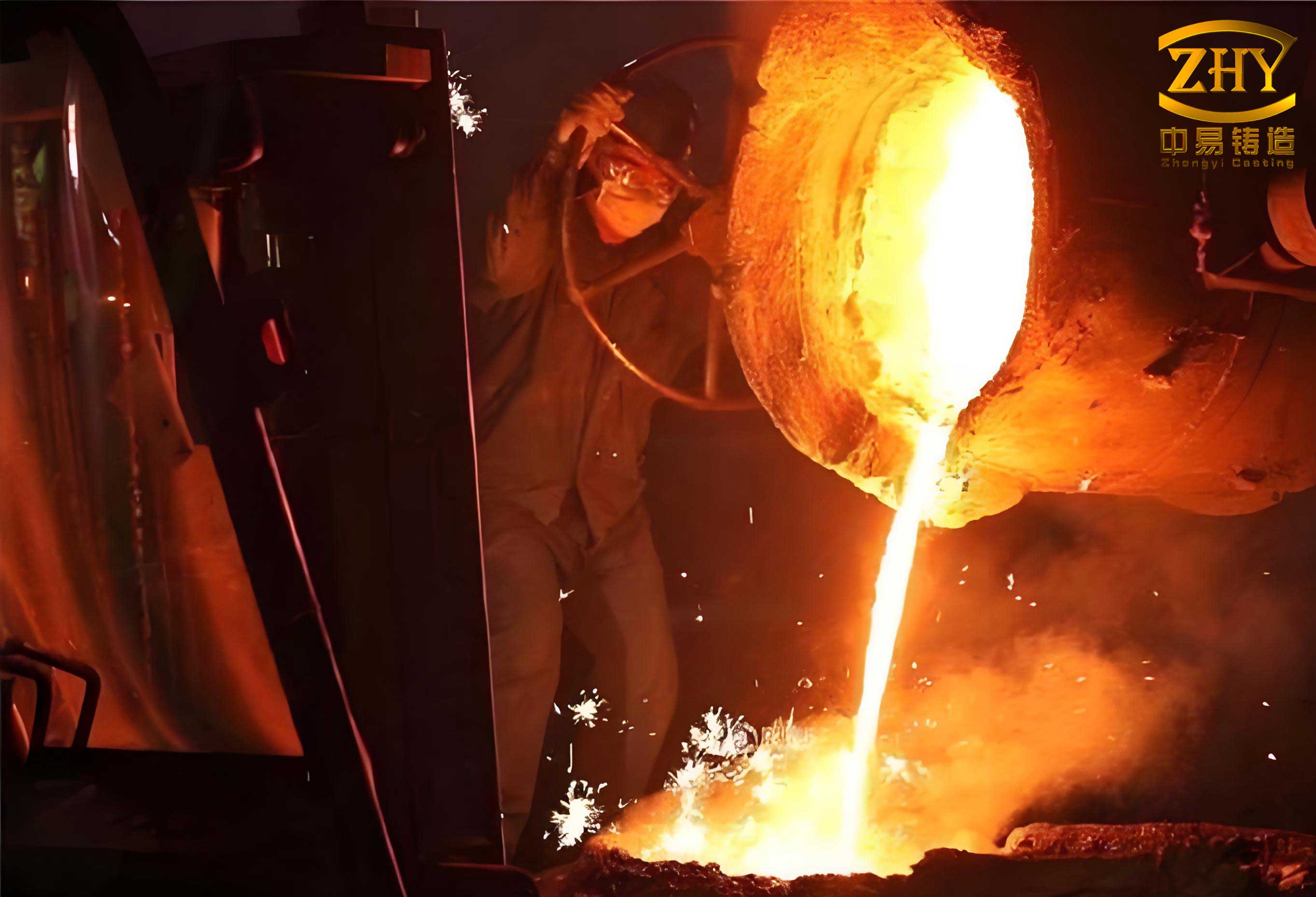
To illustrate the practical application of these principles, I conducted a comprehensive simulation study on a large valve body component produced via sand casting. The component, weighing approximately 7.12 metric tons, was made of a heat-resistant cast steel alloy. The chemical composition of the alloy is crucial for determining material properties in the simulation, such as thermal conductivity and solidification behavior. The composition is summarized in Table 1.
| Element | C | Si | Mn | Cr | Ni | S | P | Fe |
|---|---|---|---|---|---|---|---|---|
| Content (wt%) | 0.35 | 2.00 | 2.00 | 26.00 | 12.00 | 0.04 | 0.04 | Balance |
The first step in the sand casting process design was to create a three-dimensional model of the valve body using CAD software, which was then exported in STL format for simulation. In sand casting, the orientation of the part within the mold significantly influences heat distribution and defect formation. I evaluated two distinct orientation schemes, as illustrated conceptually below. Scheme 1 positioned the part vertically, while Scheme 2 placed it horizontally. Through preliminary thermal analysis, I found that Scheme 2 resulted in more concentrated hot spots, simplifying the feeding system design. Therefore, I selected Scheme 2 for further simulation and optimization.
Subsequently, I performed a solidification simulation on the oriented model to identify hot spots and shrinkage areas. The results indicated that significant shrinkage cavities were predicted at two locations along the upper edge of the valve body. The volumetric analysis estimated shrinkage volumes of approximately 64,897.9 mm³ and 43,786,386.5 mm³ at these sites, necessitating the design of effective feeding systems, namely risers, to compensate for solidification shrinkage. In sand casting, risers are essential reservoirs of molten metal that feed the casting as it solidifies. Based on the modulus method, which accounts for the geometry and cooling characteristics, I designed two risers: an elliptical side riser and a cylindrical top riser. The design parameters, considering a shrinkage allowance of 5%, are summarized in Table 2.
| Riser Type | Diameter (mm) | Length (mm) | Height (mm) | Modulus (mm) |
|---|---|---|---|---|
| Elliptical Side Riser | 510 | 760 | 640 | 102.26 |
| Cylindrical Top Riser | 640 | 740 | 640 | 104.32 |
Additionally, the gating system for this sand casting process was designed to ensure smooth and controlled filling. It consisted of two cylindrical sprue with a diameter of 70 mm, eight cylindrical ingates with a diameter of 50 mm, and four trapezoidal runners with dimensions of 50 mm top width, 55 mm bottom width, and 45 mm height. The complete casting assembly, including the part, risers, and gating, was then set up in ProCAST for a full-scale simulation of the pouring and solidification processes.
The simulation results provided profound insights into the behavior of the sand casting process. The temperature distribution during filling showed that the molten metal flowed uniformly through the gating system, filling the cavity without excessive turbulence or air entrapment. However, the solidification phase revealed critical defect patterns. As depicted in the defect analysis output, porosity defects were predominantly located within the risers, which is expected as risers are designed to solidify last and trap shrinkage. However, scattered porosity was also predicted along the bottom circumferential region of the valve body. These defects arose due to isolated hot spots that formed localized liquid pools, which solidified without adequate feeding, leading to microporosity. The Niyama criterion map confirmed these areas with low M values, indicating a high risk of shrinkage porosity.
To mitigate these defects, I implemented process optimization strategies specific to sand casting. The primary approach involved the use of chills—metal inserts placed in the sand mold to accelerate cooling in targeted regions. By adding chills at the bottom circumferential zones where porosity was predicted, I aimed to enhance the thermal gradient and cooling rate, thereby promoting directional solidification towards the risers. The modified mold design incorporated several chills around the valve body’s base. I then re-ran the simulation with this updated configuration.
The results from the optimized sand casting process were markedly improved. The solidification sequence showed a more progressive pattern, with the chills effectively dissipating heat and eliminating the isolated hot spots. The porosity prediction map indicated a significant reduction in defects at the bottom regions, with most shrinkage now confined to the risers, as intended. The Niyama values in previously critical areas increased above the threshold, confirming soundness. This optimization underscores the power of computer simulation in sand casting to preemptively address issues that would otherwise require costly physical trials.
Beyond this case study, the integration of simulation into sand casting workflows offers broader benefits. For instance, sensitivity analyses can be conducted to evaluate the impact of various parameters, such as pouring temperature, mold material properties, and alloy composition, on casting quality. Table 3 summarizes key process parameters and their typical ranges in sand casting, which can be explored in simulation studies.
| Parameter | Typical Range | Influence on Casting |
|---|---|---|
| Pouring Temperature | 1450-1600°C (for steels) | Affects fluidity, heat transfer, and defect formation. |
| Mold Sand Permeability | 50-150 AFS units | Impacts gas escape and cooling rates. |
| Riser Size | Based on modulus calculations | Determines feeding efficiency and yield. |
| Chill Design | Varies with geometry | Controls local cooling and solidification direction. |
Furthermore, advanced simulation techniques in sand casting can incorporate microstructural modeling to predict grain size and mechanical properties, adding another layer of optimization. For example, the cooling rate $R_C$ is directly linked to secondary dendrite arm spacing (SDAS), which influences tensile strength. A simplified relationship can be expressed as:
$$\text{SDAS} = a \cdot R_C^{-b}$$
where $a$ and $b$ are material constants. Such models enable foundries to tailor sand casting processes for enhanced performance.
In reflection, the journey from traditional sand casting methods to computer-aided design represents a paradigm shift. The ability to visualize and quantify phenomena like metal flow, temperature gradients, and defect formation in a virtual environment drastically reduces reliance on physical prototypes. In my experience, implementing simulation for sand casting projects has consistently led to shorter development times—often by 30-50%—and improved first-pass yield rates. Moreover, it fosters a deeper understanding of process variables, empowering engineers to make informed decisions.
However, the efficacy of sand casting simulation hinges on accurate input data, including material properties, boundary conditions, and geometric details. Calibration with experimental results is essential to validate models. For instance, thermocouple data from actual sand casting trials can be used to refine heat transfer coefficients at the metal-mold interface. The interfacial heat transfer coefficient $h$ (in W/m²·K) is a critical parameter modeled as:
$$q = h (T_{\text{metal}} – T_{\text{mold}})$$
where $q$ is heat flux. Accurate determination of $h$ through inverse modeling enhances simulation fidelity.
Looking ahead, the convergence of simulation with emerging technologies like artificial intelligence and additive manufacturing holds promise for further advancing sand casting. AI algorithms could automate optimization, suggesting ideal gating and riser designs based on historical data. Additive manufacturing of sand molds allows for complex geometries that were previously impractical, and simulation can verify their feasibility. The synergy of these tools will continue to elevate sand casting as a precise and efficient manufacturing process.
In conclusion, computer-aided design and simulation have become indispensable in modern sand casting. Through the detailed case study presented, I have demonstrated how numerical tools like ProCAST can model the intricacies of gravity sand casting, from fluid flow and heat transfer to defect prediction. By identifying shrinkage porosity via the Niyama criterion and optimizing the process with chills, simulation enables the production of high-integrity castings with minimal trial-and-error. As foundries increasingly adopt these digital approaches, sand casting will continue to evolve, offering enhanced quality, sustainability, and competitiveness in the manufacturing landscape. The journey from virtual analysis to physical realization epitomizes the transformative power of technology in traditional crafts like sand casting.