
In today’s highly competitive market for casting products, the relentless rise in raw material prices has placed immense pressure on foundries, particularly those specializing in manganese steel casting foundry operations. As a practitioner in this field, I have observed that low-end product prices often decline despite increasing costs, threatening the survival of many enterprises. Therefore, effective cost management has become a critical focus for ensuring profitability and sustainability. Through extensive experience in manganese steel casting foundry processes, I believe that cost control must be approached systematically, primarily through stringent raw material management and the adoption of optimized production techniques. This article delves into these strategies, emphasizing practical measures that can significantly reduce expenses while maintaining high-quality standards in manganese steel casting foundry outputs. By sharing insights from real-world applications, I aim to provide a comprehensive guide for foundries seeking to enhance their cost-efficiency in this challenging environment.
The foundation of cost control in any manganese steel casting foundry lies in managing raw materials, which typically account for approximately 65% of total production costs. For instance, in a foundry producing 8,000 tons of castings annually, raw material expenses can reach around 36 million currency units. A mere 1% reduction in procurement costs could save up to 360,000 currency units, underscoring the importance of strategic sourcing. From my perspective, the first step is to establish a robust procurement framework that leverages market intelligence and diverse supply channels. In our manganese steel casting foundry, we implemented a centralized purchasing system combined with competitive bidding, inviting at least four suppliers for each tender to ensure transparency and cost-effectiveness. This approach has yielded substantial savings; for example, we previously sourced magnesium sand powder alcohol-based coatings from a supplier at 6,900 currency units per ton, but after market research and bidding, we switched to a vendor offering the same quality at 4,500 currency units per ton. Overall, such measures have reduced our procurement costs by 3–5% annually, translating to savings exceeding one million currency units. This experience highlights how proactive procurement strategies are essential for a manganese steel casting foundry to mitigate price volatility and maintain competitiveness.
Beyond procurement, effective usage management of materials is equally crucial in a manganese steel casting foundry. We introduced a detailed cost accounting system where expenses are broken down by product type and allocated to specific workshops and teams. Each team is assigned consumption targets for various materials, with performance directly linked to employee incentives. This creates a culture of cost consciousness, encouraging workers to minimize waste and optimize resource utilization. For example, in our steel casting workshop, we implemented monthly cost assessments for teams involved in manganese steel casting foundry production. The table below illustrates a cost performance evaluation for a melting team over one month, demonstrating how savings are quantified and rewarded.
| Material Name | Unit Price (currency units/kg) | Standard Consumption (kg/ton of steel) | Standard Cost (currency units/ton) | Actual Consumption (kg/ton of steel) | Actual Cost (currency units/ton) | Cost Variance (currency units) | Bonus Base (currency units) | Awarded Bonus (currency units) |
|---|---|---|---|---|---|---|---|---|
| Medium Carbon Ferromanganese | 8 | 50 | 400 | 43.57 | 348.56 | 51.44 | 10.29 | 2.06 |
| High Carbon Ferromanganese | 6 | 115 | 690 | 119.29 | 715.74 | -25.74 | -5.15 | -1.03 |
| 75% Ferrosilicon | 4.5 | 4 | 18 | 2.98 | 13.41 | 4.59 | 0.92 | 0.18 |
| Aluminum Blocks | 22 | 1 | 22 | 1.07 | 23.54 | -1.54 | -0.31 | -0.06 |
| Electrodes | 9 | 6 | 54 | 6.57 | 59.13 | -5.13 | -1.03 | -0.21 |
| Magnesium Sand | 0.9 | 40 | 36 | 40.95 | 36.86 | -0.86 | -0.17 | -0.03 |
| Lime | 0.15 | 60 | 9 | 57.14 | 8.57 | 0.43 | 0.09 | 0.02 |
| Fluorspar | 0.5 | 40 | 20 | 39.29 | 19.65 | 0.35 | 0.07 | 0.01 |
| Graphite Powder | 1.02 | 6 | 6.12 | 5.71 | 5.82 | 0.30 | 0.06 | 0.01 |
| Oxygen Blowing Tubes | 3.6 | 5 | 18 | 4.88 | 17.57 | 0.43 | 0.09 | 0.02 |
| Iron Ore | 0.8 | 40 | 32 | 43.33 | 34.66 | -2.66 | -0.53 | -0.11 |
| Electricity | 0.6 | 850 | 510 | 817.14 | 490.28 | 19.72 | 3.94 | 0.79 |
| Total Variance | 41.67 | 8.33 | 1.67 | |||||
This table exemplifies how meticulous tracking and incentivization can drive savings in a manganese steel casting foundry. The bonus calculation follows a formula where the award is a percentage of the cost variance, typically 20% as shown: $$ \text{Bonus} = \text{Cost Variance} \times 0.2 $$. Such systems not only reduce material waste but also foster employee engagement, making cost control a shared responsibility in the manganese steel casting foundry ecosystem.
In addition to raw material management, optimizing production processes is paramount for cost reduction in a manganese steel casting foundry. One of the most effective techniques we adopted is the use of knock-off risers, also known as易割冒口 in some contexts. These risers offer multiple advantages: they can be removed by impact, eliminating the need for cutting with oxygen and acetylene, which reduces labor and gas consumption. Moreover, since the casting body experiences minimal thermal shock, the risk of cracking and deformation decreases, enhancing product quality. Environmental benefits also accrue, as cutting fumes are minimized, improving workplace conditions in the manganese steel casting foundry. For a foundry producing 8,000 tons of manganese steel castings annually, traditional methods might incur oxygen costs of 140 currency units per ton and cutting gas expenses of 70 currency units per ton. By implementing knock-off risers, we achieved a 30% reduction in gas consumption, leading to annual savings of approximately 504,000 currency units. This underscores how process innovations can yield significant financial and operational gains in a manganese steel casting foundry.
Furthermore, the integration of composite fiber insulated risers and high-efficiency riser cover agents has revolutionized yield rates in our manganese steel casting foundry. Previously, the yield for typical manganese steel castings ranged from 65% to 70%, but with these technologies, we boosted it to 75–80%. The yield rate, defined as the ratio of casting weight to total poured metal weight, can be expressed as: $$ \text{Yield Rate} = \frac{W_c}{W_t} \times 100\% $$ where \(W_c\) is the casting weight and \(W_t\) is the total metal weight poured. To illustrate, consider the production of a ball mill liner plate weighing 300 kg in a manganese steel casting foundry. With a conventional yield of 70%, the riser weight would be approximately 90 kg. Using insulated risers, the riser weight reduces to 60 kg while maintaining superior feeding efficiency. The cost analysis for this improvement is as follows: the insulated riser costs about 10 currency units, and the cover agent costs 2.5 currency units (0.5 kg at 5 currency units per kg). Assuming a direct steel cost of 2,000 currency units per ton, the savings per casting amount to: $$ \text{Savings} = (90 – 60) \times 2 – 10 – 2.5 = 47.5 \text{ currency units} $$. On a per-ton basis, this translates to: $$ \text{Savings per Ton} = \frac{47.5}{300} \times 1000 = 158.33 \text{ currency units} $$. For an annual output of 8,000 tons in a manganese steel casting foundry, the total savings reach: $$ \text{Total Annual Savings} = 8000 \times 158.33 = 1,266,640 \text{ currency units} $$. This demonstrates the profound impact of advanced riser technologies on cost efficiency in manganese steel casting foundry operations.
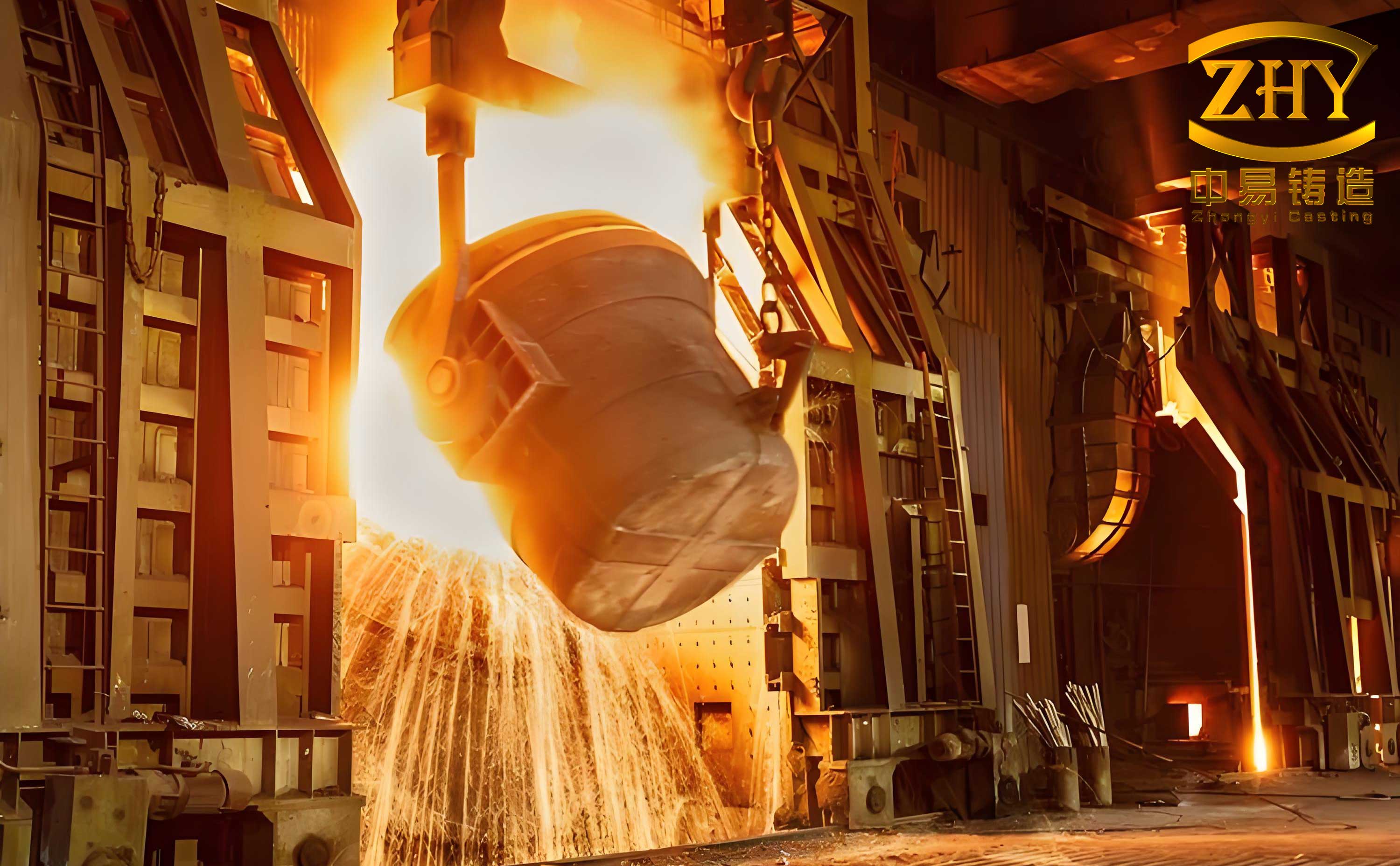
The visual representation above highlights the application of these techniques in a manganese steel casting foundry, showcasing how innovative methods contribute to cost-effective production. Beyond riser optimization, other process adjustments can further enhance savings. For instance, optimizing gating system design reduces metal turbulence and inclusion formation, improving the integrity of manganese steel casting foundry products. We also implemented statistical process control (SPC) to monitor key parameters like pouring temperature and solidification time, which minimizes defects and rework. The relationship between defect rate and cost can be modeled using a simple linear equation: $$ C_d = k \times D_r $$ where \(C_d\) is the defect-related cost, \(k\) is a constant factor, and \(D_r\) is the defect rate. By reducing \(D_r\) through SPC, we lowered \(C_d\) substantially in our manganese steel casting foundry. Additionally, energy management plays a vital role; we installed variable frequency drives on induction furnaces to cut electricity consumption by 15%, as per the formula: $$ E_s = P \times t \times \eta $$ where \(E_s\) is energy saved, \(P\) is power rating, \(t\) is operating time, and \(\eta\) is efficiency gain. These cumulative measures underscore the holistic approach required for cost control in a modern manganese steel casting foundry.
Another critical aspect is the recycling and reuse of materials within the manganese steel casting foundry. We developed a closed-loop system for sand reclamation, where used molding sand is processed and reintegrated into production, reducing new sand purchases by 40%. The economic benefit can be calculated using: $$ S_s = Q_r \times P_s $$ where \(S_s\) is sand savings, \(Q_r\) is the quantity reclaimed, and \(P_s\) is the price of new sand. Similarly, scrap metal from risers and defective castings is remelted, with the recovery rate \(R_r\) given by: $$ R_r = \frac{W_r}{W_s} \times 100\% $$ where \(W_r\) is the weight of recycled metal and \(W_s\) is the total scrap weight. In our manganese steel casting foundry, \(R_r\) exceeds 95%, significantly lowering raw material costs. These practices not only cut expenses but also align with sustainability goals, enhancing the environmental profile of the manganese steel casting foundry.
To provide a comprehensive overview, the table below summarizes key cost-saving initiatives and their impacts in a manganese steel casting foundry, based on our experiences. This includes both material and process-related measures, with quantified savings where applicable.
| Initiative | Description | Key Metrics | Estimated Savings (currency units/year) | Impact on Manganese Steel Casting Foundry |
|---|---|---|---|---|
| Competitive Procurement | Centralized bidding for raw materials | Cost reduction of 3–5% | 1,080,000 – 1,800,000 | Lower input costs, improved supplier diversity |
| Usage Incentives | Team-based cost targets with bonuses | Material waste reduction of 10–15% | 500,000 – 750,000 | Enhanced employee engagement, reduced consumption |
| Knock-off Risers | Replace traditional risers with impact-removable ones | Gas consumption cut by 30% | 504,000 | Lower labor and energy costs, better quality |
| Insulated Risers & Cover Agents | Use composite fiber risers and高效覆盖剂 | Yield increase from 70% to 78% | 1,266,640 | Higher metal utilization, reduced melting needs |
| Sand Reclamation | Recycle molding sand through processing | New sand purchase reduction of 40% | 200,000 – 400,000 | Lower material costs, waste minimization |
| Energy Efficiency | Install VFDs and optimize furnace operations | Electricity savings of 15% | 300,000 – 500,000 | Reduced utility bills, lower carbon footprint |
| Defect Reduction via SPC | Implement statistical controls on process variables | Defect rate decrease of 20% | 600,000 – 900,000 | Fewer rejects, higher product reliability |
This table illustrates the multifaceted strategies that can be deployed in a manganese steel casting foundry to achieve substantial cost savings. Each initiative contributes to a leaner operation, reinforcing the competitiveness of the manganese steel casting foundry in a volatile market. Moreover, the integration of these measures often creates synergistic effects; for example, improved yield from insulated risers reduces the demand for raw materials, amplifying the benefits of procurement savings. In our manganese steel casting foundry, we observed that a 1% improvement in yield could lower overall costs by approximately 2%, as per the empirical relationship: $$ \Delta C = -0.02 \times \Delta Y $$ where \(\Delta C\) is the percentage change in cost and \(\Delta Y\) is the percentage change in yield. Such insights guide continuous improvement efforts in the manganese steel casting foundry.
Looking deeper into technological advancements, the adoption of simulation software has become a game-changer for cost control in manganese steel casting foundry operations. We use finite element analysis (FEA) to predict solidification patterns and optimize riser placement, minimizing trial-and-error expenses. The simulation accuracy \(A_s\) can be defined as: $$ A_s = \frac{N_c}{N_t} \times 100\% $$ where \(N_c\) is the number of correct predictions and \(N_t\) is the total trials. In our manganese steel casting foundry, \(A_s\) exceeds 90%, reducing development costs by 25%. Additionally, automation in molding and pouring lines has cut labor costs by 30% while improving consistency. The return on investment (ROI) for such automation in a manganese steel casting foundry can be calculated as: $$ \text{ROI} = \frac{\text{Net Savings}}{\text{Investment Cost}} \times 100\% $$. For a recent automation project, we achieved an ROI of 40% within two years, demonstrating its viability for cost-sensitive manganese steel casting foundry environments.
Quality assurance also plays a pivotal role in cost control for a manganese steel casting foundry. By implementing rigorous inspection protocols, we reduce the likelihood of customer returns and warranty claims, which can be costly. The cost of poor quality (COPQ) is often expressed as: $$ \text{COPQ} = C_i + C_e + C_p $$ where \(C_i\) is internal failure costs (e.g., rework), \(C_e\) is external failure costs (e.g., recalls), and \(C_p\) is prevention costs. In our manganese steel casting foundry, we focused on increasing \(C_p\) through better training and equipment, which lowered \(C_i\) and \(C_e\) by 15% annually. This proactive approach not only saves money but also strengthens the reputation of the manganese steel casting foundry for reliability.
Furthermore, supply chain optimization extends cost control beyond the foundry walls. We established long-term partnerships with reliable suppliers for critical inputs like ferromanganese and chromium, securing stable prices and timely deliveries. The total cost of ownership (TCO) model helps evaluate suppliers: $$ \text{TCO} = P_a + C_t + C_h + C_r $$ where \(P_a\) is purchase price, \(C_t\) is transportation cost, \(C_h\) is holding cost, and \(C_r\) is risk cost. By minimizing TCO, our manganese steel casting foundry achieves better cost predictability. Additionally, we diversified our supplier base to mitigate disruptions, ensuring that the manganese steel casting foundry remains resilient amid market fluctuations.
In terms of human resource management, training programs have been instrumental in cost reduction for our manganese steel casting foundry. We educate workers on best practices for material handling and process control, reducing errors and enhancing efficiency. The learning curve effect can be modeled as: $$ T_n = T_1 \times n^{-b} $$ where \(T_n\) is the time for the \(n\)-th unit, \(T_1\) is the time for the first unit, \(n\) is the cumulative number of units, and \(b\) is the learning rate. In our manganese steel casting foundry, we observed a 10% learning rate, leading to a 5% reduction in labor hours per ton over six months. This translates to direct labor cost savings, reinforcing the value of skilled personnel in a manganese steel casting foundry.
To encapsulate the financial impact, we can develop a comprehensive cost model for a manganese steel casting foundry. Let \(C_{\text{total}}\) represent the total production cost, which can be broken down as: $$ C_{\text{total}} = C_{\text{materials}} + C_{\text{labor}} + C_{\text{energy}} + C_{\text{overhead}} $$. By applying the discussed strategies, each component can be optimized. For instance, \(C_{\text{materials}}\) is reduced through procurement savings and yield improvements, while \(C_{\text{labor}}\) decreases via automation and training. The overall cost reduction \(\Delta C_{\text{total}}\) can be approximated as: $$ \Delta C_{\text{total}} = \sum_{i=1}^{n} \Delta C_i $$ where \(\Delta C_i\) are the savings from individual initiatives. In our manganese steel casting foundry, we achieved a 12% reduction in \(C_{\text{total}}\) over two years, validating the effectiveness of these integrated approaches.
In conclusion, cost control in a manganese steel casting foundry demands a holistic strategy encompassing raw material management, process innovation, and continuous improvement. From my firsthand experience, measures such as competitive procurement, incentivized usage, knock-off risers, insulated risers, and advanced technologies have proven highly effective. These not only lower expenses but also enhance product quality and operational sustainability. As the market for manganese steel casting foundry products evolves, embracing such cost-conscious practices will be essential for long-term success. By sharing these insights, I hope to inspire other foundries to explore similar avenues, fostering resilience and growth in the face of economic challenges. The journey toward cost efficiency is ongoing, but with diligent implementation, any manganese steel casting foundry can achieve significant savings and secure a competitive edge.