
As a leading manufacturer in the heavy machinery sector, we recognize that machine tool castings form the backbone of modern CNC equipment. The quality of machine tool castings directly impacts the precision, durability, and overall performance of high-end machine tools. Over the years, we have focused on advancing our casting processes to meet the stringent demands of large-scale CNC machines, which require exceptional mechanical properties, dimensional stability, and resistance to deformation under heavy loads. In this article, we delve into the technical specifications, production controls, and material science behind superior machine tool castings, emphasizing the role of innovation in overcoming international technological barriers.
The development of high-precision CNC machine tools, such as multi-axis machining centers and heavy-duty lathes, hinges on the integrity of their structural components, most of which are derived from machine tool castings. These castings must exhibit a combination of high tensile and compressive strength, excellent wear resistance, and superior vibration damping capabilities. For instance, in our production of large vertical turning centers and horizontal lathes, we have observed that machine tool castings with optimized material compositions can significantly enhance the machine’s accuracy retention and service life. Below, we outline the key technical requirements and our approach to quality assurance.
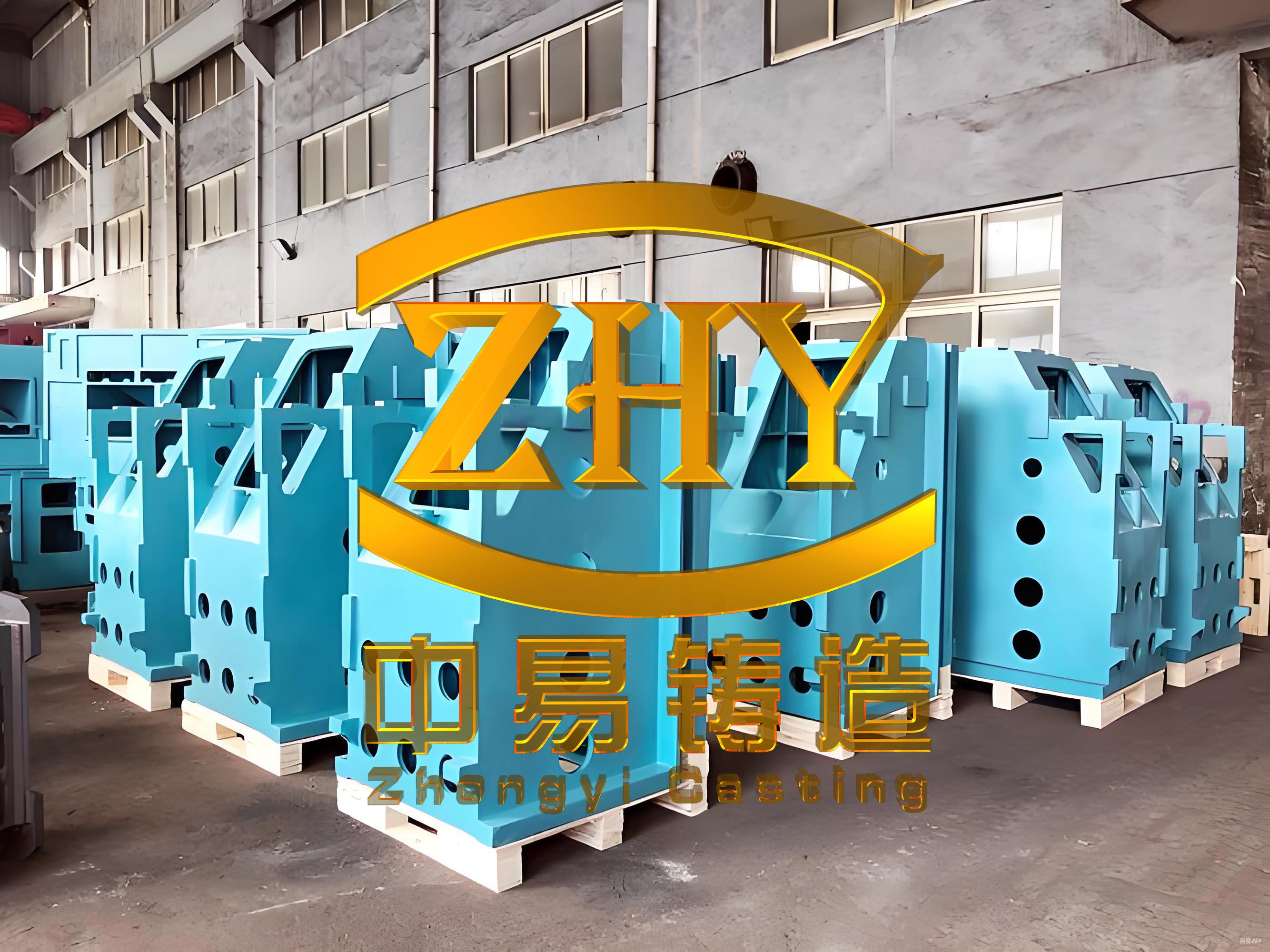
One of the primary considerations in producing machine tool castings is the control of chemical composition to ensure consistent hardness and machinability. We maintain strict tolerances for elements such as carbon (C), silicon (Si), and manganese (Mn), with fluctuations limited to ±0.05% for carbon and ±0.1% for silicon and manganese. Additionally, for castings incorporating guideways, we introduce copper (Cu) and chromium (Cr) in controlled amounts, typically around 0.6% and 0.3% by weight, respectively, to improve wear resistance and overall strength. The relationship between carbon equivalent (CE) and strength is critical; a higher CE often correlates with better castability but may reduce strength if not managed properly. We employ the formula for carbon equivalent: $$CE = \%C + \frac{\%Si + \%P}{3}$$ to optimize the balance, ensuring that our machine tool castings achieve high strength without compromising铸造性能.
To illustrate the impact of chemical composition on the properties of machine tool castings, we have compiled data from our production batches in the table below. This table summarizes the target ranges for key elements and their effects on mechanical properties:
| Element | Target Range (wt%) | Effect on Castings |
|---|---|---|
| Carbon (C) | 3.2 – 3.6 | Enhances fluidity and reduces shrinkage; critical for achieving high carbon equivalent. |
| Silicon (Si) | 1.8 – 2.2 | Promotes graphitization, improving machinability and strength. |
| Manganese (Mn) | 0.8 – 1.2 | Increases hardness and tensile strength; counteracts sulfur effects. |
| Phosphorus (P) | < 0.07 | Minimized to prevent brittleness and hot tearing. |
| Sulfur (S) | < 0.02 | Kept low to avoid impairing mechanical properties. |
| Copper (Cu) | 0.5 – 0.7 | Boosts corrosion resistance and hardness in guideway sections. |
| Chromium (Cr) | 0.2 – 0.4 | Enhances wear resistance and refines grain structure. |
In addition to chemical control, the mechanical properties of machine tool castings, such as tensile strength and elastic modulus, are paramount. High-strength gray iron grades like HT300 and HT350 are commonly used for critical components like beds, columns, and cross-rails. The elastic modulus (E) is a key indicator of stiffness, which directly affects a machine tool’s ability to maintain precision under cutting forces. We have established a correlation between tensile strength (σ_b) and elastic modulus, as shown in the following table based on empirical data from our castings:
| Tensile Strength, σ_b (MPa) | Elastic Modulus, E (GPa) |
|---|---|
| 155 | 103.5 |
| 185 | 111.7 |
| 215 | 120.0 |
| 265 | 129.7 |
| 310 | 137.9 |
| 355 | 141.4 |
| 400 | 144.8 |
This data underscores that higher strength grades yield greater stiffness, but it is essential to note that elastic modulus does not always scale linearly with strength. Factors such as graphite morphology and Si/C ratio play a significant role. For example, increasing the Si/C ratio from 0.4-0.5 to 0.7-0.8 can enhance both strength and elastic modulus, as described by the approximate relationship: $$E \propto \sigma_b^{0.5} \times \left(\frac{Si}{C}\right)$$ where a higher ratio improves graphitization and reduces stress concentrations. In our practice, we prioritize achieving a Si/C ratio above 0.7 to maximize the performance of machine tool castings while maintaining good铸造性能.
Dimensional accuracy is another critical aspect for machine tool castings, particularly in large components like beds and tables that can exceed 10 meters in length. We utilize resin sand molding processes to achieve casting tolerances within CT8 to CT10, with flatness deviations limited to less than 1.5 mm over any 600 mm span. However, consistent attainment of CT8 remains challenging; our internal studies show that only a minority of productions meet this level, whereas international standards often demand CT8 with flatness under 1 mm. To quantify the impact of process variables, we employ statistical models that relate molding parameters to dimensional stability. For instance, the variance in flatness (Δ) can be expressed as: $$\Delta = k \times \frac{T_c}{E}$$ where \(T_c\) is the cooling time and \(E\) is the elastic modulus, with \(k\) as a process-dependent constant. This highlights the importance of controlled cooling and high modulus in minimizing distortions.
The production of high-quality machine tool castings also involves rigorous heat treatment to relieve residual stresses. As strength increases in grades like HT350, so does the inherent stress, necessitating effective aging methods. We primarily use thermal aging and vibration aging, with a growing interest in low-stress iron technologies that eliminate the need for heat treatment. The stress relief efficiency (η) can be modeled as: $$\eta = 1 – e^{-\frac{t}{\tau}}$$ where \(t\) is the aging time and \(\tau\) is a material-specific time constant. Our experiments indicate that thermal aging at elevated temperatures for prolonged periods reduces stress by over 80%, ensuring long-term stability in machine tool castings.
Furthermore, the design of gating and risering systems is crucial for preventing defects like shrinkage and porosity in machine tool castings. For heavy sections, we implement slot gates and multiple risers to promote directional solidification. The Chvorinov’s rule, $$t_s = k \times \left(\frac{V}{A}\right)^2$$ where \(t_s\) is solidification time, \(V\) is volume, \(A\) is surface area, and \(k\) is a constant, guides our riser placement to ensure adequate feeding. In one case, for a 95-ton column casting, we optimized the riser design using simulation software, reducing scrap rates by 15% and improving the overall integrity of the machine tool castings.
In terms of mechanical performance, we conduct regular tests to verify that our machine tool castings meet the required specifications. The table below summarizes the typical mechanical properties for various grades of gray iron used in our castings, based on average values from our quality control records:
| Material Grade | Tensile Strength (MPa) | Compressive Strength (MPa) | Hardness (HBW) | Elastic Modulus (GPa) |
|---|---|---|---|---|
| HT200 | 200 | 750 | 180-220 | 105-115 |
| HT250 | 250 | 900 | 190-240 | 115-125 |
| HT300 | 300 | 1050 | 200-250 | 125-135 |
| HT350 | 350 | 1200 | 210-260 | 135-145 |
These properties are essential for components like cross-rails and columns, where loads can exceed 11 kN and deflections must be minimized to less than 5.5 mm. Our focus on high elastic modulus ensures that machine tool castings resist deformation under heavy cutting forces, thereby preserving accuracy over extended periods. Moreover, the hardness of guideway surfaces is maintained above 180 HBW after machining, with surface roughness often achieving Ra = 0.8 μm through precise control of the casting and finishing processes.
Another vital consideration is the铸造性能 of machine tool castings, which encompasses fluidity, shrinkage, and tendency for defects. We monitor the cooling curves and use thermal analysis to predict microstructure development. The solidification behavior can be described by the cooling rate equation: $$\frac{dT}{dt} = -\frac{hA}{\rho C_p V}(T – T_m)$$ where \(T\) is temperature, \(t\) is time, \(h\) is heat transfer coefficient, \(A\) is surface area, \(\rho\) is density, \(C_p\) is specific heat, \(V\) is volume, and \(T_m\) is melting temperature. By optimizing these parameters, we reduce the incidence of cold shuts and misruns in complex machine tool castings.
Looking ahead, the advancement of machine tool castings is integral to the global competitiveness of CNC machinery. Through continuous research and development, we aim to push the boundaries of material science, incorporating alloying elements and process innovations to achieve higher performance. The journey from a manufacturing giant to a technology leader relies on our ability to produce machine tool castings that meet the ever-increasing demands of precision and reliability. In conclusion, the future of high-end machine tools is inextricably linked to the quality of their cast components, and we remain committed to excellence in this field.