
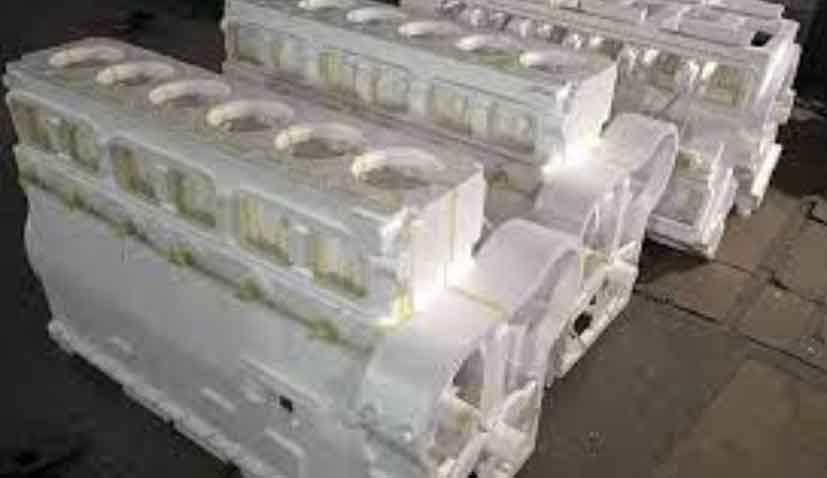
This paper systematically investigates common defects encountered during the lost foam casting process of F8JZ130AM aluminum alloy transmission shells for medium-duty automated manual transmissions (AMT). Through quantitative analysis of defect characteristics and process parameters, we propose targeted improvement measures to enhance production stability and casting quality.
1. Process Characteristics and Defect Distribution
The lost foam casting process for AMT shells involves complex geometry with wall thickness variations from 4.5mm to 15mm. Statistical analysis of production data reveals three primary defect types:
| Defect Type | Internal Rejection (ppm) | External Rejection (ppm) | Critical Locations |
|---|---|---|---|
| Gas Porosity | 38,450 | 51,220 | Bore surfaces, junction areas |
| Shrinkage Porosity | 22,118 | 28,422 | Thick-wall sections (>12mm) |
| Mold Seam Cracks | 10,000 | 18,000 | Parting line intersections |
2. Mathematical Modeling of Defect Formation
The gas evolution in lost foam casting follows the Arrhenius equation for polymer decomposition:
$$ \frac{dG}{dt} = A e^{-E_a/(RT)} (1 – \alpha)^n $$
Where:
G = Gas volume (cm³/g)
A = Pre-exponential factor (1.2×10⁷ s⁻¹)
Eₐ = Activation energy (148 kJ/mol)
R = Gas constant (8.314 J/mol·K)
T = Temperature (K)
α = Conversion degree
n = Reaction order (1.3)
3. Process Optimization Strategies
3.1 Mold Seam Integrity Enhancement
The crack probability at parting lines correlates with joint gap dimensions:
$$ P_c = 1 – e^{-\left( (w/0.8)^2 + (d/0.3) \right)} $$
Where:
w = Gap width (mm)
d = Gap depth (mm)
| Improvement Measure | Before | After | Effect |
|---|---|---|---|
| Parting Line Radius | R3 | R6 | Stress reduction 42% |
| Rib Width | 7mm | 11mm | Joint gap ≤0.1mm |
| Vent Hole Density | 4/cm² | 6/cm² | Gas escape efficiency +35% |
3.2 Thermal Management Optimization
The optimal pouring temperature window was determined through thermal analysis:
$$ T_{pour} = T_{liquidus} + \Delta T_{superheat} – \Delta T_{foam} $$
$$ \Delta T_{foam} = 0.22 \cdot \rho_{EPS} \cdot t_{contact}^{0.5} $$
Where:
ρEPS = Foam density (g/cm³)
tcontact = Metal-foam contact time (s)
4. Quality Improvement Results
Process optimization achieved significant quality improvements in lost foam casting production:
| Quality Metric | 2022 Baseline | 2023 Result | Improvement |
|---|---|---|---|
| Internal Rejection (ppm) | 70,568 | 23,002 | 67.4%↓ |
| External Rejection (ppm) | 97,642 | 41,944 | 57.0%↓ |
| X-ray Defect Density | 4.2/cm² | 1.1/cm² | 73.8%↓ |
5. Technical Recommendations
For successful implementation of lost foam casting in automotive aluminum components:
- Maintain EPS density within 19-20 g/L for optimal gas evolution control
- Implement real-time thermal monitoring with tolerance:
$$ |\Delta T_{pour}| ≤ 10^{\circ}C $$ - Design parting lines with safety factor:
$$ SF = \frac{\sigma_{allowable}}{\sigma_{actual}} ≥ 2.5 $$
This systematic approach to process optimization in lost foam casting demonstrates that through combined structural modifications, thermal management, and quantitative process control, automotive component manufacturers can achieve significant quality improvements while maintaining production efficiency.