
In the foundry industry, clay green sand molding remains one of the most prevalent and economical methods for producing sand casting products, accounting for approximately 60% to 70% of all sand mold usage. As a foundry engineer with extensive experience in manufacturing diesel engine components such as flywheels, flywheel housings, and various small castings, I have observed that green sand systems, while advantageous for cost-effectiveness and short production cycles, present significant challenges due to inherent weaknesses like low mold strength and hardness. These limitations often lead to defects that compromise the quality of sand casting products. This article delves into a comprehensive analysis of common defects in green sand castings—namely sand holes, pores, sand inclusions, and sand sticking—and outlines practical solutions derived from years of hands-on practice. By integrating rigorous material controls, optimized process parameters, and systematic quality checks, we have successfully reduced scrap rates from around 8% to 4–5%, yielding substantial economic benefits and enhancing our reputation among original equipment manufacturers. Throughout this discussion, I will emphasize the critical role of proper sand management in ensuring the integrity of sand casting products, supported by tables and mathematical formulations to clarify key concepts.
Clay green sand is primarily composed of base sand, clay (typically bentonite), additives (such as coal dust and starch), and water. This mixture allows for recyclability, with used sand utilization rates reaching 90–95% after replenishment with fresh sand, bentonite, and additives. However, the low strength and hardness of green sand molds restrict their application to smaller castings; for instance, sand casting products weighing over 200 kg or with wall thicknesses exceeding 50 mm are generally unsuitable for this process. In our production line, which handles a diverse range of sand casting products in small batches, we employ an automated sand processing system with frequency-converted rotor mixers and real-time monitoring. This setup helps mitigate issues like “hot sand,” where sand temperatures exceeding ambient by 10–15°C can exacerbate defects. Our focus on controlling sand properties—such as moisture content, compactability, and permeability—is paramount to minimizing defects in sand casting products.
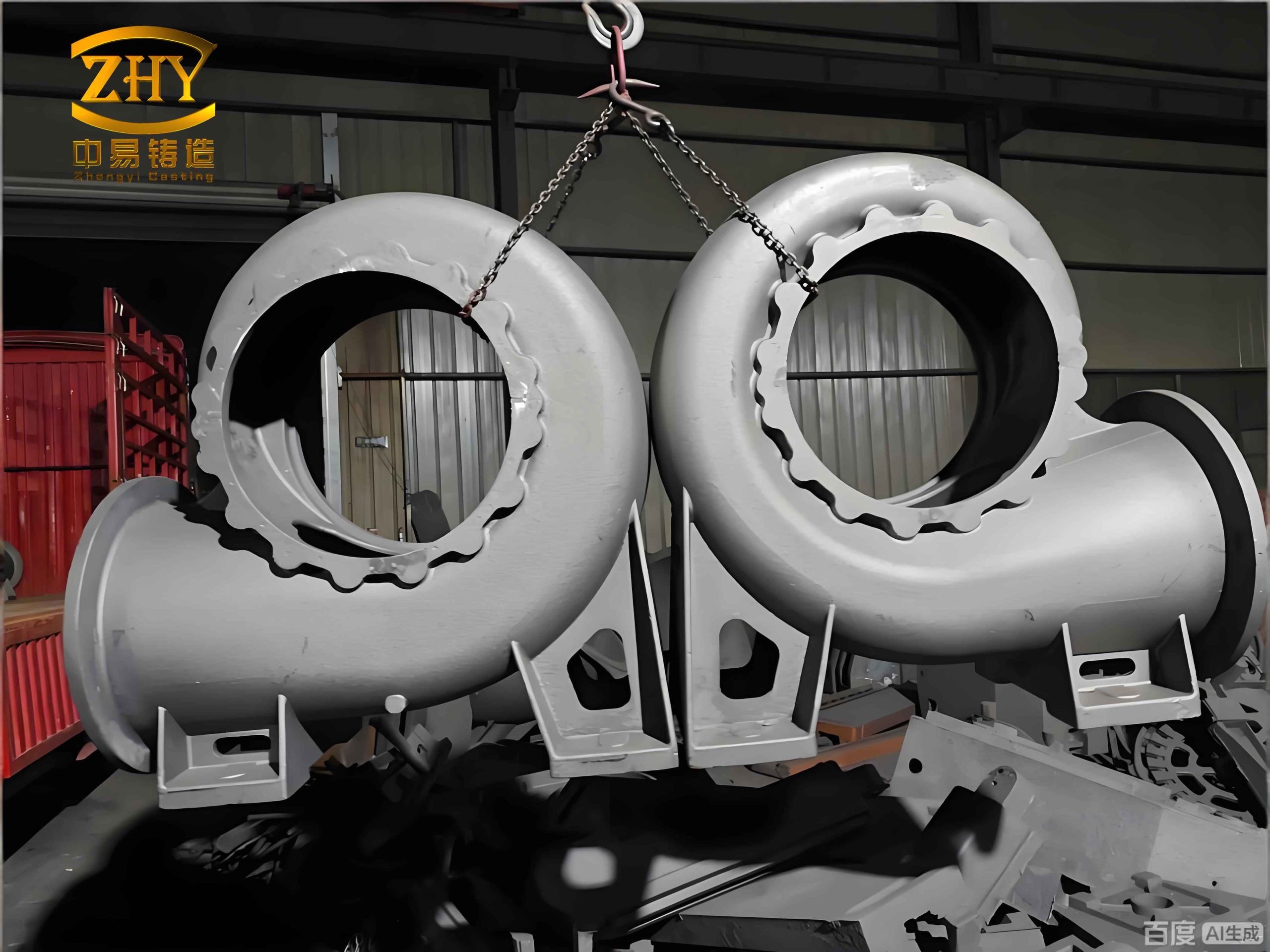
The defects in sand casting products arising from green sand issues can be categorized into four main types: sand holes, pores (including blowholes and gas porosity), sand inclusions (such as scabs and buckles), and sand sticking (both mechanical and chemical). Each defect stems from specific interactions between the sand mold and molten metal during pouring and solidification. Below, I analyze these defects in detail, incorporating formulas and tables to summarize their causes and remedies. The consistent theme is that effective defect prevention hinges on precise control of sand composition and process variables, which directly impact the quality of sand casting products.
Sand Holes in Sand Casting Products: Sand holes manifest as cavities or inclusions of loose sand within the castings, often resulting from eroded mold surfaces or dislodged sand particles. This defect is particularly prevalent in green sand casting products due to the mold’s susceptibility to冲刷. Key factors include inadequate green compression strength of the sand, non-uniform mold compaction, prolonged waiting times before pouring leading to surface drying, and design flaws in core prints. For example, if the green compression strength is too low, the mold may erode under the冲击 of molten metal, especially at gates or sharp corners. In our practice, we maintain green compression strength within 0.11–0.16 MPa, with higher values for thicker sand casting products like flywheels. The relationship between sand strength and erosion resistance can be expressed using an empirical formula for critical冲刷 velocity, though in practice, we rely on standardized tests. Additionally, mold compaction should exceed 85 on a hardness scale, with specific attention to sidewalls using ramming tools to achieve densities above 90. A summary of causes and solutions is presented in Table 1.
| Cause | Solution | Key Parameter Range |
|---|---|---|
| Low green compression strength | Adjust bentonite addition; control moisture | 0.11–0.16 MPa |
| Non-uniform mold compaction | Use ramming for sidewalls; monitor hardness | >85 hardness |
| Core print design issues | Increase draft angles to 10°; ensure clearances | 0.5–1 mm clearance |
| Long waiting times | Synchronize molding and pouring; avoid surface drying | Minimize delay to <2 hours |
Mathematically, the risk of sand hole formation can be modeled by considering the冲刷 force exerted by molten metal. For a given浇注 velocity \(v\), the dynamic pressure \(P_d\) on the mold surface is given by:
$$P_d = \frac{1}{2} \rho v^2$$
where \(\rho\) is the density of the molten metal. To prevent erosion, the sand’s green compression strength \(\sigma_g\) must satisfy:
$$\sigma_g > k P_d$$
with \(k\) as a safety factor typically ranging from 1.5 to 2.0. This underscores the importance of maintaining adequate strength in sand casting products molds.
Porosity and Gas Defects in Sand Casting Products: Porosity, including blowholes and gas porosity, is a major defect in green sand casting products, often accounting for a high percentage of scrap. It arises from gases generated within the mold or metal that become trapped during solidification. Primary sources include moisture in the sand, volatile additives like coal dust, poor venting of molds and cores, and high gas content in the molten metal. In our system, we tightly control sand moisture to 3.2–3.8% for high-pressure molding, as excess water leads to steam generation and gas entrapment. The compactability (CB value) of the sand, which correlates with moisture, is maintained at 32–36%, with a ratio of compactability to moisture content kept between 10 and 12 to ensure optimal sand plasticity. This ratio is defined as:
$$R_{cm} = \frac{CB}{M}$$
where \(CB\) is the compactability percentage and \(M\) is the moisture content percentage. When \(R_{cm}\) falls outside 10–12, the sand becomes either too brittle or too sensitive to moisture variations. Additionally, permeability of the sand must be balanced; too low permeability impedes gas escape, while too high promotes mechanical sand sticking. We aim for permeability values of 100–140, as verified through extensive production trials for sand casting products. Other measures include adding vents and risers to模具, using degassed molten metal, and ensuring proper drying of charge materials. The impact of gas evolution can be quantified using the ideal gas law, where the volume of gas \(V_g\) produced from sand moisture at pouring temperature \(T\) is:
$$V_g = \frac{nRT}{P}$$
with \(n\) being moles of water vapor, \(R\) the gas constant, and \(P\) atmospheric pressure. Minimizing \(n\) through moisture control is crucial for defect-free sand casting products.
| Parameter | Target Range | Effect on Porosity |
|---|---|---|
| Sand moisture content | 3.2–3.8% | Lower moisture reduces gas evolution |
| Compactability (CB) | 32–36% | Optimal CB ensures proper gas venting |
| Permeability number | 100–140 | Balances gas escape and surface finish |
| Coal dust addition (LOI) | 3–5% | Excess increases gas generation |
Sand Inclusions in Sand Casting Products: Sand inclusions, such as scabs and buckles, occur when surface layers of the mold expand and detach due to thermal stress during pouring. This defect is common in green sand casting products because of the low thermal conductivity and inadequate hot wet tensile strength of the sand. To combat this, we use sodium-activated bentonite to enhance hot wet tensile strength, targeting values above 2.5 kPa for demanding sand casting products like flywheel housings. Coal dust also plays a role by increasing the sand’s thermal plasticity through the formation of coke residues, thereby reducing layer separation. We adjust coal dust addition to 80% of bentonite content for prone castings, keeping loss on ignition (LOI) at 3–5%. Process modifications, such as倾斜浇注 at angles of 3–15° and using nails to reinforce mold surfaces, further mitigate sand inclusions. The thermal expansion stress \(\sigma_t\) in the sand layer can be approximated by:
$$\sigma_t = E \alpha \Delta T$$
where \(E\) is the modulus of elasticity of the sand, \(\alpha\) the coefficient of thermal expansion, and \(\Delta T\) the temperature gradient. By improving hot wet tensile strength, we ensure \(\sigma_t\) remains below the sand’s failure threshold, safeguarding sand casting products from inclusions.
Sand Sticking in Sand Casting Products: Sand sticking, encompassing both mechanical and chemical types, adversely affects the surface finish of sand casting products, making cleaning difficult and increasing rejection rates. Mechanical sand sticking results from metal penetration into sand interstices, often due to high permeability or excessive pouring pressure. Chemical sand sticking involves reactions between molten metal and sand components (e.g., SiO₂), forming low-melting-point compounds that adhere to the casting. In our experience, controlling sand grain fineness is vital; as core sand incorporation coarsens the system over time, we add fine new sand (100–200 mesh) to maintain an AFS grain fineness distribution of 50–140 mesh, with four-screen consistency. Coal dust addition, while beneficial for preventing sand sticking, must be limited to 3–5% LOI to avoid blue, rough surfaces on sand casting products. Pouring temperature and pressure are also critical: lower temperatures reduce fluidity and penetration, but too low can cause other defects like cold shuts. We optimize pouring temperatures between 1,320°C and 1,420°C based on casting thickness. The tendency for mechanical penetration can be modeled using Darcy’s law for flow through porous media:
$$Q = \frac{k A \Delta P}{\mu L}$$
where \(Q\) is the flow rate of metal, \(k\) the permeability of the sand, \(A\) the area, \(\Delta P\) the pressure drop, \(\mu\) the viscosity of metal, and \(L\) the penetration depth. Reducing \(k\) and \(\Delta P\) through sand control and gating design minimizes sticking in sand casting products.
| Strategy | Implementation | Expected Outcome |
|---|---|---|
| Grain size control | Add fine sand; monitor AFS fineness | Reduced permeability; smoother surfaces |
| Coal dust management | Limit LOI to 3–5%; adjust based on casting | Prevents chemical reactions and blue cast |
| Pouring parameter optimization | Control temperature and pressure | Minimizes metal penetration |
| Mold coating application | Use fast-drying refractory coatings | Enhances surface resistance without drying |
The cumulative effect of these measures is evident in the scrap rate reduction for our sand casting products. Before implementation, defects related to green sand caused a scrap rate of approximately 8%. After adopting the solutions outlined—including strict raw material specifications, real-time sand property monitoring, and process adjustments—the scrap rate dropped to 4–5%. This improvement not only cuts costs but also boosts the reliability of sand casting products for critical applications. To quantify the impact, consider the cost savings equation:
$$S = (R_b – R_a) \times N \times C$$
where \(S\) is the annual savings, \(R_b\) and \(R_a\) are the scrap rates before and after (8% and 4.5%, respectively), \(N\) is the annual production volume of sand casting products, and \(C\) is the average cost per casting. For a production volume of 100,000 castings annually at $50 per casting, savings amount to $175,000, highlighting the economic significance of defect control.
In conclusion, the quality of sand casting products produced via clay green sand molding is highly dependent on meticulous control of sand properties and process parameters. Through systematic analysis of defects like sand holes, porosity, sand inclusions, and sand sticking, we have developed a robust framework for improvement. Key takeaways include maintaining optimal sand strength, moisture, and permeability; leveraging additives like bentonite and coal dust judiciously; and designing molds and gating systems to minimize thermal and mechanical stresses. The integration of automated sand systems with continuous monitoring has been instrumental in achieving consistency. As the foundry industry evolves, these practices will remain essential for producing high-integrity sand casting products efficiently and economically. Future work may explore advanced additives or digital twins for sand management, but the fundamentals discussed here provide a solid foundation for any operation focused on excellence in green sand casting.