
In my extensive experience with the lost foam casting process, particularly for critical components like armatures in rapid electromagnetic brakes, I have encountered numerous challenges related to defect formation. The armature, a thin-walled disc-shaped casting made of low-carbon steel such as ZG200-400, requires excellent magnetic permeability and comprehensive mechanical properties—including strength, hardness, and impact toughness—to ensure the brake’s sensitivity and accuracy. However, the lost foam casting process often introduces defects like inclusions, porosity, and surface carburization, which severely compromise these properties. Through rigorous analysis and practical adjustments, I have developed effective strategies to mitigate these issues, leading to successful production. This article delves into the root causes of defects in the lost foam casting process for low-carbon steel armatures and outlines the technical measures I implemented to overcome them, emphasizing the importance of process optimization in the lost foam casting process.
The lost foam casting process, while advantageous for complex geometries and reduced machining, poses unique difficulties for low-carbon steel castings due to the decomposition of foam patterns. In the case of armatures, defects primarily manifest as slag inclusions and gas pores near the ingates or on the upper surfaces, along with carburization layers of 1.0–2.5 mm on the casting skin. These defects appear as irregular, diffuse clusters with blurred boundaries, often resistant to removal even after machining. My investigation revealed that such issues stem from multiple interlinked factors inherent to the lost foam casting process, including turbulent metal flow, inadequate venting, and material-related reactions. To address this, I adopted a holistic approach focusing on metal treatment, pattern design, and process parameters, all within the framework of the lost foam casting process.
Firstly, let’s analyze the defect types in detail. Inclusions and porosity typically occur due to the entrapment of decomposition products from the foam pattern during metal filling. In the lost foam casting process, the foam pattern—usually made of expandable polystyrene (EPS) or similar materials—vaporizes upon contact with molten steel, generating gases and residual carbon. If the filling is turbulent, these by-products can be卷入 into the metal, forming defects. Carburization, on the other hand, results from the deposition of solid carbon from the pattern’s thermal decomposition onto the casting surface, exacerbated by certain process conditions. The table below summarizes the common defects and their characteristics in the lost foam casting process for armatures:
| Defect Type | Typical Location | Morphology | Impact on Properties |
|---|---|---|---|
| Inclusions/Slag | Near ingates, upper surfaces | Irregular clusters, often with gas pores | Reduces magnetic permeability, causes stress concentration |
| Gas Porosity | Throughout casting, especially top sections | Round or elongated voids, sometimes associated with slag | Weakens mechanical integrity, affects machinability |
| Surface Carburization | Outer skin (1.0–2.5 mm depth) | Diffuse carbon-rich layer, uneven coloration | Lowers magnetic response, increases brittleness |
The root causes of these defects are multifaceted. In the lost foam casting process, metal filling dynamics play a crucial role. When the ingate cross-sectional area is too small, the metal velocity increases, leading to射流 or turbulence. This can be described by the fluid flow equation for incompressible fluids in a pipe, akin to the ingate:
$$v = \frac{Q}{A}$$
where \(v\) is the velocity, \(Q\) is the flow rate, and \(A\) is the cross-sectional area. High \(v\) promotes oxidation and gas entrainment, forming inclusions. Moreover, the negative pressure (vacuum) applied in the lost foam casting process to stabilize the mold can inadvertently cause附壁效应, where metal quickly solidifies along the walls, creating a U-shaped cavity that traps decomposition gases. This phenomenon relates to heat transfer and solidification kinetics, expressible as:
$$\frac{\partial T}{\partial t} = \alpha \nabla^2 T$$
where \(T\) is temperature, \(t\) is time, and \(\alpha\) is thermal diffusivity. Rapid cooling at the walls inhibits gas escape, fostering porosity and carburization.
Another key factor is the pattern material. EPS has a high carbon content (92%), which upon decomposition, yields substantial solid carbon. Alternatives like styrene-methyl methacrylate (STMMA) or expandable polymethyl methacrylate (EPMMA) have lower carbon contents—69.6% and 60.0%, respectively—reducing carburization potential. My experiments in the lost foam casting process showed that switching from EPS to STMMA decreased surface carbon increase from 0.1–0.3% to below 0.05%, significantly minimizing defects. The table below compares pattern materials in the lost foam casting process:
| Pattern Material | Carbon Content (%) | Typical Carburization in Castings (%) | Remarks on Decomposition |
|---|---|---|---|
| EPS | 92.0 | 0.1–0.3 | High gas and carbon residue, prone to defects |
| STMMA | 69.6 | <0.05 | Lower residue, better for low-carbon steels |
| EPMMA | 60.0 | <0.05 | Similar benefits, but may have higher cost |
Furthermore, the gating system design in the lost foam casting process is critical. Long or convoluted runners increase metal exposure time, leading to cooling, oxidation, and turbulence. I optimized this by minimizing横浇道 and using direct ingates to shorten metal travel. Additionally, pattern assembly—where multiple foam pieces are glued—introduces adhesive that decomposes into gases and carbon. In the lost foam casting process, I reduced glue usage by adopting整体制作模样 (integral pattern fabrication) and specialized low-carbon adhesives, cutting down decomposition by-products. The negative pressure system also needed revision; traditional side- or bottom-vented molds create抽气方向 perpendicular to gas buoyancy, hindering removal. I implemented top-vented molds where vacuum is applied from above, aligning with natural gas rise and improving defect elimination in the lost foam casting process.
Melting practices are equally vital. In the lost foam casting process, steel composition must be tightly controlled to avoid excess carbon and impurities. I used medium-frequency induction furnaces and rigorous charge selection, excluding alloy steel scrap to prevent unintended carbon solubility increases. The carbon balance during melting can be expressed as:
$$C_{\text{final}} = C_{\text{charge}} + \Delta C_{\text{decomposition}} – \Delta C_{\text{oxidation}}$$
where \(C_{\text{final}}\) is the final carbon content in the casting, \(C_{\text{charge}}\) is the charge carbon, \(\Delta C_{\text{decomposition}}\) is carbon from pattern decomposition, and \(\Delta C_{\text{oxidation}}\) is carbon loss due to oxidation. By minimizing \(C_{\text{charge}}\) and \(\Delta C_{\text{decomposition}}\), I achieved lower \(C_{\text{final}}\), reducing carburization. Additionally, I employed熔液净化 techniques like fluxing agents to adsorb inclusions, enhancing metal cleanliness in the lost foam casting process.
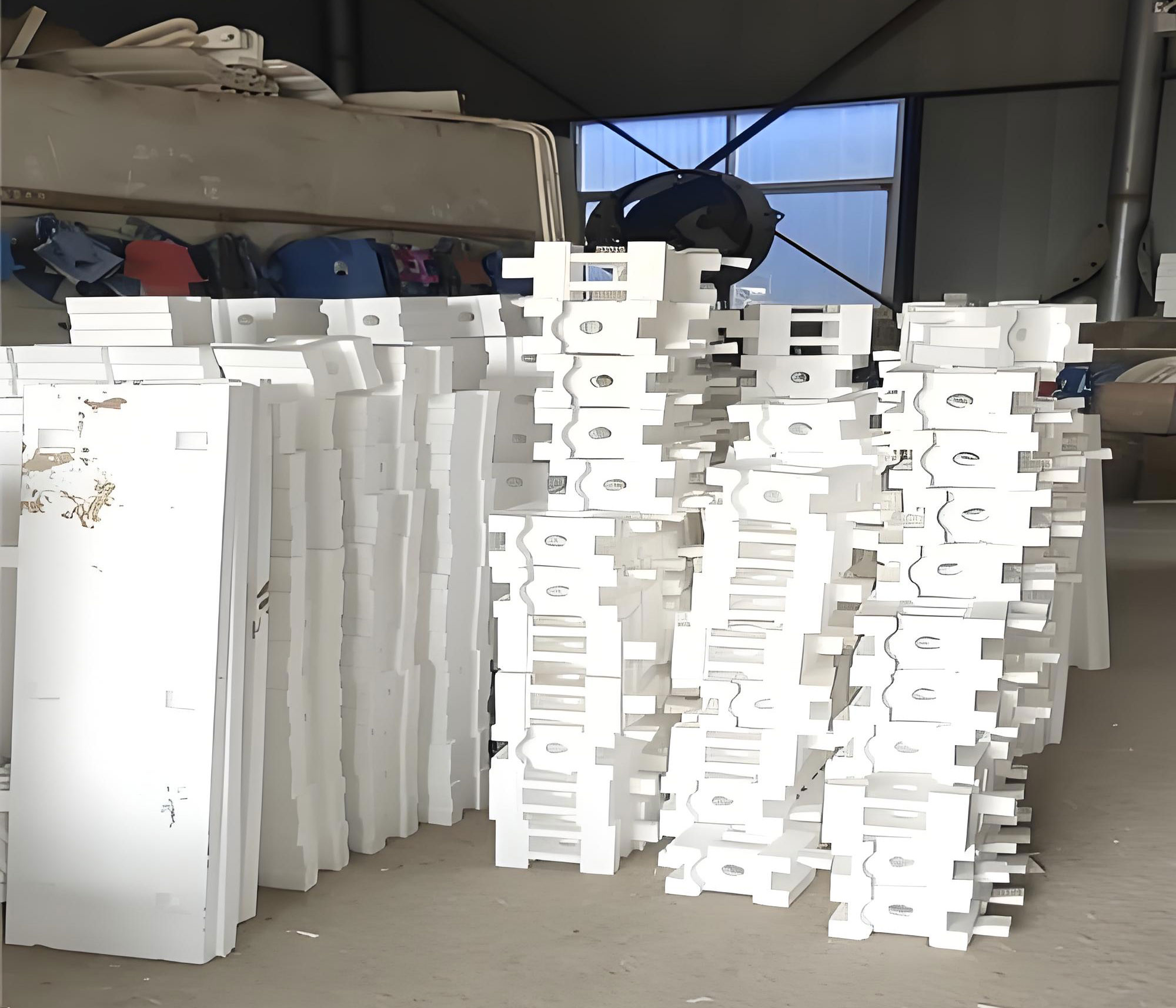
To systematically address defects, I implemented a multi-pronged strategy in the lost foam casting process. First, I refined the casting工艺 parameters. For armatures with轮廓尺寸 of Ø256 mm × 14 mm, I increased ingate cross-sectional area to降低流速, using the formula for laminar flow transition:
$$Re = \frac{\rho v D}{\mu}$$
where \(Re\) is Reynolds number, \(\rho\) is density, \(v\) is velocity, \(D\) is hydraulic diameter, and \(\mu\) is viscosity. By keeping \(Re\) below 2000, I minimized turbulence. Second, I optimized the负压 level and duration; excessive vacuum can加剧附壁效应, while insufficient vacuum leads to mold collapse. Through trial, I found an optimal range of 0.04–0.06 MPa for the lost foam casting process. Third, I introduced过滤网 in the gating system to trap inclusions, mathematically represented as a filtration efficiency model:
$$\eta = 1 – \exp\left(-\frac{K A_f}{Q}\right)$$
where \(\eta\) is filtration efficiency, \(K\) is a constant, \(A_f\) is filter area, and \(Q\) is flow rate. This significantly reduced slag defects in the lost foam casting process.
Moreover, I enhanced pattern-making techniques. In the lost foam casting process, I switched to STMMA beads for pattern production, which have lower carbon content and decompose more cleanly. I also minimized cutting and gluing by using CNC-machined integral patterns, reducing adhesive-related carbon sources. For coating applications, I ensured uniform thickness to prevent涂料刺 (coating spikes) that could break off and become inclusions. The coating permeability, crucial for gas escape, was adjusted using Darcy’s law:
$$v_g = \frac{k}{\mu} \nabla P$$
where \(v_g\) is gas velocity, \(k\) is permeability, \(\mu\) is gas viscosity, and \(\nabla P\) is pressure gradient. By optimizing \(k\) through coating配方, I improved gas venting in the lost foam casting process.
My approach also involved advanced process monitoring. I used thermal analysis to track foam decomposition during pouring in the lost foam casting process, described by the Arrhenius equation for pyrolysis:
$$r = A \exp\left(-\frac{E_a}{RT}\right)$$
where \(r\) is decomposition rate, \(A\) is pre-exponential factor, \(E_a\) is activation energy, \(R\) is gas constant, and \(T\) is temperature. By controlling pouring temperature and rate, I moderated \(r\) to reduce gas generation. Additionally, I adopted top-vented mold designs, which align vacuum direction with buoyancy forces, aiding in the removal of decomposition products. The effectiveness of this modification can be quantified by comparing defect rates before and after implementation in the lost foam casting process, as shown in the table below:
| Process Modification | Defect Rate (Before, %) | Defect Rate (After, %) | Improvement Factor |
|---|---|---|---|
| Switching to STMMA patterns | 60 (overall scrap) | 20 | 3x |
| Optimized gating design | High inclusions | Reduced by 70% | Significant |
| Top-vented mold system | Porosity and carburization prevalent | Below 5% occurrence | Major reduction |
| Improved melting control | Variable carbon content | Consistent low carbon | Enhanced reliability |
The results from these interventions in the lost foam casting process were profound. Armature castings produced exhibited magnetic permeability and mechanical properties fully meeting operational requirements. For instance, the magnetic flux density \(B\) and coercivity \(H_c\)—key for导磁性—were within optimal ranges, as confirmed by testing. The yield strength and impact toughness also satisfied specifications, ensuring brake performance. This success underscores the importance of a comprehensive, science-based approach to the lost foam casting process, where every parameter—from material selection to fluid dynamics—is meticulously controlled.
In conclusion, the lost foam casting process for low-carbon steel armatures is susceptible to defects like inclusions, porosity, and carburization, but these can be effectively prevented through targeted measures. My experience demonstrates that optimizing pattern materials, gating design, negative pressure systems, and melting practices is crucial. By integrating theoretical principles with practical adjustments, the lost foam casting process can yield high-quality castings with the desired magnetic and mechanical properties. The key lies in understanding the interplay of decomposition, fluid flow, and heat transfer in the lost foam casting process, and continuously refining the process based on empirical data. As the lost foam casting process evolves, such strategies will remain essential for producing reliable components for critical applications like electromagnetic brakes. Ultimately, the lost foam casting process, when mastered, offers a versatile and efficient manufacturing route, provided that defect mechanisms are proactively addressed through holistic工艺 control.
To further elaborate on the scientific underpinnings, consider the carbon diffusion during carburization in the lost foam casting process. Fick’s second law describes this phenomenon:
$$\frac{\partial C}{\partial t} = D \frac{\partial^2 C}{\partial x^2}$$
where \(C\) is carbon concentration, \(t\) is time, \(D\) is diffusion coefficient, and \(x\) is depth from the surface. By minimizing the source term (from pattern decomposition) and reducing exposure time \(t\), surface carburization can be mitigated in the lost foam casting process. Similarly, for gas pore formation, the ideal gas law approximates the behavior of decomposed gases:
$$PV = nRT$$
where \(P\) is pressure, \(V\) is volume, \(n\) is moles of gas, \(R\) is ideal gas constant, and \(T\) is temperature. In the lost foam casting process, ensuring adequate venting keeps \(P\) low, preventing gas entrapment. These principles guide the ongoing optimization of the lost foam casting process for defect-free production.
In summary, the lost foam casting process requires a deep integration of materials science, fluid mechanics, and thermal analysis. My work highlights that success in the lost foam casting process hinges on addressing both macroscopic工艺 parameters and microscopic decomposition reactions. By sharing these insights, I aim to contribute to the broader advancement of the lost foam casting process, enabling its more reliable application for precision components like armatures. The lost foam casting process, with its unique advantages, can indeed achieve high integrity when defects are systematically prevented through evidence-based engineering.