
The solidification of cast iron parts, encompassing both gray and ductile iron, is fundamentally shaped by the formation of austenitic dendrites and the subsequent precipitation of graphite. This graphite expansion imparts a unique and significant potential for self-compensation of solidification shrinkage. However, effectively harnessing this inherent capability in industrial practice remains a complex challenge. The solidification contraction and self-compensation are influenced by a multitude of interacting factors: alloy composition, melting and treatment practices, the cooling capacity of the mold, pouring conditions, and the geometry of the casting itself, particularly section thickness. Variations in these parameters lead to significant differences in the mode, sequence, quantity, and morphology of the primary austenitic dendrites, eutectic graphite, carbides, and segregated phases. Consequently, the associated volumetric changes at each stage of solidification are highly variable, complicating process control during the production of cast iron parts. Based on contemporary research, this analysis delves into the characteristics of the solidification structure in cast iron parts and its profound impact on self-compensation mechanisms, aiming to foster further discussion and refinement of foundry process methodologies.
Dendritic Solidification and Shrinkage Defect Formation
1. The Pervasiveness of Dendritic Growth
For hypoeutectic cast iron, solidification within the mold commences with the nucleation and growth of primary austenitic dendrites. This dendritic skeleton develops rapidly, quickly spanning the entire solidifying region. The release of latent heat during this growth momentarily slows the cooling rate, often visible as a brief thermal arrest on cooling curve analysis, followed by a period of dendrite coarsening. As the cooling rate increases, so does the volume fraction of primary dendrites. At very high cooling rates (e.g., exceeding 200°C/min), a substantial portion of the austenite can even form during the eutectic reaction phase, highlighting the powerful influence of process conditions on dendritic crystallization. Intriguingly, even hypereutectic ductile iron castings often exhibit a well-developed dendritic structure. This is attributed to the significant undercooling tendency induced by nodularizing agents. In such cases, while primary graphite nodules form first, the subsequent eutectic reaction leads to the independent growth of austenite into the undercooled liquid, creating a dendritic network. Similarly, hypereutectic gray iron under rapid cooling or influenced by certain alloying elements can also develop dendritic morphologies. Therefore, beyond alloy composition, the cooling rate or undercooling propensity dictated by process conditions is a crucial factor promoting dendritic solidification in cast iron parts.
2. Dendrites as the Architectural Framework for Defects
The formation of shrinkage porosity and macro-shrinkage cavities is intrinsically linked to the development of the dendritic network. Upon filling the mold, the liquid metal cools and undergoes thermal contraction. If feeding from the gating system or risers ceases prematurely, the liquid level in the upper parts of the mold cavity can drop, forming surface sinks or internal shrinkage cavities. In cast iron parts, once the primary dendrites interconnect to form a coherent, three-dimensional network, the inter-dendritic liquid becomes isolated, severely impeding fluid flow for feeding. This network effectively acts as numerous microscopic solid shells. The contraction of both the dendrites and the entrapped liquid, combined with the retreat of the liquid front at the dendrite tips, leads to the formation of pore walls, which often exhibit exposed dendritic tips. The onset of graphite expansion can arrest this liquid metal retreat, potentially stabilizing the cavity size if the expansion balances the ongoing contraction in other regions. Thus, shrinkage cavities primarily initiate at the dendrite tips during the final stages of primary solidification and the initial phase of eutectic transformation.
Macro-shrinkage (often termed sponginess or dispersed shrinkage) forms in the last-to-freeze regions, such as thermal centers and axial zones. When dendrites growing from opposite directions impinge upon each other, and no external feeding source is available, continued cooling causes further issues. The solid-state contraction of the dendrites themselves can cause them to pull apart slightly. More significantly, the volumetric contraction of the remaining inter-dendritic liquid occurs at a faster rate than the solid shrinkage, analogous to a receding tide, leaving behind a porous region defined by a skeleton of exposed dendrite arms. A wide mushy zone, a well-developed dendritic structure, and the cessation of external feeding are thus the direct causes for the formation of shrinkage porosity in cast iron parts. Chronologically, macro-shrinkage tends to form later than concentrated shrinkage cavities.
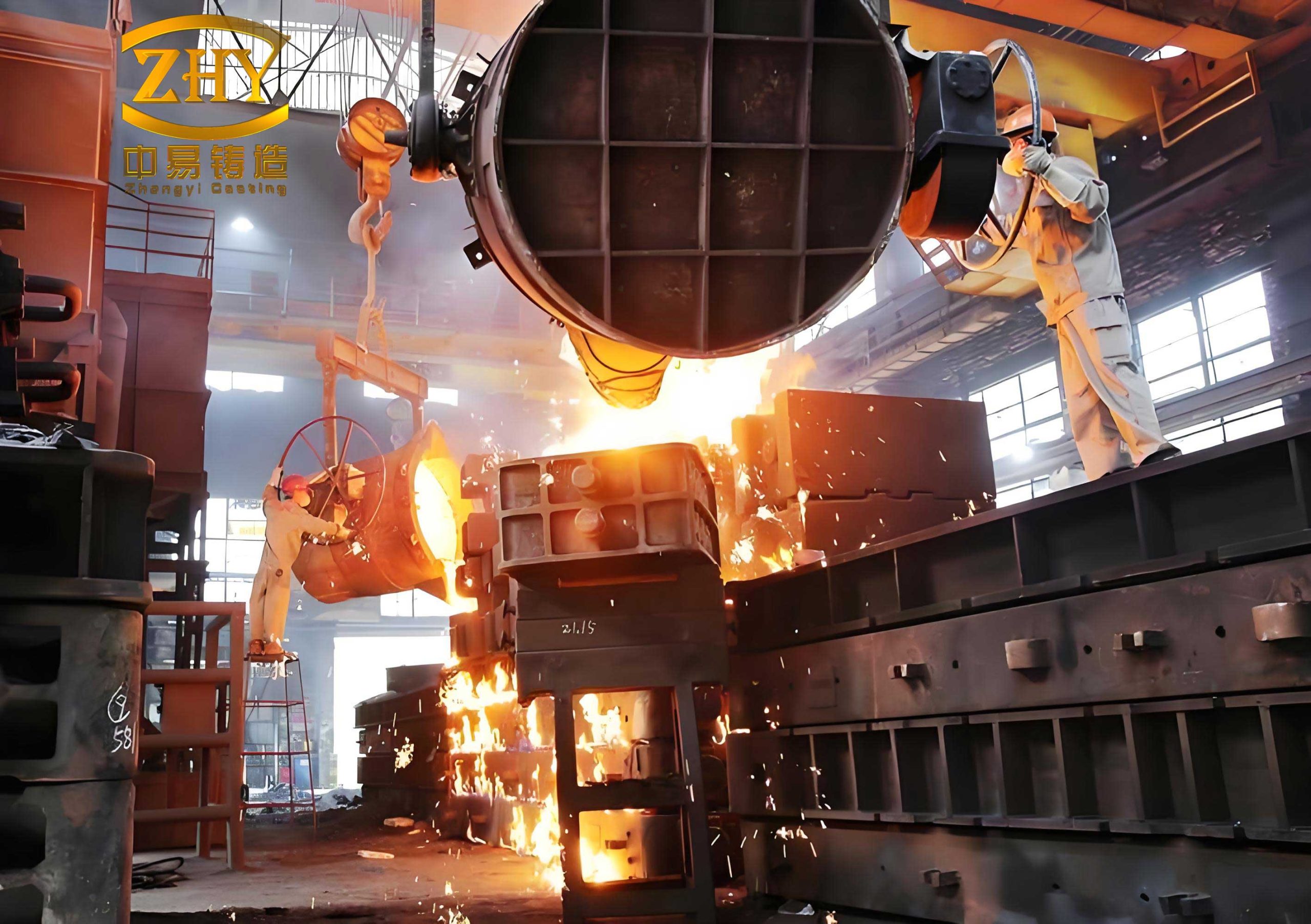
Modes of Self-Compensation in Cast Iron Parts
A rational casting process for cast iron parts should maximize this inherent self-compensation, with risers designed only to supplement any deficit. Understanding the distinct modes of self-compensation is therefore essential for effective process design and control.
1. Equilibrium Compensation (Simultaneous Compensation)
The theory of equilibrium solidification posits a unique volumetric characteristic for cast iron parts: dendritic solidification with its associated liquid and solidification shrinkage occurs first, while the expansive graphite eutectic reaction is delayed. This sequential pattern—contraction followed by expansion at any given location—enables a simultaneous compensation across different regions of the casting. Thinner sections or outer edges, which solidify and begin their graphite expansion earlier, can feed the thicker sections or thermal centers that are still undergoing contraction at the same moment. If the expansion in one area quantitatively matches the contraction in another at a given time, a state of equilibrium is reached, representing perfect internal compensation. This process can be visualized as an equilibrium interface moving through the casting, separating expanding zones from contracting ones. The condition for this equilibrium at a specific time t can be expressed as:
$$ \sum V_{exp}(t) = \sum V_{sh}(t) $$
where $V_{exp}(t)$ is the expansive volume from graphite formation and $V_{sh}(t)$ is the contracting volume from liquid shrinkage and dendritic solidification. The time at which the net volumetric change from this point forward is zero is termed the “equilibrium point.” An earlier equilibrium point is desirable, and processes that promote earlier graphite expansion (e.g., lower cooling rate molds, higher carbon equivalent, optimal pouring temperature) favor this efficient mode of self-compensation in cast iron parts.
2. Channel-Transmission Compensation
Graphite expansion can also drive residual liquid over longer distances through established or newly formed channels, leading to a delayed, transmission-based feeding mechanism. This can occur at two distinct scales.
a) Micro-Channel Transmission: After the formation of shrinkage porosity in the inter-dendritic spaces of a thermal center, the subsequent graphite expansion in adjacent, still-molten regions can force residual eutectic liquid back into these pores through the microscopic channels between dendrite arms. If the volume of liquid forced in equals the pore volume, the defect can be effectively healed. The transported liquid, solidifying rapidly in contact with the existing dendrites, often results in a finer eutectic microstructure (e.g., smaller graphite flakes/particles, finer grain size) distinctly different from the surrounding areas, serving as metallographic evidence of this phenomenon.
b) Macro-Channel Transmission: In later stages, after a solid shell has formed, massive internal graphite expansion can generate significant stress. If this stress exceeds the high-temperature strength of the shell, it can fracture. Surplus expansive liquid may then be extruded through this macroscopic crack towards the casting exterior or into an existing cavity. The transported liquid solidifies with a characteristic eutectic structure, often observed as “fins” or “bursts” leading into shrinkage cavities or riser pipes. This mode is less efficient due to the longer flow distance and greater resistance, often resulting in only partial cavity filling or the formation of external metal beads.
3. Solid-State Extrusion Compensation
This mode is particularly significant for ductile iron castings, which generate very high expansion pressures. In a rigid mold that resists wall movement, the expansive force is directed inwards. During the final stages of solidification, when eutectic cells are in contact and the structure is a semi-solid mass of graphite nodules, austenite, and residual liquid, the expansion pressure can plastically deform the solid dendrite arms. This plastic flow can extrude the semi-solid material into adjacent shrinkage pores, effectively compressing and welding the dendritic network to eliminate voids. This solid-state extrusion is a key mechanism behind the success of riserless or small-riser casting of sound, dense ductile iron parts in rigid molds (e.g., green sand with high compaction, chemically bonded sand).
The following table summarizes the key characteristics, mechanisms, and influencing factors for these three self-compensation modes in cast iron parts.
| Compensation Mode | Primary Mechanism | Dominant Phase/Timing | Key Influencing Factors | Typical Evidence in Microstructure |
|---|---|---|---|---|
| Equilibrium Compensation | Simultaneous, volume-for-volume feeding of contracting regions by expanding regions. | Mid-late solidification; requires a temperature gradient. | Cooling rate, Carbon Equivalent (CE), pouring temperature, casting geometry. | Uniform microstructure; absence of localized shrinkage in properly designed castings. |
| Micro-Channel Transmission | Expansion forces residual liquid through inter-dendritic channels into pre-formed micro-porosity. | Late eutectic solidification, after pore formation. | Dendrite coherency, expansion pressure, amount of residual liquid. | Localized zones of fine eutectic structure within a coarser dendritic matrix. |
| Macro-Channel Transmission | Expansion fractures solid shell, extruding liquid through macroscopic cracks. | Very late solidification, after shell formation. | Shell strength, magnitude of expansion, mold rigidity. | Eutectic “veins” or channels penetrating from interior defects to surface or riser. |
| Solid-State Extrusion | Plastic deformation and flow of the dendritic network under internal expansion pressure. | Final stages of solidification, semi-solid state. | Extremely high mold rigidity, high expansion pressure (typical of ductile iron). | Dense microstructure in thermal centers; deformed dendrite arms observed via deep etching. |
These three modes are interconnected and often operate concurrently during the solidification of cast iron parts. Equilibrium compensation is the most efficient primary mode. Channel-transmission and solid-state extrusion act as secondary, corrective mechanisms that can “heal” deficits occurring before the equilibrium point is reached or in regions where equilibrium is not fully achieved. For ductile iron parts with their wide mushy zone, solid-state extrusion often plays a more critical role than channel transmission in ensuring soundness. The dominant mode is influenced by the alloy type (gray vs. ductile) and specific process conditions. Effective casting design and process engineering for cast iron parts therefore require an analysis to determine the predominant expected self-compensation behavior and the implementation of complementary risering and chilling strategies.
Mathematical Modeling and Process Windows
The interaction between shrinkage and expansion can be conceptualized through volumetric balance models. The net volume change $ \Delta V_{net}(t) $ of a casting region over time can be described as:
$$ \Delta V_{net}(t) = V_{pour} – [V_{l}(t) + V_{s}(t) – V_{g}(t)] $$
where $V_{pour}$ is the initial poured volume, $V_{l}(t)$ is the cumulative liquid contraction, $V_{s}(t)$ is the solidification shrinkage (from austenite formation), and $V_{g}(t)$ is the expansion from graphite precipitation. Each term is a function of time and local thermal history. Liquid contraction is often approximated as:
$$ V_{l} = \beta (T_{pour} – T_{liquidus}) $$
where $\beta$ is the coefficient of thermal contraction for the liquid iron. The timing and rate of the expansion term $V_{g}(t)$ are critical. A process window for sound cast iron parts can be defined by the condition that the internal pressure $P_{int}(t)$ generated by expansion always meets or exceeds the pressure drop $ \Delta P_{feed}(t) $ required to feed shrinkage through the dendritic network or any other flow path:
$$ P_{int}(t) \geq \Delta P_{feed}(t) $$
The internal pressure depends on the expansion force and the mold rigidity, while the feeding pressure drop is governed by Darcy’s law for flow through a porous medium (the mushy zone):
$$ \Delta P_{feed} = \frac{\mu}{K} v L $$
where $\mu$ is the dynamic viscosity, $K$ is the permeability of the dendritic network (a function of dendrite arm spacing, $\lambda_2$), $v$ is the feeding velocity, and $L$ is the feeding distance. The dendrite arm spacing itself is related to the local solidification time or cooling rate $\dot{T}$:
$$ \lambda_2 = k \dot{T}^{-n} $$
where $k$ and $n$ are material constants. These relationships illustrate how process variables like cooling rate directly affect the microstructure ($\lambda_2$), which in turn controls the permeability ($K$) and the difficulty of feeding, ultimately determining whether self-compensation can overcome shrinkage tendencies in cast iron parts.
Conclusions and Engineering Implications
- Dendritic solidification is a fundamental characteristic of most cast iron parts, directly governing the formation mechanisms of shrinkage cavities and porosity. The dendrite network dictates the pathways and resistance for liquid feeding during solidification.
- Self-compensation in cast iron parts manifests through three principal, interrelated modes: Equilibrium (simultaneous) compensation, channel-transmission compensation (both micro and macro), and solid-state extrusion compensation. The effectiveness of each mode depends on the alloy type, casting geometry, and the employed foundry process parameters.
- Successful casting process design must be congruent with the dominant self-compensation mode. For gray iron parts where equilibrium and channel-transmission are prominent, controlled cooling to promote a favorable expansion timing and provide minimal but timely external feeding is key. For ductile iron parts, where solid-state extrusion is vital, ensuring extremely high mold rigidity is often more critical than providing large risers.
- The scientific principles outlined provide a framework for analysis. By considering the volumetric balance, the pressure conditions within the mushy zone, and the permeability of the dendritic structure, foundry engineers can move beyond trial-and-error to a more predictive approach in designing gating, risering, and cooling systems for producing sound, high-quality cast iron parts.