
In the field of metal casting, the development of high-quality shell castings is a complex endeavor that requires meticulous process design and optimization. As an engineer involved in this project, I have witnessed firsthand how computer-aided engineering (CAE) simulations can revolutionize the way we approach casting processes. This article delves into the comprehensive process design and optimization for a QT550-6 shell casting, focusing on the use of advanced simulation tools like MAGMA to address challenges such as shrinkage porosity, gas defects, and sand adhesion. Throughout this discussion, the term “shell castings” will be emphasized to highlight the specific application and importance of these components in industrial machinery.
The shell casting under consideration is a critical part used in large agricultural machinery, designed to withstand alternating impact loads in harsh outdoor environments. Its structural complexity, with multiple bosses and uneven wall thicknesses, poses significant challenges in achieving defect-free castings. The casting weighs approximately 61.5 kg, with a maximum outer diameter of 462 mm and a height of 274 mm. Wall thickness varies from 8 mm to 45 mm, leading to isolated hot spots that are prone to shrinkage defects. Production is carried out on a KW static pressure line with a mold box size of 1320 mm × 800 mm, using a 3-ton medium-frequency induction furnace for melting and an automatic pouring machine for casting. The core challenges include ensuring high mechanical properties, meeting strict metallographic requirements (e.g., nodularity ≥80%), and achieving dimensional accuracy within CT9 to CT8 tolerances.
To better understand the casting characteristics, key parameters are summarized in the following table:
| Parameter | Value | Description |
|---|---|---|
| Weight | 61.5 kg | Total weight of the shell casting |
| Max Diameter | 462 mm | Outer diameter of the casting |
| Height | 274 mm | Overall height of the shell casting |
| Min Wall Thickness | 8 mm | Thinnest section of the shell casting |
| Max Wall Thickness | 45 mm | Thickest section of the shell casting |
| Casting Temperature | 1350-1400°C | Typical pouring temperature range |
| Production Line | KW Static Pressure | Molding line used for shell castings |
The initial casting process design involved placing the major flange face downward to facilitate riser placement for feeding the thick sections. A hot riser system was employed, where molten metal first enters the riser before filling the mold cavity, enhancing feeding efficiency. Shrinkage allowances were set at 1.0% for length and width, and 0.5% for height, consistent across all dimensions. A ceramic filter with dimensions of 100 mm × 100 mm × 22 mm was integrated into the runner system to reduce inclusions. The total pouring weight was estimated at 190 kg. However, without simulation, this design was prone to defects, underscoring the need for CAE analysis.
Using MAGMA solidification simulation software, we conducted a detailed analysis of the filling and solidification processes. The simulation predicted defect distributions, particularly in isolated hot spots like the bosses and flange areas. The governing equations for heat transfer during solidification can be expressed as follows. The energy conservation equation accounts for phase change:
$$
\rho c_p \frac{\partial T}{\partial t} = \nabla \cdot (k \nabla T) + Q
$$
where \( \rho \) is density, \( c_p \) is specific heat, \( T \) is temperature, \( t \) is time, \( k \) is thermal conductivity, and \( Q \) represents latent heat release due to solidification. For shell castings, this is critical as uneven cooling leads to shrinkage. The Niyama criterion is often used to predict shrinkage porosity:
$$
N_y = \frac{G}{\sqrt{\dot{T}}}
$$
with \( G \) being the temperature gradient and \( \dot{T} \) the cooling rate. Values below a threshold indicate potential defects. Simulation results highlighted areas with low Niyama values, corresponding to shrinkage risks in the shell casting.
The initial simulation revealed significant shrinkage porosity in the four bosses and the lower flange. To address this, we optimized the process by incorporating chills and modifying geometry. The table below summarizes the optimization measures applied to the shell casting process:
| Defect Type | Root Cause | Optimization Measure | Outcome |
|---|---|---|---|
| Shrinkage Porosity | Isolated hot spots in bosses and flange | Use of 25 mm thick conformal chills; increase fillet radius from R3 to R15 | Elimination of shrinkage in bosses; reduction to grade 2 in flange |
| Gas Porosity | Trapped gas in lower flange; high gas evolution from cold cores | Addition of 6 vent holes (ø16 mm) in cores; improved drying | No gas defects observed in batch production |
| Sand Adhesion | Low sand strength in inner cavity; high metal pressure | Increase molding pressure from 135-132 N/cm to 148-145 N/cm; apply refractory coating | Complete elimination of sand adhesion after shot blasting |
These optimizations were validated through production trials. For instance, the addition of chills enhanced cooling in critical zones, which can be modeled using the heat flux boundary condition:
$$
q = h (T – T_{\text{env}})
$$
where \( q \) is heat flux, \( h \) is heat transfer coefficient, and \( T_{\text{env}} \) is environmental temperature. In shell castings, chills increase \( h \), accelerating solidification and reducing shrinkage. The geometry modification, such as increasing fillet radii, helped balance wall thickness differences, reducing thermal gradients. This is supported by the Fourier’s law of heat conduction:
$$
\vec{q} = -k \nabla T
$$
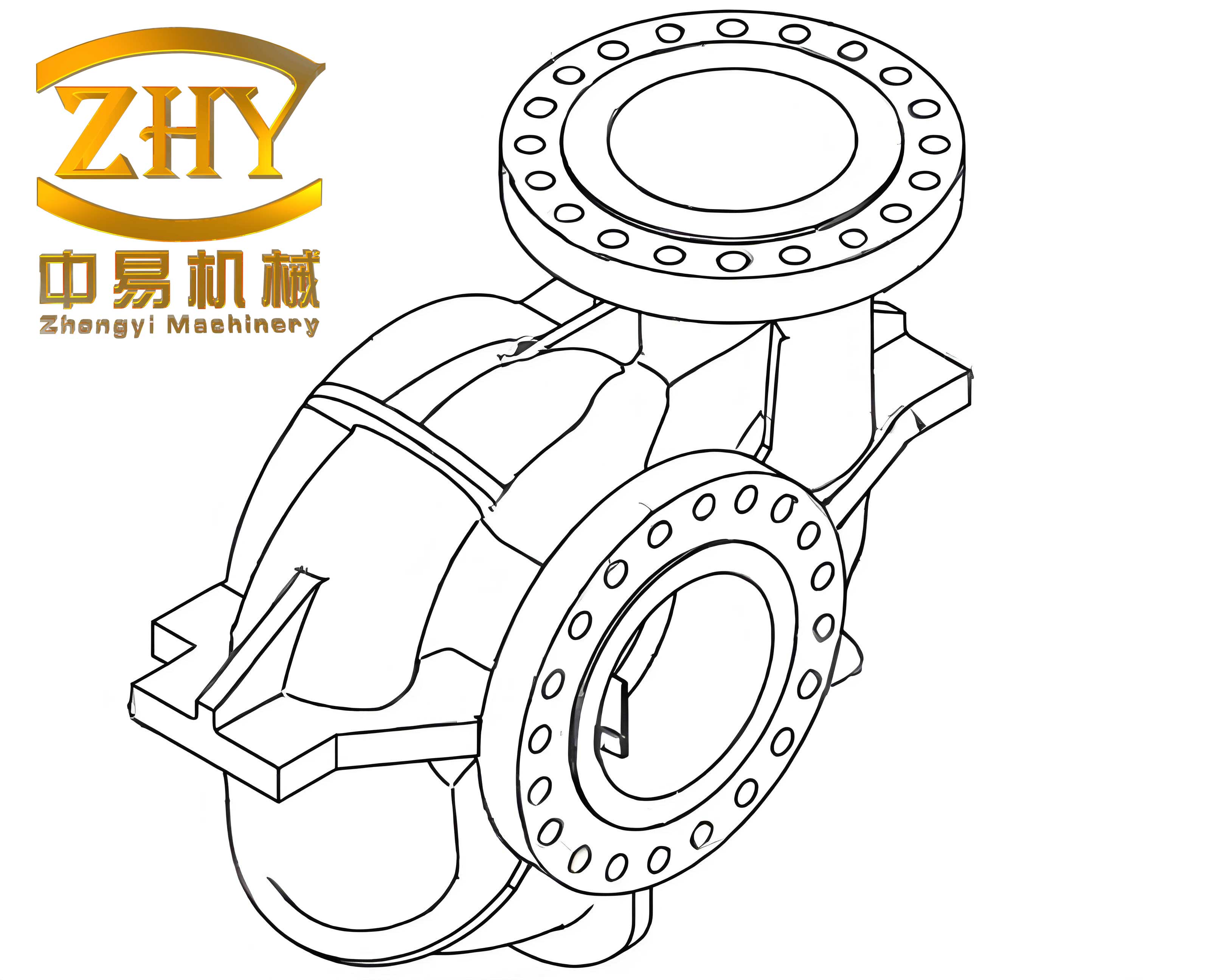
where a more uniform \( \nabla T \) minimizes hot spots. The image below illustrates the complex structure of a typical shell casting, highlighting areas prone to defects like those addressed in this study:
Gas porosity was another major issue in the shell casting, particularly in the lower flange where gas entrapment occurred. The core venting strategy involved creating vent holes to allow gas escape during pouring. The ideal gas law can be referenced to understand gas behavior:
$$
PV = nRT
$$
where \( P \) is pressure, \( V \) is volume, \( n \) is moles of gas, \( R \) is the gas constant, and \( T \) is temperature. By providing vents, we reduced \( P \), preventing gas bubble formation. Additionally, improving core drying lowered \( n \), further mitigating defects. For sand adhesion, increasing molding pressure enhanced sand compaction, which can be quantified by the sand strength equation:
$$
\sigma = \sigma_0 e^{-k \epsilon}
$$
with \( \sigma \) as strength, \( \sigma_0 \) as initial strength, \( k \) as a constant, and \( \epsilon \) as strain. Higher pressure reduces \( \epsilon \), improving resistance to metal penetration. The use of refractory coatings added a protective layer, modeled as an additional thermal barrier:
$$
R_{\text{th}} = \frac{L}{k_{\text{coat}}}
$$
where \( R_{\text{th}} \) is thermal resistance, \( L \) is coating thickness, and \( k_{\text{coat}} \) is coating conductivity. This reduced heat transfer to the sand, preventing fusion.
After implementing these optimizations, the shell casting quality improved significantly. Dimensional inspections confirmed compliance with CT9 and CT8 tolerances, and metallographic analysis showed nodularity exceeding 80%, meeting customer specifications. The success of this project underscores the value of CAE simulation in designing robust processes for shell castings. To further illustrate the process parameters, here is a table comparing initial and optimized conditions for the shell casting:
| Process Parameter | Initial Design | Optimized Design | Impact on Shell Castings |
|---|---|---|---|
| Riser Design | Hot riser without chills | Hot riser with conformal chills | Improved feeding, reduced shrinkage in shell castings |
| Fillet Radius | R3 in thin sections | R15 in critical areas | Balanced wall thickness, minimized hot spots in shell castings |
| Venting | No dedicated vents in cores | 6 vent holes (ø16 mm) added | Eliminated gas porosity in shell castings |
| Molding Pressure | 135-132 N/cm | 148-145 N/cm | Enhanced sand strength, reduced adhesion in shell castings |
| Pouring Temperature | Higher range | Controlled lower range | Reduced thermal stress, better solidification for shell castings |
The integration of MAGMA simulations allowed us to visualize solidification patterns and defect formation in shell castings before physical trials. For example, the software solved the Navier-Stokes equations for fluid flow during mold filling:
$$
\rho \left( \frac{\partial \vec{v}}{\partial t} + \vec{v} \cdot \nabla \vec{v} \right) = -\nabla p + \mu \nabla^2 \vec{v} + \rho \vec{g}
$$
where \( \vec{v} \) is velocity, \( p \) is pressure, \( \mu \) is viscosity, and \( \vec{g} \) is gravity. This helped optimize gating systems to ensure smooth filling without turbulence, crucial for shell castings with complex geometries. The solidification time \( t_s \) can be estimated using Chvorinov’s rule:
$$
t_s = C \left( \frac{V}{A} \right)^n
$$
with \( C \) and \( n \) as constants, \( V \) as volume, and \( A \) as surface area. For shell castings, modifying riser size and placement altered \( V/A \), affecting feeding efficiency. Simulation outputs, such as temperature contours and liquid fraction plots, guided these adjustments.
In conclusion, the development of QT550-6 shell castings demonstrates how CAE-driven optimization can overcome inherent challenges in casting processes. By leveraging MAGMA software, we identified defect-prone areas and implemented targeted solutions like chills, venting, and sand strengthening. This approach not only reduced trial-and-error but also shortened development cycles, ensuring high-quality shell castings for demanding applications. The lessons learned here can be extended to other shell castings, promoting wider adoption of simulation tools in foundries. Future work may involve advanced materials modeling or real-time monitoring to further enhance shell casting quality and efficiency.
Throughout this project, the focus on shell castings has been paramount, as these components play a vital role in heavy machinery. The repeated emphasis on shell castings in this article highlights their significance and the need for specialized process design. As technology advances, continuous improvement in simulation accuracy and process control will drive innovation in shell castings, enabling more reliable and cost-effective production. The integration of empirical data with computational models will further refine our understanding, making shell castings a benchmark for quality in the casting industry.