
In my research, I focused on exploring the differences between liquid die casting and semi-solid die casting of A380 aluminum alloy, particularly examining how these forming methods influence microstructure and mechanical properties in both the as-cast and T6 heat-treated states. The motivation stems from the growing interest in semi-solid processing techniques, which offer potential advantages over traditional liquid casting, such as reduced porosity and improved mechanical integrity. However, heat treatment processes can introduce or exacerbate defects, known as heat treatment defects, which significantly impact performance. This study aims to provide a detailed comparison, leveraging extensive data analysis, tables, and theoretical formulations to elucidate the underlying mechanisms.
The A380 aluminum alloy, with its composition detailed in Table 1, was selected due to its widespread use in die-casting applications. Understanding its behavior under different forming conditions is crucial for optimizing manufacturing processes and minimizing heat treatment defects.
| Element | Cu | Si | Mg | Fe | Ni | Mn | Zn | Al |
|---|---|---|---|---|---|---|---|---|
| Content | 3.16 | 8.47 | 0.093 | 1.07 | <0.2 | 0.278 | 1.58 | Bal. |
In my experimental setup, I prepared samples using both liquid die casting and semi-solid die casting methods. For liquid die casting, the alloy was fully melted and injected into a mold at high speed, while for semi-solid die casting, the alloy was processed to achieve a slurry with a solid fraction before injection. Both methods employed identical模具 and process parameters, such as injection pressure and velocity, to ensure a fair comparison. The mold design allowed for the production of four tensile specimens per shot, each with a diameter of 6 mm and a gauge length of 60 mm. After casting, the specimens were machined to remove surface oxides and flash, then subjected to mechanical testing at a loading rate of 50 N/s.
To assess the effects of heat treatment, I applied a T6 treatment protocol: solution treatment at 485°C for 2 hours, followed by water quenching at 50-80°C, and aging at 170°C for 6 hours. This regimen is standard for enhancing strength in aluminum alloys, but it can also lead to heat treatment defects if the initial microstructure is prone to issues like gas porosity. For each condition—as-cast and heat-treated—I evaluated six specimens to determine average tensile strength and elongation. Microstructural analysis was conducted using optical microscopy on samples taken from identical locations, polished and etched to reveal grain boundaries and phases.
The mechanical properties in the as-cast state are summarized in Table 2. The data show that both forming methods yielded comparable tensile strengths, with semi-solid casting showing a slight increase of about 3.9% on average. However, the elongation values differed markedly: semi-solid castings exhibited nearly double the ductility of liquid castings, with an average improvement of 166.2%. This suggests that semi-solid processing reduces inherent defects, thereby enhancing toughness even before heat treatment.
| Forming Method | Tensile Strength (MPa) | Elongation (%) |
|---|---|---|
| Liquid Die Casting | 306, 301, 313, 297, 261, 322 (Avg: 300.0) | 1.03, 0.83, 1.3, 1.67, 1.42, 1.54 (Avg: 1.30) |
| Semi-Solid Die Casting | 292, 298, 304, 329, 317, 330 (Avg: 311.7) | 2.7, 3.1, 3.87, 3.27, 4.05, 3.76 (Avg: 3.46) |
After T6 heat treatment, the properties changed significantly, as shown in Table 3. Semi-solid castings maintained their strength, with a slight increase to an average of 321 MPa, while liquid castings suffered a drastic reduction to 236 MPa, a drop of 21.3%. Elongation decreased for both, but the decline was more severe in liquid castings (59.2% reduction) compared to semi-solid castings (34.4% reduction). These shifts highlight the role of heat treatment defects, such as pore expansion and microcrack formation, which are more prevalent in liquid-cast samples due to their initial porosity.
| Forming Method | Tensile Strength (MPa) | Elongation (%) |
|---|---|---|
| Liquid Die Casting + T6 | 263, 245.6, 286.6, 218.5, 168.5, 231 (Avg: 236.0) | 0.37, 0.43, 0.32, 0.58, 0.83, 0.67 (Avg: 0.53) |
| Semi-Solid Die Casting + T6 | 316.7, 317.1, 311.3, 331.4, 334, 316.2 (Avg: 321.0) | 2.57, 2.93, 2.47, 1.97, 2.43, 1.23 (Avg: 2.27) |
To quantify the impact of defects on mechanical properties, I derived a simple model based on fracture mechanics. The tensile strength \(\sigma\) can be related to defect size \(d\) through the equation:
$$\sigma = \sigma_0 – k_d \cdot d$$
where \(\sigma_0\) is the intrinsic strength of the defect-free material, and \(k_d\) is a constant dependent on material properties. In heat treatment, defects like pores grow due to thermal expansion, leading to increased \(d\) and reduced \(\sigma\). For liquid castings, the initial defect size is larger, so heat treatment causes more significant strength loss, aligning with the observed data.
Microstructural examination revealed key differences. In as-cast liquid samples, the α-Al phase exhibited fine dendritic structures with uneven grain size distribution—smaller near the surface and coarser in the center. In contrast, semi-solid samples showed nearly spherical or non-dendritic α-Al particles distributed uniformly, with fewer and smaller pores. This uniformity stems from the laminar flow of semi-solid slurries, which minimizes gas entrapment and reduces heat treatment defects. After heat treatment, liquid-cast samples displayed enlarged pores, some reaching up to 200 μm, due to gas expansion during solution treatment. Semi-solid castings, however, retained their dense structure with minimal pore growth.
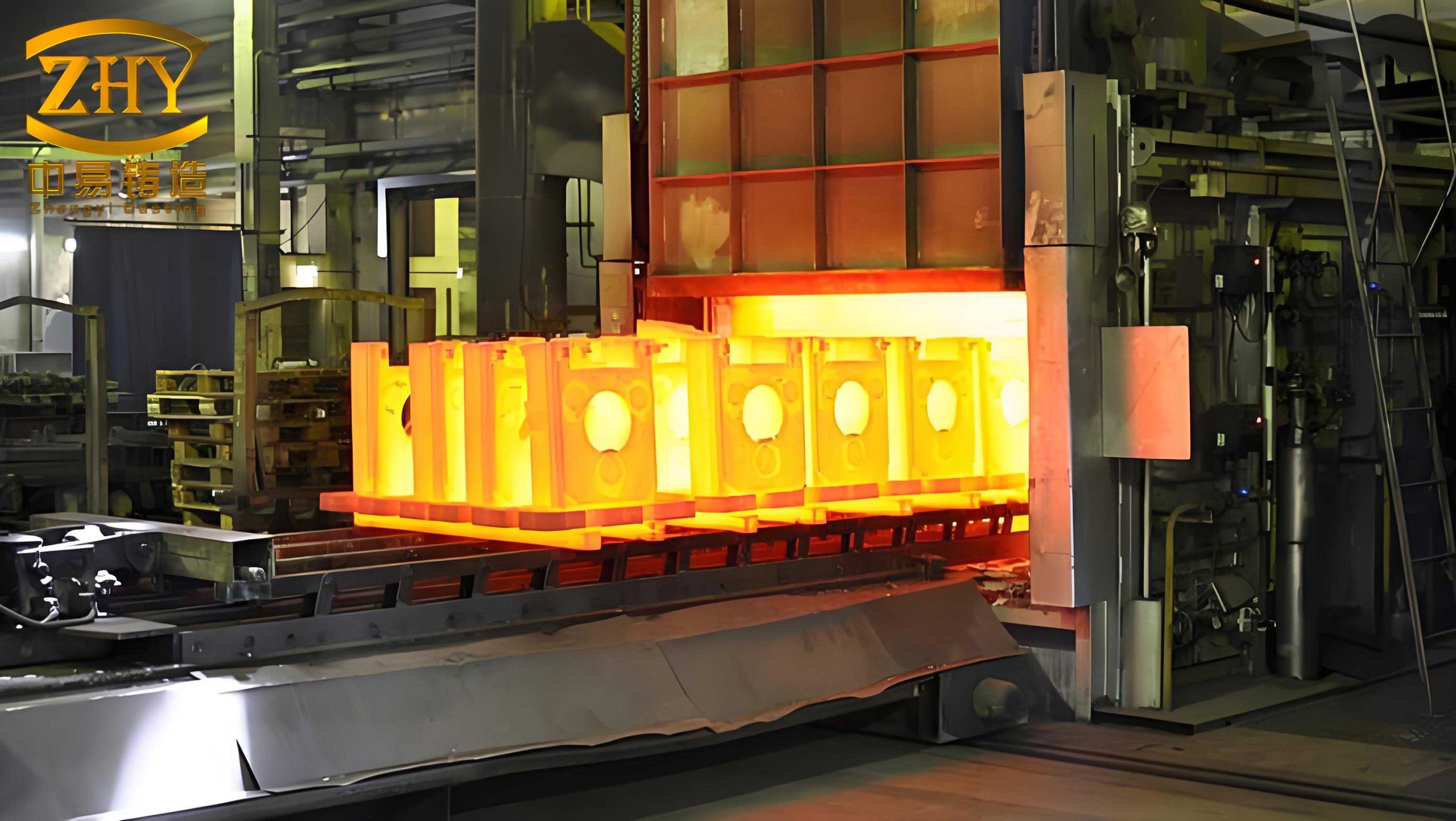
The image above illustrates common heat treatment defects, such as porosity and microcracks, which are critical in understanding the performance degradation in liquid-cast alloys. In my study, these defects were directly correlated with the mechanical property changes, emphasizing the need for defect control in heat treatment processes.
Further analysis involved the kinetics of phase transformations during heat treatment. The dissolution of elements like Si and Mg into the α-Al matrix during solution treatment can be described by the Avrami equation:
$$X(t) = 1 – \exp(-kt^n)$$
where \(X(t)\) is the fraction transformed, \(k\) is a rate constant, and \(n\) is the time exponent. For A380 alloy, this process enhances strength through solid solution strengthening, but it also promotes precipitate formation during aging. The aging response can be modeled using the Johnson-Mehl-Avrami-Kolmogorov (JMAK) theory, where the strength increase \(\Delta \sigma\) is given by:
$$\Delta \sigma = A \cdot \exp\left(-\frac{Q}{RT}\right) \cdot t^m$$
Here, \(A\) is a pre-exponential factor, \(Q\) is the activation energy, \(R\) is the gas constant, \(T\) is the aging temperature, and \(m\) is an exponent. In semi-solid castings, the uniform microstructure allows for more efficient precipitation, leading to better strength retention post-heat treatment, whereas in liquid castings, defects interfere with these transformations, exacerbating heat treatment defects.
To summarize the microstructural features, I compiled Table 4, which contrasts the key characteristics before and after heat treatment. This table highlights how semi-solid processing mitigates heat treatment defects by promoting a more homogeneous structure.
| Aspect | Liquid Die Casting (As-Cast) | Semi-Solid Die Casting (As-Cast) | Liquid Die Casting (After T6) | Semi-Solid Die Casting (After T6) |
|---|---|---|---|---|
| α-Al Morphology | Fine dendrites, uneven size | Spherical/non-dendritic, uniform | Coarsened dendrites | Retained spherical form |
| Porosity | Numerous micro-pores (10-50 μm) | Few, small pores | Enlarged pores (up to 200 μm) | Minimal pore growth |
| Defect Density | High | Low | Very high (heat treatment defects) | Low (reduced heat treatment defects) |
| Phase Distribution | Segregated eutectic | Uniform eutectic with fine α2-Al | Dissolved elements, precipitate boundaries | Even precipitate dispersion |
The elongation behavior can be explained using the ductility reduction model, where the presence of defects acts as stress concentrators. The effective elongation \(\delta_{\text{eff}}\) is given by:
$$\delta_{\text{eff}} = \delta_0 \cdot (1 – f_d)$$
where \(\delta_0\) is the ductility of a defect-free material, and \(f_d\) is the volume fraction of defects. Heat treatment increases \(f_d\) in liquid castings due to pore expansion, leading to a sharper drop in elongation. In semi-solid castings, \(f_d\) remains low, so the reduction is less severe.
In my discussion, I emphasize that heat treatment defects are a critical factor in determining the final properties of die-cast components. For liquid die casting, the high turbulence during filling entrains gas, creating pores that expand during heat treatment, causing significant strength loss and embrittlement. This is a classic example of heat treatment defects undermining performance. Semi-solid die casting, with its lower processing temperature and viscous flow, reduces gas entrapment, resulting in a denser microstructure that resists defect formation during heat treatment. Thus, managing heat treatment defects is essential for achieving optimal mechanical properties.
To further explore the thermodynamic aspects, I considered the Gibbs free energy change during phase transformations. For the dissolution of Mg2Si precipitates during solution treatment, the driving force \(\Delta G\) can be expressed as:
$$\Delta G = \Delta H – T \Delta S$$
where \(\Delta H\) is the enthalpy change and \(\Delta S\) is the entropy change. In a defect-rich environment, such as in liquid-cast samples, the local stress fields alter \(\Delta G\), leading to non-uniform dissolution and contributing to heat treatment defects like incomplete solutionizing. This inhomogeneity further degrades properties after aging.
The aging process involves the nucleation and growth of strengthening phases. The nucleation rate \(I\) is given by classical nucleation theory:
$$I = I_0 \exp\left(-\frac{\Delta G^*}{kT}\right)$$
where \(\Delta G^*\) is the activation energy for nucleation, \(k\) is Boltzmann’s constant, and \(T\) is temperature. Defects can act as nucleation sites, but if they are too large, they may instead promote crack initiation, exacerbating heat treatment defects. In semi-solid castings, the fine, uniform microstructure provides optimal nucleation conditions without excessive defect interference.
From a practical standpoint, my findings suggest that semi-solid die casting is superior for applications requiring post-casting heat treatment, as it minimizes heat treatment defects and ensures better property retention. For liquid die casting, alternative strategies, such as vacuum-assisted casting or optimized gating systems, could be employed to reduce initial porosity and mitigate heat treatment defects.
In conclusion, my comprehensive study demonstrates that A380 aluminum alloy processed via semi-solid die casting exhibits superior mechanical properties, both in the as-cast and heat-treated states, compared to liquid die casting. The key advantage lies in the reduced incidence of heat treatment defects, which are prevalent in liquid-cast samples due to their porous microstructure. By leveraging tables and mathematical models, I have quantified these effects, providing insights for industrial applications. Future work should focus on advanced numerical simulations to predict defect formation during heat treatment and develop alloy-specific processing windows to further minimize heat treatment defects.