
In the manufacturing of high-speed punching machines, the disc component plays a critical role as part of the flywheel assembly, ensuring uniform punching force and extended service life. This disc, characterized by its large size and complex geometry, is typically produced from spheroidal graphite cast iron, specifically QT500-7 grade, to meet stringent mechanical property requirements. As an engineer involved in foundry process development, I have undertaken the task of designing and optimizing the casting process for such a heavy-duty spheroidal graphite cast iron disc, with a focus on minimizing defects and ensuring structural integrity. This article details the comprehensive approach, from initial工艺 analysis to simulation validation and production verification, emphasizing the use of tables and formulas to summarize key data and principles.
The disc casting has a massive weight of approximately 38,000 kg, with overall dimensions of 1,700 mm in height and 4,800 mm in outer diameter, reaching a maximum size of 5,820 mm. The primary wall thickness is 220 mm, with localized hot spots at the bearing seat roots. The material specification demands a tensile strength greater than 420 MPa, yield strength above 320 MPa, and elongation over 5% from separately cast test bars. Given the extensive cavity area and the propensity of spheroidal graphite cast iron for oxidation and turbulence-related defects, a meticulous工艺 design is essential. The large modulus of the casting theoretically allows for riserless casting, provided that resin sand strength is adequate and effective in-mold inoculation is applied.
In the工艺 analysis, I first addressed the chemical composition, which is foundational for achieving the desired microstructure and properties in spheroidal graphite cast iron. Carbon equivalent (CE) is a key parameter, typically controlled between 4.0% and 4.2% to balance fluidity and shrinkage behavior. The formula for carbon equivalent is often expressed as: $$CE = C + \frac{Si}{3} + \frac{P}{3}$$ where C, Si, and P are weight percentages. For this application, I aimed for a carbon content around 3.5%, with silicon adjusted to achieve the target CE. Phosphorus, a positive segregating element that promotes carbide formation, must be kept as low as possible, ideally below 0.02%. Sulfur content is critical for effective magnesium treatment; a low sulfur level (below 0.015%, preferably under 0.01%) ensures that a lower residual magnesium content (0.035–0.055%) can yield good spheroidization. Trace elements are categorized into magnesium-consuming elements (e.g., Ti, S, O) and positive segregating carbide formers (e.g., Mn, Cr, Mo). For heavy-section spheroidal graphite cast iron, minor additions of interferents like Sb or Bi (0.005–0.01%) can enhance graphite nodule count and spheroidization rate, mitigating chunk graphite formation. The designed chemical composition before and after treatment is summarized in Table 1.
| Element Category | C | Si | Mn | P | S | Cu | Sb | Mgres |
|---|---|---|---|---|---|---|---|---|
| Before Spheroidization | 3.5–3.7 | 1.4–1.5 | 0.35–0.45 | ≤0.02 | ≤0.01 | – | – | – |
| After Spheroidization | 3.4–3.6 | 2.0–2.4 | 0.35–0.45 | ≤0.02 | 0.006–0.01 | 0.5–0.8 | 0–0.01 | 0.035–0.055 |
The molding工艺 employed furan resin sand with a three-part flask system. The parting surface was designed to position the disc’s bottom surface in the drag, facilitating a bottom-gating system for平稳 filling. To ensure material density at the bottom face and minimize冲砂 risks, the浇注位置 was set with the底面 downward, and metal was introduced through multiple ingates from the bottom. A conformal runner was used to reduce turbulence. Given the prolonged solidification time of large-modulus spheroidal graphite cast iron, chills were strategically placed at hot spots, particularly near the bearing seats, to accelerate cooling, refine microstructure, and reduce shrinkage porosity. The浇注系统 was designed based on principles for heavy spheroidal graphite cast iron castings, with a total metal weight of about 40,000 kg. The cross-sectional area ratios were set approximately as ΣSsprue : ΣSrunner : ΣSingate = 1 : 1.2 : 0.8, ensuring high flow rate and平稳 flow. The gating and chilling layout is illustrated in the工艺 schematic.
Melting and treatment processes are crucial for achieving high-quality spheroidal graphite cast iron. For球化处理, a冲入法 was used with a yttrium-based heavy rare earth spheroidizer. This choice helps combat球化衰退 in thick sections by maintaining stable spheroidization over longer solidification times. The spheroidizer composition and addition rate are detailed in Table 2. The residual magnesium content is tightly controlled, as excessive镁 can lead to shrinkage and slag defects. Sulfur content post-treatment is kept at 0.006–0.01% to延缓衰退.
| Type | RE | Mg | Si | Addition Rate |
|---|---|---|---|---|
| Yttrium-based Heavy RE Spheroidizer | 1.5–2.5 | 6–7 | 45 | 1.0–1.2 |
孕育处理 involved multiple stages to enhance graphite nucleation and prevent degenerate forms like chunk graphite. A barium-containing高效孕育剂 was used for ladle inoculation, followed by a长效随流孕育剂 during pouring. The孕育剂 details are in Table 3. It’s important to note that原铁液 sulfur should not be too low (>0.006%) and oxygen content should be adequate (>0.001%) for effective inoculation, while total silicon is monitored to avoid excessive levels.
| Type | Si | Ca | Al | Ba | RE | Addition Rate |
|---|---|---|---|---|---|---|
| Ba-containing高效孕育剂 | 70–75 | 1.5–2.0 | 1.0–2.0 | 1.0–2.0 | – | 0.5–0.6 |
| 长效随流孕育剂 | 55–65 | – | – | – | 1.0–2.0 | 0.1–0.2 |
Melting parameters were optimized to shorten solidification time and reduce液态收缩. The melt was superheated to 1,500–1,550°C, held for 5–8 minutes for purification, then tapped at 1,430–1,460°C. To achieve a low pouring temperature without extending holding time (which could cause孕育衰退), methods like ladle transfer were used for rapid cooling. The pouring temperature was set at 1,300–1,330°C, balancing fluidity and defect minimization.
To validate the工艺 design, I utilized AnyCasting software for模拟分析 of filling and solidification processes. The simulation results confirmed平稳 filling with minimal turbulence. At 40% fill, the average fluid velocity within the casting was 51 cm/s, indicating no冲砂 risk. Oxide inclusion risks were reduced by the end of filling, and temperature drops were moderate (50°C total), eliminating cold shut concerns. The filling sequence showed uniform metal arrival times across the cavity after 43 seconds, with no isolated liquid islands after 12 seconds. Velocity fields indicated acceptable speeds at ingate entries (160 cm/s at 14% fill). Oxide distribution simulations highlighted potential risks at bearing seat工艺台 early in filling, but these diminished by completion. Temperature field analysis revealed gradual cooling, supporting the designed浇注温度 range.
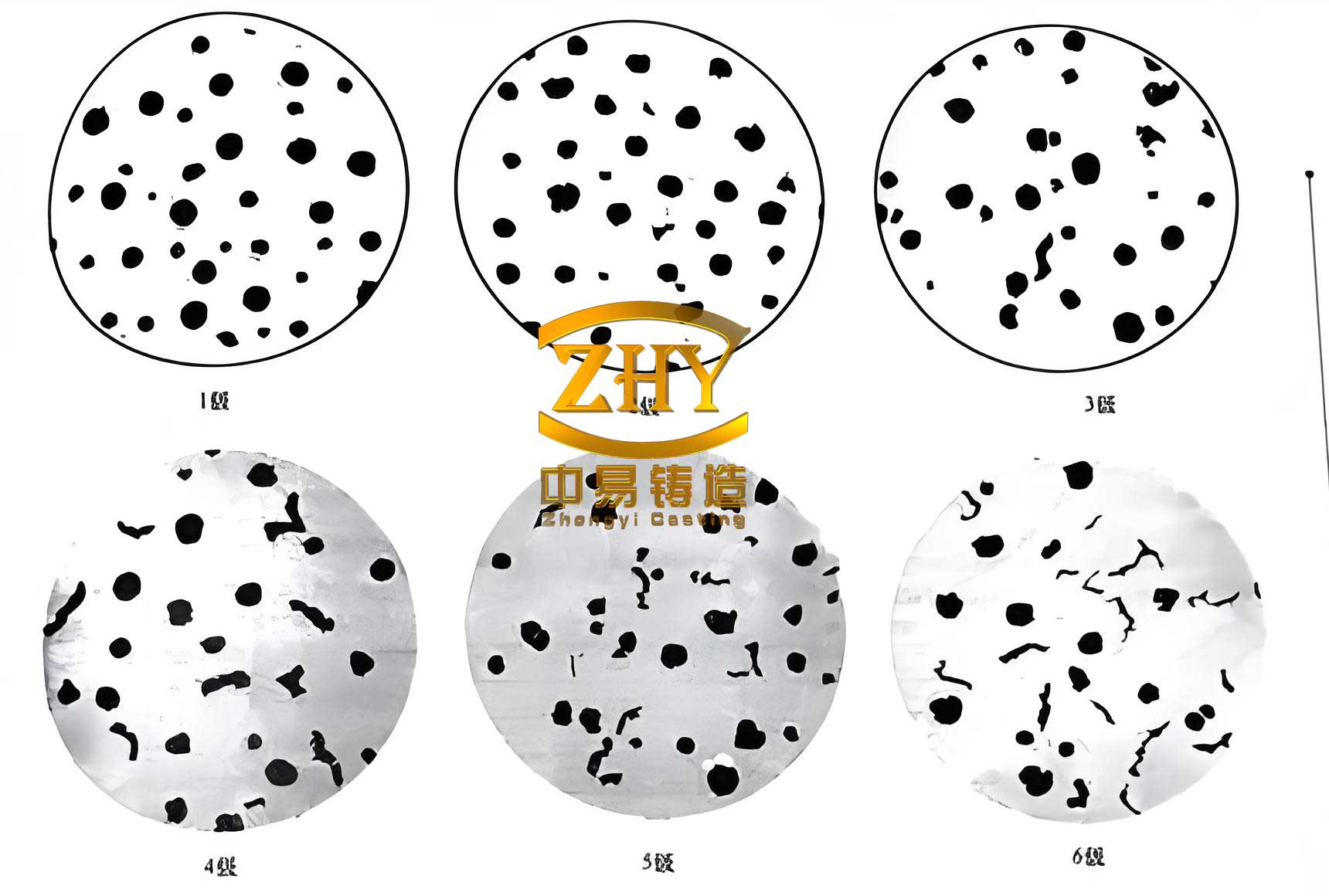
Based on these simulations, the工艺 was finalized and implemented in production. The resulting spheroidal graphite cast iron disc was evaluated for chemical composition, mechanical properties, and microstructure. The actual composition, shown in Table 4, aligns well with design targets. The attached test specimens exhibited excellent properties: tensile strength of 535 MPa, elongation of 5.5%, graphite grade 6, and spheroidization rate of 95.42%, all meeting specifications (Table 5). Metallographic examination revealed well-formed graphite nodules and a pearlitic-ferritic matrix, confirming effective treatment and cooling.
| C | Si | Mn | P | S | Cu | Sb | Mgres |
|---|---|---|---|---|---|---|---|
| 3.43 | 2.09 | 0.42 | 0.020 | 0.010 | 0.65 | 0.005 | 0.045 |
| Property | Tensile Strength (MPa) | Elongation (%) | Graphite Grade | Spheroidization Rate (%) |
|---|---|---|---|---|
| Requirement | ≥420 | ≥5 | ≥4 | ≥90 |
| Actual | 535 | 5.5 | 6 | 95.42 |
The first article was machined without defects, demonstrating the工艺’s success. The process was then standardized for production. Key conclusions from this work include: For punch disc castings in spheroidal graphite cast iron, chemical composition should target a carbon equivalent of 4.0–4.2%, silicon 2.1–2.3%, manganese ≤0.5%, with residual magnesium at 0.035–0.055% and rare earth elements at 0.01–0.02%. Multiple inoculation stages and yttrium-based heavy rare earth spheroidizers are effective in缩短凝固时间 and improving graphite morphology. A bottom-gating system with dispersed ingates ensures平稳 filling, while chills enhance cooling at critical areas, reducing shrinkage and improving density and mechanical properties. The integration of simulation tools like AnyCasting provides valuable insights for optimizing spheroidal graphite cast iron casting processes, ultimately leading to reliable high-performance components.
Throughout this project, the importance of controlling elemental interactions in spheroidal graphite cast iron cannot be overstated. The relationship between sulfur and magnesium can be described by an equilibrium equation: $$[Mg] + [S] \rightarrow MgS$$ where low sulfur allows lower magnesium residuals for effective spheroidization. Similarly, the effect of cooling rate on graphite nodule count can be approximated using solidification models. For instance, the nodule count N is often related to undercooling ΔT by: $$N = k \cdot (\Delta T)^n$$ where k and n are material constants. These principles guided the工艺 design to achieve fine, uniform graphite in the heavy-section spheroidal graphite cast iron disc.
In summary, the successful production of the spheroidal graphite cast iron punch disc hinges on a holistic approach combining precise chemistry, advanced molding techniques, controlled melting practices, and thorough simulation validation. This methodology not only meets the immediate requirements but also sets a benchmark for future large-scale spheroidal graphite cast iron castings in industrial applications.