
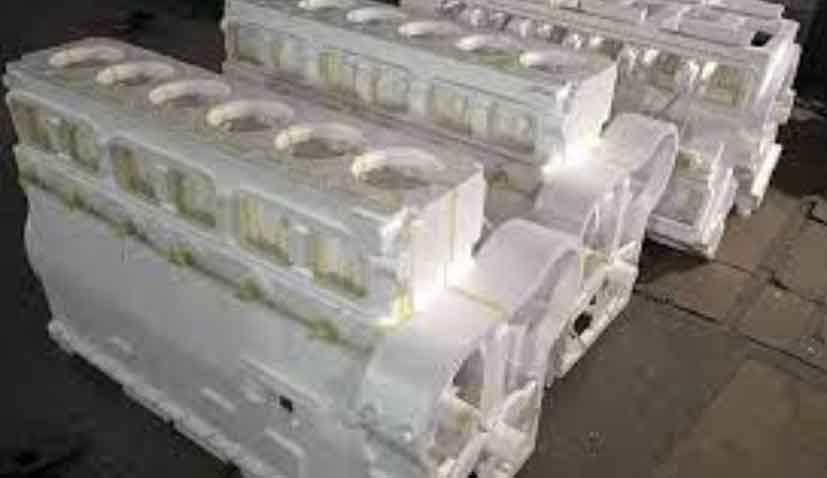
Lost foam casting is a green manufacturing method characterized by clean production, where a foam pattern proportional to the cast part is formed, coated with a refractory layer, and compacted in sand. Under negative pressure conditions, molten metal is poured directly into the mold containing the foam pattern, causing the pattern to vaporize and decompose at high temperatures. The metal then replaces the pattern’s position, solidifying to produce the desired casting. The surface roughness, dimensional accuracy, and defects of lost foam castings are influenced by factors such as the stiffness, strength, and surface quality of the vaporized foam pattern. For specific pattern materials, optimizing the molding process and precisely controlling pattern preparation parameters are prerequisites for ensuring casting quality and yield. Currently, fully automated pre-foaming equipment with controllable parameters is widely used for complex lost foam castings. However, due to the high cost of such equipment, it is essential to develop a user-friendly, high-performance, and low-cost pre-foaming system for lost foam casting. Therefore, this study focuses on the design of a control system for lost foam casting pattern molding using an OMRON CJ2M PLC. The system sequentially controls the pre-foaming process through PLC programming, monitoring process parameters and I/O statuses of corresponding equipment. This approach has practical significance for optimizing pattern molding processes and stabilizing pre-foaming quality in lost foam casting.
The pre-foaming molding equipment for lost foam casting primarily includes a pre-foaming machine and a vertical hydraulic molding machine. The basic structure is illustrated in the following diagram, which shows the integration of key components such as the material silo, pre-foaming chamber, and molding unit. The system employs a shared steam heating system with adjustable temperature, pressure, and steam time, where steam temperature is limited to ≤181°C and pressure to ≤1 MPa. Based on the selected foam material and blowing agent, the steam system regulates preheating and pre-foaming parameters in the pre-foaming chamber. A blower and fluidized bed are used for uniform drying of pre-foamed beads, controlling their pre-expansion density. The pre-foamed beads are then transported to a ventilated, dry aging silo, where aging time is adjusted to restore bead elasticity. After mold clamping, the molding machine preheats the mold via the steam system, automatically injects material through a feeder to fill the mold cavity, and adjusts steam temperature, pressure, and heating time to facilitate secondary foaming into the pattern. The molded pattern is cooled by spray, and moisture is extracted under negative pressure to prevent deformation. Upon mold opening, a vacuum suction cup removes the pattern, which is then assembled with gating systems to form the final lost foam casting pattern cluster.
The electromechanical control system for lost foam casting pre-foaming equipment consists of a PLC control system, steam heating and pressurization devices, aging and feeding equipment, an electro-hydraulic mold clamping system, a pattern cooling system, and a vacuum device. The system precisely controls pre-foaming feeding and injection mass by monitoring weight reduction in the material silo and aging silo, and it online monitors process parameters such as temperature and pressure during pre-foaming and molding. The PLC processes these data to directly control the operation of steam heating, injection, vacuum, cooling, and mold clamping equipment. Given the complexity of the lost foam casting pre-foaming process, the system adopts an OMRON CJ2M-CPU32 PLC and serial communication scheme, considering factors such as equipment cost, control performance, device spacing, I/O port count, and analog signal measurement. The hardware configuration is detailed in Table 1.
| Component | Description | Function |
|---|---|---|
| CPU Rack | Power supply CJ1W-PA205R, controller CJ2M-CPU32, serial communication CJ1W-SCU41, I/O interface CJ1W-IC101, analog input CJ1W-AD081, digital input CJ1W-ID211 (3×), digital output CJ1W-OC211 (2×) | Connects to operation panel, intermittent feeder, and pre-foaming machine; monitors temperature, pressure, and weight signals |
| Expansion Rack | Power supply, I/O interface CJ1W-II101, analog input CJ1W-AD041, digital input CJ1W-ID211 (2×), digital output CJ1W-OC211 (2×) | Connects to vertical hydraulic molding machine, cooling device, and vacuum system; monitors temperature and pressure signals |
| Touch Screen | NS10-TV | Provides interface for parameter setting and online monitoring |
The controller CJ2M-CPU32 is responsible for centralized monitoring and control of process parameters and equipment status in lost foam casting pattern molding. The serial module CJ1W-SCU41 connects to the touch screen NS10-TV, allowing easy setting of parameters such as preheating temperature, feeding amount, pre-foaming temperature, pressure, and action time. It also facilitates online monitoring and management of the pre-foaming process. The CJ2M-CPU32 includes a built-in Ethernet interface, enabling technicians to export historical data and correct pre-foaming process parameters to improve pattern quality. The expansion I/O interface CJ1W-IC101 links to CJ1W-II101, integrating I/O modules from the expansion rack into the controller for centralized processing. The two racks provide 80 digital input and 64 digital output points, used for connecting operation buttons, control switches, position sensors, status indicators, and fault alarms.
The analog input module CJ1W-AD081 in the CPU rack has eight channels: three connect to PT100 temperature sensors (with an upper limit of 200°C) to monitor steam heating and pre-foaming chamber temperatures; one connects to a PTS305H pressure sensor to monitor absolute pressure and negative pressure in the foaming chamber; and three connect to YZC-242/75 kg load cells to measure the weight of foam material in the silo and aging silo, enabling precise control of feeding and injection amounts. The analog input module CJ1W-AD041 in the expansion rack has four channels: three connect to temperature sensors to measure oil temperature, motor temperature, and cooling spray temperature in the hydraulic system; and one connects to a pressure sensor to monitor hydraulic oil pressure during mold clamping.
The control system for lost foam casting pre-foaming equipment requires both “automatic” and “manual debugging” modes. Based on the hardware configuration, the PLC program flow is designed as follows: after system power-on and initialization, technicians set process parameters such as time, pressure, and injection amount according to the process card. If “automatic” control is selected, the PLC performs hardware detection on the pre-foaming equipment and control system. If no abnormalities are found in process parameters and equipment operation, the PLC executes automatic control of the pre-foaming process, monitoring equipment status and parameters via digital and analog modules. The key aspects of PLC program control for lost foam casting include precise regulation of pre-foaming and foaming temperatures and accurate control of cavity injection. Temperature is critically linked to pattern density: low temperature results in insufficient foaming and high density, leading to gas defects in castings, while high temperature causes poor mechanical properties and dimensional instability. Therefore, a closed-loop PID control is employed for temperature regulation, as the temperature variation range is small. The control principle is expressed mathematically as follows:
Let \( T_{\text{set}} \) be the set temperature and \( T_{\text{actual}} \) be the measured temperature from PT100 sensors. The error \( e(t) \) is calculated as:
$$ e(t) = T_{\text{set}} – T_{\text{actual}} $$
The PID control output \( u(t) \) is given by:
$$ u(t) = K_p e(t) + K_i \int_0^t e(\tau) d\tau + K_d \frac{de(t)}{dt} $$
where \( K_p \), \( K_i \), and \( K_d \) are the proportional, integral, and derivative gains, respectively. In the constant temperature phase, the integral term eliminates steady-state error, while the derivative term compensates for oscillations to maintain stability. If the temperature deviation exceeds a threshold, the proportional parameter is adjusted based on the error sign to regulate heating rate. During manual debugging, temperature control relies on empirical adjustments. For cavity injection, closed-loop control is based on the mass reduction signal of the aging silo: the total feeding amount is set according to the desired bead expansion density and aging time, and the injection feeder fills the cavity intermittently. The feeding amount for each interval is stored in a PLC intermediate variable and compared with the mass reduction signal, with the deviation feedback controlling the subsequent feeding amount.
To facilitate operator interaction, an operation panel and touch screen monitoring interface are designed. The operation panel is used for point-to-point control of pre-foaming equipment in manual debugging mode, with actual status feedback via indicators and signal lights. The touch screen enables online monitoring and control of pre-foaming parameters and states, developed to support interactive processing of PLC intermediate variables, I/O variables, and analog signals. As shown in Table 2, the interface allows setting of pre-foaming/foaming temperature, time, and pressure, and provides sequential control of feeding, electric heating, steam enable, and pre-foaming processes, while displaying set and measured values.
| Function | Description |
|---|---|
| Parameter Setting | Allows input of pre-foaming temperature, pressure, time, and injection amount |
| Process Control | Enables sequential control of feeding, heating, steam, and pre-foaming operations |
| Status Display | Shows real-time temperature, pressure, weight, and equipment status |
| Data Logging | Records historical data for parameter optimization |
The developed control system for lost foam casting was tested under practical conditions, using a pattern wall thickness of approximately 4 cm, made from Longwang F-MS beads with a grain size of 1.2–1.8 mm and pre-expansion density of 15 g/L. The process parameters were set to pressure (0.4 ± 0.02) MPa, foaming temperature (105 ± 5)°C, and time 20 s. The CJ2M PLC sampling time was 200 ms, and the measured foaming temperature results are summarized in Table 3. The PID-controlled foaming temperature exhibited a fluctuation range of 103–109°C, meeting the process requirement of (105 ± 5)°C. This demonstrates the system’s effectiveness in maintaining stable temperature control for lost foam casting.
| Time (s) | Set Temperature (°C) | Actual Temperature (°C) | Deviation (°C) |
|---|---|---|---|
| 0 | 105 | 103 | -2 |
| 5 | 105 | 106 | +1 |
| 10 | 105 | 108 | +3 |
| 15 | 105 | 107 | +2 |
| 20 | 105 | 109 | +4 |
In conclusion, this study presents a PLC-based control system for lost foam casting pattern molding that is general-purpose, user-friendly, and cost-effective. The system integrates touch screen interface for online parameter setting, sensors and I/O modules for monitoring equipment status, and PLC processing to ensure adherence to process parameters. The software includes control programs and touch screen operations that enhance usability and contribute to stable pre-foaming pattern quality in lost foam casting. The system successfully automates the monitoring and control of complex pre-foaming processes and equipment, with PID temperature control and mass-based injection feedback ensuring precision. For instance, the foaming temperature control exhibits minimal steady-state fluctuation within specified thresholds. Furthermore, the system design accommodates future expansions and upgrades, allowing technicians to communicate with the PLC via Ethernet, export historical data, and optimize pre-foaming parameters offline or online, thereby improving pattern quality in lost foam casting applications. The integration of advanced control strategies like PID and feedback mechanisms underscores the potential for broader adoption in industrial lost foam casting processes, promoting efficiency and sustainability.
The lost foam casting method, with its environmental benefits and production efficiency, relies heavily on precise control systems to achieve high-quality castings. The automation of pre-foaming and molding processes through PLC technology not only reduces human error but also enhances repeatability and scalability. In this work, the focus on temperature and injection control addresses critical variables that directly impact pattern integrity and final casting properties. Future developments could involve integrating machine learning algorithms for adaptive control or expanding the system to include real-time quality assessment using vision systems. Overall, the proposed system represents a significant step forward in making lost foam casting more accessible and reliable for various manufacturing sectors, aligning with industry trends toward smart and green foundry practices.