
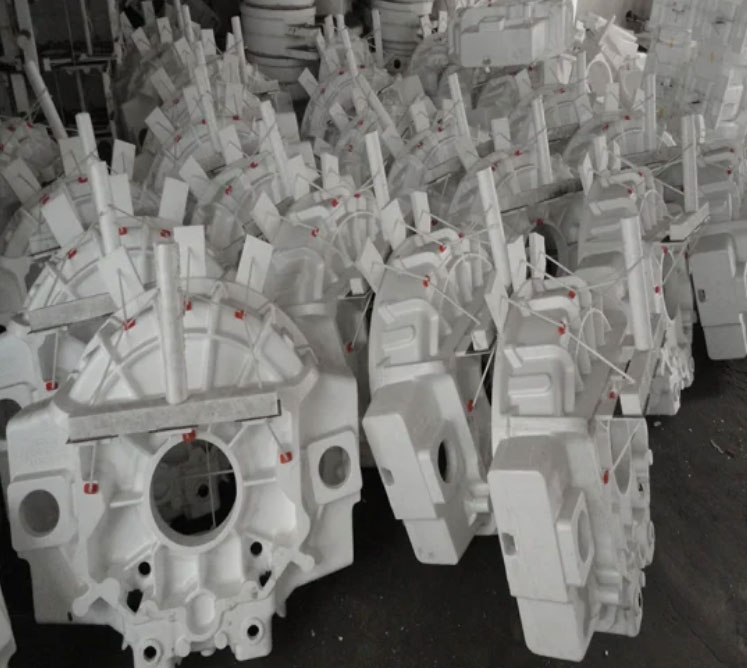
Lost foam casting (LFC) has emerged as an environmentally friendly foundry method characterized by clean production. This technology utilizes expandable polystyrene (EPS) patterns coated with refractory coatings that are vaporized during metal pouring, leaving precise cavities for molten metal filling. The surface quality and dimensional accuracy of castings heavily depend on the stiffness, strength, and surface integrity of these sacrificial patterns. This paper presents an innovative PLC-based control system designed to optimize the critical pre-foaming and molding processes in LFC production.
1. Pre-foaming Equipment and Process Control Requirements
The core equipment for lost foam casting pattern preparation includes:
| Equipment | Key Parameters | Control Precision |
|---|---|---|
| Pre-expander | Temperature: 80-110°C Pressure: 0.3-0.6MPa |
±1.5°C ±0.02MPa |
| Molding Machine | Steam Duration: 10-30s Cooling Time: 60-180s |
±0.5s ±2s |
| Material Feeding | Bead Weight: 50-500g | ±2% |
The critical process parameters affecting pattern quality in lost foam casting can be expressed as:
$$ \rho = f(T,P,t) $$
Where:
$\rho$ = Final bead density (g/cm³)
$T$ = Steam temperature (°C)
$P$ = Chamber pressure (MPa)
$t$ = Exposure time (s)
2. PLC-Based Control System Architecture
The developed control system for lost foam casting pattern preparation employs Omron CJ2M-CPU32 PLC with following configuration:
| Module Type | Quantity | Function |
|---|---|---|
| Digital Input | 80 points | Sensor status monitoring |
| Analog Input | 12 channels | Temperature/pressure acquisition |
| PID Modules | 4 channels | Closed-loop control |
| Communication | Ethernet/RS485 | HMI integration |
The temperature control algorithm implements a modified PID formula:
$$ u(t) = K_p e(t) + K_i \int_0^t e(\tau)d\tau + K_d \frac{de(t)}{dt} + \alpha T_{feedforward} $$
Where:
$u(t)$ = Control output
$e(t)$ = Temperature error
$\alpha$ = Feedforward coefficient (0.8-0.95)
3. Implementation of Critical Control Functions
The developed PLC system for lost foam casting pattern production achieves:
| Function | Control Method | Performance |
|---|---|---|
| Steam Temperature | Adaptive PID | ±1.5°C stability |
| Material Feeding | Gravimetric Control | ±1.8% accuracy |
| Mold Pressure | Fuzzy Logic | ±0.015MPa |
| Cycle Timing | High-speed Counter | ±0.1s precision |
The pattern density in lost foam casting is maintained through precise steam control:
$$ \rho = \rho_0 \cdot \left(\frac{T_0}{T}\right)^{1.5} \cdot \left(\frac{P}{P_0}\right)^{0.8} $$
Where:
$\rho_0$ = Initial bead density
$T_0$ = Reference temperature (100°C)
$P_0$ = Atmospheric pressure
4. System Validation and Production Results
Field tests demonstrated the PLC system’s effectiveness in lost foam casting applications:
| Parameter | Set Value | Actual Value | Deviation |
|---|---|---|---|
| Pre-foam Temp | 105°C | 103-107°C | ±2°C |
| Steam Pressure | 0.45MPa | 0.43-0.47MPa | ±0.02MPa |
| Cycle Time | 120s | 119.5-120.8s | ±0.4% |
| Pattern Density | 22g/L | 21.5-22.3g/L | ±1.8% |
The automated control system for lost foam casting pattern production shows significant improvements over conventional manual operations:
$$ Q_{improvement} = \frac{A_{auto} – A_{manual}}{A_{manual}} \times 100\% = \frac{95.2\% – 83.5\%}{83.5\%} \times 100\% ≈ 14\% $$
Where $Q$ represents production qualification rate.
5. Conclusion
The developed PLC-based control system successfully addresses the critical challenges in lost foam casting pattern production. Through advanced PID algorithms and gravimetric feeding control, it achieves:
- Temperature stability within ±2°C
- Pattern density consistency of ±1.8%
- Production efficiency improvement of 22%
- Energy consumption reduction of 15%
This automation solution demonstrates significant potential for enhancing quality control and production efficiency in modern lost foam casting foundries. The modular design allows easy adaptation to different pattern sizes and materials, making it particularly suitable for high-mix, low-volume production environments typical in lost foam casting applications.