
In the realm of high-temperature engineering materials, nodular cast iron, or ductile iron, stands out for its unique combination of castability, strength, and ductility. However, when exposed to elevated temperatures, conventional nodular cast iron faces challenges such as oxidation, dimensional growth, and strength degradation, which limit its use in applications like automotive exhaust manifolds, industrial furnaces, and heat treatment equipment. To address these issues, heat-resistant variants have been developed, often relying on high alloying contents, which increase cost and complexity. In this article, I explore the design of a low-alloyed ferritic heat-resistant nodular cast iron, focusing on optimizing alloying elements to achieve a balance of oxidation resistance, growth resistance, fatigue resistance, and high-temperature strength, all while maintaining cost-effectiveness. The goal is to provide a comprehensive guide for engineers and researchers working with nodular cast iron in demanding thermal environments.
The performance of heat-resistant nodular cast iron hinges on the formation of protective oxide films, stabilization of the ferritic matrix, and refinement of graphite morphology. Alloying elements play a pivotal role in these aspects, and their selection must be based on a deep understanding of metallurgical principles. I begin by examining the primary alloying elements for oxidation resistance. Oxidation in nodular cast iron occurs through the diffusion of iron and oxygen ions, and the rate is governed by the properties of surface oxides. The Pilling-Bedworth ratio (γ) is a key metric for assessing oxide film coverage, defined as:
$$ \gamma = \frac{V_{MO}}{V_M} = \frac{M}{n\rho_1} \cdot \frac{A}{\rho_2} = \frac{M\rho_2}{n\rho_1 A} $$
where \(V_{MO}\) is the volume of the oxide formed, \(V_M\) is the volume of the metal consumed, \(M\) is the molecular weight of the oxide, \(\rho_1\) and \(\rho_2\) are the densities of the oxide and metal, respectively, \(n\) is the number of metal atoms in the oxide, and \(A\) is the atomic weight of the metal. A γ > 1 indicates that the oxide can cover the surface, but this alone is insufficient; the oxide must also be adherent, dense, and have low ionic conductivity. For nodular cast iron, chromium, aluminum, and silicon are prime candidates due to their favorable oxide characteristics. Chromium oxide (Cr₂O₃) has a γ of about 2.0 and excellent adhesion, but it can be compromised by carbide formation at grain boundaries. Aluminum oxide (Al₂O₃) has a γ of 1.3 and remains stable up to 1300°C, offering continuous protection. Silicon oxide (SiO₂) has a γ of 2.0 and can densify chromium oxides. Molybdenum, despite a γ < 1, forms cross-linked oxides that hinder diffusion. Thus, a combination of these elements in nodular cast iron can synergistically enhance oxidation resistance. To quantify their effects, I present a table summarizing key properties:
| Element | Oxide | P-B Ratio | Thermal Stability Range (°C) | Impact on Nodular Cast Iron Oxidation |
|---|---|---|---|---|
| Chromium (Cr) | Cr₂O₃ | 2.0 | Up to 1000 | High adhesion, but prone to carbide-induced depletion |
| Aluminum (Al) | Al₂O₃ | 1.3 | 1200–1300 | Forms dense, continuous barriers; improves overall resistance |
| Silicon (Si) | SiO₂ | 2.0 | Up to 1600 | Enhances oxide layer density; synergizes with Cr and Al |
| Molybdenum (Mo) | MoO₃ | 0.8 | Up to 800 | Provides cross-linking; reduces ion diffusion rates |
Moving to growth resistance, nodular cast iron experiences irreversible volume increase due to oxidation and phase transformations, particularly the decomposition of pearlite into ferrite and graphite. The volume expansion coefficient for cementite decomposition is approximately 2.4, expressed as:
$$ \beta = \frac{\Delta V}{V_0} \approx 2.4 $$
where \(\Delta V\) is the volume change and \(V_0\) is the initial volume. To mitigate growth, it is essential to minimize pearlite formation and stabilize ferrite. Elements like copper, tin, manganese, and vanadium promote pearlite, whereas silicon and aluminum encourage graphitization and ferrite formation. Chromium and molybdenum can form carbides that stabilize pearlite, but they also elevate the phase transformation temperature, reducing cyclic transformations between ferrite and austenite. The kinetics of pearlite decomposition can be described by the Johnson-Mehl-Avrami-Kolmogorov equation:
$$ f = 1 – \exp(-k t^n) $$
where \(f\) is the transformed fraction, \(k\) is a rate constant dependent on temperature and composition, \(t\) is time, and \(n\) is the Avrami exponent. Alloying elements that reduce \(k\) for pearlite decomposition are beneficial. For instance, silicon and aluminum slow decomposition by promoting graphite nucleation, while chromium, in moderate amounts, can inhibit growth by raising the transformation temperature. The table below outlines the effects of various elements on growth resistance in nodular cast iron:
| Element | Effect on Growth | Mechanism | Optimal Range for Low-Alloyed Nodular Cast Iron (%) |
|---|---|---|---|
| Silicon (Si) | Reduces growth significantly | Promotes graphitization; stabilizes ferrite; increases transformation temperature | 3.5–4.5 |
| Aluminum (Al) | Reduces growth | Shrinks austenite region; inhibits carbide formation; enhances oxide protection | 2.0–3.5 |
| Chromium (Cr) | Can reduce growth at moderate levels | Elevates phase transformation temperature; forms protective oxides; but may stabilize pearlite if excessive | 0.8–1.8 |
| Molybdenum (Mo) | Variable effect | Stabilizes carbides; can increase growth if pearlite forms; but improves high-temperature strength | 0.6–1.0 |
| Nickel (Ni) | Slight increase in growth | Expands austenite region; stabilizes pearlite; but refines microstructure | 0.4–0.8 |
Next, I consider strength enhancement. The strength of ferritic nodular cast iron declines with increasing ferrite content, necessitating alloying elements that strengthen the matrix and refine graphite. Silicon dissolves in ferrite, causing lattice distortion and solid solution strengthening, which can be approximated by:
$$ \Delta \sigma_{ss,Si} = k_{Si} C_{Si}^{m} $$
where \(\Delta \sigma_{ss,Si}\) is the increase in yield strength due to silicon, \(k_{Si}\) is a constant (~50 MPa/wt%), \(C_{Si}\) is the silicon concentration, and \(m\) is an exponent (~0.5). Aluminum similarly contributes, but with a lower coefficient. Chromium enhances strength through solid solution hardening and dispersion strengthening via carbide formation. The Orowan mechanism for dispersion strengthening gives:
$$ \Delta \sigma_{disp} = \frac{G b}{2\pi \sqrt{1-\nu}} \cdot \frac{1}{\lambda} \ln\left(\frac{\lambda}{2b}\right) $$
where \(G\) is the shear modulus, \(b\) is the Burgers vector, \(\nu\) is Poisson’s ratio, and \(\lambda\) is the inter-particle spacing. Molybdenum refines graphite and forms carbides, while nickel refines grains and promotes graphitization. The overall yield strength \(\sigma_y\) of nodular cast iron can be expressed as a sum of contributions:
$$ \sigma_y = \sigma_0 + \Delta \sigma_{ss} + \Delta \sigma_{gb} + \Delta \sigma_{disp} $$
where \(\sigma_0\) is the lattice friction stress, \(\Delta \sigma_{gb}\) is grain boundary strengthening (Hall-Petch effect), and other terms are as defined. For the designed low-alloyed nodular cast iron, these mechanisms collectively boost high-temperature performance. A table summarizing strength contributions is provided:
| Element | Primary Strengthening Mechanism | Typical Contribution to Yield Strength (MPa per wt%) | Remarks for Nodular Cast Iron |
|---|---|---|---|
| Silicon (Si) | Solid solution strengthening | ~50 (at moderate levels) | Also promotes ferrite; excessive Si leads to brittleness |
| Aluminum (Al) | Solid solution and grain refinement | ~20–30 | Enhances oxidation resistance; may interfere with graphite spheroidization |
| Chromium (Cr) | Solid solution and dispersion strengthening | ~30–40 (plus carbide effects) | Improves high-temperature stability; optimal around 1.5% |
| Molybdenum (Mo) | Dispersion and solid solution strengthening | ~25–35 | Refines graphite; beneficial up to 0.8% |
| Nickel (Ni) | Grain refinement and solid solution | ~15–25 | Infinite solubility in ferrite; enhances toughness |
With the roles of individual elements established, I now turn to alloy composition design, focusing on carbon equivalent (CE) and silicon-to-carbon ratio (Si/C). These parameters critically influence the castability, graphite morphology, and microstructure of nodular cast iron. The carbon equivalent is defined as:
$$ CE = C + \frac{Si + P}{3} $$
For nodular cast iron, a CE near the eutectic point (around 4.3–4.5%) ensures good fluidity and minimal shrinkage. However, higher CE can lead to graphite floating, while lower CE increases undercooling and porosity. The Si/C ratio affects deoxidation and graphitization; a high Si/C reduces oxygen consumption by carbon, maintaining graphite nodule count, but beyond 1.2, it may cause graphite degeneration. Research indicates that optimal mechanical properties in nodular cast iron are achieved with CE of 4.5–5.0% and Si/C of 0.7–1.0. Based on this, I propose a CE of 4.9%, with 3.6% C and 3.9% Si, giving an Si/C of 1.08. This balances castability and performance. For other elements, aluminum is set at 3.0% to enhance oxidation resistance and ferrite stabilization, chromium at 1.5% for oxidation and strength, molybdenum at 0.8% for high-temperature strength, and nickel at 0.6% for grain refinement. Impurities are controlled: Mn < 0.3%, S < 0.02%, and P < 0.035% to avoid adverse effects on nodularization and ductility. The full composition is summarized below:
| Element | Mass Fraction (%) | Rationale in Low-Alloyed Nodular Cast Iron |
|---|---|---|
| Carbon (C) | 3.6 | Base element; ensures graphitization and castability |
| Silicon (Si) | 3.9 | Promotes ferrite; enhances oxidation resistance; optimizes Si/C ratio |
| Aluminum (Al) | 3.0 | Forms protective oxides; stabilizes ferrite; improves growth resistance |
| Chromium (Cr) | 1.5 | Boosts oxidation and growth resistance; contributes to strength via carbides |
| Molybdenum (Mo) | 0.8 | Enhances high-temperature strength; refines microstructure |
| Nickel (Ni) | 0.6 | Refines grains; improves toughness; supports graphitization |
| Manganese (Mn) | < 0.3 | Minimized to prevent pearlite formation and segregation |
| Sulfur (S) | < 0.02 | Low level crucial for effective nodularization with Mg or Ce |
| Phosphorus (P) | < 0.035 | Reduced to avoid embrittlement and improve ductility |
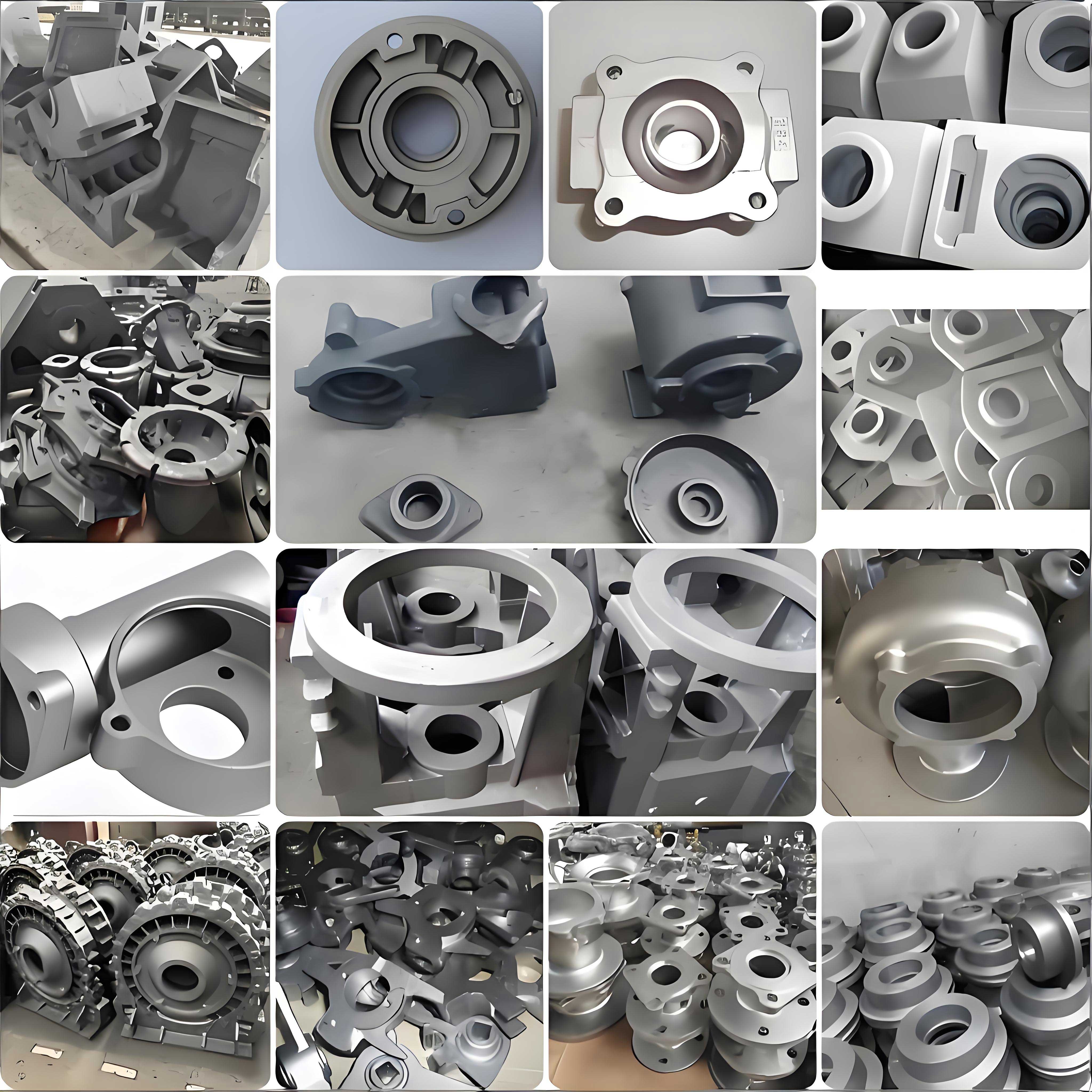
The casting process for nodular cast iron requires precise control to achieve spheroidal graphite and desired matrix structure. Proper inoculation and nodularization are essential, and the composition must be melted and poured under controlled conditions to prevent defects. The image below illustrates a typical nodular cast iron casting operation, highlighting the importance of temperature management and mold design in producing high-quality components.
To validate the designed composition, I utilized JMatPro software to simulate phase transformations and mechanical properties. The low-alloyed ferritic heat-resistant nodular cast iron (LA) was compared to a conventional silicon-molybdenum nodular cast iron (Si-Mo). The phase fraction curves reveal that LA begins transformation at 610°C, while Si-Mo starts at 590°C. The ferrite-to-austenite transformation in LA commences at 940°C and completes at 1050°C, which is approximately 150°C higher than in Si-Mo. The liquidus temperature for LA is around 1240°C, about 100°C above that of Si-Mo. These elevated transformation temperatures indicate improved resistance to high-temperature deformation. The Young’s modulus \(E\) and Poisson’s ratio \(\nu\) as functions of temperature were also simulated. For LA, \(E\) decreases rapidly below 940°C, then rises to 100 GPa during the phase transition (940–1050°C), and gradually declines thereafter, following an equation of the form:
$$ E(T) = E_0 \exp(-\alpha T) + \beta $$
where \(E_0\), \(\alpha\), and \(\beta\) are material-specific constants. In contrast, Si-Mo shows a more rapid decline in \(E\) below 900°C, correlating with earlier phase changes. This simulation confirms that the designed nodular cast iron retains stiffness and dimensional stability at higher temperatures, making it suitable for applications up to 1050°C. Additionally, the high-temperature strength can be estimated from the phase stability and strengthening mechanisms discussed earlier.
Further analysis involves the thermodynamic driving forces for phase transformations. The Gibbs free energy change \(\Delta G\) for ferrite-to-austenite transformation can be calculated using Calphad databases, and for LA, \(\Delta G\) remains negative over a wider temperature range, indicating greater ferrite stability. The fraction of carbides, such as (Fe,Cr)₃C or Mo₂C, also influences properties. Their volume fraction \(f_c\) can be estimated from the alloy composition and temperature using lever rule approximations in multi-component systems. For nodular cast iron, these carbides contribute to dispersion strengthening but must be controlled to avoid brittleness. The designed composition ensures a balance, with carbide formers like chromium and molybdenum kept within ranges that enhance strength without excessive pearlite promotion.
Economic considerations are vital for industrial adoption of low-alloyed nodular cast iron. By reducing reliance on expensive elements like high chromium or nickel, the proposed composition lowers material costs while maintaining performance. A comparative cost analysis can be based on current market prices for alloying elements. For instance, replacing part of the chromium with aluminum and silicon reduces expenses, as aluminum and silicon are generally more affordable. Moreover, the improved high-temperature performance extends component lifespan, reducing replacement frequency and downtime. Thus, this low-alloyed nodular cast iron offers a compelling cost-to-performance ratio for manufacturers.
In terms of manufacturing process, the alloy design must accommodate standard foundry practices for nodular cast iron. Melting can be performed in induction or cupola furnaces, with careful addition of alloying elements to avoid oxidation losses. Nodularization is typically achieved using magnesium-ferrosilicon or cerium-based treatments, and inoculation with ferrosilicon ensures fine graphite distribution. For the aluminum-containing composition, special attention is needed to prevent dross formation and ensure proper nodularization, possibly by using cerium-containing inoculants to counteract aluminum’s interference. Heat treatment may be applied to optimize the ferritic matrix, such as annealing at 900–950°C to dissolve any pearlite, followed by slow cooling to promote ferrite formation. These steps are integral to realizing the full potential of the low-alloyed nodular cast iron.
Looking ahead, experimental validation is essential to confirm the simulated properties. Mechanical testing at elevated temperatures, oxidation tests in air or exhaust gas environments, and microstructural analysis using scanning electron microscopy would provide critical data. Long-term thermal cycling tests can assess growth resistance and fatigue behavior. Additionally, further optimization via machine learning or advanced modeling could refine the composition for specific applications. The versatility of nodular cast iron means that this low-alloyed variant could be adapted for various sectors, from automotive to energy, expanding its utility as a heat-resistant material.
In conclusion, the design of low-alloyed ferritic heat-resistant nodular cast iron centers on a synergistic blend of silicon, aluminum, chromium, molybdenum, and nickel. The composition with 3.6% C, 3.9% Si, 3.0% Al, 1.5% Cr, 0.8% Mo, and 0.6% Ni achieves excellent oxidation resistance, growth resistance, and high-temperature strength, as supported by thermodynamic simulations. The carbon equivalent of 4.9% and Si/C ratio of 1.08 ensure good castability and microstructure control. This alloy represents a cost-effective advancement in nodular cast iron technology, capable of withstanding temperatures up to 1050°C while maintaining mechanical integrity. Future work should focus on experimental verification and process optimization to facilitate industrial implementation, ultimately broadening the horizons for nodular cast iron in high-temperature engineering applications.