
In the realm of metal casting, the production of thick-walled, complex geometry components presents a significant set of challenges. This is particularly true for gray iron casting, where achieving soundness in sections with varying thicknesses and intricate thermal profiles is paramount. My recent work has focused on a family of spiral-shaped components, which epitomize these challenges. These castings are part of a low-volume, high-mix product series, with individual weights ranging from 500 to 2000 kg. The defining characteristic is their pronounced wall thickness variation, transitioning from nominal sections of 20 mm to massive sections exceeding 100 mm. This non-uniformity creates a complex distribution of thermal hot spots, making the components highly susceptible to classic foundry defects like shrinkage porosity and slag inclusions. The final product mandate is stringent: after machining, no visual or sub-surface casting defects are permitted, necessitating compliance with rigorous non-destructive testing standards such as UT and MT.
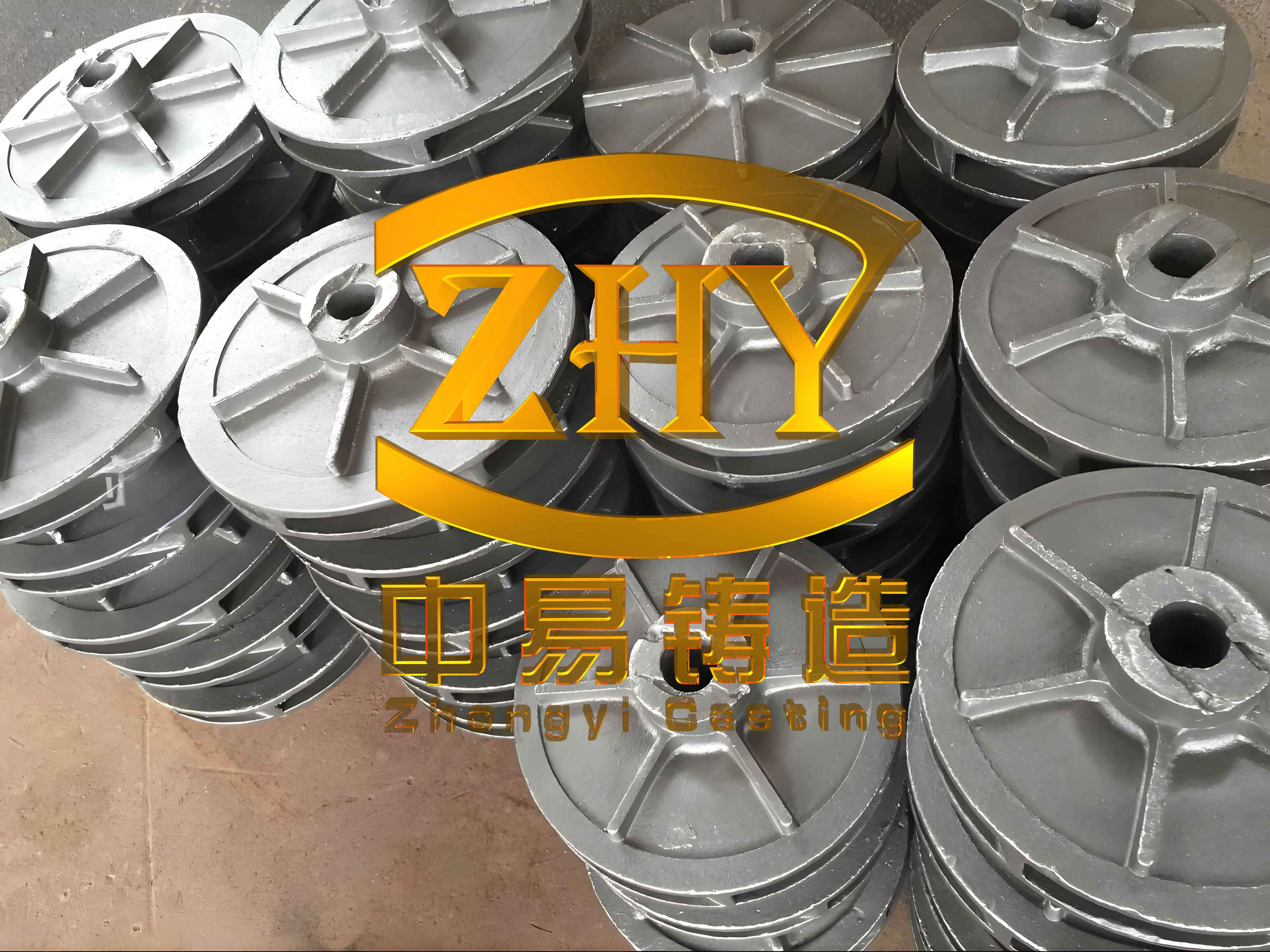
The spiral component’s geometry, as illustrated, is the root cause of the processing difficulty. The presence of large flanges, hubs, and intersecting ribs creates isolated thermal masses that solidify last. In gray iron casting, which solidifies with a eutectic expansion phase, proper feeding and directional solidification are still critical to prevent micro-shrinkage or porosity, especially in heavy sections. Furthermore, the turbulent filling of such a complex cavity can easily lead to oxide formation and dross entrapment. The initial trials using conventional gating and risering approaches consistently yielded parts with unacceptable levels of these defects, driving the need for a fundamentally optimized process.
Foundational Analysis and Process Strategy
The core objective was to devise a single, robust casting process capable of accommodating the entire weight range of the spiral series (200-1500 kg) while guaranteeing quality. The strategy was built on three pillars: standardization to reduce cost and complexity, aggressive control of melt cleanliness and mold integrity, and the precise application of chilling and feeding to govern solidification. The overarching geometry had a bounding box of approximately 1450 mm x 850 mm x 380 mm. The material specification was a ductile iron equivalent to QT400-18-LT, but the principles applied are directly relevant and often more critical for high-quality gray iron casting, where graphite morphology does not provide the same level of internal feeding via expansion.
The thermal calculation for feeding design remains crucial. The required riser volume \( V_r \) can be estimated using the modulus method. The modulus \( M \) of a casting section is defined as its volume \( V \) divided by its cooling surface area \( A \):
$$ M = \frac{V}{A} $$
For a riser to effectively feed a hot spot, its modulus \( M_r \) must be greater than the modulus of the hot spot \( M_c \), typically by a factor of 1.2. For a cylindrical side riser, \( M_r = D/6 \) (where D is diameter). Therefore, the riser diameter needed for a section of modulus \( M_c \) is:
$$ D \geq 7.2 \times M_c $$
This formula guided the initial sizing of the exothermic risers used on the thickest sections of the spiral gray iron casting.
Standardization and Cost Optimization in Tooling and Method
For a low-volume, high-variety product family, flexibility and low upfront cost are essential. The first step was to decouple the tooling from fixed, expensive patterns. A novel “pattern-on-a-plate” approach was adopted, which eliminated the need for a solid matchplate.
| Tooling Approach | Description | Cost/Benefit Impact |
|---|---|---|
| Modular Wood Pattern | Base pattern with attachable extension blocks for different spiral models. | Reduced pattern cost by ~50% for new variants; enables model sharing. |
| Removable Gating & Padding | Gating system and mold padding designed as separate, movable pieces. | Allows adaptation to various existing flask sizes, reducing sand consumption. |
| Universal Gating Design | A single gating system dimension used for the entire weight range. | Simplifies molding, eliminates operator error in system switching, lowers模具 costs. |
The molding sequence involved placing the modular pattern and extensions onto a simple carrier board. The drag flask is placed over this assembly and rammed. After curing, the mold is rolled over, the carrier board is removed, and the cope is rammed. This method provided remarkable flexibility. Furthermore, by designing a single, slightly oversized gating system, we could handle all casting weights within the family. The gating ratio was designed as a pressurized system to ensure rapid mold filling, but with key modifications discussed later to control turbulence. The cross-sectional areas were fixed: one sprue at 28 cm² (Ø60mm), two runners at 40 cm² total (2 x 40/50 x 40 mm), and four ingates at 50 cm² total (4 x Ø40 mm). This standardization was a cornerstone for the repeatable production of this gray iron casting family.
Comprehensive Defect Control Strategy
The solution to the quality challenges lay in a multi-faceted attack on the root causes of slag inclusion and shrinkage.
Slag and Inclusion Mitigation
Inclusions in gray iron casting primarily originate from two sources: ladle slag/crust and mold erosion. Our strategy targeted both.
| Source of Inclusion | Control Measure | Mechanism of Action |
|---|---|---|
| Ladle Slag | 1. Strict hold time < 10 min. 2. Ceramic foam filter in runner. 3. Skimming with insulating blanket before pour. |
Minimizes oxide generation and slag volume; filters macro-inclusions. |
| Mold Sand | 1. Bottom-gating (reverse taper sprue). 2. Ceramic inlet tubes for ingates. 3. Pre-inspection and cleaning of cavity. |
Reduces metal velocity and turbulence; prevents erosion at ingate; removes loose sand. |
The bottom-gating system was critical. By introducing metal at the base of the mold cavity, a calm, upward-filling front was established. This minimized turbulence, which is a primary driver for both oxide formation and mold wall erosion. The flow velocity \( v \) at the ingate is given by Bernoulli’s equation:
$$ v = C_d \sqrt{2gh} $$
where \( C_d \) is the discharge coefficient, \( g \) is gravity, and \( h \) is the metallostatic head. Our design aimed to minimize \( h \) during the initial fill of the critical cavity, thereby reducing \( v \) and erosion potential. Any inclusions that did form had a long travel path to rise through the molten metal and be trapped in the top of the risers or the cope surface, away from the final part.
Shrinkage Porosity Control
Eliminating shrinkage in a thick-walled gray iron casting with varying sections requires precise control of the solidification sequence. We employed a combined approach of chilling and feeding.
| Location/Feature | Thermal Management | Design Parameter |
|---|---|---|
| Major Hub & Flanges (Top) | Exothermic Riser | Ø200mm x 200mm riser with Ø100mm neck. |
| Secondary Hub (Top) | Exothermic Riser | Ø100mm x 100mm riser with Ø50mm neck. |
| Thick Rib Intersections & Critical Machining Areas | Internal Chill (Steel) | Various rectangular chills, sized to local modulus. |
| Overall Solidification Control | Low Pour Temperature | 1330 ± 10 °C |
The chills were strategically placed on the drag side (bottom) of the mold at key thermal junctions. Their function was to rapidly extract heat, creating a point of initial solidification and effectively extending the cooling surface area of the hot spot. The effectiveness of a chill can be related to its ability to absorb heat, which is a function of its thermal diffusivity \( \alpha \):
$$ \alpha = \frac{k}{\rho c_p} $$
where \( k \) is thermal conductivity, \( \rho \) is density, and \( c_p \) is specific heat. Steel chills have high \( \alpha \), making them efficient. By placing chills at lower points, we encouraged directional solidification towards the top-mounted risers. The low pouring temperature further promoted a faster overall solidification rate, reducing the time available for pore formation and growth. The solidification time \( t_s \) for a simple shape can be approximated by Chvorinov’s rule:
$$ t_s = B \left( \frac{V}{A} \right)^n = B \cdot M^n $$
where \( B \) is the mold constant and \( n \) is an exponent (typically ~2). By reducing \( M \) locally with chills and globally with low superheat, we minimized \( t_s \), favoring a sounder gray iron casting structure.
Process Validation and Solidification Simulation
Prior to physical trials, the entire process was modeled using commercial solidification simulation software. The model incorporated the 3D geometry of the spiral gray iron casting, the gating system, the exothermic risers, and the chills. The key output for shrinkage prediction is the Niyama criterion \( Ny \), often used as a porosity indicator for alloys with a long freezing range (and applicable to gray iron):
$$ Ny = \frac{G}{\sqrt{\dot{T}}} $$
where \( G \) is the temperature gradient (°C/cm) and \( \dot{T} \) is the cooling rate (°C/s). Low values of \( Ny \) in isolated liquid pockets indicate a high risk of microporosity. The simulation allowed us to iteratively adjust the placement and size of chills and risers to eliminate these critical zones.
The final simulation predicted a shrinkage porosity percentage, a volumetric defect indicator. For our optimized design, the predicted porosity was concentrated almost exclusively in the riser necks and bodies, with the casting itself showing a very low and dispersed defect percentage, typically below 1% in volume fraction across the part. This was a strong indicator of a sound process.
Physical validation followed a structured “1+2+4” batch sequence. The first casting was extensively inspected via visual, MT, and UT methods. After confirming compliance, two more were cast and inspected, followed by a final batch of four. All castings met the Grade 1 UT and SM 3 MT standards. Most importantly, after full machining, the functional surfaces of the spiral gray iron castings were completely free of visible defects such as pinholes, slag scars, or surface shrinkage. The process was subsequently released for batch production and has successfully been used to manufacture over 150 castings across 35 different spiral variants, demonstrating exceptional robustness and consistency.
Conclusions and Engineering Principles
The successful development of this process for thick-walled, complex gray iron castings underscores several key engineering principles:
- Integrated Thermal Management is Non-Negotiable: For heavy-section gray iron casting, a combination of chilling and feeding is the most reliable method to control solidification. Chills promote directional solidification and eliminate isolated hot spots, while properly sized risers provide the necessary liquid feed metal.
- Melt and Mold Cleanliness Prevents Cascading Defects: A bottom-gating system, coupled with ceramic filters and strict procedural controls (hold time, skimming), is highly effective in minimizing slag and dross defects. A clean fill is the foundation for a sound casting.
- Standardization Enables Quality in High-Mix Production: Designing a flexible, modular tooling and a universal gating system for a product family reduces complexity, minimizes operator error, and ensures consistent process application—all of which directly contribute to consistent quality in gray iron casting.
- Simulation-Guided Design Reduces Trial Cost and Time: Using solidification modeling to predict shrinkage and optimize riser/chill layout before any metal is poured is an indispensable tool for modern foundry engineering, especially for one-off or low-volume complex parts.
The final equation for success in such a challenging gray iron casting project is therefore multifaceted:
$$ \text{Sound Casting} = f(\text{Standardized Process}, \text{Clean Metal Fill}, \text{Chills} + \text{Risers}, \text{Low Superheat}) $$
This holistic approach, balancing cost-effective tooling with rigorous metallurgical and thermal controls, provides a replicable framework for tackling similar thick-walled, geometrically complex gray iron casting components across the industry.