
In the foundry industry, the production of cast iron parts is a complex process fraught with potential defects that can compromise quality and increase costs. As a practitioner in this field, I have observed that the experiential knowledge and historical insights gained from dealing with casting defects are invaluable treasures, representing the collective wisdom of countless foundry workers. This knowledge plays a pivotal role in preventing, analyzing, and resolving defects in cast iron parts. However, a significant challenge persists: this critical information is often scattered, expressed in diverse, non-standardized formats, and poorly integrated with actual production data. With the rapid adoption of new processes, technologies, equipment, and software like CAD/CAE/CAM, SPC, and PDM in enterprises producing cast iron parts, defect-related knowledge is continuously evolving. Yet, its management remains largely unstructured, hindering effective utilization and innovation.
Motivated by this gap, our team embarked on developing an Iron Casting Defect Management System (ICDMS). Our primary goal was to create a unified platform that could systematically manage defect knowledge, production data, and quality cases specific to cast iron parts. We aimed to transform isolated, experiential snippets into a dynamic, accessible, and actionable knowledge base. This system is designed not just for record-keeping but to actively enhance decision-making efficiency for technical personnel, ultimately improving the quality of cast iron parts and reducing rejection rates. The core philosophy revolves around the continuous cycle where production data informs quality cases, which in turn are refined into generalized defect knowledge, and that knowledge guides future production, as conceptualized in our workflow.
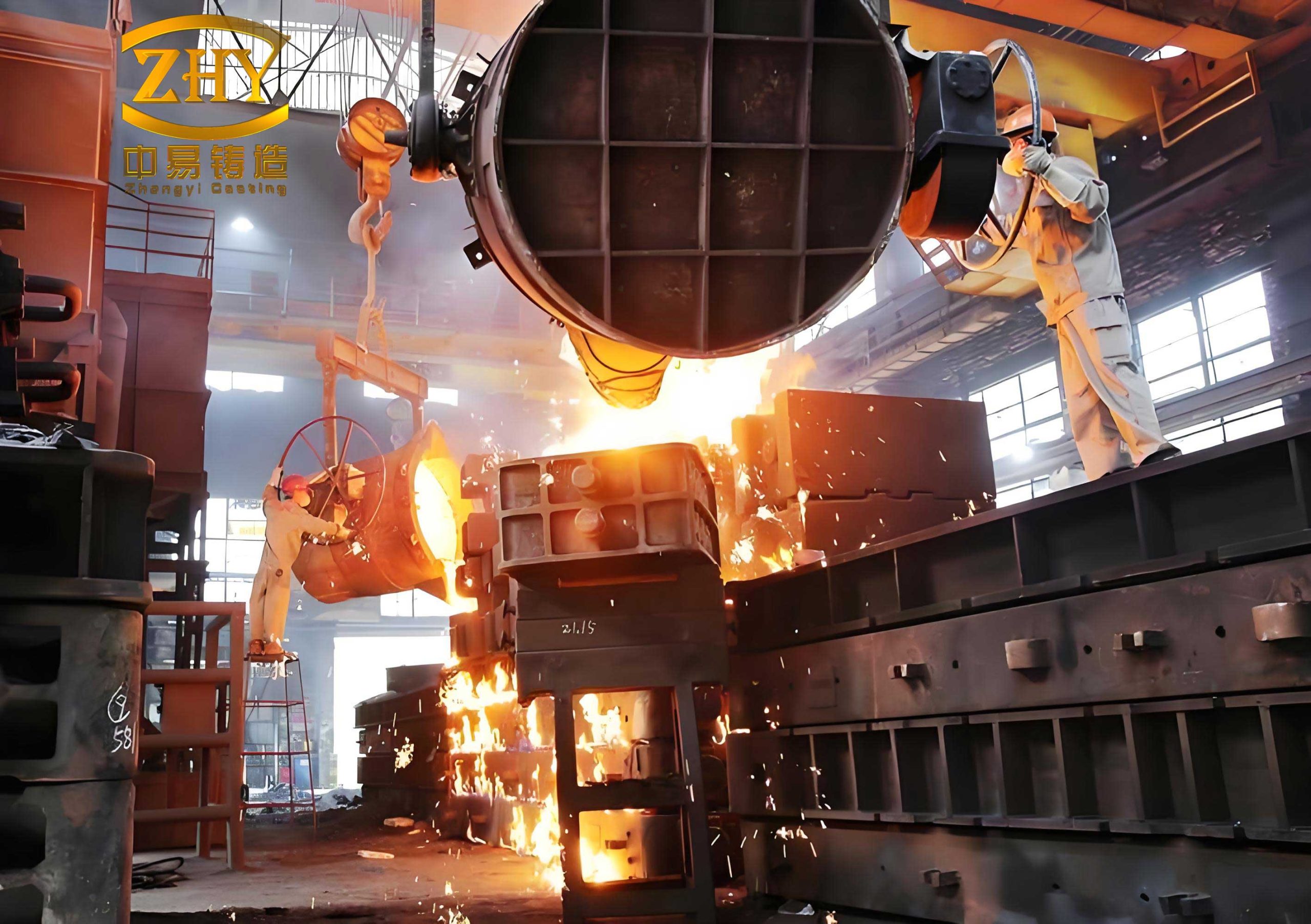
The development of high-quality cast iron parts demands meticulous control over every manufacturing stage. Defects can arise from myriad sources—improper mold design, alloy composition fluctuations, inadequate gating systems, or uncontrolled cooling. The traditional approach to managing this knowledge relied on paper records, isolated digital files, or unwritten tribal knowledge, making it susceptible to loss and inefficiency. Our system seeks to digitize, centralize, and intelligently process this information. By leveraging advancements in database technology, network systems, and software engineering, we built a tool that not only stores information but also provides powerful statistical and analytical capabilities tailored for foundries specializing in cast iron parts.
System Analysis and Architectural Design
Our initial phase involved a thorough functional analysis. We identified two overarching objectives for the ICDMS. First, it must enable efficient management of existing defect knowledge, real-time production data, and historically resolved quality cases related to cast iron parts. Second, and more crucially, it must actively assist users—from floor technicians to quality engineers—in statistically analyzing, learning from, identifying, preventing, and treating casting defects encountered during the production of cast iron parts. Data integrity, system stability, and information security were paramount non-functional requirements.
To meet these needs, we adopted a three-tier architecture (presentation, business logic, and data layers) using the C# programming language and the Visual Studio 2013 development platform. The backend is powered by a SQL Server 2008 database management system, ensuring robust data handling. We incorporated ASP.NET Web Services for distributed component functionality, resulting in a Client/Server (C/S) structured application. This architecture promotes scalability, maintainability, and clear separation of concerns. The system’s modular structure is designed for flexibility, allowing for future enhancements. The core modules are summarized in the table below.
| Module Name | Primary Functions | Key Components / Sub-modules |
|---|---|---|
| Authorization & Settings | User access control and system configuration. | User Management, Role Management, User Switch, Password Modification. |
| Defect Knowledge Base | Comprehensive management of defect definitions, characteristics, and solutions. | Manage Defect Knowledge, Search Defect Knowledge. |
| Quality Case Repository | Documentation and management of specific defect incidents and resolutions. | Manage Quality Cases, Search Quality Cases. |
| Defect Statistics | Analytical tools for quantifying and visualizing defect occurrences. | Daily Statistics, Defect Pareto Analysis, Rejection Rate Statistics. |
| Production Data Management | Recording and management of daily production and rejection details. | Daily Production Management, Non-conforming Product Management. |
| Database Maintenance | Ensuring data safety and system health. | Backup Database, Restore Database, Maintenance Log. |
| Usage Records | Auditing system access and user activities. | User Access Logs, Most Frequently Used Features. |
| Help & Documentation | User support and system information. | User Manual, About the Software. |
In-Depth Module Functionality for Cast Iron Parts Defect Management
1. Defect Knowledge Base Management
For the system to be effective, a standardized taxonomy for defects in cast iron parts was essential. We primarily referenced national standards to categorize defects into eight major classes, such as Gas Defects (Porosity, Blowholes), Shrinkage Defects, Mold Material Defects, Pouring Metal Defects, Metallurgical Defects, etc. However, recognizing that individual foundries might have their own classification schemes for specific cast iron parts, the system allows administrators to customize categories, names, and definitions. Each defect entry is assigned a unique code to avoid confusion stemming from synonymous terms. The knowledge schema for each defect includes:
- Defect Code & Name
- Category
- Formal Definition
- Typical Location on the cast iron part
- Morphological Characteristics
- Probable Causes
- Prevention Methods
- Remedial Measures (if any)
- Typical Photographic Examples
This structured format transforms vague experience into searchable, consistent knowledge. For instance, the knowledge entry for “Microporosity” in nodular iron castings would detail its appearance under a microscope, link it to insufficient inoculation or high carbon equivalent, and suggest corrective actions for the melt treatment process.
2. Quality Case Management
While defect knowledge provides general rules, quality cases capture specific, contextualized instances. This module is designed to document the full narrative of a defect event in the production of cast iron parts. Each case record contains both descriptive and analytical fields, as shown in the following schema representation.
| Field | Description | Example for a Cast Iron Bracket |
|---|---|---|
| Case Title | Brief, descriptive name of the incident. | “Cold Shuts on Bracket XYZ, Batch #2205” |
| Machine/Model | The product or model line of the cast iron part. | Model XYZ Bracket |
| Batch & Lot Number | Production batch identifier. | Batch 2205, Lot 3 |
| Visibility Level | Access control (e.g., public, department, confidential). | Department Level |
| Occurrence Date/Time | When the defect was discovered. | 2023-10-26, Molding Shift |
| Process Stage | Stage where defect originated or was detected. | Molding, Pouring, or Finishing |
| Defect Type & Code | Linked to the Defect Knowledge Base. | Cold Shut (CS-102) |
| Description | Detailed narrative of the problem observed. | “Linear discontinuity on the upper flange surface…” |
| Root Cause Analysis | Investigation findings on why it happened. | “Inadequate pouring temperature (1340°C vs. required 1380°C) combined with a thin section.” |
| Corrective Actions | Steps taken to resolve the immediate issue. | “Rejected 15 parts. Adjusted pouring protocol.” |
| Preventive Actions | Long-term steps to prevent recurrence. | “Updated SOP to mandate minimum 1380°C for this part geometry.” |
| Attachments | Images, documents, CAD files, micrographs. | Photos of defect, SOP document, thermal analysis chart. |
The system supports file uploads, downloads, and previews, enabling rich documentation. The “visibility level” protects sensitive technical know-how. Furthermore, cases can be tagged as “open” for long-term monitoring, allowing users to add follow-up data on the effectiveness of implemented solutions over subsequent production runs of similar cast iron parts.
3. Production Data Management and Defect Statistics
This module forms the quantitative backbone. It involves the daily logging of production output and detailed records of every rejected cast iron part. The “Daily Production” table logs date, machine/model, part name, production line, shift, and total quantity produced. The “Non-conforming Product” table records for each defective unit: production date, inspection date, part identification (cast number), defect code, textual description, location on the part, responsible department, process stage where it occurred, inspector, disposal action (scrap, rework, repair), and notes.
The real power lies in the Defect Statistics module. It processes this raw data to generate actionable insights. Two main types of analysis are performed: Rejection Rate Statistics and Daily Trend Statistics.
a) Rejection Rate Statistics: This analysis answers questions like “What are the top defect types for engine block cast iron parts on Line A in Q1?” Users set filters for date range, production line, part model, etc. The system calculates the rejection rate for each defect type. The fundamental formula used is:
$$ \text{Rejection Rate for Defect } D_i = \left( \frac{N_{D_i}}{N_{\text{total}}} \right) \times 100\% $$
where $N_{D_i}$ is the number of cast iron parts rejected due to defect $D_i$, and $N_{\text{total}}$ is the total number of cast iron parts produced under the selected filters. The system can also calculate the overall First Pass Yield (FPY):
$$ \text{FPY} = \left(1 – \frac{\sum_{i=1}^{k} N_{D_i}}{N_{\text{total}}} \right) \times 100\% $$
where $k$ is the number of distinct defect types. Results are displayed in interactive Pareto charts (bar chart of frequency sorted descending with a cumulative percentage line), pie charts, bar graphs, and detailed tabular reports. Clicking on a defect in the chart can directly link to its knowledge base entry and related historical cases.
b) Daily Trend Statistics: This function plots the daily count or percentage of defective cast iron parts over a selected period, helping to identify temporal patterns, such as a spike in defects after a maintenance shutdown or a gradual increase correlated with sand reuse cycles.
The statistical engine allows for multi-dimensional analysis. For example, one can compare defect profiles across different production lines manufacturing similar cast iron parts or analyze the impact of a shift change. This transforms data into preventive intelligence.
| Defect Code | Defect Name | Number of Rejects | Rejection Rate (%) | Cumulative % |
|---|---|---|---|---|
| P-201 | Pinhole Porosity | 142 | 4.73% | 4.73% |
| S-105 | Shrinkage Cavity | 89 | 2.97% | 7.70% |
| IS-301 | Inclusion (Slag) | 65 | 2.17% | 9.87% |
| CS-102 | Cold Shut | 47 | 1.57% | 11.44% |
| MS-401 | Mold Shift | 33 | 1.10% | 12.54% |
| Total Production (N_total): | 3000 cast iron parts | |||
4. Knowledge Retrieval and System Integration
Managed knowledge is useless if not readily accessible. The ICDMS provides multiple retrieval pathways. For quick access, a fast search by defect code or name is available. An advanced search allows for defect identification based on attributes like location, shape, and appearance—effectively serving as a diagnostic tool. For example, a user can search for defects occurring in “thin sections” with a “crack-like” appearance, and the system will return likely candidates such as “hot tears” or “cold cracks,” complete with comparative images from the knowledge base.
Perhaps the most powerful feature is the cross-linking. From a statistical report, one can drill down to the defect knowledge. From the defect knowledge page, one can retrieve all historical quality cases related to that specific defect in cast iron parts. From a quality case, links to the relevant defect knowledge and similar cases are provided. This creates a self-reinforcing learning ecosystem. All reports, knowledge entries, and case details can be exported to formats like Excel or PDF for sharing and offline study.
5. System Security and Maintenance
Given the critical nature of the data, security is enforced through a role-based access control (RBAC) system within the Authorization module. Permissions for viewing, adding, modifying, or deleting records are granularly assigned. All data modification events are logged in an audit trail. Regular database backups and restoration capabilities are built into the Database Maintenance module, safeguarding against data loss. The Usage Records module provides administrators with insights into how the system is being utilized, helping to optimize training and support.
Practical Application and Impact on Cast Iron Parts Production
The true test of the ICDMS lies in its application within a live foundry environment. During deployment in a partner foundry specializing in heavy-duty cast iron parts like pump housings and gearboxes, the system demonstrated tangible benefits.
Scenario 1: Solving a Recurring Pinholing Problem. The defect statistics module highlighted a persistent issue with pinhole porosity in a certain grade of ductile iron parts, showing a 15% increase over two months. Engineers used the advanced search in the knowledge base with parameters “subsurface, spherical, <1mm diameter,” which pointed to “Microporosity due to dissolved gases.” Reviewing the linked knowledge entry suggested hydrogen or nitrogen pickup. The quality case repository was then searched for “pinhole” and the specific part name. This revealed several recent cases where the problem coincided with changes in resin binder supplier. Cross-referencing production data logs, they correlated the defect spike with batches using a new lot of sand additive. The collective evidence guided them to suspect nitrogen from the new binder. A simple corrective action—increasing the amount of iron oxide in the sand mix—was implemented based on a preventive measure suggested in an older case. Subsequent production data entered into the system showed the defect rate returning to baseline, and this new successful resolution was documented as a fresh quality case, enriching the knowledge base.
Scenario 2: New Technician Training and Defect Identification. A new quality inspector encountered an unfamiliar surface defect on a large cast iron frame. Using the ICDMS’s advanced search, he described the defect as “rat-tail” pattern on the cope surface. The system returned “Scab” and “Rattail” as possible matches with illustrative images. By comparing the onsite defect with system images, he correctly identified it as a “Scab.” He then immediately accessed the knowledge entry for Scabs, which listed “too-rapid heating of the mold surface” as a cause and “reduce pouring temperature or use a mold coating” as prevention. He flagged the batch and informed the molding department, who adjusted their practice. The entire diagnosis took minutes instead of hours of consultation or manual handbook searching.
The system’s flexibility was proven when the foundry needed to add a custom defect category for “Core Strain Crack” specific to their complex cored cast iron parts. Administrators easily added this new category and began populating it with cases and knowledge, which immediately became available to all users.
The statistical functions provided management with clear, visual reports on Overall Equipment Effectiveness (OEE) metrics related to quality. The cost of poor quality for cast iron parts became quantifiable. For instance, the Pareto analysis consistently showed shrinkage defects as the top contributor. This directed investment towards improving feeding system design and implementing simulation software, with the results of these improvement projects fed back into the system as cases, creating a closed-loop quality improvement cycle.
Mathematical Foundation for Advanced Analysis
Beyond basic rates, the ICDMS is structured to support more sophisticated statistical process control (SPC) for cast iron parts production. The data collected enables the calculation of control limits for defect rates. For a given process producing cast iron parts, if we consider the defect occurrence as a binomial process (defective or not), the standard deviation for the proportion defective ($p$) can be estimated. For a sample of $n$ cast iron parts, the control limits for the fraction defective chart ($p$-chart) would be:
$$ \text{Center Line (CL)} = \bar{p} = \frac{\sum \text{Number of defective cast iron parts}}{\sum \text{Total cast iron parts inspected}} $$
$$ \text{Upper Control Limit (UCL)} = \bar{p} + 3 \sqrt{\frac{\bar{p}(1-\bar{p})}{n}} $$
$$ \text{Lower Control Limit (LCL)} = \bar{p} – 3 \sqrt{\frac{\bar{p}(1-\bar{p})}{n}} \quad \text{(or 0 if negative)} $$
The system can automatically plot these control charts for key defect types over time, signaling when the process for manufacturing cast iron parts is going out of statistical control. Furthermore, correlation analysis can be hinted at using the data. Suppose we suspect pouring temperature ($T$) affects shrinkage defect count ($S$). The system can export data pairs ($T_i$, $S_i$) for analysis. A simple linear model could be explored:
$$ S = \beta_0 + \beta_1 T + \epsilon $$
where $\beta_0$ and $\beta_1$ are coefficients, and $\epsilon$ is error. While full regression might be external, the system provides the clean, structured data necessary for such advanced quality engineering studies focused on cast iron parts.
Summary and Future Directions
The development and application of the Iron Casting Defect Management System (ICDMS) represent a significant step towards digitalizing and leveraging the profound experiential knowledge inherent in cast iron parts foundries. By integrating defect knowledge, quality cases, and production data into a single, interactive platform, the system successfully addresses the chronic issues of information fragmentation and underutilization. It transforms tacit, personal knowledge into explicit, organizational assets, preserving valuable expertise against personnel turnover. The application results demonstrate enhanced decision-making speed, more effective root cause analysis, and a measurable reduction in the rejection rate of cast iron parts through proactive prevention.
The system’s modular and flexible architecture ensures its adaptability not only to various铸铁件 (cast iron parts) production environments but also to other casting domains like steel or non-ferrous alloys with minimal customization. The key to maximizing its value lies in fostering a culture of continuous knowledge contribution within the organization, where sharing successful problem-solving experiences is recognized and rewarded.
Looking ahead, the future of such systems is integration. The next evolutionary phase involves creating a fully integrated铸件质量保证体系 (castings quality assurance system). This would mean deeper, bidirectional connectivity with other software and hardware: directly pulling process parameters from PLCs on furnaces or molding machines, exchanging data with CAD/CAE simulation tools to validate predicted shrinkage against actual defects in cast iron parts, or feeding defect statistics back into ERP systems for precise cost accounting. The vision is a holistic, intelligent manufacturing ecosystem where the ICDMS acts as the central brain for quality knowledge, constantly learning from data, predicting potential issues in new designs of cast iron parts, and prescribing optimal process parameters to achieve first-time-right quality. The journey from isolated data points to predictive wisdom for the flawless production of cast iron parts is well underway, and systems like ICDMS are paving the road.