
In our extensive work on improving the durability of critical hydropower equipment, we focused on the significant challenge posed by components operating in sediment-laden and often corrosive water. The primary targets of this research were the oil-guide bearing mirror plates and the wear plates for the guide apparatus top covers and stay rings in hydraulic turbines. These parts are subjected to severe abrasive wear from hard quartz sand particles suspended in the water, combined with corrosive attack, leading to frequent failures, oil leakage, and unscheduled maintenance downtime. The conventional material of choice, such as 1Cr18Ni9Ti stainless steel, offers good corrosion resistance but exhibits inadequate wear resistance under these harsh conditions. Therefore, the development of a new material with superior combined abrasion and corrosion resistance, along with acceptable mechanical strength and toughness, became a critical engineering objective. Our research identified high-chromium white cast iron as a profoundly promising candidate for this demanding application.
High-chromium white cast irons are a class of ferrous alloys renowned for their exceptional wear resistance, which stems from a microstructure comprising a high volume fraction of hard chromium carbides (M7C3) embedded in a metallic matrix. Beyond wear resistance, these alloys generally possess better mechanical properties than many other abrasion-resistant cast irons and demonstrate commendable corrosion resistance in aqueous environments, making them uniquely suited for hydro-turbine conditions. The key to their performance lies in carefully balancing the chemical composition to optimize carbide morphology, volume, and stability, as well as the matrix structure through subsequent heat treatment.
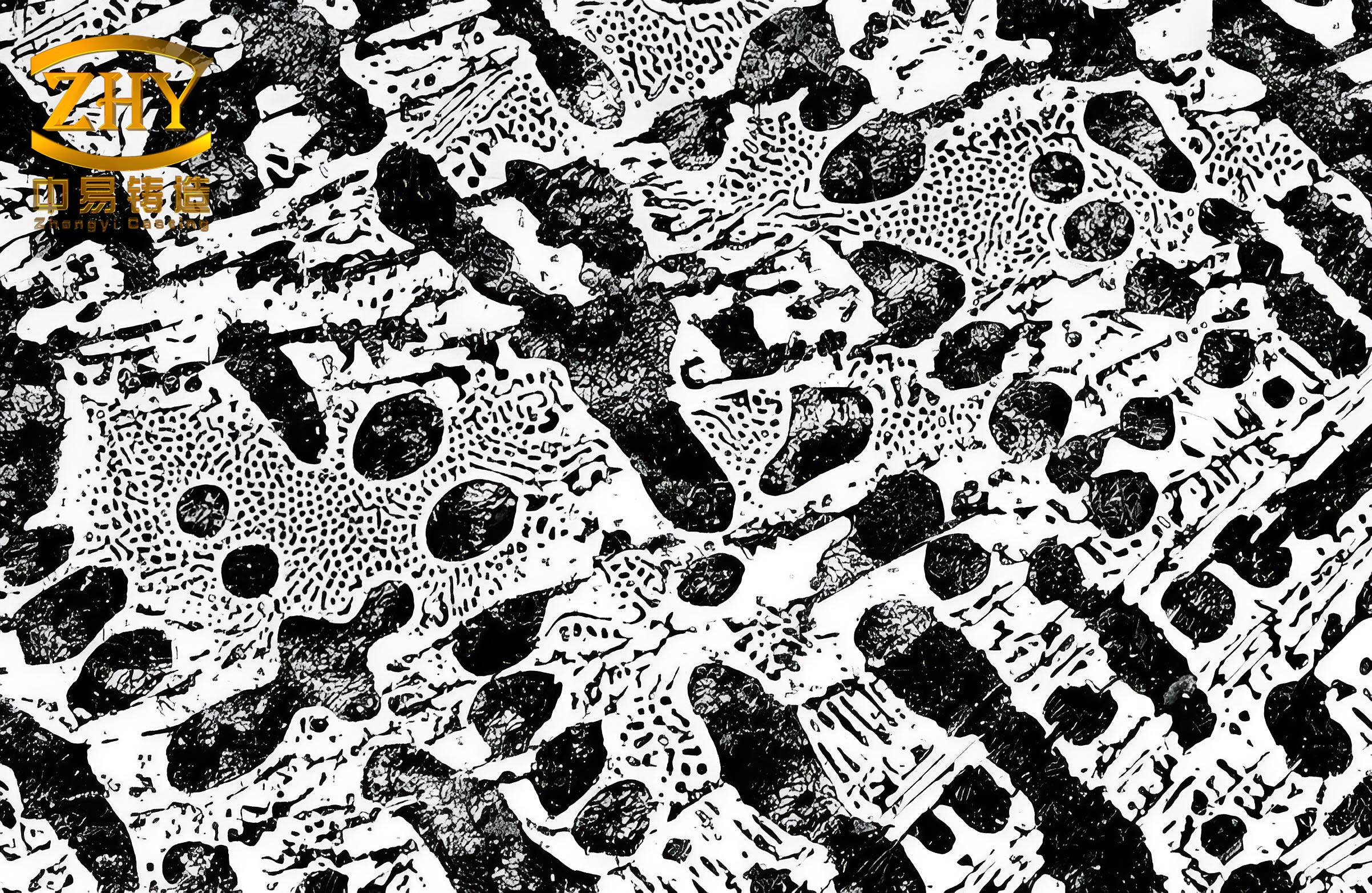
Our initial development target was guided by the ASTM A532 Class III Type A standard, a widely recognized specification for high-chromium abrasion-resistant white cast iron. The nominal composition is approximately: Carbon (C) 2.4-2.8%, Chromium (Cr) 15-18%, Molybdenum (Mo) 0.5-1.0%, with controlled levels of Manganese (Mn), Silicon (Si), and others. This particular high-chromium white cast iron composition was chosen for its established balance of properties. Subsequently, with the release of a relevant Chinese national standard, our research focus aligned with a specification closely mirroring the ASTM standard, confirming the universal suitability of this composition range. For our experimental melts, we targeted a chromium content of approximately 16.0% and a carbon content around 2.6% to achieve a favorable carbide-to-matrix ratio. The actual chemical compositions of three trial melts conducted in our foundry are detailed in Table 1.
| Melt No. | C | Si | Mn | Cr | Mo | Ni | S | P |
|---|---|---|---|---|---|---|---|---|
| 1 | 2.62 | 0.71 | 0.73 | 16.23 | 0.62 | 0.15 | 0.031 | 0.045 |
| 2 | 2.58 | 0.68 | 0.69 | 15.98 | 0.58 | 0.14 | 0.028 | 0.042 |
| 3 | 2.65 | 0.75 | 0.77 | 16.45 | 0.65 | 0.16 | 0.034 | 0.048 |
The role of each alloying element in this high-chromium white cast iron is crucial. Carbon and chromium form the primary (Cr,Fe)7C3 carbides. The ratio of Cr to C significantly influences the carbide type; a high Cr/C ratio promotes the formation of M7C3 over the less desirable M3C cementite. The M7C3 carbides are exceptionally hard (approximately 1200-1800 HV) and exhibit a rod-like or hexagonal morphology that provides excellent resistance to micro-cutting and grooving wear. Molybdenum and nickel are added primarily to enhance hardenability, ensuring that the desired martensitic matrix can be achieved in heavier sections during air quenching. Silicon and manganese are present for deoxidation and to influence solidification characteristics, but their levels are kept moderate to avoid promoting graphitization or excessive retained austenite.
The casting of high-chromium white cast iron requires careful attention to its specific foundry characteristics. This alloy exhibits good fluidity, allowing it to fill thin and complex sections—a favorable trait for engineering components. However, it also possesses a relatively high total solidification shrinkage, comparable to some stainless steels. This necessitates the use of adequate risering systems designed with a feeding modulus similar to that used for steel castings; a patternmaker’s shrinkage allowance of approximately 2.0% is typically applied. Perhaps the most critical challenge is its pronounced tendency towards hot tearing and cracking due to the formation of a continuous carbide network and the development of high thermal stresses during cooling. To mitigate this, the casting process must be designed to promote uniform cooling. In our practice for the mirror plates and wear plates, we used sodium silicate-bonded sand molds with oil sand cores. After pouring, the castings were allowed to cool in the mold to ambient temperature before shakeout to minimize thermal shock and stress.
Melting was conducted in a medium-frequency induction furnace. Control over the superheating temperature is vital. We maintained a melting temperature of approximately 1550°C. The pouring temperature was carefully controlled within the range of 1380°C to 1420°C. An excessively high pouring temperature leads to coarse grain structure and, more detrimentally, to the coarsening of primary carbides. Such coarse carbides can remain even after heat treatment, resulting in high as-cast hardness and causing severe difficulties in subsequent machining. Conversely, a pouring temperature that is too low can lead to casting defects such as cold shuts and surface folds, compromising the integrity of the component. The as-cast microstructure of this high-chromium white cast iron typically consists of austenitic dendrites (which may transform to ferrite or pearlite on very slow cooling) with inter-dendritic networks of primary M7C3 carbides and some eutectic carbides. The as-cast hardness usually ranges between 45 and 55 HRC.
The full potential of high-chromium white cast iron is unlocked through a carefully designed heat treatment cycle, which transforms the brittle as-cast structure into a tough, wear-resistant one. The process involves three key stages: softening (subcritical annealing), hardening (austenitizing and quenching), and tempering. The primary purpose of the softening heat treatment is to condition the microstructure for machinability. This involves heating the castings to a temperature below the lower critical temperature (Ac1), typically around 950°C, holding for a sufficient time (e.g., 4-6 hours depending on section size), and then slowly cooling. This process serves to: 1) homogenize the matrix, 2) partially dissolve and spheroidize the coarse, interconnected carbide network, and 3) transform any metastable austenite or martensite into a softer mixture of ferrite and spheroidized carbides or pearlite. The resulting hardness after this treatment is typically reduced to about 38-42 HRC, which allows for effective machining operations like turning, milling, and drilling.
The hardening treatment is designed to produce a high-strength, wear-resistant matrix. The castings are austenitized in the temperature range of 980°C to 1020°C. At this temperature, carbon and alloying elements dissolve from the carbides into the austenite matrix, increasing its hardenability and carbon content. The holding time is critical to achieve this solutioning effect without excessive grain growth, typically 1-2 hours per inch of section thickness. Following austenitization, the components are quenched in air. The high alloy content, particularly chromium and molybdenum, provides sufficient hardenability for air quenching, which minimizes distortion and quench cracking risks compared to oil or water quenching. The rapid cooling transforms the high-carbon, high-alloy austenite into a hard martensitic matrix, while the primary chromium carbides remain largely undissolved and distributed throughout. The martensite start (Ms) temperature for these alloys can be estimated by an empirical formula considering the strong depression effect of dissolved alloying elements:
$$M_s (^\circ C) = 550 – 350 \cdot (\%C) – 40 \cdot (\%Mn) – 35 \cdot (\%V) – 20 \cdot (\%Cr) – 17 \cdot (\%Ni) – 10 \cdot (\%Cu) – 10 \cdot (\%Mo) + 15 \cdot (\%Co) + 30 \cdot (\%Al)$$
Given our composition, the Ms is relatively low, often below 200°C, which is why significant amounts of retained austenite can be present after quenching.
To relieve the internal stresses induced by the martensitic transformation and to improve toughness, a tempering treatment is essential. The components are reheated to a temperature of 200-250°C, held for 2-4 hours, and then air-cooled. This low-temperature tempering allows for the precipitation of fine carbides from the supersaturated martensite and promotes the transformation of some retained austenite to lower bainite or tempered martensite, further enhancing dimensional stability and toughness without a substantial loss in hardness. The final microstructure after the complete heat treatment cycle consists of a matrix of tempered (lath or plate) martensite, possibly with some retained austenite and lower bainite, uniformly embedded with hard, primary (Cr,Fe)7C3 carbides. The carbides appear as refined rods and globular particles, no longer in a continuous brittle network.
The mechanical properties of the heat-treated high-chromium white cast iron are a direct result of this engineered microstructure. We conducted comprehensive testing to characterize these properties, as summarized in Table 2. Transverse rupture strength (TRS) was measured using test bars of 30mm diameter with a span of 300mm. Unnotched Charpy impact toughness was evaluated on 10x10x55mm specimens with a 40mm support span. Fracture toughness (KIC) was determined using pre-cracked specimens. The hardness, a primary indicator of wear resistance, was consistently high.
| Property | Unit | Value Range (Typical) |
|---|---|---|
| Transverse Rupture Strength (TRS) | MPa | 850 – 1050 |
| Deflection at Fracture (TRS test) | mm | 2.5 – 4.0 |
| Unnotched Charpy Impact Energy | J | 8 – 15 |
| Fracture Toughness (KIC) | MPa·m1/2 | 20 – 30 |
| Hardness (Rockwell C) | HRC | 58 – 65 |
The superior wear resistance of this material can be conceptually related to its microstructure through a simplified model. The wear rate under abrasive conditions is inversely proportional to the material’s hardness and its ability to resist crack propagation. The hard M7C3 carbides (Hv > 1500) provide the primary resistance to abrasion, while the tough martensitic matrix (Hv ~ 600-800) supports these carbides and absorbs energy. A simplified abrasive wear resistance factor (WR) can be considered as:
$$W_R \propto \frac{H_v \cdot V_c}{\sqrt{K_{IC}}}$$
where \(H_v\) is the hardness of the reinforcing phase (carbide), \(V_c\) is the volume fraction of carbides, and \(K_{IC}\) is the fracture toughness of the composite material. The high-chromium white cast iron offers an optimal combination of a high \(H_v \cdot V_c\) product from its carbides with a reasonably moderate \(K_{IC}\) from its alloyed martensitic matrix.
The transition from laboratory success to field application is the ultimate validation. Mirror plates and anti-wear plates manufactured from this developed high-chromium white cast iron were installed in multiple hydro-turbine units operating in power stations known for water with high sediment load, particularly containing hard quartz particles. The performance contrast with the previously used 1Cr18Ni9Ti stainless steel was dramatic and immediate. The stainless steel components typically exhibited an average wear rate requiring adjustment or replacement on a monthly basis, with wear depths often reaching 0.1-0.15 mm per month. This rapid wear led to persistent issues with seal integrity, causing chronic oil leakage and water ingress into the bearing housing.
In contrast, the high-chromium white cast iron components demonstrated extraordinary wear life. After a full year of continuous operation under identical conditions, measurement of the mirror plates revealed wear depths of less than 0.05 mm—an order of magnitude improvement. This negligible wear completely eliminated the leakage problems that had plagued the turbines for years. The economic and operational benefits are substantial: drastically extended maintenance intervals, reduction in unscheduled outage time, elimination of costly oil loss and environmental contamination, and significant savings in spare parts inventory and replacement labor. The successful application proves that this grade of high-chromium white cast iron is not merely a laboratory material but a robust, reliable, and economically superior engineering solution for severe abrasion-corrosion service in hydropower and related industries. Its development represents a significant advancement in the application of specialized ferrous alloys to solve persistent industrial wear problems.