
In the field of industrial machinery, the demand for large-scale and heavy-duty components has driven the advancement of material science and casting technologies. Among various materials, ductile iron casting stands out due to its excellent mechanical properties, cost-effectiveness, and relative ease of manufacturing. This material, characterized by its graphite spheroids embedded in a ferrous matrix, offers a unique combination of strength, ductility, and wear resistance. In this work, we focus on the development of a critical component: a tailstock for a high-pressure die-casting machine. This ductile iron casting is a massive part, weighing 16.8 tons, with wall thicknesses exceeding 400 mm in some sections, classifying it as a heavy-section ductile iron casting. The production of such thick-walled ductile iron castings presents significant challenges, including the risks of graphite flotation, coarse microstructure, shrinkage porosity, and graphite degeneration. Our objective was to design and implement a robust casting process that ensures the tailstock meets stringent quality standards, including rigorous non-destructive testing and specific mechanical property requirements equivalent to grade QT500-7.
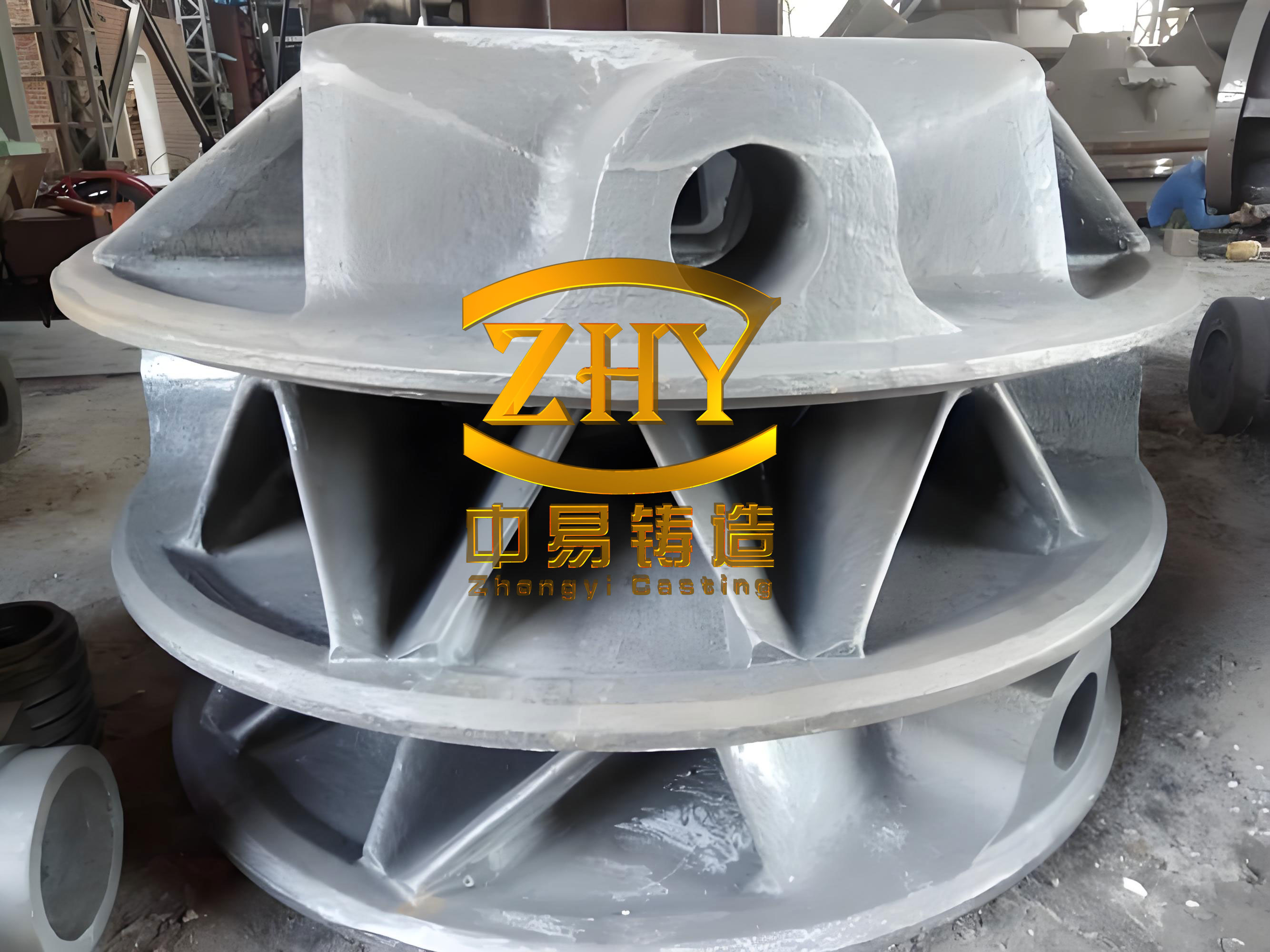
The tailstock, as a key element in the clamping mechanism of a die-casting machine, must withstand substantial operational stresses and maintain precision over its service life. Its complex geometry, resembling an open-frame structure with an “L-shaped” side profile, and its considerable dimensions (approximately 4,820 mm × 3,890 mm × 795 mm) necessitate a meticulously planned casting strategy. The minimum wall thickness is 100 mm, but several regions are much thicker, creating pronounced thermal masses. The casting must adhere to dimensional tolerances per GB/T 6414-2017 CT 11 and undergo 100% ultrasonic testing on all machined surfaces according to GB/T 34904-2017 Grade 3. Achieving internal soundness in such a heavy-section ductile iron casting is a formidable task that requires integrated process design, from pattern making and gating to melting and post-processing.
The foundational step in our approach was the design of the casting process itself. We employed a combination of physical patterns and core boxes for mold assembly, utilizing a two-part flask system. The outer mold was created using a full-size expendable polystyrene pattern mounted on a plywood baseplate. To prevent distortion during handling, temporary braces were attached to the pattern and removed before molding. The orientation of the ductile iron casting in the mold was critical; we positioned it with its open-frame profile horizontal and the protruding sections facing downward. This allowed the main body to be located in the drag (lower flask), while the raised bosses were crafted as separate, removable pieces. The four bearing bore cores were produced using split core boxes.
A key aspect of producing a sound heavy-section ductile iron casting is managing solidification and feeding. We designed a risering system using insulating sleeves to enhance feeding efficiency. The size and placement of these risers were determined based on the local wall thickness of the casting. Additionally, multiple vent holes were placed in the cope (upper flask) to allow gases to escape during pouring. The gating system was designed as a bottom-pouring, open-type arrangement to promote tranquil filling and minimize turbulence. The runners were positioned along the inner sides of the casting and connected to the downsprue via a cross-shaped transition. The ingates, implemented using curved pipes, were distributed evenly around the perimeter to ensure uniform metal distribution. A slag trap was incorporated to improve the cleanliness of the molten iron entering the mold cavity.
To address the slow cooling inherent in thick sections, which can lead to microstructural issues, we strategically placed chills in regions with the highest thermal mass. These chills accelerate localized cooling, balance thermal gradients, and promote directional solidification towards the risers. The layout and specifications of these chills were carefully marked on the pattern backing board. The mold and core sand was a phenolic-modified furan resin self-curing sand, chosen for its high strength and low yield. A rigid mold system is crucial for heavy-section ductile iron casting because it can better withstand the graphite expansion pressures during eutectic solidification, thereby enhancing the self-feeding effect and reducing the propensity for shrinkage defects.
Prior to physical production, we leveraged numerical simulation software to virtually analyze the solidification process of the ductile iron casting. This involved creating a 3D model, meshing it, defining initial and boundary conditions (such as pouring temperature and heat transfer coefficients), and running the simulation. The results, visualized through fraction solid and temperature distribution plots, were instrumental in optimizing the process. The simulation confirmed that areas with chills solidified faster, and the solidification sequence progressively moved from the thicker sections in the lower part of the casting toward the risers located above. No isolated liquid pools were observed within the main casting body. The final areas to solidify were concentrated within the risers, indicating their effectiveness as feeders. The simulation also predicted a low risk of macro-shrinkage, with any potential porosity being finely dispersed and minimal in volume. This virtual validation gave us confidence in the proposed gating and risering design for this heavy-section ductile iron casting.
The governing equation for solidification time in a casting, often described by Chvorinov’s rule, is relevant here:
$$ t = B \left( \frac{V}{A} \right)^n $$
where \( t \) is the total solidification time, \( V \) is the volume of the casting section, \( A \) is its surface area, \( B \) is a mold constant, and \( n \) is an exponent typically around 2. For thick sections, the modulus \( \left( \frac{V}{A} \right) \) is large, leading to long solidification times. Our use of chills effectively reduces the local modulus, thereby shortening \( t \) and improving microstructure.
The chemical composition of the ductile iron casting is a critical factor in achieving the desired grade QT500-7, which specifies a ferritic-pearlitic matrix with minimum tensile strength of 420 MPa and elongation of 7%. We carefully controlled the alloying elements within the ranges shown in the table below. The base charge consisted of high-purity pig iron (Q10 grade), selected steel scrap, and controlled amounts of returns from previous ductile iron casting production. All charge materials were clean, rust-free, and free of contaminants like oil or sealed containers.
| Element | Target Range | Achieved Value |
|---|---|---|
| Carbon (C) | 3.3 – 3.7 | 3.55 |
| Silicon (Si) | 1.9 – 2.3 | 2.15 |
| Manganese (Mn) | 0.3 – 0.6 | 0.45 |
| Phosphorus (P) | ≤ 0.04 | 0.03 |
| Sulfur (S) | ≤ 0.02 | 0.015 |
| Magnesium (Mg) | 0.04 – 0.06 | 0.05 |
| Rare Earth (RE) | 0.01 – 0.03 | 0.02 |
The melting was conducted in a 30-ton medium-frequency coreless induction furnace. The charging sequence was steel scrap first, followed by pig iron and returns. Once the charge was fully molten, the slag was removed, and the chemistry was fine-tuned. The melt was then superheated to above 1,500 °C and held for 5-10 minutes to ensure homogeneity and dissolve any inclusions. Subsequently, the temperature was allowed to decrease naturally to the tapping range of 1,410–1,450 °C. During tapping into a preheated 30-ton ladley, a first-stage inoculation was performed by adding a silicon-barium inoculant in the stream.
The nodularization (spheroidization) treatment is the heart of producing high-quality ductile iron casting. We employed the wire feeding method for this critical step. The treatment began at a temperature between 1,350 and 1,390 °C. A cored wire containing magnesium and rare earth elements was fed into the molten iron at a controlled rate. Simultaneously, a secondary inoculation was carried out to promote graphite nucleation. Immediately after treatment, the slag was thoroughly skimmed off, and a protective covering agent was applied to the melt surface to prevent magnesium fade and sulfur reversion. To further enhance the inoculation effect—a vital measure for heavy-section ductile iron casting to avoid undercooled graphite and ensure a high nodule count—we implemented a multi-stage inoculation process. A third inoculation stage was performed in the pouring basin, where silicon-ferro blocks were placed. The entire process, from the end of nodularization to the completion of pouring, was strictly controlled to be within 25 minutes to minimize treatment degradation. The pouring temperature was maintained between 1,300 and 1,340 °C.
The efficiency of nodularization and inoculation can be conceptually related to the resulting graphite characteristics. The nodule count \( N_v \) (number of graphite spheres per unit volume) is a critical quality metric and can be influenced by inoculation potency. While a precise predictive formula is complex, it is known that effective inoculation increases \( N_v \), which refines the microstructure and improves mechanical properties. For a given cooling rate, a higher \( N_v \) generally leads to smaller, more uniform nodules.
After the ductile iron casting was poured, the risers were covered with exothermic material to maintain their thermal efficiency. The casting was allowed to cool in the mold for a predetermined time before shakeout. The resulting raw casting was then subjected to a series of inspections and tests. Visual inspection confirmed the integrity of the overall shape and the absence of surface defects. The most critical evaluation was the ultrasonic testing (UT) performed on all machined surfaces. The UT results confirmed that the internal quality of the heavy-section ductile iron casting fully complied with the specified Grade 3 requirements, with no significant indications of shrinkage or inclusions.
To verify the mechanical properties, test coupons were taken from attached blocks that solidified under conditions representative of the thickest sections of the tailstock casting. The results of tensile and hardness tests are summarized in the following table. All values are averages from three separate specimens.
| Property | QT500-7 Requirement | Measured Value |
|---|---|---|
| Yield Strength (Rp0.2), MPa | ≥ 290 | 347 |
| Tensile Strength (Rm), MPa | ≥ 420 | 485 |
| Elongation (A), % | > 5 (typically ≥ 7) | 10 |
| Hardness, HBW | 170 – 230 | 190 |
The mechanical properties exceeded the minimum requirements for QT500-7, demonstrating the success of our process in producing a high-integrity heavy-section ductile iron casting. The relationship between tensile strength and microstructure can be approximated by a rule of mixtures for the ferritic-pearlitic matrix, but the superior ductility also points to a favorable graphite morphology.
Metallographic examination of the samples from the attached blocks provided further insight into the quality of the ductile iron casting. The microstructure revealed a graphite nodularity of 90%, with a nodule size rating of 6 (according to relevant standards, indicating a reasonably fine distribution). The matrix consisted predominantly of ferrite, with approximately 5% pearlite. This microstructure is ideal for achieving the combination of strength and ductility specified by QT500-7. The absence of chunky graphite, flake graphite, or excessive carbides in the thick sections confirmed the effectiveness of the alloy design, chilling strategy, and multi-stage inoculation in mitigating the typical defects of heavy-section ductile iron casting.
The successful production of this tailstock validates the integrated approach combining advanced process design, simulation, and precise metallurgical control. The challenges inherent in heavy-section ductile iron casting, such as controlling solidification and maintaining graphite quality, were overcome through a synergy of techniques: a rigid mold system to harness expansion pressure, strategic use of chills to modify cooling rates, a clean and controlled melting practice, and a robust nodularization and multi-stage inoculation treatment using the wire feeding method. This project not only delivered a critical component for high-pressure die-casting machinery but also contributed valuable experience to the field of large-scale ductile iron casting production. The methodologies developed here—particularly the application of numerical simulation for optimizing riser and chill placement in complex, thick-walled geometries—are directly transferable to other demanding applications, such as wind turbine hubs, large gear blanks, or heavy machinery bases. The consistent emphasis on process control at every stage, from charge selection to final inspection, is paramount for replicating this success in future heavy-section ductile iron casting projects.
Future work could involve further refining the simulation models to more accurately predict microstructural features like nodule count and pearlite fraction in heavy sections. Additionally, exploring the effects of different inoculant types or post-inoculation techniques on the stability of graphite morphology in the slowest-cooling zones of a massive ductile iron casting could yield further improvements. The continuous development of these technologies ensures that ductile iron casting remains a competitive and reliable solution for the most challenging industrial components.