
The evolution of rail transportation systems continuously demands advancements in material science and manufacturing technologies to meet the dual challenges of performance enhancement and operational efficiency. A primary focus within the foundry industry serving this sector is the pursuit of component lightweighting. Reducing the mass of vehicle components offers a twofold benefit: it directly decreases the overall vehicle weight, leading to significant savings in raw material usage, and it indirectly reduces the required traction and braking forces, resulting in lower energy consumption and operational costs. Consequently, the development of lightweight, high-integrity castings has become a critical objective. Traditionally, ductile iron grades such as QT400 to QT600 have been the standard for rail transit components, offering a good balance of castability, strength, and cost. However, their mechanical properties pose a limitation for further weight reduction strategies that require higher specific strength (strength-to-weight ratio).
This context has driven the exploration and adoption of Austempered Ductile Iron (ADI) as a superior engineering material for demanding applications like shell castings. ADI is a heat-treated form of ductile iron that undergoes a precise isothermal quenching process, transforming its matrix microstructure into a unique blend of acicular ferrite and high-carbon, stabilized austenite, known as ausferrite. This microstructure confers exceptional mechanical properties, including high tensile and yield strength, excellent wear resistance, and notably good fatigue strength and ductility. Crucially, ADI components can achieve performance levels comparable to or exceeding those of forged or cast steel while being approximately 10% lighter, making it an ideal candidate for weight-sensitive shell castings in rail bogies, gearboxes, and structural housings. The successful implementation of high-grade ADI, such as EN-GJS-800-10 (equivalent to QT800-10), for complex, safety-critical shell castings requires a holistic approach encompassing meticulous compositional design, robust casting process engineering, and precisely controlled heat treatment.
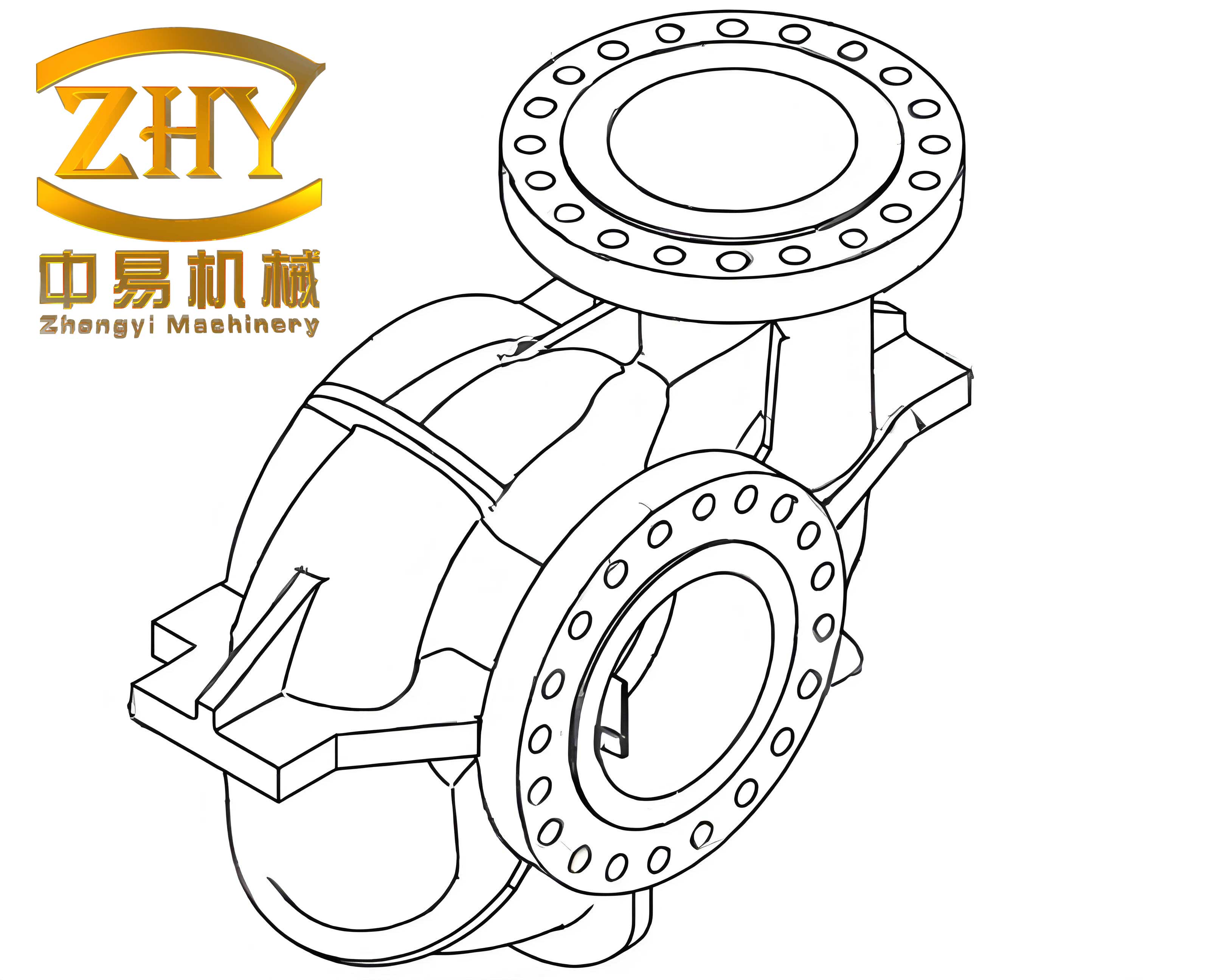
The development journey for such a component begins with a thorough analysis of the shell casting itself. The geometry is typically complex, integrating mounting flanges, internal ribbing, and varied wall thicknesses to meet functional and stiffness requirements. For instance, a representative housing shell casting may have a mass of approximately 37 kg, with wall thicknesses ranging from as thin as 9 mm in certain sections to over 50 mm in high-load areas. This non-uniformity presents significant challenges: it complicates the design of an effective feeding system to prevent shrinkage defects and makes it difficult to achieve a uniform, desirable microstructure throughout the component, both in the as-cast and heat-treated states. The mechanical property targets for a high-grade ADI shell casting are stringent, often requiring a minimum tensile strength (Rm) of 800 MPa, a yield strength (Rp0.2) above 500 MPa, and an elongation (A) exceeding 10%, alongside a specific hardness range and a fully ausferritic matrix.
Material Design and Alloying Strategy for ADI Shell Castings
The foundation of high-performance ADI lies in its chemical composition. The base ductile iron must be designed not only for good castability and graphite nodulization but also to ensure sufficient hardenability for the subsequent austempering heat treatment. The goal is to avoid the formation of pearlite or other undesired transformation products during the quench to the isothermal holding temperature. Key elements and their roles are summarized below:
| Element | Primary Role | Target Range (wt.%) | Influence on ADI Shell Castings |
|---|---|---|---|
| Carbon (C) | Graphite former, Austenite stabilizer | 3.60 – 3.80 | High carbon ensures graphite nucleation and provides carbon for austenite enrichment during heat treatment. Carbon equivalent (CE) must be optimized for castability versus shrinkage tendency. |
| Silicon (Si) | Graphitizer, Ferrite strengthener | 2.35 – 2.55 | Promotes graphite formation, suppresses cementite, and raises the austempering transformation temperature. Higher Si can improve ductility but must be balanced to avoid embrittlement. |
| Manganese (Mn) | Hardenability enhancer | 0.30 – 0.50 | Increases hardenability, aiding in suppressing pearlite in thicker sections of the shell casting. However, it segregates to cell boundaries and can promote carbides, so content is minimized. |
| Copper (Cu) | Hardenability enhancer, Austenite stabilizer | 0.40 – 0.70 | A very effective yet non-segregating hardenability agent. It also refines the ausferrite structure and improves strength and corrosion resistance. |
| Molybdenum (Mo)* | Powerful hardenability enhancer | 0 – 0.30 | Often used in heavy-section ADI castings. It strongly suppresses pearlite but is costly and can promote carbides. |
| Magnesium (Mg) | Nodulizing agent | 0.035 – 0.055 | Essential for spheroidizing graphite. Residual levels are tightly controlled. |
| Bismuth (Bi) | Inoculant (as part of complex inoculant) | ~0.01 – 0.03 (in inoculant) | Used in specialized inoculants to increase graphite nodule count, refine microstructure, and improve mechanical properties, particularly ductility. |
*Note: While not listed in the initial target, Mo is a common alloying addition for demanding applications.
The interplay of these elements is critical. For example, the combined effect of Mn and Cu on hardenability can be qualitatively assessed. The goal is to achieve a composition that allows the entire cross-section of the shell casting—from thin to thick regions—to transform uniformly to ausferrite during the austempering process. Furthermore, the use of specialized inoculants containing elements like bismuth has been shown to be highly beneficial. Bismuth acts as a potent graphitizer and nucleation site, significantly increasing the graphite nodule count (N). A higher nodule count refines the matrix structure, leading to more uniform properties and improved toughness. The nodule count can be approximated as a function of inoculation potency and cooling rate, which is itself influenced by the shell casting geometry and the use of chills.
Casting Process Design and Numerical Simulation for Shell Castings
The manufacturing of sound, high-quality ADI starts with producing a defect-free ductile iron casting. The complex geometry of rail transit shell castings necessitates a rigorous design of the gating and feeding system. Modern foundries rely heavily on numerical simulation software, such as MAGMA, ProCAST, or Flow-3D, to virtually prototype and optimize the casting process before any metal is poured.
The initial process design typically involves creating a 3D model of the casting, along with proposed runner systems, gates, and feeders (risers). For a shell casting produced in a high-volume molding line (e.g., a DISAMATIC or similar), a multi-cavity mold is common. The gating system is designed to be open and pressurized to ensure smooth, turbulence-free filling, minimizing oxide formation and sand inclusion. Filters are often placed in the runner to further clean the metal. The key challenge lies in designing an effective feeding system to compensate for solidification shrinkage, especially in the thick sections of the shell casting.
The fundamental principle is to establish directional solidification, where the thinner sections solidify first and the thicker sections solidify last, with the final point of solidification being in the feeder. The required feeder size can be estimated using the modulus method. The modulus (M) of a casting section is its volume (V) divided by its cooling surface area (Ac):
$$ M_{casting} = \frac{V}{A_c} $$
The feeder modulus must be larger than the modulus of the region it is intended to feed. A common rule is:
$$ M_{feeder} \geq 1.2 \times M_{casting} $$
An initial simulation based on this design often reveals problem areas. For a complex shell casting, the simulation might show isolated liquid pools (hot spots) within the casting body, indicating a high risk of macro- or micro-shrinkage porosity. These defects are unacceptable as they act as stress concentrators and severely compromise the fatigue life and pressure tightness of the final component.
Process optimization then becomes essential. A highly effective technique for promoting directional solidification in isolated hot spots is the strategic placement of chills. Chills are masses of high-thermal-conductivity material (typically iron or copper) embedded in the sand mold. They act as heat sinks, locally increasing the cooling rate and effectively modifying the solidification sequence. By placing chills adjacent to thick sections, they can create a “cooling gradient,” forcing solidification to initiate from the chill and progress towards the feeder. The design of a chill involves its volume, contact area, and material. The required chill volume (Vchill) to absorb the latent heat of solidification from a casting section can be conceptually related by:
$$ \rho_{chill} \cdot V_{chill} \cdot C_{p,chill} \cdot \Delta T \approx \rho_{iron} \cdot V_{casting,section} \cdot L $$
Where $\rho$ is density, $C_p$ is specific heat capacity, $\Delta T$ is the temperature rise of the chill, and $L$ is the latent heat of fusion of iron. In practice, rules of thumb and simulation are used to determine optimal chill size and placement.
The optimized process—incorporating carefully sized and positioned chills—is then re-simulated. A successful simulation will show a clear solidification path where all thermal centers (hot spots) are progressively moved into the feeders, and no isolated liquid remains within the shell casting itself. This virtual validation is crucial for achieving a high yield and consistent quality in the production of ADI shell castings.
Austempering Heat Treatment: The Transformation to High Performance
The defining step in creating ADI is the austempering heat treatment. This two-stage process transforms the as-cast ferritic-pearlitic or pearlitic matrix of the ductile iron into the coveted ausferritic structure. The process must be precisely controlled, as the final mechanical properties are extremely sensitive to the time-temperature parameters.
Stage 1: Austenitization. The cast shell castings are heated to a temperature within the fully austenitic region, typically between 850°C and 950°C (1562°F – 1742°F). The holding time (usually 1-3 hours) is critical to ensure complete dissolution of carbides and homogeneous saturation of the austenite with carbon. The temperature selection influences the final carbon content of the austenite: higher austenitizing temperatures lead to higher carbon-in-austenite, which generally increases ductility and fracture toughness but may slightly reduce strength.
Stage 2: Isothermal Quenching (Austempering). After austenitization, the castings are rapidly quenched into a molten salt bath maintained at a constant temperature, typically between 250°C and 400°C (482°F – 752°F). The transfer must be swift (usually less than a minute) to prevent any pearlite formation during cooling. The castings are then held at this isothermal temperature for a duration sufficient to complete the transformation of austenite to ausferrite. This transformation is a bainitic reaction, but unique to high-Si iron, it does not form cementite. Instead, it produces acicular ferrite and carbon-enriched, retained austenite.
The austempering temperature is the primary lever for adjusting properties:
- Lower Austempering Temperature (e.g., 250-300°C): Produces a fine, acicular ausferrite. Results in high strength and hardness but lower ductility and impact resistance.
- Higher Austempering Temperature (e.g., 350-400°C): Produces a coarser ausferrite with a higher volume fraction of retained austenite. Results in high ductility, toughness, and wear resistance, with somewhat lower strength.
For a grade like QT800-10, an intermediate temperature range around 350-370°C is typical. The holding time must be optimized; under-holding leaves untransformed austenite that can later form martensite, while over-holding leads to the decomposition of the high-carbon austenite into ferrite and carbide (stage II transformation), embrittling the material.
Experimental Validation and Property Analysis for Shell Castings
The efficacy of the integrated approach—composition, casting, and heat treatment—must be validated experimentally. This involves producing trial castings with varying alloying additions, subjecting them to the designed austempering cycle, and evaluating their microstructure and mechanical properties. The following table synthesizes findings from a typical development program for ADI shell castings, illustrating the impact of key variables:
| Trial Design | Key Compositional Variables (wt.%) | As-Cast Nodule Count (mm⁻²) | ADI Tensile Properties (After Austempering) | Microstructural Notes |
|---|---|---|---|---|
| Trial A (Baseline) | Higher Mn (0.49), Higher Cu (0.66), No Bi inoculation. | ~160 | Rm ~785 MPa, A ~6.5% | Lower nodularity (80%), presence of irregular graphite, mixed matrix. |
| Trial B (Optimized) | Reduced Mn (0.47), Reduced Cu (0.53), Added 0.1% Bi-inoculant. | ~300 | Rm ~908 MPa, A ~12.0% | High nodularity (90%), fine ausferrite, uniform graphite distribution. |
| Trial C (Advanced) | Further reduced Mn (0.38) & Cu (0.44), Increased Bi-inoculant to 0.15%. | ~345 | Rm ~978 MPa, A ~18.0% | Excellent nodularity (95%), very high nodule count, fully ausferritic matrix. |
The results are clear. Trial A, with higher levels of hardenability agents but no specific inoculation for nodule refinement, yielded mediocre properties, failing the elongation requirement for QT800-10. The microstructure was suboptimal. Trial B, by moderately reducing segregation-prone Mn, adjusting Cu, and introducing a bismuth-based inoculant, dramatically increased the graphite nodule count. This refined the matrix and led to a significant boost in both strength and, most notably, ductility, comfortably meeting the target specifications for the shell casting.
Trial C represents the pinnacle of optimization. By further minimizing alloying elements (reducing the risk of segregates and carbides) and maximizing the inoculation effect, the highest nodule count was achieved. This ultra-fine microstructure resulted in an outstanding combination of strength (approaching 1000 MPa) and exceptional ductility (18% elongation), far exceeding the minimum requirements. This demonstrates that for ADI shell castings, the pathway to supreme toughness lies not in excessive alloying for hardenability alone, but in achieving an extremely fine and uniform as-cast microstructure through superior inoculation and controlled chemistry. The hardenability must be sufficient, but not at the expense of microstructural cleanliness and homogeneity.
The final quality assurance involves testing coupons machined from representative areas of the shell casting (e.g., from attached test bars or non-critical regions of the casting itself). Tests include tensile testing, hardness mapping, and microstructural analysis to confirm a fully ausferritic matrix free from deleterious phases like pearlite or carbides.
Conclusion
The successful development of high-grade Austempered Ductile Iron (ADI) components such as rail transit shell castings is a multifaceted engineering achievement. It requires a synergistic integration of advanced material design, sophisticated casting process simulation and optimization, and meticulously controlled heat treatment. The shift from traditional lower-grade ductile irons to ADI grades like QT800-10 enables significant component lightweighting without compromising—and indeed enhancing—mechanical performance.
Key insights from this development process highlight that superior properties are attained through a balanced alloy strategy that prioritizes microstructural refinement. Minimizing segregating elements like manganese while employing potent inoculation techniques to maximize graphite nodule count is more effective for achieving high ductility than merely increasing hardenability additives. Furthermore, the use of numerical simulation to design and validate the casting process, particularly through the strategic application of chills, is indispensable for ensuring the internal soundness of complex shell castings.
Finally, the precise execution of the austempering cycle—controlling austenitization and isothermal transformation parameters—locks in the desired ausferritic microstructure, translating the high-quality casting into a final component with an exceptional combination of strength, ductility, and fatigue resistance. This holistic approach makes ADI a reliable and superior material choice for the next generation of lightweight, high-performance shell castings in the demanding rail transportation industry and beyond.