
In the field of modern casting, the demand for lightweight and high-performance automotive components has driven the development of advanced materials. As a researcher and practitioner in metallurgy, I have focused on enhancing the properties of spheroidal graphite cast iron, particularly aiming to achieve a combination of high strength and ductility in the as-cast condition. Spheroidal graphite cast iron, often referred to as ductile iron, is renowned for its excellent mechanical properties, including good tensile strength, elongation, wear resistance, and damping capacity. These characteristics make it a viable alternative to steel for complex-shaped parts, offering cost reductions and improved manufacturability. In this article, I will delve into the comprehensive process of developing a grade similar to QT700-10, which exhibits a tensile strength exceeding 700 MPa and an elongation over 10% in the as-cast state. The emphasis will be on alloying strategies, precise control of chemical composition, melting practices, and cooling rate management, all critical for optimizing the microstructure and performance of spheroidal graphite cast iron.
The foundation of producing high-quality spheroidal graphite cast iron lies in the meticulous selection of chemical composition. Each element plays a pivotal role in influencing the graphite morphology, matrix structure, and final mechanical properties. Carbon equivalent (CE) is a crucial parameter, as it affects the fluidity, shrinkage tendency, and graphite formation during solidification. An excessively high CE can lead to graphite flotation or exploded graphite, compromising the strength on the upper surfaces of castings, while a low CE may reduce graphite content, diminishing the beneficial graphite expansion that aids in feeding and increasing the risk of shrinkage defects like porosity. For spheroidal graphite cast iron, the CE is typically controlled within a narrow range, depending on the cooling rate. For faster-cooling sections, CE is maintained between 4.4% and 4.6%, whereas for slower-cooling sections, it is kept between 4.3% and 4.5%. The CE can be calculated using the formula: $$CE = C + \frac{1}{3}(Si + P)$$ where C, Si, and P are the weight percentages of carbon, silicon, and phosphorus, respectively. This equation helps in balancing the graphitization potential and avoiding undesired phases.
Phosphorus and sulfur are detrimental impurities that must be minimized. Phosphorus forms brittle phosphide eutectics, which can severely reduce ductility and impact toughness. Sulfur, being an anti-spheroidizing element, reacts with magnesium during nodularization, forming MgS and causing fluctuations in residual magnesium content, leading to inconsistent spheroidization. Therefore, in high-strength, high-ductility spheroidal graphite cast iron, the phosphorus content should be below 0.035%, and sulfur below 0.02%. Manganese is an alloying element that stabilizes and refines pearlite, enhancing strength and hardness through solid solution strengthening. However, due to its strong segregation tendency, excessive manganese can impair elongation. Thus, manganese is generally limited to less than 0.6% in grades requiring high toughness.
Copper is a key alloying element for achieving high strength in pearlitic spheroidal graphite cast iron. It promotes graphitization during eutectic transformation, reducing the formation of free carbides, and encourages pearlite formation during eutectoid transformation, suppressing ferrite development. Additionally, copper provides solid solution strengthening and precipitation hardening, significantly improving tensile strength. It also enhances the uniformity of microstructure and properties across casting sections. Typically, copper additions range from 0.3% to 1.0% for pearlitic grades. If higher toughness is required, nickel can be substituted for copper, albeit at a higher cost. The synergistic effects of these elements are summarized in the table below, which outlines the targeted chemical composition for developing as-cast spheroidal graphite cast iron with tensile strength over 700 MPa and elongation over 10%.
| Element | Target Range (wt.%) | Role and Impact |
|---|---|---|
| Carbon (C) | 3.4–3.8 | Influences graphite formation and CE; higher C improves fluidity but risks flotation. |
| Silicon (Si) | 2.2–2.7 | Promotes graphitization; enhances strength and hardness but can reduce toughness if excessive. |
| Manganese (Mn) | 0.3–0.6 | Refines pearlite; increases strength but must be limited to avoid segregation. |
| Phosphorus (P) | ≤ 0.035 | Harmful; forms brittle phosphides; kept low for ductility. |
| Sulfur (S) | ≤ 0.020 | Anti-spheroidizing; reacts with Mg; controlled for consistent nodularization. |
| Magnesium (Mg) | 0.035–0.060 | Essential for graphite spheroidization; residual content critical for nodule formation. |
| Copper (Cu) | 0.5–0.8 | Promotes pearlite; strengthens matrix; improves uniformity. |
| Cerium (Ce) | 0.01–0.02 | Trace element from nodulizer; aids in spheroidization and counteracts impurities. |
Beyond individual elements, the interaction between them can be modeled using empirical relationships. For instance, the tendency for pearlite formation can be estimated by a parameter like the pearlite factor, which might incorporate copper and manganese contents. A simplified expression could be: $$P_f = k_1 \cdot Cu + k_2 \cdot Mn$$ where \(k_1\) and \(k_2\) are constants derived from experimental data, and \(P_f\) correlates with the volume fraction of pearlite. Such formulas aid in predicting the matrix structure and tailoring compositions for specific grades of spheroidal graphite cast iron.
The melting and processing techniques are equally vital in realizing the desired properties of spheroidal graphite cast iron. I typically employ a charge mix comprising 30–50% high-purity pig iron (such as Q10 grade), 20–40% low-carbon steel scrap with titanium content below 0.05%, and 20–40% returns from previous casts. This blend ensures a clean base with controlled trace elements. Melting is conducted in a medium-frequency induction furnace of 500 kg capacity, where the molten iron is heated to a temperature of 1500–1550°C to achieve homogeneity and proper superheat. The chemical composition is verified using optical emission spectrometry, allowing for real-time adjustments before treatment.
Nodularization is a critical step that determines the spheroidal morphology of graphite. I prefer the sandwich or pour-over method using a ladle with a reaction chamber. The nodulizer chosen is a ferrosilicon-magnesium alloy containing 7.5–8.5% Mg and 4.5–5.5% rare earths (e.g., cerium), with the balance being silicon and iron. The addition rate is 1.2–1.5% of the molten iron weight, and the particle size is maintained between 6–25 mm to ensure a controlled reaction. Upon treatment, the magnesium reacts with sulfur and oxygen, facilitating the formation of spheroidal graphite nodules. The reaction time is kept between 30–60 seconds by using covering compounds to moderate the vigor. Immediately after nodularization, inoculation is performed to refine the graphite and matrix. I use a 75% ferrosilicon inoculant with a grain size of 4–8 mm, added at 0.3–0.5% of the iron weight in the treatment ladle. This is followed by a second inoculation during transfer to the pouring ladle, where 0.4–0.6% of finer 75% ferrosilicon (1–4 mm) is added. This double inoculation enhances graphite nucleation, improves nodule count, and minimizes chilling tendencies.
After thorough slag removal using fluxing agents, the molten spheroidal graphite cast iron is poured at temperatures ranging from 1350 to 1390°C. To monitor the quality, Y-block test samples (25 mm × 55 mm × 140 mm) are cast simultaneously, and samples are taken from the ladle for chemical analysis. The typical composition after treatment is shown in the following table, which reflects the consistency achievable through this process.
| Heat No. | C (wt.%) | Si (wt.%) | Mn (wt.%) | P (wt.%) | S (wt.%) | Mg (wt.%) | Cu (wt.%) | Ce (wt.%) |
|---|---|---|---|---|---|---|---|---|
| 1 | 3.49 | 2.49 | 0.40 | 0.035 | 0.013 | 0.057 | 0.54 | 0.028 |
| 2 | 3.68 | 2.31 | 0.39 | 0.031 | 0.012 | 0.036 | 0.78 | 0.020 |
| 3 | 3.55 | 2.61 | 0.35 | 0.031 | 0.014 | 0.051 | 0.57 | 0.018 |
| 4 | 3.66 | 2.31 | 0.44 | 0.031 | 0.015 | 0.040 | 0.47 | 0.019 |
| 5 | 3.55 | 2.52 | 0.32 | 0.030 | 0.016 | 0.053 | 0.55 | 0.021 |
| 6 | 3.53 | 2.63 | 0.22 | 0.026 | 0.013 | 0.042 | 0.50 | 0.016 |
The cooling rate during solidification and subsequent transformations profoundly influences the microstructure of spheroidal graphite cast iron. In particular, the eutectoid transformation range (approximately 700–800°C) is where the pearlite and ferrite phases form. Accelerating cooling through this interval refines the pearlite lamellae and increases the pearlite volume fraction, thereby boosting strength without excessively compromising ductility. For the Y-block test samples, I achieve this by shaking out the molds at 730–800°C, about 20 minutes after pouring. This controlled rapid cooling mimics conditions in processes like sand-coated metal mold casting, which is beneficial for producing high-strength grades. The cooling rate can be quantified using Newton’s law of cooling: $$ \frac{dT}{dt} = -h (T – T_{\text{env}}) $$ where \(T\) is the temperature, \(t\) is time, \(h\) is the heat transfer coefficient, and \(T_{\text{env}}\) is the ambient temperature. By manipulating \(h\) through mold design or shakeout timing, one can tailor the microstructure of spheroidal graphite cast iron.
The microstructural evaluation of the test samples reveals the effectiveness of the adopted practices. The graphite nodules are predominantly spheroidal, with a nodularity rating of 2 (according to standards like ISO 945), and the graphite size is around 6 on the ASTM scale. The matrix consists of approximately 65–80% pearlite, with the remainder being ferrite, and no free carbides or phosphide eutectics are observed. This balance is crucial for achieving the target mechanical properties. The relationship between nodularity and mechanical performance can be expressed as: $$ \sigma_t = \sigma_0 + k_n \cdot N $$ where \(\sigma_t\) is the tensile strength, \(\sigma_0\) is a base strength, \(k_n\) is a constant, and \(N\) is the nodularity percentage. Similarly, elongation correlates inversely with pearlite content but benefits from fine and well-distributed nodules.
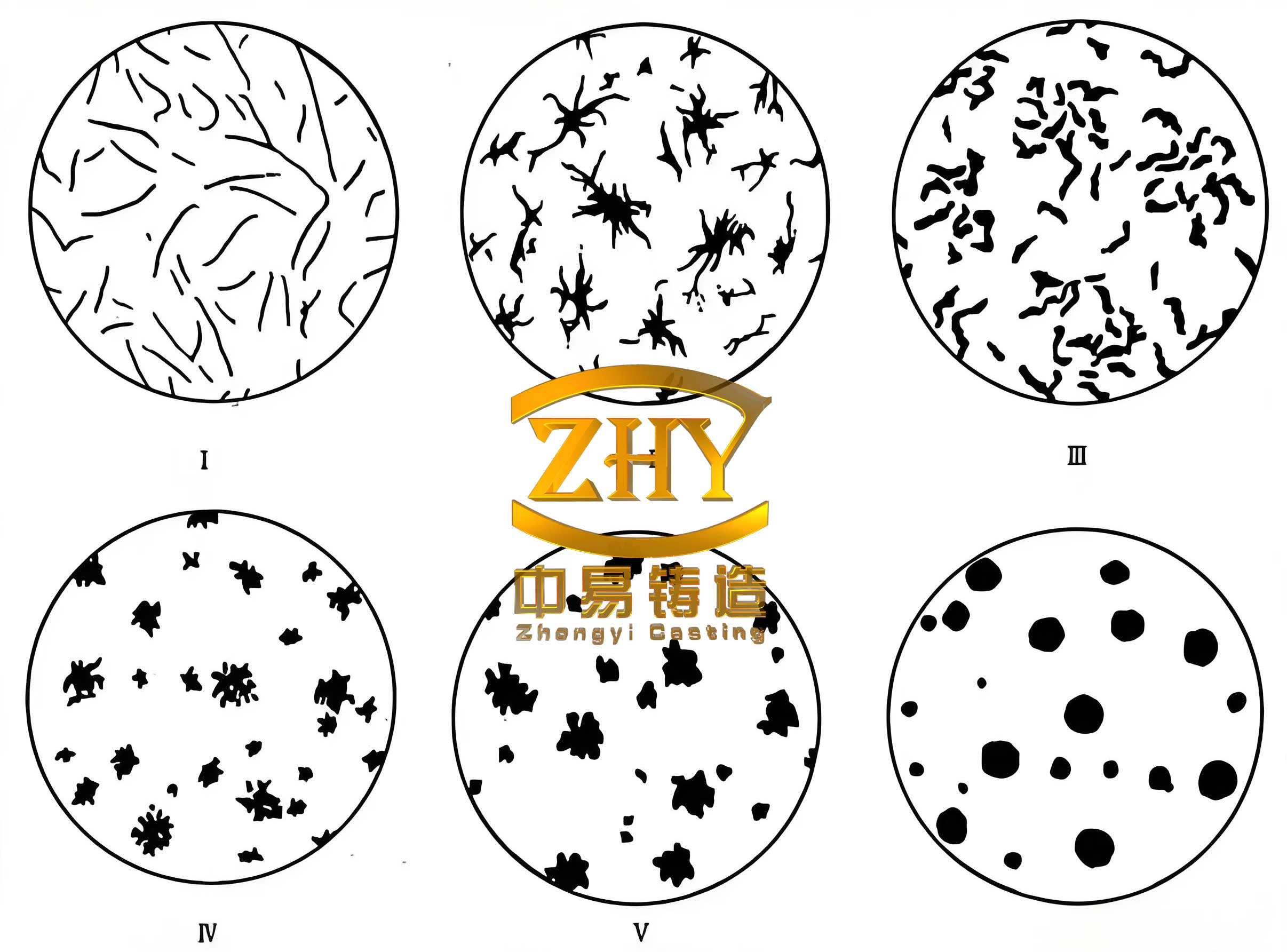
The mechanical properties derived from the Y-block tests are summarized in the table below. All heats meet or exceed the tensile strength of 700 MPa and elongation of 10%, demonstrating the reproducibility of the process for high-performance spheroidal graphite cast iron.
| Heat No. | Nodularity Grade | Graphite Size (ASTM) | Pearlite Volume Fraction (%) | Average Hardness (HB) | Tensile Strength (MPa) | Elongation (%) |
|---|---|---|---|---|---|---|
| 1 | 2 | 6 | 75 | 266 | 743 | 11.0 |
| 2 | 2 | 6 | 80 | 272 | 808 | 10.0 |
| 3 | 2 | 6 | 75 | 269 | 755 | 10.5 |
| 4 | 2 | 6 | 65 | 246 | 713 | 11.5 |
| 5 | 2 | 6 | 75 | 255 | 762 | 10.5 |
| 6 | 2 | 6 | 75 | 260 | 762 | 10.0 |
To validate the applicability to actual components, I produced a bracket casting using the same methodology. The casting was free from shrinkage porosity, and the attached test blocks exhibited consistent properties, as shown in the following table. This confirms that the approach is scalable for industrial production of high-integrity spheroidal graphite cast iron parts.
| Heat No. | Nodularity Grade | Graphite Size (ASTM) | Pearlite Volume Fraction (%) | Average Hardness (HB) | Tensile Strength (MPa) | Elongation (%) |
|---|---|---|---|---|---|---|
| A | 3 | 6 | 65 | 249 | 718 | 11 |
| B | 3 | 6 | 75 | 261 | 740 | 10 |
The successful development of this grade hinges on two fundamental conditions. First, the spheroidal graphite cast iron must exhibit a nodularity grade of 1 to 2, ensuring that the graphite is predominantly spherical to maximize strength and ductility. Second, the pearlite volume fraction should be controlled between 65% and 80%, providing a balance of strength from pearlite and toughness from ferrite. These criteria are interconnected, as high nodularity promotes a uniform stress distribution, allowing the pearlite matrix to contribute effectively to strength without premature failure. The pearlite fraction can be estimated from the cooling rate and alloy content using an equation like: $$ V_p = \frac{1}{1 + e^{-a(T_c – b)}} $$ where \(V_p\) is the pearlite volume fraction, \(T_c\) is the cooling rate in the eutectoid range, and \(a\) and \(b\) are material constants. This sigmoidal relationship highlights the sensitivity of microstructure to processing conditions.
Furthermore, the accelerated cooling during the eutectoid transformation is indispensable for achieving the desired matrix refinement. In sand molds, this can be accomplished by early shakeout, while in metal molds, the inherent faster heat extraction suffices. The interplay between chemistry and cooling can be optimized through simulation tools that model solidification and phase transformations. For instance, the kinetics of pearlite formation can be described by the Johnson-Mehl-Avrami-Kolmogorov equation: $$ V_p = 1 – \exp(-k t^n) $$ where \(k\) is a rate constant dependent on temperature and composition, \(t\) is time, and \(n\) is an exponent. Such models aid in designing cooling protocols for spheroidal graphite cast iron.
In conclusion, the production of high-strength, high-ductility spheroidal graphite cast iron in the as-cast condition requires a holistic approach. Through careful alloying with copper, strict control of impurities like phosphorus and sulfur, precise nodularization and inoculation, and managed cooling rates, I have demonstrated that tensile strengths above 700 MPa and elongations exceeding 10% are achievable. This makes spheroidal graphite cast iron a competitive material for demanding applications, particularly in automotive lightweighting. Future work may explore the use of other alloying elements such as nickel or molybdenum, or advanced inoculation techniques to further enhance properties. The versatility and cost-effectiveness of spheroidal graphite cast iron continue to drive innovation in foundry practices, solidifying its role in modern manufacturing.
Throughout this exploration, the term “spheroidal graphite cast iron” has been emphasized to underscore its unique microstructure and properties. The spheroidal graphite cast iron family offers a wide range of grades tailored to specific needs, and the QT700-10 equivalent represents a significant advancement in as-cast performance. By adhering to the principles outlined here, foundries can reliably produce spheroidal graphite cast iron components that meet stringent mechanical requirements while optimizing production efficiency and sustainability. The ongoing evolution of spheroidal graphite cast iron technology promises even greater achievements in material science and engineering applications.