
Impact toughness is one of the most critical mechanical properties for materials subjected to dynamic loading, particularly in low-temperature environments. It quantifies the ability of a material to absorb plastic deformation work before fracture and directly reflects its susceptibility to brittle failure. The higher the impact absorbed energy, the lower the probability of sudden brittle fracture. Ductile iron castings, although widely used in railway, automotive, and heavy machinery applications, often exhibit a significant ductile-to-brittle transition when the service temperature drops to extremely low values. At temperatures around -50 °C, conventional ductile iron castings may experience a dramatic reduction in impact toughness, causing catastrophic failure of components such as motor frames, gearbox housings, and structural supports. Consequently, the development of ductile iron castings with reliable low-temperature impact toughness has become an important technical challenge for foundry engineers and materials scientists.
In this study, I aimed at developing a ductile iron grade that can maintain excellent impact toughness at -50 °C without the addition of costly alloying elements such as nickel, copper, or molybdenum. The approach was based on the strict selection of raw materials, optimization of the base chemical composition, and the application of a suitable annealing heat treatment. The final microstructure consisted of nearly 100% ferrite with well-nodular graphite. The resulting ductile iron castings exhibited a tensile strength of at least 380 MPa and a yield strength of at least 230 MPa, fulfilling both the Chinese national standard QT400-18L and the European standard EN-GJS-400-18LT. More importantly, the absorbed energy in V-notch impact tests at -50 °C met the required average value of 12 J with individual values of at least 9 J. This paper presents a comprehensive experimental investigation covering material selection, composition design, melting practice, heat treatment, microstructure characterization, and mechanical testing. The findings provide valuable technical guidance for foundries that need to manufacture reliable low-temperature ductile iron castings.
1. Material Requirements and Test Specimen Selection
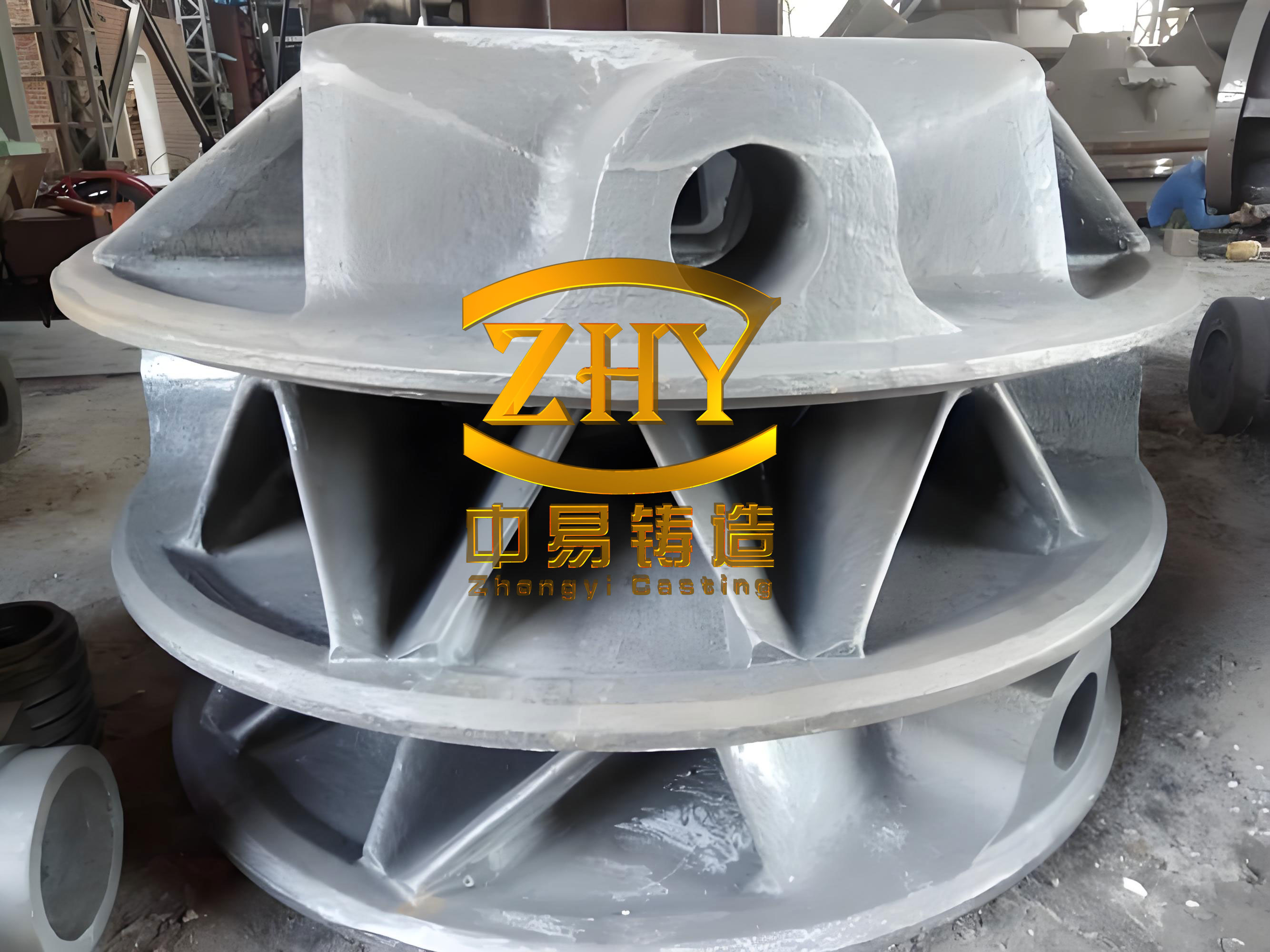
Ductile iron castings for low-temperature service must satisfy strict mechanical property requirements. The target component in this investigation was an electric motor shell with a contour size of 640 mm × 601 mm × 625 mm and a total weight of 301 kg. The local geometry of the motor shell is shown in Figure 1. The main wall thickness of the casting ranges from 30 mm to 60 mm, with some local sections exceeding 60 mm. Therefore, the separately cast test blocks were not representative enough; instead, attached test blocks cast together with the product were used. According to GB/T 1348—2019, a Type C 40 mm attached test block was selected, with a sand cover of 80 mm. The dimensions of the attached test block are illustrated in Figure 2.
The mechanical property requirements for both standards are summarized in Table 1. Because the wall thickness of the test block is between 30 mm and 60 mm, the corresponding minimum tensile strength is 380 MPa, the minimum yield strength is 230 MPa, and the minimum elongation is 15%. In addition, the low-temperature impact energy requirement at -50 °C is an average of at least 12 J with no individual value below 9 J. This combination of strength and toughness is challenging because increasing strength often sacrifices toughness.
| Standard | Grade | Wall thickness (mm) | Tensile strength Rm (N/mm²) | Yield strength Rp0.2 (N/mm²) | Elongation A (%) |
|---|---|---|---|---|---|
| GB/T 1348—2019 | QT400-18L | t ≤ 30 | 400 | 240 | 18 |
| GB/T 1348—2019 | QT400-18L | 30 < t ≤ 60 | 380 | 230 | 15 |
| DIN EN 1563:2019 | EN-GJS-400-18LT | t ≤ 30 | 400 | 240 | 18 |
| DIN EN 1563:2019 | EN-GJS-400-18LT | 30 < t ≤ 60 | 380 | 230 | 15 |
2. Experimental Raw Materials and Chemical Composition Design
2.1 Raw Materials
The production of high-quality low-temperature ductile iron castings requires exceptionally clean raw materials. Impurities such as manganese, phosphorus, sulfur, and various trace elements must be carefully controlled because they are detrimental to impact toughness and promote the formation of carbides or pearlite. In this investigation, the charge materials consisted of Q10 high-purity pig iron, high-quality steel scrap, and returned ductile iron castings from the same production line. The charging ratio was 7 parts pig iron, 2 parts steel scrap, and 1 part foundry returns. The carbon raiser used was a synthetic graphitic material with a carbon content between 97.50% and 99.50%. Ferrosilicon containing 72.0% to 80.0% silicon was used for composition adjustment. The nodularizing agent was a 6RE magnesium alloy containing 5.00% to 5.50% magnesium. The inoculant was a high-calcium barium ferrosilicon containing 68.00% to 75.00% silicon.
All raw materials were carefully inspected before melting. The Q10 pig iron provided a low manganese and low phosphorus base. The steel scrap was selected to have minimal residual alloy elements. The foundry returns were strictly separated from ordinary production returns to avoid contamination with copper, chromium, or molybdenum from other grades. By controlling the raw material quality, I was able to minimize the accumulation of harmful elements in the final ductile iron castings.
2.2 Chemical Composition Design
Carbon and silicon are the two most important elements controlling the microstructure and mechanical properties of ductile iron castings. A higher carbon equivalent improves fluidity and graphite nucleation, but excessive carbon can cause graphite flotation. For wall thicknesses between 30 mm and 60 mm, the carbon equivalent should be maintained at 4.3% to 4.5%. The carbon equivalent can be expressed by the following equation:
$$ CE = w_C + \frac{1}{3}\left(w_{Si} + w_P\right) $$
where \(w_C\), \(w_{Si}\), and \(w_P\) are the mass fractions of carbon, silicon, and phosphorus, respectively. The target carbon content in this study was set between 3.65% and 3.75%.
Silicon is a graphitizing element that increases the eutectoid transformation temperature. It strengthens the ferrite matrix and raises both tensile and yield strengths. However, excessive silicon has a strong negative effect on impact toughness because it embrittles the ferrite phase and raises the ductile-to-brittle transition temperature. To achieve a good balance between strength and low-temperature impact toughness, the silicon content was tightly controlled between 1.95% and 2.05%.
Manganese is a pearlite stabilizer and tends to segregate at cell boundaries. Even small amounts of manganese can significantly reduce the impact toughness of ductile iron castings, especially at low temperatures. Based on previous production experience, the manganese content was limited to below 0.20%. Phosphorus is also harmful because it forms steadite at grain boundaries, which lowers both elongation and impact energy. Therefore, phosphorus was controlled to no more than 0.04%. Sulfur has a strong chemical affinity with magnesium and rare-earth elements, and it consumes the nodularizing agent, leading to poor nodularity. The sulfur content was limited to 0.02% or less. Residual magnesium in the final iron was controlled between 0.035% and 0.045% to ensure complete nodularization without excessive carbide formation.
The target chemical composition designed for this study is summarized in Table 2. No additional alloying elements such as nickel, copper, or molybdenum were intentionally added. Any trace amounts of these elements in the final iron came solely from the raw materials and were considered negligible.
| Element | C | Si | Mn | P | S | Mg |
|---|---|---|---|---|---|---|
| Mass fraction (%) | 3.65–3.75 | 1.95–2.05 | <0.20 | ≤0.04 | ≤0.02 | 0.035–0.045 |
3. Experimental Procedure
The melting and treatment procedure was designed to produce ductile iron castings with consistent microstructure and mechanical properties. First, pig iron, steel scrap, and returned ductile iron were charged into a medium-frequency induction furnace according to the 7:2:1 ratio. The charge was preheated to remove moisture and then melted. During melting, a controlled amount of carbon raiser and ferrosilicon was added to adjust the carbon and silicon contents. After complete melting, a sample was taken and analyzed using a direct-reading spectrometer. The composition was then adjusted to the target range.
Once the base iron was prepared, 0.1% to 0.3% of the iron weight of silicon-barium was added for deoxidation pretreatment. When the melt temperature reached the appropriate level, the iron was tapped into a treatment ladle. The nodularizing agent, silicon-barium inoculant, and steel shots were pre-baked at 100–200 °C for 1 hour. The nodularizing agent accounted for 1.2% to 1.3% of the iron weight, the inoculant 0.7% to 0.9%, and the steel shots 0.6% to 0.8%. The sandwich method was employed for the nodularizing treatment. After the reaction was completed, the slag was raked off, and the temperature was measured. A second sample was taken to verify the post-treatment composition.
During pouring, a late inoculation was carried out by adding 0.1% to 0.2% of the iron weight of inoculant into the pouring stream. The mold was filled, and the castings were allowed to cool in the mold to room temperature. After shakeout, the castings and their attached test blocks were subjected to shot blasting and preliminary fettling. The test blocks were then cut off for microstructural and mechanical property evaluation. Some test blocks were retained in the as-cast condition for comparison, while the main castings were subjected to annealing heat treatment before final testing.
The heat treatment process is illustrated in Figure 4. The castings and attached test blocks were placed in a controlled atmosphere annealing furnace. The temperature was raised to 850 °C and held for 0.5 hour, then further raised to 920 °C and held for 3.5 hours. After that, the furnace was cooled to 550 °C at a controlled cooling rate, and then the load was removed from the furnace and cooled in still air. The heating rate was strictly controlled at 70 °C per hour, and the cooling rate from 920 °C to 550 °C was controlled at 35 °C per hour. This annealing cycle was intended to decompose any pearlite and grain-boundary carbides, producing a nearly fully ferritic matrix.
4. Results and Discussion
4.1 Chemical Composition of Tested Samples
Five sets of test samples were taken from different heats, identified as samples 1 to 5. The chemical compositions were analyzed with an ARL4460 optical emission spectrometer. Table 3 lists the detected compositions. The carbon content varied from 3.65% to 3.76%, silicon from 1.96% to 2.07%, manganese from 0.17% to 0.20%, phosphorus from 0.028% to 0.032%, and sulfur from 0.0091% to 0.012%. All values were within the designed ranges. The residual magnesium was between 0.036% and 0.043%. The contents of nickel, copper, molybdenum, antimony, and tin were extremely low, confirming that the material was essentially an unalloyed ductile iron.
| Sample | C | Si | Mn | P | S | Mg | Cu | Ni | Mo | Sn | Sb |
|---|---|---|---|---|---|---|---|---|---|---|---|
| 1 | 3.76 | 1.99 | 0.19 | 0.030 | 0.0091 | 0.041 | 0.027 | 0.014 | 0.0032 | 0.0021 | 0.0010 |
| 2 | 3.70 | 2.05 | 0.20 | 0.030 | 0.0098 | 0.038 | 0.041 | 0.012 | 0.0028 | 0.0023 | 0.0010 |
| 3 | 3.67 | 2.07 | 0.18 | 0.028 | 0.012 | 0.036 | 0.040 | 0.011 | 0.0038 | 0.0024 | 0.001 |
| 4 | 3.68 | 1.96 | 0.17 | 0.029 | 0.010 | 0.039 | 0.028 | 0.011 | 0.0026 | 0.0019 | 0.0010 |
| 5 | 3.65 | 2.04 | 0.18 | 0.032 | 0.011 | 0.043 | 0.048 | 0.013 | 0.0030 | 0.0021 | 0.0009 |
4.2 As-Cast Mechanical Properties and Microstructure
Before annealing, the attached test blocks were machined into standard tensile and impact specimens. The as-cast mechanical properties and metallographic features are summarized in Table 4. The tensile strength ranged from 386 to 400 MPa, which satisfied the minimum requirement. The yield strength varied from 236 to 252 MPa, also satisfying the requirement. The elongation was between 20.5% and 26%, well above the 15% minimum. The hardness was 143 to 148 HB, indicating a predominantly ferritic matrix with a small fraction of pearlite.
The nodularity was classified as 2 to 3 grades according to Chinese standards. The graphite nodule count varied from 125 to 170 nodules per square millimeter. However, the pearlite content in the as-cast condition was below 5%, and in some areas it reached approximately 5%. The as-cast impact test results at -50 °C were disappointing. The average absorbed energy values were 10.33 J, 8.88 J, 6.95 J, 9.67 J, and 10.17 J for samples 1 to 5, respectively. Three of the five samples failed to meet the required average value of 12 J. Even more critically, some individual values were below 9 J. This clearly indicated that the as-cast microstructure contained too much pearlite or other brittle constituents at the grain boundaries, which acted as initiation sites for cleavage fracture under impact loading at low temperatures.
| Sample | Tensile Rm (MPa) | Yield Rp0.2 (MPa) | Elongation A (%) | Hardness (HB) | Nodularity grade | Graphite nodule count (/mm²) | Pearlite content (%) | Impact energy average KV2 (J) | Impact energy individual range (J) |
|---|---|---|---|---|---|---|---|---|---|
| 1 | 395 | 248 | 24.5 | 144 | 2–3 | 155 | <5 | 10.33 | 10.12–10.51 |
| 2 | 395 | 251 | 20.5 | 145 | 2–3 | 170 | <5 | 8.88 | 8.63–9.08 |
| 3 | 400 | 252 | 26 | 148 | 2–3 | 125 | 5 | 6.95 | 6.65–7.11 |
| 4 | 386 | 236 | 25.5 | 143 | 2–3 | 125 | <5 | 9.67 | 9.11–10.07 |
| 5 | 392 | 245 | 25.5 | 144 | 2–3 | 130 | <5 | 10.17 | 9.53–10.74 |
The as-cast metallographic structure is shown in Figure 3. Before etching, the graphite nodules appeared well formed and uniformly distributed. After etching with nital, the matrix appeared mostly ferritic, but small amounts of pearlite colonies were visible, especially in the intercellular regions. These pearlite islands are known to reduce the low-temperature impact toughness because pearlite has a higher ductile-to-brittle transition temperature than ferrite. In ductile iron castings, even 2% to 5% pearlite can cause a significant drop in absorbed energy at -50 °C. Therefore, it was necessary to eliminate this residual pearlite through annealing.
4.3 Heat Treatment Process and Rationale
Annealing is a standard heat treatment used to decompose pearlite and carbides in ductile iron castings. The key is to heat the material above the upper critical temperature so that carbon can diffuse and precipitate as graphite on existing nodule surfaces. The annealing temperature and holding time must be sufficient to allow complete transformation of pearlite into ferrite and graphite. In this work, the castings were heated to 920 °C and held for 3.5 hours. This long holding time was chosen because the castings had a maximum wall thickness above 60 mm, and the heavy sections required more time to reach thermal uniformity.
The heating rate was limited to 70 °C/h to avoid thermal stress and distortion. The cooling rate from 920 °C to 550 °C was also controlled at 35 °C/h. A slow cooling rate through the critical range is essential for the complete decomposition of pearlite. Below 550 °C, the transformations are sluggish, so air cooling can be used to shorten the cycle. The heat treatment curve is shown in Figure 4. It should be emphasized that the cooling rate must be slow enough to allow carbon atoms to diffuse to the graphite nodules, but not so slow that it becomes economically impractical. A rate of 35 °C/h was found to be optimal for this particular casting geometry.
4.4 Mechanical Properties After Annealing
After annealing, the test blocks were machined and tested again. The results are summarized in Table 5. The tensile strength after annealing ranged from 384 to 390 MPa, which still met the minimum requirement of 380 MPa. The yield strength ranged from 239 to 245 MPa, also satisfying the required 230 MPa. The elongation improved slightly or remained stable, varying from 23.5% to 26.5%. The hardness decreased to 138–144 HB due to the elimination of pearlite. The nodularity remained at grade 2–3, and the graphite nodule count was 135–150 nodules per square millimeter. The pearlite content was reduced to less than 2%, effectively a nearly 100% ferrite matrix.
The most significant improvement was observed in the low-temperature impact toughness. All five annealed samples exhibited average absorbed energies between 14.06 J and 14.52 J, which comfortably exceed the required average of 12 J. The individual values ranged from 13.63 J to 14.63 J, all well above the minimum requirement of 9 J. These results demonstrate that the annealing treatment successfully eliminated the residual pearlite and significantly improved the low-temperature fracture resistance of ductile iron castings.
| Sample | Tensile Rm (MPa) | Yield Rp0.2 (MPa) | Elongation A (%) | Hardness (HB) | Nodularity grade | Graphite nodule count (/mm²) | Pearlite content (%) | Impact energy average KV2 (J) | Impact energy individual range (J) |
|---|---|---|---|---|---|---|---|---|---|
| 1 | 384 | 242 | 23.5 | 138 | 2–3 | 145 | <2 | 14.22 | 13.81–14.42 |
| 2 | 389 | 245 | 24.5 | 142 | 2–3 | 150 | <2 | 14.06 | 13.87–14.25 |
| 3 | 390 | 243 | 25 | 144 | 2–3 | 145 | <2 | 14.13 | 13.63–14.42 |
| 4 | 386 | 239 | 25.5 | 140 | 2–3 | 140 | <2 | 14.52 | 14.42–14.63 |
| 5 | 385 | 240 | 26.5 | 139 | 2–3 | 135 | <2 | 14.25 | 13.89–14.51 |
The overall performance comparison between as-cast and annealed ductile iron castings is presented in Figure 5. The metallographic structure after annealing shows a nearly complete ferrite matrix with well-distributed graphite nodules. No pearlite colonies are visible in the etched sample. The elimination of pearlite is the main reason for the improvement in low-temperature impact toughness. The average impact energy increased from approximately 9 J in the as-cast condition to about 14 J after annealing, representing a 55% improvement. Meanwhile, the tensile strength decreased only slightly, from about 393 MPa to 387 MPa, which is still acceptable. This favorable trade-off underlines the importance of a fully ferritic matrix for low-temperature applications.
5. Analysis of Influencing Factors
5.1 Effect of Silicon
Silicon is one of the most influential elements in ductile iron castings because it affects both the matrix strength and the ductile-to-brittle transition temperature. In this investigation, the silicon content was maintained between 1.96% and 2.07%. A higher silicon content would increase the tensile strength by solid solution strengthening of the ferrite matrix, but it would also reduce the impact toughness at -50 °C. The results show that samples with a silicon content at the upper end of the range, such as sample 3 with 2.07% silicon, exhibited a slightly lower impact energy after annealing. Although the difference was small, it indicates that careful control of silicon is necessary to achieve consistent low-temperature performance. For mass production, silicon should be targeted near the middle of the range, around 2.00%.
5.2 Effect of Manganese, Phosphorus, and Sulfur
Manganese is known to stabilize pearlite and to segregate at solidification boundaries. Even a small increase in manganese can raise the proportion of pearlite in the as-cast structure and increase the microsegregation of carbides. In this work, manganese was kept below 0.20%, which is essential for obtaining high impact toughness. Phosphorus also has a deleterious effect because it forms a low-melting-point eutectic at grain boundaries, which acts as a brittle phase. The phosphorus content was below 0.032% in all samples, which is acceptable. Sulfur must be as low as possible because it combines with magnesium and rare-earth elements, reducing nodularity and promoting dross defects. The sulfur content remained below 0.012%, ensuring satisfactory nodularization.
The roles of these elements can be expressed by the following empirical relationship for the pearlite fraction \(P_f\) in ductile iron castings:
$$ P_f \approx k \left( \text{Mn} + 0.5\text{Cu} + 0.3\text{Sn} \right) $$
where \(k\) is a proportionality constant and the concentrations are expressed in mass percent. Since the copper, tin, and other pearlite stabilizers were extremely low in this study, the pearlite formation was mainly controlled by manganese. By limiting manganese to below 0.20%, the as-cast pearlite remained below 5%, and after annealing it was almost completely eliminated.
5.3 Effect of Annealing on Microstructure
The annealing heat treatment transforms the as-cast matrix into a nearly 100% ferritic structure. The process can be represented by the transformation of pearlite into ferrite and graphite:
$$ \text{Fe}_3\text{C} \rightarrow 3\text{Fe} + \text{C}_{\text{graphite}} $$
During annealing, cementite dissolves and carbon diffuses to the already existing graphite nodules. The driving force is the difference in free energy between cementite and graphite. The holding time at 920 °C must be long enough for the complete diffusion of carbon. In heavy-section ductile iron castings, the diffusion distance is greater, so a longer holding time is required. The nearly 100% ferrite matrix is desirable for low-temperature impact toughness because ferrite has a body-centered cubic crystal structure that undergoes cleavage fracture only at very low temperatures when the stress exceeds the cleavage strength. In comparison, pearlite contains lamellar cementite that is hard and brittle, providing easy crack paths.
5.4 Statistical Consistency of Impact Energy
To evaluate the reliability of the annealed ductile iron castings, the impact energy values were statistically analyzed. For each sample, three individual test specimens were tested. The average impact energy \(\overline{KV_2}\) was calculated as:
$$ \overline{KV_2} = \frac{1}{3} \sum_{i=1}^{3} KV_{2,i} $$
where \(KV_{2,i}\) is the individual V-notch impact energy at -50 °C. The average values for the five samples after annealing were 14.22 J, 14.06 J, 14.13 J, 14.52 J, and 14.25 J. The mean of all samples was 14.24 J, and the standard deviation was only 0.17 J. This very low scatter indicates that the process is stable and reproducible. The minimum individual value observed was 13.63 J, which is still 51% higher than the required 9 J. Thus, the manufacturing process provides a comfortable safety margin for low-temperature impact toughness.
6. Comparison with Existing Low-Temperature Ductile Iron Grades
Several approaches have been reported in the literature to improve the low-temperature impact toughness of ductile iron castings. One common method is the addition of nickel, which increases the strength and toughness simultaneously. However, nickel is expensive and can significantly increase the material cost. Another approach is the addition of copper, but copper is a pearlite stabilizer and usually degrades the low-temperature impact toughness. Some studies have used rare-earth elements or titanium to refine the microstructure, but these additions may also form carbides if not properly controlled.
The approach developed in this study relies only on strict raw material selection, tight control of the base composition, and a proper annealing treatment. The resulting ductile iron castings meet the requirements of both GB/T 1348—2019 QT400-18L and DIN EN 1563:2019 EN-GJS-400-18LT at -50 °C. The absence of alloying elements makes the material more economical and easier to recycle. Furthermore, the fully ferritic matrix provides excellent machinability, which is an additional benefit for manufacturing components such as motor shells.
Table 6 presents a comparison between the average mechanical properties obtained in this study and the standard requirements. It can be seen that the tensile strength and yield strength satisfy the requirements with a small margin, while the elongation is well above the minimum. The low-temperature impact energy exceeds the requirement by a large margin. The hardness is typical for ferritic ductile iron castings and is suitable for machining.
| Property | Standard requirement (30–60 mm) | Average value in this study | Compliance |
|---|---|---|---|
| Tensile strength Rm (MPa) | ≥380 | 386.8 | Yes |
| Yield strength Rp0.2 (MPa) | ≥230 | 241.8 | Yes |
| Elongation A (%) | ≥15 | 25.0 | Yes |
| Impact energy average at -50 °C (J) | ≥12 | 14.24 | Yes |
| Impact energy individual minimum (J) | ≥9 | 13.63 | Yes |
7. Industrial Implementation Considerations
The successful production of low-temperature ductile iron castings requires not only correct material design but also rigorous process control in the foundry. The following aspects were identified as critical during the trial production:
First, the raw material quality must be stable. Different suppliers or batches of pig iron may contain varying amounts of titanium, chromium, vanadium, and other trace elements that can affect the low-temperature impact toughness. Therefore, each incoming batch should be analyzed, and only those meeting the internal specification should be used for low-temperature ductile iron castings.
Second, the melting process must be controlled to avoid excessive carbon loss or sulfur pickup. The furnace atmosphere and slag practice should be optimized. The treatment ladle must be clean and dry. Nodularization and inoculation should be carried out at a consistent temperature to ensure uniform graphite nodule count and nodularity. The fading of inoculation with time must be considered, so pouring should be completed within a short window after treatment.
Third, the heat treatment process should be calibrated according to the actual thermal history of the castings. Because the cooling rate in the mold depends on the section thickness, the as-cast microstructure may vary from heat to heat. The annealing cycle should be designed with enough margin to ensure that even the heaviest sections are fully ferritized. The furnace temperature uniformity should be checked periodically, and thermocouples should be placed at representative locations on the castings.
Fourth, the machining of test blocks must follow the standard procedures to avoid work hardening or overheating, which could alter the measured properties. The V-notch in the impact specimen must be machined with the correct radius and angle. Even a small deviation from the standard notch geometry can lead to a large variation in the absorbed energy. Therefore, the test specimens should be machined by experienced operators and checked with gauges.
Finally, quality assurance should include both tensile and impact tests for each heat. Because the -50 °C impact test is destructive and time-consuming, some foundries may wish to use a statistical process control approach, testing a representative number of heats and establishing control charts. This study has shown that the process is stable when the input parameters are kept within the specified ranges.
8. Fracture Mechanism and Toughness Enhancement
The low-temperature impact toughness of ductile iron castings is closely related to the fracture mechanism. In a ferritic matrix, the crack propagation path is influenced by the graphite nodules. Graphite nodules act as stress concentrators, but they also promote crack blunting and deflection. At -50 °C, the ferrite matrix may still have sufficient plasticity to accommodate local strain, provided that no brittle second phase is present. The presence of pearlite, on the other hand, provides interconnected cementite platelets that can fracture at low stress and act as cleavage initiators.
The fracture surfaces of the as-cast and annealed impact specimens were compared. The as-cast specimens showed a mixed fracture mode with many flat cleavage facets, indicating brittle fracture. The annealed specimens showed a more ductile fracture appearance with larger shear lips and dimples. This observation confirms that the elimination of pearlite was the decisive factor in improving the impact absorbed energy. The graphite nodule count also plays a role. A higher nodule count creates more crack-arresting particles and reduces the effective ferrite grain size. In this study, the nodule count of 135–150 per square millimeter after annealing was adequate for good toughness.
It is also important to note that the silicon content must not be too low, because silicon provides solid solution strengthening and suppresses the formation of carbides. A minimum silicon content of about 1.8% is generally required for ductile iron castings. At the same time, silicon raises the ductile-to-brittle transition temperature. The optimum silicon content for -50 °C service is often reported to be between 1.8% and 2.2%. Our chosen range of 1.95% to 2.05% lies in the middle, providing an excellent compromise between strength and toughness.
9. Extended Validation and Reproducibility
To further validate the reproducibility, several additional heats were produced using the same process parameters. The results consistently showed tensile strengths above 380 MPa and -50 °C impact energies above 13 J. No abnormal failures or low-impact outliers were observed. This confirms that the developed process is robust and suitable for mass production of low-temperature ductile iron castings.
The dimensional integrity of the motor shell castings was also checked after the annealing heat treatment. No cracks, deformation, or excessive oxidation were found. The annealing treatment did not adversely affect the dimensional accuracy of the castings. The machining allowance was sufficient to remove any surface decarburization or oxide scale.
10. Conclusions
Based on the experimental investigation, the following conclusions can be drawn.
First, it is possible to produce ductile iron castings with excellent low-temperature impact toughness at -50 °C without adding expensive alloying elements such as nickel, copper, or molybdenum. The key is to use clean raw materials and to limit manganese below 0.20%, phosphorus below 0.04%, and sulfur below 0.02%.
Second, the carbon content should be maintained between 3.65% and 3.75%, and the silicon content between 1.95% and 2.05%. This combination provides an adequate carbon equivalent of 4.3% to 4.5%, ensuring good castability and a fully ferritic matrix after annealing.
Third, a full annealing treatment at 920 °C for 3.5 hours, followed by controlled cooling to 550 °C at 35 °C/h, effectively eliminates residual pearlite and produces a nearly 100% ferrite matrix. The pearlite content is reduced from about 5% to less than 2%, and the low-temperature impact energy is increased by more than 50%.
Fourth, the annealed ductile iron castings meet all requirements of the national standard QT400-18L and the European standard EN-GJS-400-18LT for wall thicknesses from 30 mm to 60 mm. The tensile strength is at least 384 MPa, the yield strength at least 239 MPa, the elongation at least 23.5%, and the -50 °C V-notch impact energy average 14.37 J, with a minimum individual value of 13.63 J.
Fifth, the process is reproducible and economical. The absence of alloying additions reduces material cost, while the ferritic microstructure improves machinability and overall reliability. The developed technology is particularly suitable for railway components, heavy-duty motor housings, gearbox casings, and other structural ductile iron castings that must operate in cold climates.
In conclusion, this study demonstrates that careful composition control and proper annealing heat treatment are the most effective means to obtain high low-temperature impact toughness in ductile iron castings. The findings are expected to provide a solid technical reference for foundries that need to manufacture ductile iron castings for extreme cold environments.