
In the field of metallurgy and casting, nodular cast iron, also known as ductile iron, has garnered significant attention due to its exceptional combination of high strength, good ductility, wear resistance, and damping capacity. These properties make it an ideal material for replacing steel castings in complex components, particularly in the automotive industry where lightweighting is a critical demand. As a researcher focused on cast iron and steel materials, I embarked on a project to develop a high-performance as-cast nodular cast iron grade QT700-10, which aims to achieve a tensile strength exceeding 700 MPa and an elongation over 10% without heat treatment. This endeavor involves meticulous control of chemical composition, melting processes, and cooling conditions to optimize microstructure and mechanical properties. The following sections detail my comprehensive approach, including theoretical foundations, experimental methodologies, and results, with an emphasis on the role of alloying and cooling rate. Throughout this discussion, the term ‘nodular cast iron’ will be frequently referenced to underscore its centrality in this research.
Nodular cast iron derives its name from the spheroidal graphite morphology embedded in a metallic matrix, typically ferrite, pearlite, or a combination thereof. This structure is achieved through the addition of nodularizing elements like magnesium or cerium, which promote graphite nucleation in a spherical form during solidification. The matrix can be tailored via alloying and cooling control to enhance specific properties. For QT700-10, the target is a pearlitic matrix with sufficient ductility, balancing strength and toughness. The carbon equivalent (CE) plays a pivotal role in defining the castability and soundness of nodular cast iron. A common formula for calculating CE in cast irons is:
$$CE = C + \frac{1}{3}(Si + P)$$
However, for nodular cast iron, adjustments are often made based on empirical data. In my study, I targeted a CE range of 4.3% to 4.6%, depending on cooling conditions, to avoid defects like graphite flotation or shrinkage. The chemical composition must be precisely controlled, as even minor impurities can detrimentally affect the nodularization process and final properties. For instance, phosphorus and sulfur are harmful elements that reduce ductility and interfere with graphite spheroidization. Therefore, I limited phosphorus to below 0.035% and sulfur to below 0.02% in the melt. Manganese, while beneficial for pearlite stabilization, can segregate and impair toughness if excessive; thus, I kept it under 0.6%. Copper was chosen as the primary alloying element due to its dual role in promoting graphite during eutectic transformation and pearlite during eutectoid transformation, along with solid solution strengthening. I added 0.5% to 0.8% copper to enhance strength without compromising ductility significantly. The detailed chemical composition ranges for the as-cast QT700-10 nodular cast iron are summarized in Table 1.
| Element | Content Range (wt.%) | Role in Nodular Cast Iron |
|---|---|---|
| C | 3.4–3.7 | Primary graphite former; affects CE and fluidity |
| Si | 2.2–2.7 | Graphitizer; increases ferrite content |
| Mn | 0.3–0.6 | Pearlite stabilizer; strengthens matrix |
| P | ≤0.035 | Harmful; forms brittle phosphides |
| S | ≤0.020 | Harmful; consumes nodularizing elements |
| Mg | 0.035–0.060 | Nodularizing agent for graphite spheroidization |
| Cu | 0.5–0.8 | Alloying element; promotes pearlite and strength |
| Ce | 0.01–0.02 | Nodularizing aid; improves graphite morphology |
| CE (calculated) | 4.3–4.6 | Overall castability indicator |
The melting process is crucial for achieving homogeneity and proper nodularization. I used a 500 kg medium-frequency induction furnace to melt the charge, consisting of 30–50% Q10 pig iron, 20–40% low-carbon steel scrap (with titanium content below 0.05%), and 20–40% returns. This blend ensures a low baseline of impurities while providing adequate carbon and silicon. The molten iron was heated to an tapping temperature of 1,500–1,550 °C, and its composition was verified using optical emission spectroscopy. For nodularization, I employed the sandwich method with FeSiMg8RE5 nodularizing alloy, which contains magnesium and rare earth elements to facilitate graphite spheroidization. The chemical composition of this nodularizer is detailed in Table 2.
| Element | Content (wt.%) |
|---|---|
| RE (Rare Earths) | 4.5–5.5 |
| Mg | 7.5–8.5 |
| Si | 40–45 |
| Fe | Balance |
The nodularizer addition was 1.2–1.5% of the iron weight, with a particle size of 6–25 mm to ensure controlled reaction kinetics. After nodularization, I immediately added 0.3–0.5% of 75SiFe inoculant (4–8 mm粒度) for ladle inoculation to refine graphite and matrix. The reaction time was maintained at 30–60 seconds. Prior to transferring the iron to a pouring ladle, I added an additional 0.4–0.6% of 75SiFe inoculant (1–4 mm粒度) to enhance late-stage inoculation. Slag removal was performed at least twice using fluxing agents to minimize inclusions. The pouring temperature was controlled at 1,350–1,390 °C. During pouring, Y-block test samples (25 mm × 55 mm × 140 mm) were cast to evaluate mechanical properties and microstructure. The chemical composition of the treated iron, as sampled from the ladle, is shown in Table 3 for six different heats, demonstrating consistency in achieving the target ranges.
| Heat | C (%) | Si (%) | Mn (%) | P (%) | S (%) | Mg (%) | Cu (%) | Ce (%) |
|---|---|---|---|---|---|---|---|---|
| 1 | 3.49 | 2.49 | 0.40 | 0.035 | 0.013 | 0.057 | 0.54 | 0.028 |
| 2 | 3.68 | 2.31 | 0.39 | 0.031 | 0.012 | 0.036 | 0.78 | 0.020 |
| 3 | 3.55 | 2.61 | 0.35 | 0.031 | 0.014 | 0.051 | 0.57 | 0.018 |
| 4 | 3.66 | 2.31 | 0.44 | 0.031 | 0.015 | 0.040 | 0.47 | 0.019 |
| 5 | 3.55 | 2.52 | 0.32 | 0.030 | 0.016 | 0.053 | 0.55 | 0.021 |
| 6 | 3.53 | 2.63 | 0.22 | 0.026 | 0.013 | 0.042 | 0.50 | 0.016 |
Cooling rate control, especially during the eutectoid transformation, is another critical factor for developing high-strength, high-ductility nodular cast iron. In this study, I focused on accelerating the cooling rate in the eutectoid range to refine the pearlitic matrix and enhance mechanical properties. The Y-block samples were shaken out at 730–800 °C, approximately 20 minutes after pouring, to ensure rapid cooling through the pearlite formation temperature. This practice aligns with the principle that faster cooling suppresses ferrite formation and promotes fine pearlite, which contributes to both strength and toughness. The relationship between cooling rate and pearlite fraction can be approximated by empirical equations, such as:
$$f_P = 1 – e^{-k(T – T_0)}$$
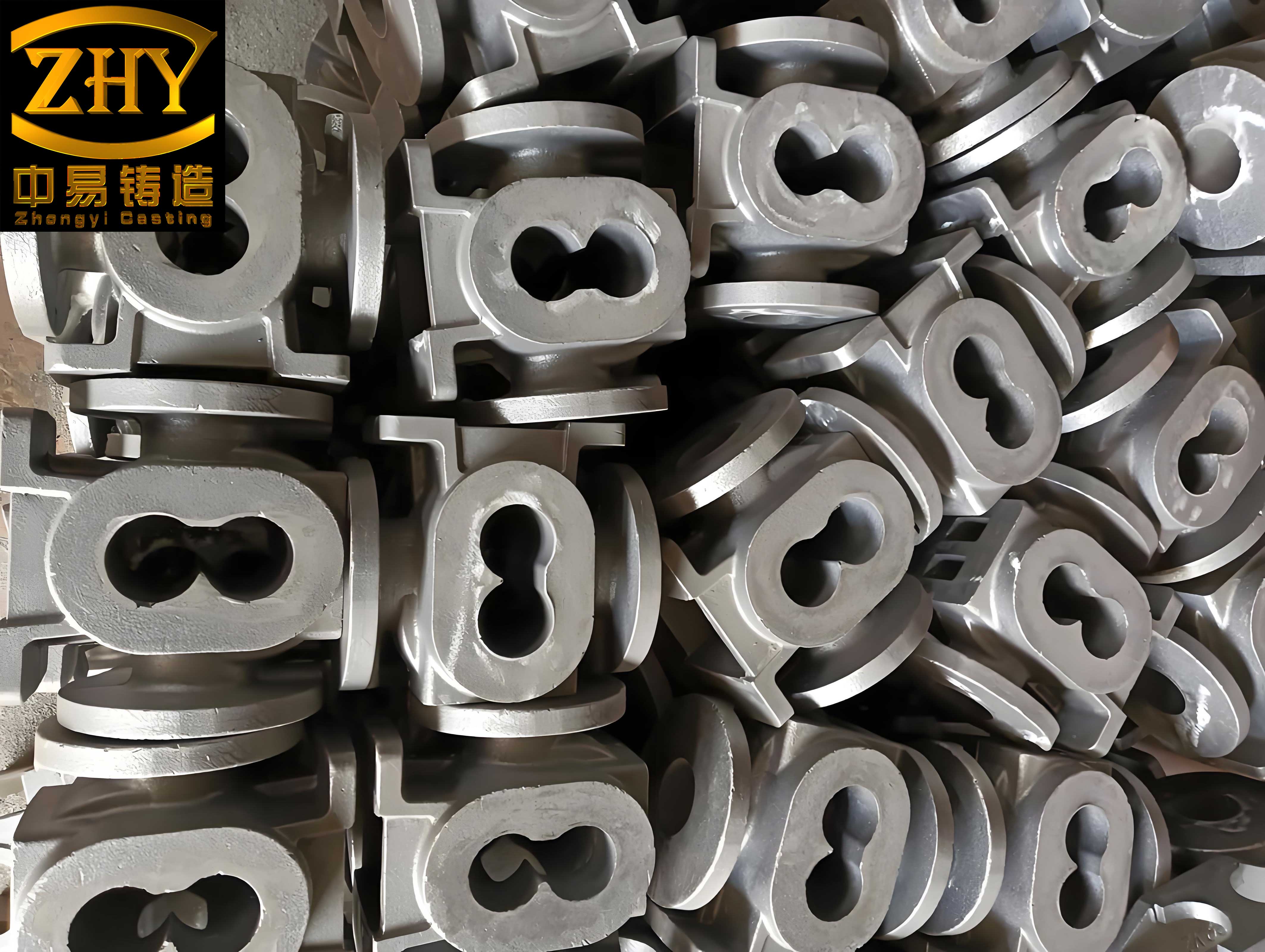
where \(f_P\) is the pearlite volume fraction, \(k\) is a rate constant dependent on alloy composition, \(T\) is the temperature, and \(T_0\) is the critical temperature for pearlite start. For nodular cast iron with copper addition, the pearlite fraction is further enhanced due to the alloying effect. In my experiments, I aimed for a pearlite volume fraction of 65–80% to achieve the desired balance. The microstructural evaluation revealed typical nodular graphite morphology with a nodularity grade of 2 and graphite size of 6, as per standard classifications. The matrix consisted primarily of fine pearlite with no observable free carbides or phosphide eutectics, indicating effective inoculation and cooling control. To illustrate the microstructure of such nodular cast iron, consider the following image that captures the essence of spheroidal graphite in a metallic matrix:
The mechanical properties of the developed nodular cast iron were assessed through tensile tests and hardness measurements on the Y-block samples. The results, summarized in Table 4, demonstrate that all heats met or exceeded the QT700-10 specifications, with tensile strengths ranging from 713 MPa to 808 MPa and elongations between 10% and 11.5%. The hardness values varied from 246 HB to 272 HB, correlating well with the pearlite content. These outcomes validate the efficacy of the copper alloying strategy coupled with controlled cooling. It is noteworthy that the nodularity grade remained consistently at 2, underscoring the stability of the nodularization process. The interplay between microstructure and properties can be described using the Hall-Petch relationship for strength, adapted for nodular cast iron:
$$\sigma_y = \sigma_0 + k_y d^{-1/2}$$
where \(\sigma_y\) is the yield strength, \(\sigma_0\) is the friction stress, \(k_y\) is a constant, and \(d\) is the grain size. In nodular cast iron, the graphite nodules act as stress concentrators, but the matrix refinement via pearlite and grain size control enhances overall strength. Additionally, the elongation is influenced by the graphite morphology and matrix ductility, with spherical graphite minimizing stress risers compared to flake graphite in gray iron.
| Heat | Nodularity Grade | Graphite Size | Pearlite Volume Fraction (%) | Average Hardness (HB) | Tensile Strength (MPa) | Elongation (%) |
|---|---|---|---|---|---|---|
| 1 | 2 | 6 | 75 | 266 | 743 | 11.0 |
| 2 | 2 | 6 | 80 | 272 | 808 | 10.0 |
| 3 | 2 | 6 | 75 | 269 | 755 | 10.5 |
| 4 | 2 | 6 | 65 | 246 | 713 | 11.5 |
| 5 | 2 | 6 | 75 | 255 | 762 | 10.5 |
| 6 | 2 | 6 | 75 | 260 | 762 | 10.0 |
To further substantiate the practical applicability of this nodular cast iron, I produced a prototype bracket component using the same processing parameters. The casting exhibited no shrinkage porosity or defects, confirming the robustness of the methodology. Attached test blocks from the bracket were evaluated, and the results, shown in Table 5, align closely with the Y-block data, indicating good reproducibility in actual castings. This success highlights the potential of QT700-10 nodular cast iron for automotive and machinery parts where high strength and ductility are paramount.
| Heat | Nodularity Grade | Graphite Size | Pearlite Volume Fraction (%) | Average Hardness (HB) | Tensile Strength (MPa) | Elongation (%) |
|---|---|---|---|---|---|---|
| 1 | 3 | 6 | 65 | 249 | 718 | 11 |
| 2 | 3 | 6 | 75 | 261 | 740 | 10 |
The development of as-cast QT700-10 nodular cast iron hinges on two fundamental conditions: first, maintaining a nodularity grade of 1–2 and a pearlite volume fraction of 65–80%; second, accelerating the cooling rate during the eutectoid transformation. These factors are interdependent and must be optimized through compositional and process controls. The use of copper as an alloying element proved instrumental in enhancing pearlite formation and solid solution strengthening, while careful nodularization and inoculation ensured consistent graphite spheroidization. The cooling strategy, involving early shakeout, facilitated fine pearlite and minimized ferrite, thereby boosting strength without sacrificing ductility. This research underscores the versatility of nodular cast iron as a material that can be engineered to meet stringent performance criteria, offering a cost-effective alternative to steel castings in weight-sensitive applications.
In conclusion, the successful production of QT700-10 nodular cast iron in the as-cast condition demonstrates the feasibility of achieving high mechanical properties through integrated metallurgical design. Future work could explore additional alloying elements like nickel or molybdenum for further enhancement, or investigate advanced cooling techniques such as insulated molds to control solidification more precisely. The ongoing evolution of nodular cast iron technology promises to expand its applications, driven by the relentless pursuit of lightweight and durable materials in industry. As I reflect on this study, it is clear that nodular cast iron remains a cornerstone of modern casting, with its unique blend of properties continuing to inspire innovation and optimization in material science.