
In modern manufacturing, surface engineering plays a pivotal role in enhancing the performance and longevity of critical components. Among various techniques, laser-based surface strengthening has emerged as a transformative method, particularly for lightweight materials like aluminum alloys in automotive applications. Concurrently, precision machining of grey iron castings remains essential for achieving superior surface quality, especially in industries reliant on durable and cost-effective materials. This article delves into these two domains, exploring how laser shock hardening can improve fatigue life in aluminum parts and how optimizing cutting parameters, specifically depth of cut, can mitigate surface defects in grey iron castings. The focus will be on practical insights, supported by tables and formulas, to provide a comprehensive guide for engineers and researchers.
Laser shock hardening, a non-thermal surface modification process, utilizes high-intensity laser pulses to induce compressive residual stresses on material surfaces. This technique is highly effective for enhancing fatigue resistance, particularly under high-frequency loading conditions. For instance, in automotive engine components made from aluminum alloys, laser shock hardening can significantly extend service life by reducing crack initiation and propagation. The process involves irradiating the surface with a short-pulse laser, typically in the nanosecond range, which generates a plasma shock wave that plastically deforms the subsurface layer. This deformation introduces compressive stresses, often exceeding 1 GPa, which counteract tensile stresses during cyclic loading. The improvement in fatigue life can be modeled using the following relationship for stress intensity factor reduction:
$$ \Delta K_{th} = K_{th,0} + \sigma_{res} \cdot \sqrt{\pi a} $$
where \( \Delta K_{th} \) is the enhanced threshold stress intensity factor, \( K_{th,0} \) is the initial threshold, \( \sigma_{res} \) is the residual compressive stress induced by laser shock hardening, and \( a \) is the crack length. This formula highlights how compressive stresses elevate the fatigue limit, making it particularly beneficial for aluminum alloys used in high-stress environments.
The applications of laser shock hardening extend beyond engine parts. It is equally valuable for lightweight automotive aluminum bodies, welded joints in high-speed rail vehicles, and precision components like bearings and gears. For example, in aluminum car bodies, laser-treated welds exhibit improved tensile strength and corrosion resistance, contributing to overall vehicle safety and durability. The table below summarizes key parameters and outcomes for laser shock hardening in various applications:
| Application | Laser Pulse Energy (J) | Pulse Duration (ns) | Residual Stress (MPa) | Fatigue Life Improvement (%) |
|---|---|---|---|---|
| Automotive Aluminum Engine Parts | 5-10 | 10-30 | -800 to -1200 | 40-60 |
| Aluminum Body Welds | 3-7 | 20-50 | -600 to -900 | 30-50 |
| High-Speed Rail Components | 8-15 | 15-40 | -1000 to -1500 | 50-70 |
| Precision Bearings and Gears | 4-9 | 10-25 | -700 to -1100 | 35-55 |
This table illustrates the versatility of laser shock hardening, with residual stresses consistently in the compressive range, leading to substantial fatigue life enhancements. The process parameters can be optimized based on material properties and component geometry, often through empirical studies or computational models like finite element analysis (FEA). For instance, the optimal laser fluence \( F_{opt} \) for inducing maximum compressive stress can be estimated as:
$$ F_{opt} = \frac{E_p}{A} \cdot \eta $$
where \( E_p \) is the pulse energy, \( A \) is the beam area, and \( \eta \) is the absorption efficiency of the material. Such formulas aid in process design, ensuring repeatability and effectiveness across different grey iron castings and alloy systems.
Transitioning to machining aspects, grey iron castings are widely used in automotive and machinery industries due to their excellent castability, damping capacity, and cost-effectiveness. However, achieving high surface quality in these castings can be challenging, especially for lower-grade irons with high carbon equivalents. Grey iron castings are characterized by a metallic matrix embedded with flake graphite, where the size and distribution of graphite depend on factors like carbon equivalent and wall thickness. During machining, particularly in roughing operations, graphite particles can be pulled out or dislodged from the matrix, leaving behind microscopic pores or holes on the surface. These defects are often visible under low magnification and can compromise the integrity and aesthetics of the component. The formation of these pores is directly linked to the graphite volume fraction \( V_g \), which can be expressed as:
$$ V_g = \frac{C_{eq} – 0.3}{7.5} $$
where \( C_{eq} \) is the carbon equivalent, calculated as \( C_{eq} = C + 0.3(Si + P) \). For grey iron castings with \( C_{eq} \) above 4.0%, graphite content increases, leading to higher susceptibility to surface pores during machining. This necessitates careful control of cutting parameters, with depth of cut being a critical factor in the finishing stage.
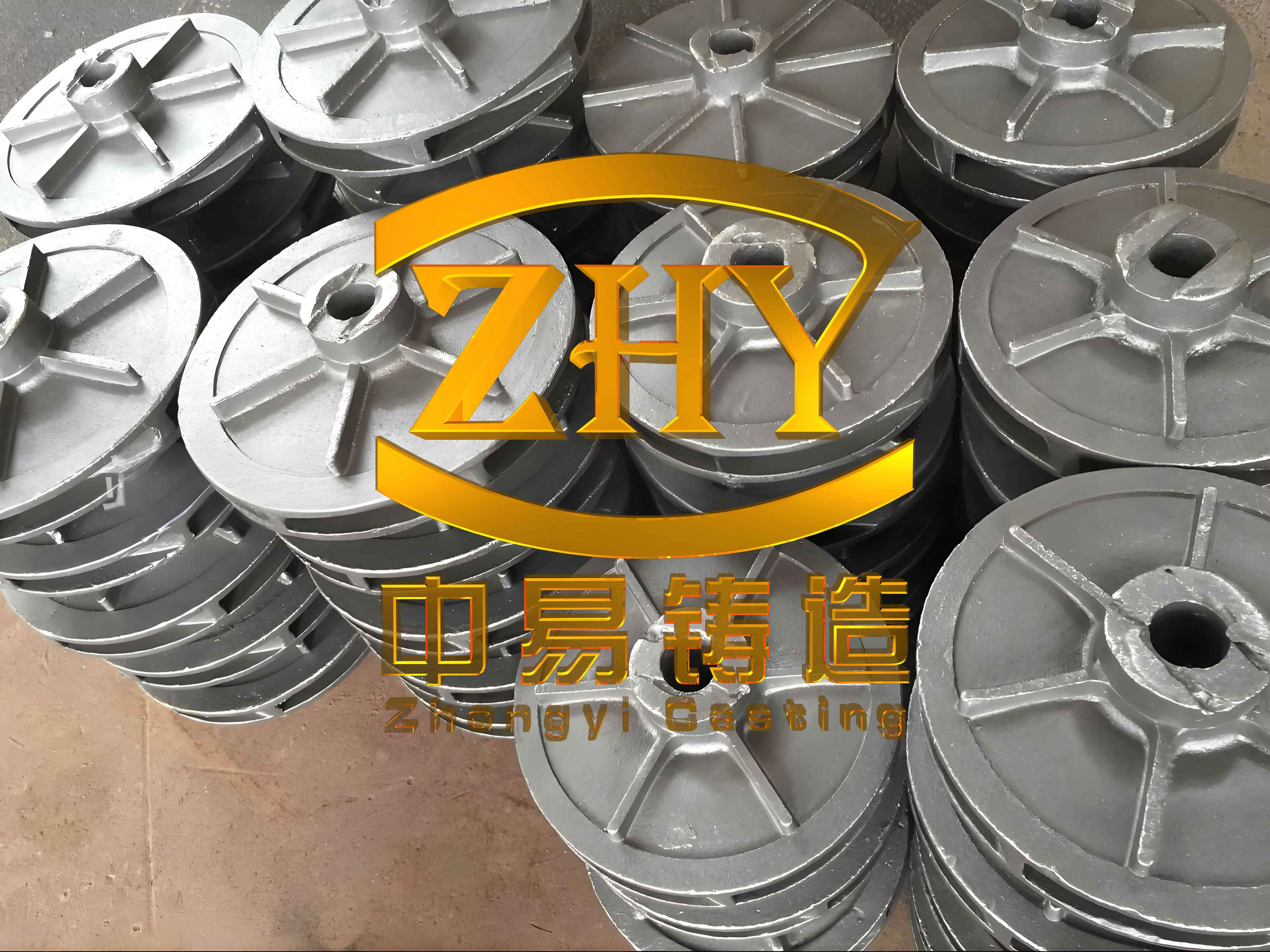
In practice, the selection of an appropriate depth of cut during finishing can significantly reduce surface porosity in grey iron castings. A shallow cut may not fully remove the defect layer from roughing, while an excessively deep cut can induce tool wear and thermal damage. Empirical studies suggest that an optimal finishing depth of cut \( d_f \) should be at least 0.3 mm to effectively eliminate pores, especially for low-grade grey iron castings. This relationship can be derived from the material removal model:
$$ d_f \geq h_d + \delta $$
where \( h_d \) is the depth of the defect layer (typically 0.1-0.2 mm for grey iron castings with high graphite content) and \( \delta \) is a safety margin (around 0.1 mm). By ensuring \( d_f \) meets this criterion, the finishing operation can “polish” the surface, reducing visible holes and improving roughness. To quantify this, surface roughness \( R_a \) after machining can be correlated with depth of cut and feed rate using the following empirical formula:
$$ R_a = k \cdot f^\alpha \cdot d^\beta $$
where \( f \) is the feed rate, \( d \) is the depth of cut, \( k \) is a material constant, and \( \alpha \) and \( \beta \) are exponents typically around 1.2 and 0.8 for grey iron castings, respectively. Optimizing these parameters can yield surface roughness values below 3.2 μm, meeting technical requirements for many applications.
A case study involving a flange made from HT200 grey iron casting illustrates the impact of cutting parameters. The component had a wall thickness of 20 mm and a required surface roughness of 3.2 μm on its end face. The table below compares surface quality under different roughing and finishing conditions:
| Operation | Feed Rate (mm/rev) | Depth of Cut (mm) | Surface Quality Observation |
|---|---|---|---|
| Rough Turning | 0.4 | 2.0 | Visible pores distributed across surface |
| Finish Turning (Inadequate) | 0.1 | 0.1 | Pores partially removed, but still apparent |
| Finish Turning (Optimal) | 0.1 | 0.3 | Pores largely eliminated, surface acceptable |
This table underscores that a finishing depth of cut of 0.3 mm or more is crucial for achieving acceptable surface quality in grey iron castings. When combined with improved tool geometry (e.g., positive rake angles) and stable fixturing, the results can be further enhanced. The mechanism behind this involves the cutting tool shearing through the metal matrix while minimizing graphite pull-out, as the increased depth ensures complete removal of the porous layer. For grey iron castings with varying graphite morphologies, the optimal depth may need adjustment, which can be guided by non-destructive testing or prior machining trials.
Beyond depth of cut, other factors influence the surface quality of grey iron castings. These include tool material (e.g., carbide or CBN inserts), cutting speed, coolant usage, and workpiece microstructure. For instance, higher cutting speeds can reduce built-up edge but may increase thermal stress on graphite flakes. A comprehensive approach involves modeling the machining process using response surface methodology (RSM) or artificial neural networks (ANNs) to predict surface roughness. One such model incorporates multiple variables:
$$ R_a = c_0 + c_1 \cdot v + c_2 \cdot f + c_3 \cdot d + c_4 \cdot V_g $$
where \( v \) is cutting speed, \( f \) is feed rate, \( d \) is depth of cut, \( V_g \) is graphite volume fraction, and \( c_0 \) to \( c_4 \) are coefficients derived from experimental data. This formula allows for tailored parameter selection based on specific grey iron casting grades, ensuring consistency in production.
In the context of laser surface strengthening, similar optimization principles apply. For grey iron castings, laser techniques like laser melting or alloying can be used to modify surface properties, such as hardness and wear resistance. However, the presence of graphite can lead to inhomogeneous melting or crack formation if parameters are not controlled. Therefore, hybrid processes combining laser pretreatment with precision machining are gaining traction. For example, laser shock hardening can be applied to critical areas of grey iron castings before machining, to induce compressive stresses that reduce tool wear and improve surface finish. The synergy between these technologies is summarized in the following table:
| Process Sequence | Key Parameters | Benefits for Grey Iron Castings | Challenges |
|---|---|---|---|
| Laser Shock Hardening Before Machining | Laser energy: 5-15 J, spot size: 1-3 mm | Enhanced subsurface strength, reduced porosity during cutting | Alignment accuracy, cost |
| Precision Machining After Laser Treatment | Depth of cut: 0.3-0.5 mm, feed: 0.05-0.2 mm/rev | Superior surface finish, extended component life | Tool selection for hardened layer |
| Combined Laser Alloying and Finishing | Laser power: 1-3 kW, scanning speed: 10-50 mm/s | Improved wear resistance, tailored surface properties | Microstructural control, thermal distortion |
This integrated approach highlights how advanced surface engineering can address the unique challenges of grey iron castings, from automotive brake discs to machine tool beds. Moreover, the economic impact is significant, as improved surface quality reduces scrap rates and post-processing needs, lowering overall manufacturing costs.
From a theoretical perspective, the interaction between laser beams and grey iron castings involves complex thermo-mechanical phenomena. When a laser pulse strikes the surface, the absorption depends on the material’s optical properties, which vary with graphite content. The absorption coefficient \( \alpha_{abs} \) can be approximated as:
$$ \alpha_{abs} = \alpha_m (1 – V_g) + \alpha_g V_g $$
where \( \alpha_m \) is the absorption coefficient of the metallic matrix (around 0.3 for iron) and \( \alpha_g \) is that of graphite (around 0.8). This implies that grey iron castings with higher graphite content absorb more laser energy, potentially leading to deeper heat-affected zones. In laser shock hardening, however, the use of a transparent overlay (e.g., water or glass) confines the plasma, minimizing thermal effects and maximizing mechanical impact. The pressure \( P \) generated by the shock wave can be estimated using the Fabbro model:
$$ P = 0.01 \sqrt{\frac{I \cdot Z}{2 \tau}} $$
where \( I \) is the laser intensity (W/cm²), \( Z \) is the reduced impedance between the target and confining medium, and \( \tau \) is the pulse duration. This pressure induces plastic deformation, with the depth of compressive layer \( L_c \) given by:
$$ L_c = \frac{P \cdot \tau}{\rho \cdot c} $$
where \( \rho \) is material density and \( c \) is the speed of sound. For grey iron castings, typical \( L_c \) values range from 0.5 to 2 mm, sufficient to mitigate surface defects from machining.
In conclusion, both laser surface strengthening and precision machining are indispensable for enhancing the performance of grey iron castings. Laser shock hardening offers a non-contact method to improve fatigue resistance, especially when applied to aluminum alloys in automotive contexts, but its principles are equally relevant to iron-based materials. Meanwhile, optimizing cutting parameters, particularly depth of cut in finishing operations, is critical for achieving defect-free surfaces in grey iron castings. By leveraging tables and formulas, manufacturers can standardize processes and predict outcomes, driving innovation in industries ranging from automotive to aerospace. Future research may focus on real-time monitoring and adaptive control, further bridging the gap between theoretical models and practical applications for grey iron castings.
To facilitate continuous improvement, I recommend establishing a database of machining parameters for different grades of grey iron castings, coupled with laser treatment records. This data-driven approach, supported by statistical analysis, can uncover hidden correlations and optimize resource allocation. As the demand for high-performance components grows, mastering these techniques will remain a cornerstone of advanced manufacturing, ensuring that grey iron castings continue to meet evolving engineering standards.