
In my research, I aimed to address the severe wear conditions in steel rolling guide plates by integrating composite design principles with foundry technology. The goal was to develop a locally reinforced composite material using tungsten carbide (WC) particles within a gray cast iron matrix, produced through conventional sand castings without the need for vacuum assistance. This approach leverages the simplicity and cost-effectiveness of sand castings, making it accessible for industrial applications. The composite was designed to enhance wear resistance in critical areas, thereby extending service life significantly. In this article, I will detail the methodology, optimization processes, and results, emphasizing the role of sand castings throughout.
The foundation of this work lies in the combination of a gray cast iron (HT200) matrix and WC particles as the reinforcement. The WC particles, with a size range of 0.600–0.425 mm, were selected for their high hardness and wear resistance. To facilitate the integration of these particles into the sand castings, I developed a proprietary compound additive, referred to as FHJ-1#. This additive was crucial in mitigating common issues in sand castings, such as gas porosity, slag inclusions, poor bonding, and uneven composite layer distribution. The additive was mixed with WC particles and water, then applied to specific locations in the mold cavity before pouring. The mold was prepared using standard sand casting techniques, dried at 250°C for 4 hours, and then assembled for casting. This process highlights the adaptability of sand castings for producing complex composites.
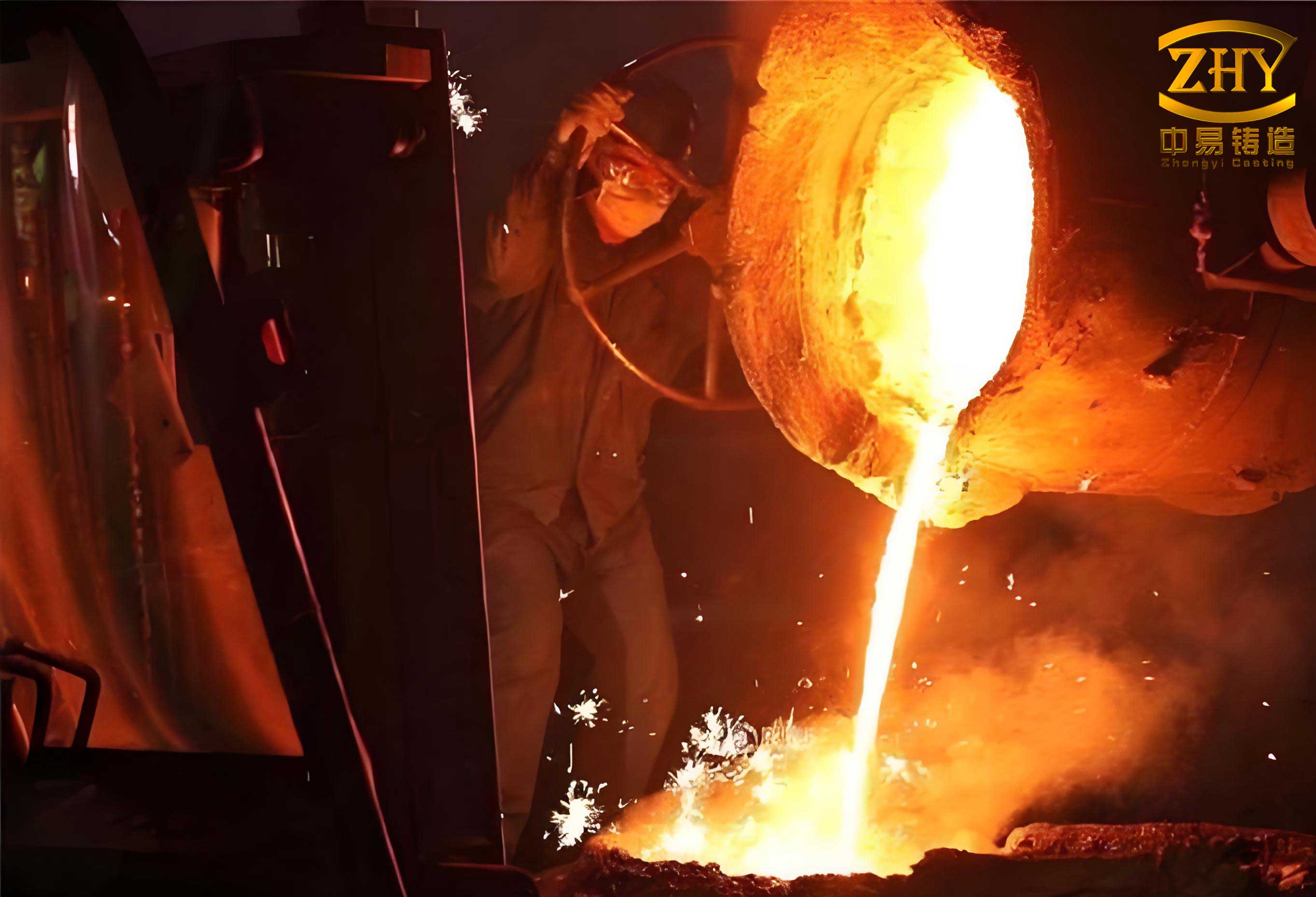
The casting process was carried out in an ordinary sand mold, with molten iron melted in a medium-frequency induction furnace and inoculated in the ladle before pouring. I investigated key parameters, including pouring temperature and gating system design, to optimize the quality of the sand castings. The composite layer thickness, bonding integrity, and surface finish were critical metrics. Through iterative trials, I established that a pouring temperature of 1430°C yielded the best results, with effective infiltration of molten metal into the WC particle bed and minimal dissolution of particles. At lower temperatures, inadequate infiltration led to gaps, while higher temperatures caused excessive particle dissolution and increased chill tendency. This temperature dependency can be expressed using a simplified thermal model for sand castings:
$$ T_{opt} = T_m – \Delta T_{inf} $$
where \( T_{opt} \) is the optimal pouring temperature, \( T_m \) is the melting point of the matrix, and \( \Delta T_{inf} \) is the temperature drop required for proper infiltration without degradation. For gray iron in sand castings, \( T_m \approx 1150°C \), but due to heat loss in sand molds, the actual pouring temperature must be higher to maintain fluidity. Based on my experiments, the relationship for sand castings can be approximated as:
$$ T_{opt} = 1150 + 280 \cdot e^{-k \cdot t} $$
where \( k \) is a constant related to mold material (typically 0.01–0.05 for sand castings), and \( t \) is time in seconds. This formula underscores the importance of thermal management in sand castings.
The gating system design proved equally vital. I tested two configurations: a closed gating system placed away from the reinforcement zone, and an open gating system with wide ingates adjacent to the WC particle layer. The open system minimized turbulence and particle displacement, ensuring uniform composite layer formation in the sand castings. This aligns with fluid dynamics principles, where the velocity \( v \) of molten metal in sand castings should be controlled to avoid erosion:
$$ v = \frac{Q}{A} \leq v_{crit} $$
Here, \( Q \) is the flow rate, \( A \) is the cross-sectional area of the ingate, and \( v_{crit} \) is the critical velocity beyond which particles are dislodged. For sand castings with WC particles, \( v_{crit} \) is approximately 0.5 m/s. The open gating system reduced velocity by increasing \( A \), thereby enhancing the quality of sand castings. The table below summarizes the effects of different gating systems on composite layer characteristics in sand castings:
| Gating System Type | Pouring Temperature (°C) | Composite Layer Thickness (mm) | Surface Quality | Particle Displacement |
|---|---|---|---|---|
| Closed | 1430 | 5–7 (uneven) | Rough | Significant |
| Open | 1430 | 7–9 (uniform) | Smooth | Minimal |
The microstructure of the composite was examined to assess bonding and phase distribution. In the sand castings, the composite layer exhibited a homogeneous dispersion of WC particles within the matrix, with refined graphite and minor amounts of cementite and pearlite. The interfacial bonding was metallurgical, indicating strong adhesion—a key advantage of this sand castings approach. The hardness profile further confirmed the enhancement. Measurements were taken from both the composite region and the base gray iron region, as shown in the following table:
| Heat Treatment Condition | Composite Region Hardness (HRC) | Base Matrix Hardness (HB) | Hardness Ratio (Composite/Base) |
|---|---|---|---|
| As-cast | 60–62 | 200–210 | ~3.0 |
| Annealed | 48–50 | 180–190 | ~2.6 |
The high hardness in the composite region, achieved through sand castings, directly contributes to wear resistance. I derived a wear model based on the Archard equation, modified for composite materials in sand castings:
$$ W = k \cdot \frac{H_{comp}}{H_{base}} \cdot \frac{F \cdot L}{V} $$
where \( W \) is wear volume, \( k \) is a wear coefficient, \( H_{comp} \) and \( H_{base} \) are hardness values of the composite and base, \( F \) is load, \( L \) is sliding distance, and \( V \) is volume fraction of WC. For sand castings with 30–40% WC, the wear resistance improvement factor \( R \) can be estimated as:
$$ R = \frac{W_{base}}{W_{comp}} = \alpha \cdot \left( \frac{H_{comp}}{H_{base}} \right)^\beta $$
with \( \alpha \) and \( \beta \) as empirical constants (e.g., \( \alpha \approx 1.2 \), \( \beta \approx 1.5 \) for sand castings). From my data, \( R \) exceeds 5, correlating with the observed life extension.
To further optimize the sand castings process, I analyzed the relationship between composite layer thickness \( d \) and process parameters. Using regression analysis on experimental data from sand castings trials, I formulated an equation:
$$ d = C_0 + C_1 \cdot T_p + C_2 \cdot t_h + C_3 \cdot m_{add} $$
where \( d \) is thickness in mm, \( T_p \) is pouring temperature in °C, \( t_h \) is holding time in minutes, \( m_{add} \) is additive mass in grams, and \( C_i \) are coefficients. For sand castings with FHJ-1# additive, \( C_0 = -5.2 \), \( C_1 = 0.008 \), \( C_2 = 0.1 \), and \( C_3 = 0.05 \). This model aids in predicting outcomes for various sand castings configurations.
The practical application of these sand castings was validated through field trials in a steel rolling mill. The WC-reinforced composite guide plates, produced via sand castings, demonstrated a service life over five times longer than conventional gray iron plates. This reduction in replacement frequency not only lowered maintenance costs but also improved product quality by minimizing downtime. The success hinges on the robustness of sand castings, which allowed for consistent composite layer formation without specialized equipment. The table below compares performance metrics:
| Material | Production Method | Average Life (hours) | Wear Rate (mm/year) | Cost Efficiency |
|---|---|---|---|---|
| Gray Iron | Standard Sand Castings | 200 | 10.5 | Base |
| WC Composite | Enhanced Sand Castings | 1000+ | 2.1 | High |
In conclusion, my research demonstrates that sand castings can be effectively utilized to manufacture high-performance composites for demanding industrial applications. By incorporating a custom compound additive and optimizing pouring parameters, I achieved a uniform, metallurgically bonded composite layer in sand castings. The simplicity of this sand castings process makes it economically viable for widespread adoption. Future work could explore other reinforcement materials or scale-up strategies for larger sand castings. Throughout this study, the versatility of sand castings has been paramount, underscoring its value in modern manufacturing.
The integration of composites into sand castings opens new avenues for material innovation. For instance, the thermal cycles in sand castings can be modeled to predict residual stresses using Fourier’s law:
$$ \frac{\partial T}{\partial t} = \alpha \nabla^2 T $$
where \( \alpha \) is thermal diffusivity, critical for sand castings due to their insulating properties. Additionally, the mechanical performance of sand castings composites can be assessed via rule-of-mixtures approximations:
$$ E_c = E_m V_m + E_p V_p $$
with \( E_c \), \( E_m \), and \( E_p \) as elastic moduli of composite, matrix, and particles, and \( V \) as volume fractions. For sand castings with WC, \( E_p \approx 700 \) GPa, significantly boosting stiffness. These principles reinforce the potential of sand castings for advanced materials.
In summary, the development of WC particle reinforced gray cast iron composites via sand castings represents a significant advancement. The process leverages the accessibility of sand castings while delivering superior wear resistance. Through meticulous parameter control and additive design, sand castings can produce components with enhanced lifetimes, proving that traditional methods like sand castings remain relevant in the era of composites. This work paves the way for further innovations in sand castings technology.