
As an observer and participant in the field of advanced manufacturing, I find the current technological evolution profoundly exciting. We are witnessing a paradigm shift where traditional, lengthy, and often environmentally taxing industrial processes are being challenged and supplanted by innovative, integrated methods. This transformation is not merely incremental; it represents a fundamental rethinking of how we conceive, design, and produce critical metallic components. Two seemingly disparate advancements—one in additive manufacturing and another in the foundational art of foundry—exemplify this shift. Both converge on a critical goal: enhancing the performance, reliability, and longevity of engineered parts. In particular, the enduring and versatile material known as ductile iron casting continues to find new life and face new challenges within this modern context, demanding ever more sophisticated approaches to its production.
The conventional manufacturing route for high-performance metal parts, especially large forgings, has followed a well-established but cumbersome path: casting, forging, heat treatment, and machining. This multi-step, long-flow process relies on massive forging presses, consumes significant energy, and presents environmental challenges. A fundamental limitation lies in the size constraint of forging equipment; large, complex components often cannot be forged as a single piece. Instead, they are forged in segments and subsequently welded together, inevitably introducing potential weak points and compromising the overall structural integrity and fatigue life. On the other hand, the rise of metal additive manufacturing (AM), or 3D printing, promised a revolution with its near-net-shape capabilities and design freedom. However, a significant shortcoming of conventional metal AM techniques like selective laser melting (SLM) or electron beam melting (EBM) is their inherent “casting-like” metallurgy. The rapid melting and solidification typically result in coarse, columnar grain structures and may leave residual stresses, leading to mechanical properties—notably fatigue strength and toughness—that often fall short of those achieved in wrought or forged materials. This gap between the convenience of AM and the performance of forgings created a pressing need for a hybrid solution.
The breakthrough, often termed “micro-casting-forging” or “additive and subtractive hybrid manufacturing,” ingeniously bridges this gap. This technology integrates the principles of casting and forging within a single, continuous operation during the layer-by-layer building process. Imagine a system where a component is built additively, but as each molten layer is deposited, it is immediately plastically deformed—’forged’—by a follow-up tool while the material is still in a semi-solid or hot state. This synergistic action fundamentally alters the material’s microstructure. The key advantages can be summarized in the following table:
| Feature | Conventional Long-Flow (Cast-Forged) | Conventional Additive Manufacturing (AM) | Micro-Casting-Forging Hybrid AM |
|---|---|---|---|
| Process Flow | Multi-step, discrete (Cast → Forge → Heat Treat → Machine) | Single-step, integrated layer deposition | Single-step, integrated layer deposition with in-situ forging |
| Microstructure | Refined by bulk forging, isotropic | Often columnar grains, anisotropic | Equiaxed, fine grains, isotropic |
| Mechanical Properties | High strength & toughness, good fatigue life | Lower toughness & fatigue life compared to forgings | Approaches or matches forged properties, high fatigue life |
| Geometric Freedom | Limited by forgeability and welding | Very high (complex internal features) | Very high (complex internal features) |
| Material Waste | High (significant machining) | Low (near-net-shape) | Low (near-net-shape) |
| Applicability to Hard-to-Form Alloys | Difficult, requires special processing | Good for many alloys | Excellent, enables gradient materials |
The in-situ forging action breaks down the coarse as-cast structure, refines grains, closes internal pores and micro-shrinkage, and reduces anisotropy. This can be conceptually linked to achieving a finer grain size (d), which directly enhances yield strength (σ_y) via the Hall-Petch relationship:
$$
\sigma_y = \sigma_0 + \frac{k_y}{\sqrt{d}}
$$
where $\sigma_0$ is the friction stress and $k_y$ is the strengthening coefficient. Furthermore, the reduction of defect size and population significantly improves fatigue performance, which is critically governed by factors like crack initiation life. The technology’s prowess was recently demonstrated in an industrial application involving blast furnace tuyeres—critical components subjected to extreme thermal cycling and abrasive wear. By employing this hybrid technique to deposit a wear-resistant, functionally graded material layer onto the tuyere’s inner surface, the service life was reportedly extended by a factor of five compared to traditional plasma-sprayed coatings. This is a testament to how hybrid AM can create composite structures with locally tailored properties, a feat difficult to achieve with monolithic ductile iron casting or traditional fabrication.
While additive technologies advance, the demand for massive, high-integrity cast components remains robust, particularly in sectors like nuclear energy. Here, the material of choice often reverts to well-understood, code-qualified alloys, with ductile iron casting playing a pivotal role. The development of a spent nuclear fuel transport cask, with a container body weighing over 100 tons, presents a monumental challenge in foundry engineering. This is not ordinary ductile iron casting; it is a “heavy-section” or “thick-walled” ductile iron casting, where the physics of solidification and cooling create unique hurdles.
The primary challenge in such heavy-section ductile iron casting is controlling the solidification time and thermal gradient to avoid degenerative graphite forms. In thin sections, cooling is rapid, favoring the formation of the desired spherical graphite (nodules). In very thick sections, the prolonged cooling in the thermal center (the “hot spot”) can lead to the precipitation of chunky graphite, also known as exploded graphite. This form drastically reduces mechanical properties, particularly elongation and impact toughness. Preventing this requires sophisticated thermal management through chilling techniques and optimized mold design to control the local solidification time (t_f). The cooling rate (ε) in a sand mold can be approximated by:
$$
\varepsilon \propto \frac{T_{pour} – T_{mold}}{(\rho c V)^{1/2}}
$$
where $T_{pour}$ is pouring temperature, $T_{mold}$ is initial mold temperature, and $\rho$, $c$, $V$ are the density, specific heat, and volume of the casting section, respectively. For a heavy-section ductile iron casting, the large V makes ε very small, pushing the system into the regime where chunky graphite is stable.
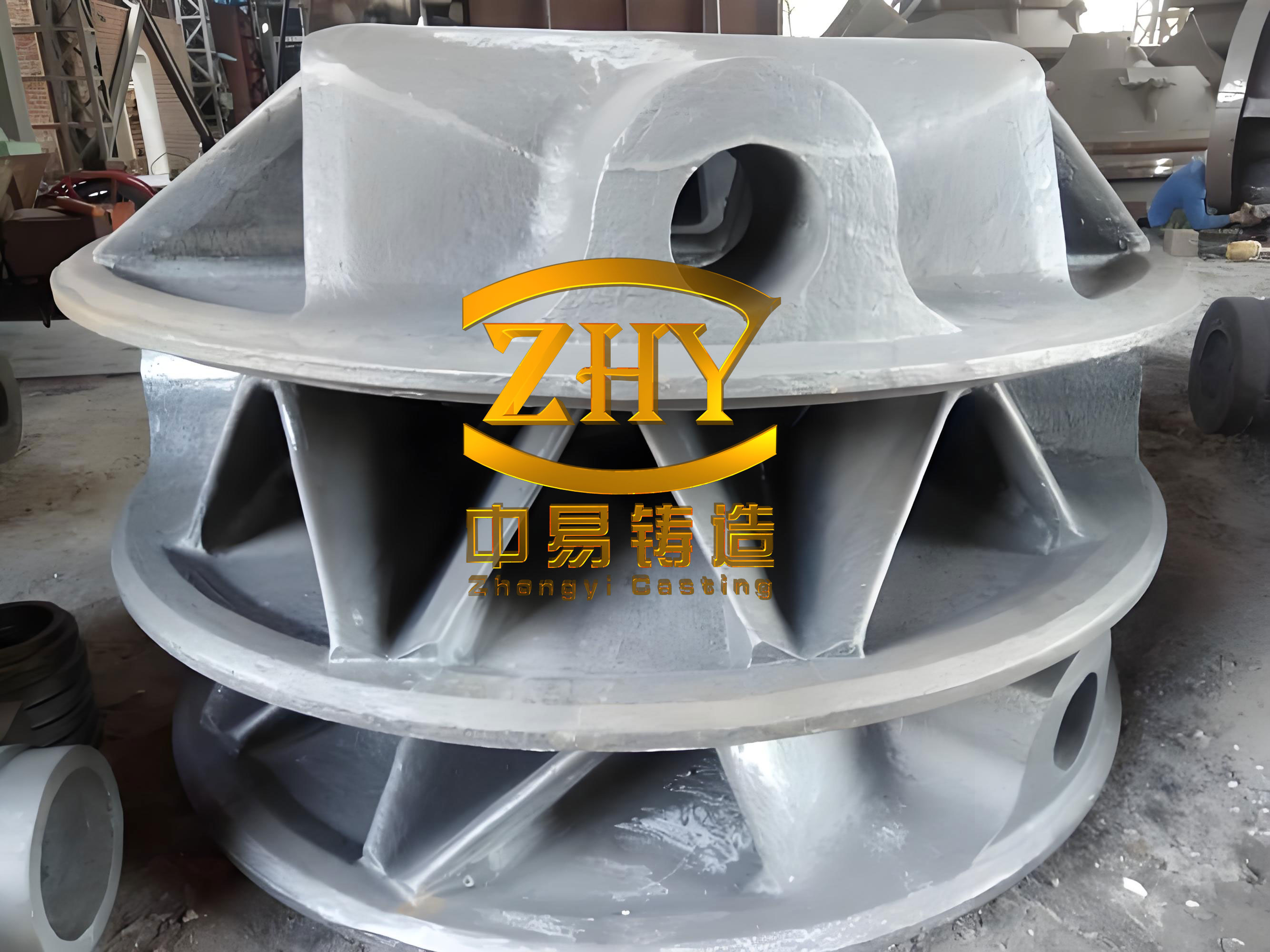
Beyond graphite morphology, achieving material uniformity throughout a 100-ton casting is paramount. Variations in microstructure—nodule count, nodularity, matrix phases (ferrite, pearlite)—lead to scatter in mechanical properties. This is unacceptable for a safety-critical component that must maintain its fracture toughness (K_{IC}) at low operating temperatures. The entire process, from charge makeup and melting to inoculation and pouring, must be meticulously controlled. The famous magnesium treatment reaction that gives ductile iron casting its name ( Mg + S → MgS ) must be uniformly effective throughout the massive volume of molten metal, which requires precise treatment methods and efficient mixing. The subsequent late-stage inoculation to prevent fade must also be robust. Furthermore, the casting must possess exceptional internal soundness, as it will be subjected to deep internal machining; any subsurface porosity or shrinkage could be catastrophic.
The logistical scale of producing such a ductile iron casting is itself a feat. It requires furnaces capable of melting and holding over 150 tons of iron, cranes with capacities exceeding 250 tons, molding pits several meters deep, and foundry buildings with sufficient headroom. The entire melt must be treated, inoculated, and poured within a narrow time window to prevent metallurgical degradation before the mold is filled. The key process parameters and challenges are summarized below:
| Aspect | Challenge in Heavy-Section Ductile Iron Casting | Potential Mitigation Strategy |
|---|---|---|
| Graphite Degeneration | Formation of chunky/exploded graphite in thermal centers. | Use of intensive chilling, mold materials with higher thermal conductivity (e.g., copper chills, chromite sand), and optimized chemical composition (e.g., rare earth elements). |
| Material Uniformity | Ensuring consistent nodule count, size, and matrix structure from surface to core. | Precise control of melting temperature, treatment, and inoculation processes; use of effective filtering and gating systems to ensure clean, uniform fill. |
| Internal Soundness | Avoiding macro-shrinkage, micro-shrinkage, and gas porosity. | Rigorous application of modulus-based feeding rules, use of exothermic and insulating feeder sleeves, controlled solidification direction. |
| Logistics & Scale | Handling >150 tons of molten iron, massive molds, and required infrastructure. | Specialized heavy-foundry facilities with large-capacity furnaces, cranes, and deep molding pits. |
| Testing & Standards | Lack of established non-destructive testing (NDT) standards for ultra-thick sections. | Development of specialized ultrasonic testing (UT) techniques, coupled with destructive testing of prototypical sections to establish baseline data. |
Successfully pouring the massive container body is only the first milestone. The subsequent steps involve extensive non-destructive examination and, crucially, destructive testing of witness coupons or even full-section cuts from a prototype casting. Samples will be taken from various locations—surface, mid-radius, and center—to mechanically validate properties like tensile strength (σ_u), yield strength (σ_y), elongation (δ%), impact energy (CVN), and fracture toughness (K_{IC}). The relationship between microstructure and these properties is key. For instance, the volume fraction of pearlite (V_p) strongly influences tensile strength, which can be modeled for a ferrite-pearlite matrix as:
$$
\sigma_u \approx \sigma_{F} (1 – V_p) + \sigma_{P} V_p
$$
where $\sigma_{F}$ and $\sigma_{P}$ are the strengths of the ferritic and pearlitic constituents, respectively. Ensuring these properties meet stringent specifications across the entire casting is the ultimate validation of the heavy-section ductile iron casting process.
The convergence of these advanced topics—hybrid manufacturing and extreme-scale casting—was a focal point at a recent major industry forum. Such gatherings are vital for cross-pollination of ideas. Discussions highlighted not only these headline technologies but also the continuous, crucial improvements in foundational foundry practices. For instance, the control of reclaimed sand quality is paramount for both consistency and environmental sustainability. A key metric gaining attention is the electrical conductivity (EC) of used sand, which correlates with the build-up of deleterious soluble salts (like sodium and potassium from binders) that can cause casting defects and binder system instability. Monitoring and controlling EC is now seen as essential for maintaining a stable sand system, whether for traditional green sand molding or for binder jetting 3D sand printing. This ties directly back to ensuring the quality of both conventional ductile iron casting and the sand molds used in some AM processes.
Furthermore, the application of inorganic binder systems, once primarily considered for aluminum casting, is expanding into iron foundries, including for ductile iron casting. These systems offer significant environmental and working condition benefits by eliminating volatile organic compound (VOC) and phenol-formaldehyde emissions. The challenge has been achieving adequate strength and collapsibility for ferrous alloys, but advancements in chemistry are overcoming these barriers. Simultaneously, the development of new alloys and composite feedstock materials specifically designed for additive manufacturing processes, including the micro-casting-forging technique, is accelerating. These materials are engineered to respond optimally to the unique thermal cycles of AM, further pushing the envelope of what is manufacturable.
In conclusion, the landscape of metal component manufacturing is diversifying at a rapid pace. The emergence of hybrid processes like micro-casting-forging offers a compelling path to combine geometric freedom with forged-like properties, opening doors for high-performance, complex parts in demanding applications. In parallel, the traditional domain of ductile iron casting is being pushed to its absolute limits, tackling engineering marvels like hundred-ton nuclear transport casks. This endeavor requires mastering the profound metallurgical complexities of heavy-section solidification. Both paths are essential. One represents a disruptive, digital-forward synthesis of processes; the other represents the relentless refinement and scaling of a foundational industrial art. Their concurrent advancement, supported by improved auxiliary technologies like sand control and binder systems, ensures that manufacturing is well-equipped to meet the future’s demands for stronger, safer, more reliable, and more sustainable metallic components. The future lies not in one technology supplanting another, but in a rich ecosystem where the most appropriate process—be it advanced ductile iron casting, hybrid AM, or something yet unforeseen—is selected to optimally meet the design, performance, and economic requirements of the component at hand.