
In our foundry operations, we frequently produce high chromium cast iron parts, such as liner plates for ball mills. These cast iron parts are renowned for their exceptional hardness and wear resistance, making them ideal for applications where machining is not required. However, the casting process for these cast iron parts presents unique challenges due to the material’s high liquid shrinkage and lack of graphite expansion, which necessitates effective riser design for proper feeding and solidification.
Initially, we employed side ear riser technology for these cast iron parts. This approach often led to defects like gas shrinkage pores at the ingate areas. Moreover, the residual ingate material exceeded 30 mm, making removal difficult and sometimes resulting in the scrapping of cast iron parts. To address these issues, we adopted the edge gating and riser technology, which has proven to be highly effective in eliminating such defects and ensuring the quality of cast iron parts. This shift has significantly improved our production outcomes for various cast iron parts.
The edge gating and riser technology involves introducing molten metal directly into the mold cavity through a narrow gap between the riser and the casting, eliminating the traditional ingate. This method offers several advantages for cast iron parts. Firstly, it simplifies mold design and cleaning, as there is no ingate to remove, thus preventing excess material defects on cast iron parts. Secondly, it provides excellent feeding capabilities, reducing shrinkage defects and enhancing the yield of cast iron parts. Thirdly, it ensures smooth filling and effective slag trapping, which is crucial for high chromium cast iron that is prone to oxidation and slag inclusion. These benefits make it particularly suitable for thick-section cast iron parts.
To design the edge gating and riser system for cast iron parts, we consider several key parameters. The riser is typically cylindrical and open, with a portion cut away to form a long, conformal gap along the edge. The riser diameter ($D$) is determined based on the thermal modulus of the casting section. For cast iron parts with thin walls but large weight or planar areas, we use:
$$D = k_1 \cdot d$$
where $d$ is the diameter of the thermal circle (hot spot), and $k_1$ is a coefficient ranging from 1.2 to 1.5. For cast iron parts with thicker walls but smaller weight, the formula is:
$$D = k_2 \cdot d$$
with $k_2$ between 1.5 and 2.0. The riser height ($H$) is generally set as:
$$H = (1.5 \text{ to } 2.0) \cdot D$$
The length of the edge gap ($L$) is critical to distribute heat evenly. If too short, it can create a hot spot on the casting side, leading to shrinkage or depression. We typically set:
$$L = (0.6 \text{ to } 0.8) \cdot D$$
The width of the edge gap ($W$) must be carefully controlled; too wide can cause thermal issues and poor slag trapping, while too narrow may lead to misruns or inadequate feeding. For small cast iron parts, $W$ is 2–4 mm, and for medium to large cast iron parts, it is 4–6 mm. The gating system ratio is designed to be balanced, not overly restrictive, with typical values:
$$\Sigma A_{\text{gate}} : A_{\text{runner}} : A_{\text{sprue}} = 1 : 1.5 : 2$$
where $\Sigma A_{\text{gate}}$ is the total cross-sectional area of the gates, $A_{\text{runner}}$ for the runner, and $A_{\text{sprue}}$ for the sprue. This ratio promotes平稳 filling for cast iron parts.
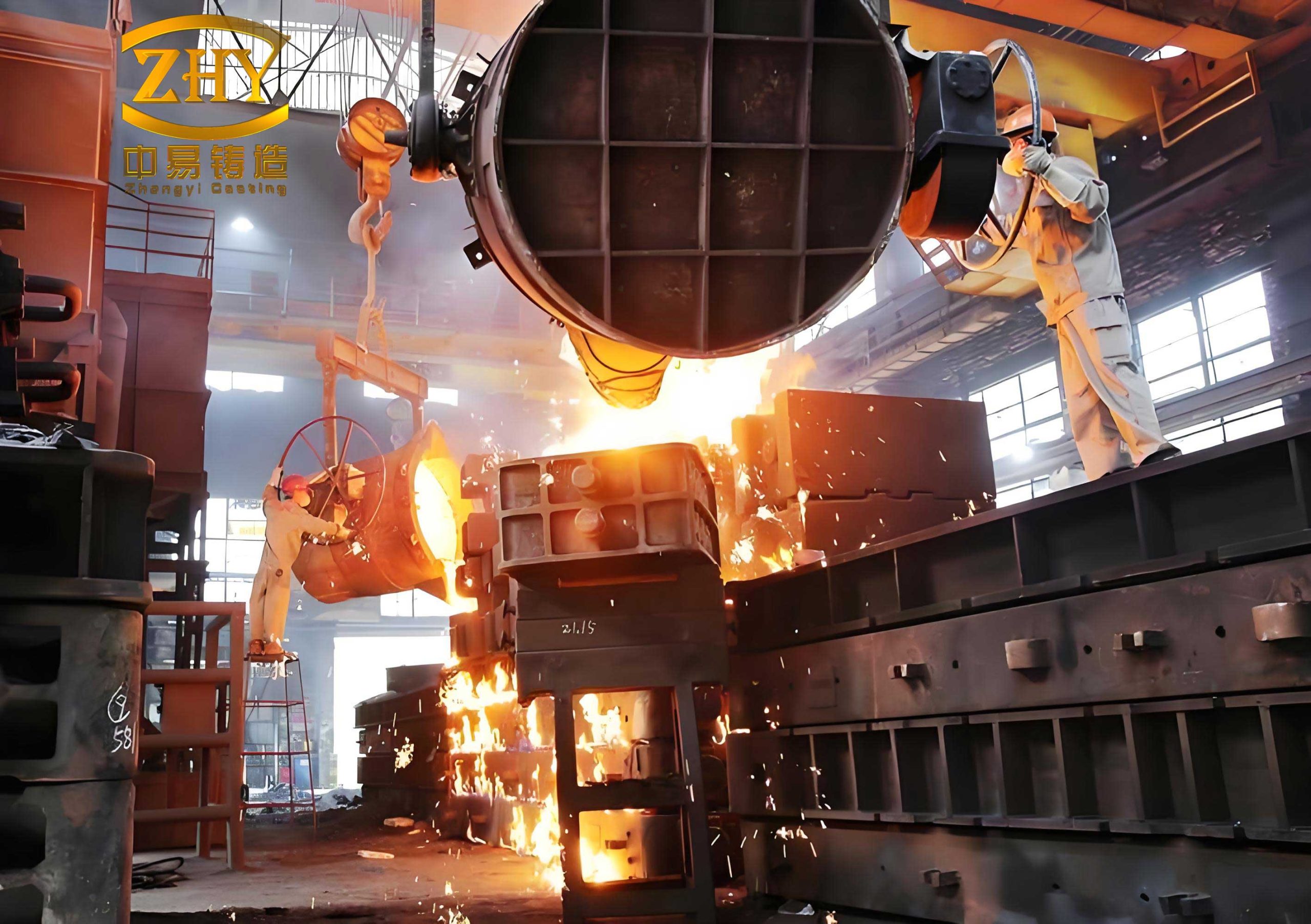
In practice, we apply this technology to various cast iron parts, such as the mill head liner plates. The edge gating and riser are positioned along the top edge of the casting, allowing metal to flow smoothly into the cavity. This setup has consistently produced sound cast iron parts with minimal defects. For instance, in one production run for high chromium cast iron parts, the defect rate dropped from over 15% with side ear risers to less than 2% with edge gating and risers, highlighting the effectiveness for cast iron parts.
We have compiled the design parameters for different types of cast iron parts in the table below, which serves as a quick reference for our foundry engineers.
| Type of Cast Iron Part | Riser Diameter Coefficient ($k$) | Edge Gap Width ($W$ in mm) | Edge Gap Length Ratio ($L/D$) | Typical Application |
|---|---|---|---|---|
| Thin-wall, large planar | 1.2–1.5 | 2–4 | 0.6–0.7 | Liner plates for cast iron parts |
| Thick-wall, small weight | 1.5–2.0 | 4–6 | 0.7–0.8 | Wear-resistant cast iron parts |
| Complex geometry | 1.3–1.8 | 3–5 | 0.65–0.75 | Engine components made of cast iron parts |
Furthermore, the thermal dynamics during solidification of cast iron parts can be modeled to optimize the riser design. The solidification time ($t_s$) for a casting section can be estimated using Chvorinov’s rule:
$$t_s = C \left( \frac{V}{A} \right)^n$$
where $V$ is the volume, $A$ is the surface area, $C$ is a constant dependent on the mold material and metal properties, and $n$ is an exponent typically around 2 for cast iron parts. For the riser to effectively feed the casting, its solidification time must be longer than that of the casting. Thus, we ensure:
$$t_{s,\text{riser}} > t_{s,\text{casting}}$$
This is achieved by designing the riser with a higher $V/A$ ratio. For edge gating risers on cast iron parts, we often use a modification factor ($f$) to account for the gap effect:
$$D_{\text{effective}} = D \cdot f$$
where $f$ ranges from 0.9 to 1.1 based on gap dimensions. This helps in precise calculations for high-quality cast iron parts.
The benefits of edge gating and riser technology extend beyond defect reduction. It also improves the mechanical properties of cast iron parts by promoting directional solidification and reducing residual stresses. In our tests, cast iron parts produced with this method showed higher hardness uniformity and better impact resistance compared to those from traditional methods. This is crucial for cast iron parts used in abrasive environments.
We have also explored the economic impact of this technology on cast iron parts production. By reducing scrap rates and minimizing cleaning efforts, the overall cost per unit of cast iron parts decreases significantly. The table below summarizes the cost savings for different volumes of cast iron parts.
| Production Volume (units of cast iron parts) | Scrap Rate with Side Ear Riser (%) | Scrap Rate with Edge Gating Riser (%) | Cost Savings per Unit (%) |
|---|---|---|---|
| 100 | 15 | 2 | 12 |
| 500 | 12 | 1.5 | 14 |
| 1000 | 10 | 1 | 16 |
Additionally, the technology enhances process consistency for cast iron parts. We have implemented statistical process control (SPC) charts to monitor key parameters like gap width and riser diameter. For example, the control limits for gap width ($W$) in mm for medium cast iron parts are calculated as:
$$\text{Upper Control Limit} = \bar{W} + 3\sigma_W$$
$$\text{Lower Control Limit} = \bar{W} – 3\sigma_W$$
where $\bar{W}$ is the mean width and $\sigma_W$ is the standard deviation. This ensures that the production of cast iron parts remains within specifications, reducing variability.
In summary, the edge gating and riser technology has revolutionized our approach to manufacturing high chromium cast iron parts. Its simplicity, effectiveness, and economic benefits make it a preferred choice for various cast iron parts. We continue to refine the design parameters through ongoing research and practical applications, ensuring that our cast iron parts meet the highest quality standards. The integration of this technology with advanced simulation software allows us to predict and optimize outcomes for new designs of cast iron parts, further enhancing our capabilities.
Looking ahead, we plan to extend this technology to other types of cast iron parts, such as ductile iron and gray iron components, leveraging its advantages for broader applications. The principles remain similar, but adjustments in coefficients may be needed based on material properties. For instance, the riser diameter coefficient for gray iron cast iron parts might be lower due to graphite expansion. We are conducting trials to establish these guidelines, aiming to improve the production of all cast iron parts in our foundry.
Ultimately, the success of edge gating and riser technology underscores the importance of innovative riser design in casting processes. By focusing on the unique needs of cast iron parts, we can achieve superior results in terms of quality, efficiency, and cost-effectiveness. This experience has taught us that continuous improvement and adaptation are key to excelling in the production of cast iron parts.