
In the automotive industry, the demand for lightweight and high-performance components has driven extensive research into advanced casting techniques. Among these, the lost foam casting process stands out as a精密铸造 method ideal for producing complex thin-walled aluminum alloy parts. I have investigated how mechanical vibration during solidification influences the microstructure, mechanical properties, and fracture behavior of A357 aluminum alloy fabricated via the lost foam casting process. This study aims to provide insights into optimizing this process for enhanced material performance.
The lost foam casting process involves creating a foam pattern, coating it with ceramic slurry to form a shell, removing the foam by heating, and then pouring molten metal into the cavity. This method offers design flexibility, cost-effectiveness, and high precision, making it suitable for A357 alloy components like engine blocks and pistons. However, conventional lost foam casting often results in coarse dendritic structures and uneven silicon particle distribution, degrading mechanical properties. To address this, I introduced mechanical vibration during solidification, a simple and economical approach to refine microstructure.
In this work, I employed the lost foam casting process to prepare A357 alloy specimens. The chemical composition of the alloy is critical, and it primarily consists of aluminum with silicon, magnesium, and other trace elements. The foam patterns were created and coated with ceramic materials to form shells. After foam removal and mold baking, the ceramic molds were placed in sand molds, and loose sand was compacted using a three-dimensional vibrating table. The A357 alloy was melted in a preheated crucible, refined with argon gas, and cast at 710°C. Mechanical vibration was applied during casting with varying frequencies (0, 5, 35, 50, 100, 120 Hz) and amplitudes (5, 15, 25, 35 mm), under a vacuum of 0.05 MPa. For frequency studies, amplitude was fixed at 25 mm; for amplitude studies, frequency was fixed at 100 Hz.
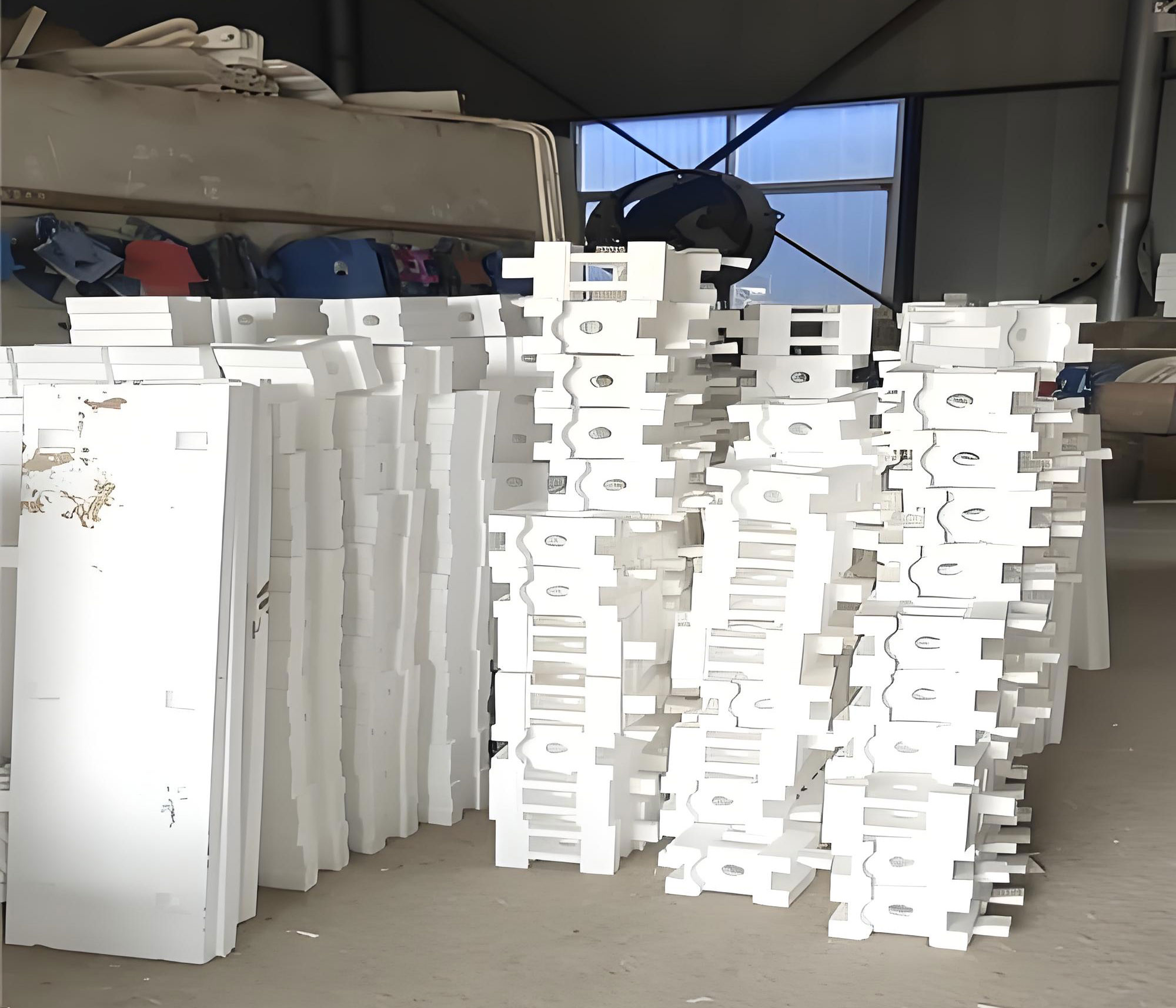
The lost foam casting process setup included a mechanical vibration device to impart controlled oscillations to the solidifying melt. This vibration alters fluid flow, potentially enhancing nucleation and grain refinement. After casting, samples were prepared for metallographic analysis using optical microscopy and scanning electron microscopy (SEM). Microstructural parameters such as α-Al grain size, secondary dendrite arm spacing (SDAS), eutectic silicon particle dimensions, and shape factors were measured using image analysis software. Mechanical properties, including tensile strength, yield strength, elongation, and hardness, were evaluated through tensile testing and Brinell hardness measurements. Density was determined via the Archimedes method. Fracture surfaces were examined using SEM to assess failure modes.
The microstructure of A357 alloy produced by the lost foam casting process without vibration exhibited coarse dendritic α-Al phases and plate-like eutectic silicon particles, as observed in metallographic images. With mechanical vibration, significant refinement occurred. As vibration frequency increased, the α-Al phase transformed from dendritic to equiaxed grains, and eutectic silicon evolved from coarse plates to fibrous or rod-like structures. Quantitative analysis revealed that grain size and SDAS decreased with higher frequencies, up to an optimal point. For instance, at 100 Hz vibration frequency, the α-Al grain size and SDAS were minimized, and the shape factor, indicating sphericity, increased substantially. The shape factor F is defined as: $$F = \frac{4\pi A}{P^2}$$ where A is the grain area and P is the perimeter. A value closer to 1 indicates a more spherical grain. The grain size D can be approximated as: $$D = \sqrt{\frac{4A}{\pi}}$$ These formulas help quantify microstructural changes induced by the lost foam casting process under vibration.
Table 1 summarizes the effect of vibration frequency on microstructural parameters of A357 alloy in the lost foam casting process. Data shows that at 100 Hz, grain refinement is most pronounced, with reductions in grain size and SDAS compared to non-vibrated samples.
| Vibration Frequency (Hz) | α-Al Grain Size (μm) | Secondary Dendrite Arm Spacing (μm) | Shape Factor (F) | Eutectic Si Length (μm) | Eutectic Si Width (μm) | Si Aspect Ratio |
|---|---|---|---|---|---|---|
| 0 | 326.29 | 77.36 | 0.21 | 15.4 | 2.1 | 7.33 |
| 5 | 298.45 | 72.18 | 0.35 | 12.8 | 1.9 | 6.74 |
| 35 | 275.12 | 68.91 | 0.48 | 10.5 | 1.8 | 5.83 |
| 50 | 250.67 | 65.43 | 0.62 | 9.2 | 1.7 | 5.41 |
| 100 | 221.87 | 62.75 | 0.76 | 8.5 | 1.6 | 5.31 |
| 120 | 235.44 | 64.89 | 0.68 | 9.0 | 1.7 | 5.29 |
Mechanical properties improved correspondingly with microstructural refinement in the lost foam casting process. Tensile strength, yield strength, elongation, and hardness all increased with vibration frequency up to 100 Hz, then slightly declined at higher frequencies. This enhancement is attributed to finer grains and more uniform silicon distribution, which hinder dislocation movement and crack propagation. The density of the alloy also rose with vibration, due to better melt filling and reduced porosity, but excessive vibration could introduce defects. Table 2 presents the mechanical properties under different vibration frequencies.
| Vibration Frequency (Hz) | Yield Strength (MPa) | Tensile Strength (MPa) | Elongation (%) | Hardness (HB) | Density (g/cm³) |
|---|---|---|---|---|---|
| 0 | 125.21 | 146.22 | 2.18 | 67.7 | 2.65 |
| 5 | 146.32 | 171.21 | 2.73 | 79.6 | 2.68 |
| 35 | 158.13 | 183.42 | 3.05 | 82.6 | 2.70 |
| 50 | 169.89 | 196.66 | 3.18 | 83.8 | 2.72 |
| 100 | 178.75 | 198.82 | 3.42 | 86.4 | 2.74 |
| 120 | 173.46 | 197.02 | 3.21 | 85.3 | 2.73 |
The role of vibration amplitude in the lost foam casting process was also examined. While vibration generally improved microstructure, higher amplitudes led to coarser grains and reduced mechanical properties. This suggests that optimal vibration parameters exist for the lost foam casting process, where sufficient energy is imparted to refine grains without causing excessive turbulence. Table 3 shows mechanical properties under different amplitudes at 100 Hz frequency.
| Vibration Amplitude (mm) | Yield Strength (MPa) | Tensile Strength (MPa) | Elongation (%) | Hardness (HB) |
|---|---|---|---|---|
| 5 | 144.07 | 192.67 | 3.37 | 79.7 |
| 15 | 135.17 | 177.37 | 2.95 | 73.6 |
| 25 | 133.27 | 162.28 | 2.87 | 68.4 |
| 35 | 130.47 | 155.97 | 2.71 | 58.8 |
Fracture behavior changed markedly with mechanical vibration in the lost foam casting process. Without vibration, SEM images revealed brittle fracture surfaces with cleavage planes and secondary cracks. As vibration frequency increased, fracture surfaces exhibited ductile characteristics, with deep and uniformly distributed dimples, indicating improved toughness. At 100 Hz, dimples were most pronounced, correlating with the finest microstructure. This shift from brittle to ductile failure underscores the benefits of vibration in enhancing alloy ductility through microstructural refinement.
The mechanisms behind these improvements in the lost foam casting process involve several factors. Mechanical vibration induces shear stresses and pressure variations in the solidifying melt, promoting nucleation by fragmenting dendrites and distributing heat more evenly. The vibration frequency affects the resonance and damping characteristics, influencing grain growth kinetics. The relationship between vibration parameters and grain size can be modeled using equations that account for fluid dynamics and solidification theory. For example, the effect of vibration on nucleation rate N can be expressed as: $$N = N_0 \exp\left(-\frac{\Delta G^*}{kT}\right) \cdot f(\omega, A)$$ where \(N_0\) is a pre-exponential factor, \(\Delta G^*\) is the activation energy for nucleation, k is Boltzmann’s constant, T is temperature, and \(f(\omega, A)\) is a function of angular frequency \(\omega\) and amplitude A. This highlights how the lost foam casting process can be optimized through vibration control.
Moreover, the lost foam casting process inherently involves complex interactions between the mold and molten metal. Vibration enhances these interactions by improving wettability and reducing gas entrapment, leading to higher density. The density \(\rho\) can be related to porosity fraction \(p\) by: $$\rho = \rho_0 (1 – p)$$ where \(\rho_0\) is the theoretical density. Vibration reduces p, thereby increasing \(\rho\), which contributes to better mechanical properties. In the lost foam casting process, this is crucial for achieving high-integrity castings.
In conclusion, my investigation demonstrates that mechanical vibration significantly refines the microstructure and enhances the mechanical properties of A357 alloy produced by the lost foam casting process. An optimal vibration frequency of 100 Hz yielded the finest α-Al grains, smallest secondary dendrite arm spacing, and most spherical silicon particles, resulting in peak tensile strength, yield strength, elongation, and hardness. Vibration also transformed fracture behavior from brittle to ductile, with dimpled surfaces indicating improved toughness. However, excessive amplitude adversely affected grain size and properties, emphasizing the need for parameter optimization. The lost foam casting process, when combined with controlled mechanical vibration, offers a promising route for manufacturing high-performance aluminum alloy components with superior microstructural characteristics and mechanical performance. Future work could explore broader frequency ranges, different alloy systems, and industrial-scale applications to further harness the potential of this approach in advanced casting technologies.