
The development of marine resources necessitates a substantial demand for corrosion-resistant materials. Cast iron, prized for its low cost, excellent wear resistance, and superior castability, holds significant promise in marine engineering. However, its application is often limited in certain harsh environments due to inherent shortcomings in corrosion resistance. STQNiCr, a nickel-chromium alloyed cast iron, is specifically engineered for components like seawater corrosion-resistant valves and industrial equipment. The nickel content is pivotal, promoting the formation of a more stable and dense passive layer on the material surface, thereby enhancing resistance to various corrosive media, including acidic, alkaline, and chloride-rich environments like seawater. This allows components to maintain performance stability over extended periods.
Silicon plays a dual role: it is a potent ferrite stabilizer and significantly improves the corrosion resistance of spheroidal graphite cast iron. High-silicon compositions can lead to a protective SiO2-rich film on the surface. Consequently, high-silicon solid solution STQNiCr spheroidal graphite cast iron exhibits a promising combination of good tensile strength, respectable elongation, high yield ratio, and superior corrosion performance, broadening its application prospects. This article systematically investigates the influence of nickel content on the microstructure and resultant mechanical properties of this advanced material.
1. Material Selection and Charge Design
The trials involved casting standard Y-block specimens with a main wall thickness of 40 mm from a 500 kg heat. The target mechanical properties were: tensile strength (Rm) ≥ 500 MPa, elongation (A) ≥ 3%, carbides ≤ 1%. The chemical specifications required Chromium ≥ 0.65 wt.% and Nickel ≥ 1.0 wt.%, with higher Ni content being desirable for enhanced corrosion resistance where mechanically permissible. Based on extensive production experience with spheroidal graphite iron, the charge was designed to minimize variability from returns, ensuring consistent baseline properties. The charge composition is detailed in Table 1.
| Charge Component | Pig Iron | Steel Scrap | Returns |
|---|---|---|---|
| Proportion (wt.%) | 60 | 15 | 25 |
2. Melting and Processing Methodology
2.1. Rationale for Chemical Composition Control
The targeted composition ranges for the key alloying elements were established based on their metallurgical functions, as outlined below.
2.1.1. Silicon (Si)
Silicon is a powerful graphitizer and ferrite stabilizer. It reduces the solubility of carbon in austenite, favoring graphite precipitation over cementite formation. In the context of corrosion, silicon elevates the electrode potential of the iron matrix and facilitates the formation of a protective SiO2-rich film. The effect of Si on carbon activity ($a_C$) can be qualitatively described by its influence on the activity coefficient ($\gamma_C$):
$$a_C = \gamma_C \cdot X_C$$
where $X_C$ is the mole fraction of carbon. Silicon decreases $\gamma_C$, thereby increasing $a_C$ and promoting graphite stability. For high-silicon solid solution spheroidal graphite cast iron, the Si content was maintained between 3.30 and 3.50 wt.% to optimize both matrix structure and corrosion resistance without excessively compromising toughness.
2.1.2. Chromium (Cr)
Chromium is a strong carbide stabilizer and pearlite promoter. Even at low levels, it significantly increases the chilling tendency by narrowing the temperature gap between the stable (graphitic) and metastable (carbidic) eutectic reactions. The effect of Cr on the eutectic carbon content ($C_{Eut}$) can be approximated for low alloy levels. To meet the specification while minimizing the risk of excessive carbide formation (chill), the Cr content was fixed at the specified lower limit of 0.65 wt.%.
2.1.3. Nickel (Ni)
Nickel is an austenite stabilizer and exhibits complete solubility in both ferrite and austenite. It promotes pearlite formation at moderate levels and can fully stabilize austenite at very high contents (>18-20 wt.%). Its primary roles include:
- Matrix Stabilization: Ni lowers the austenite-to-ferrite transformation temperature, favoring a finer pearlitic or austenitic structure.
- Solid Solution Strengthening: Ni atoms in solid solution strengthen the ferritic/pearlitic matrix.
- Carbide Inhibition: It refines the pearlite and can suppress the formation of grain boundary carbides.
- Corrosion Enhancement: Ni improves the stability and reparability of the passive film, particularly in reducing or chloride-containing environments.
The strengthening contribution from Ni in solid solution can be part of a general strengthening model:
$$\sigma_y = \sigma_0 + \sum k_i C_i^{1/2}$$
where $\sigma_y$ is the yield strength, $\sigma_0$ is the lattice friction stress, $k_i$ is the strengthening coefficient for element $i$, and $C_i$ is its concentration. Nickel has a significant $k_{Ni}$ value. The Ni content was varied as the key experimental variable: 1.0 wt.% (Sample C1), 1.5 wt.% (Sample C2), and 2.0 wt.% (Sample C3). The complete target composition matrix is shown in Table 2.
| Sample ID | C | Si | Mn | P | S | Cr | Ni |
|---|---|---|---|---|---|---|---|
| C1 | 3.45-3.55 | 3.30-3.50 | <0.20 | <0.06 | <0.015 | 0.65 | 1.0 |
| C2 | 3.45-3.55 | 3.30-3.50 | <0.20 | <0.06 | <0.015 | 0.65 | 1.5 |
| C3 | 3.45-3.55 | 3.30-3.50 | <0.20 | <0.06 | <0.015 | 0.65 | 2.0 |
2.2. Nodularizing and Inoculation Treatment
The transformation of graphite from flake to spheroidal form is the defining characteristic of ductile iron or spheroidal graphite cast iron. This morphological change drastically reduces the stress concentration effect of graphite, leading to a remarkable improvement in ductility and toughness.
2.2.1. Nodularizing Treatment
A magnesium-containing nodularizer was added using the sandwich method. The addition level was set at 1.6 wt.%, which is higher than typical for unalloyed spheroidal graphite cast iron. This was necessary to overcome the carbide-stabilizing effect of chromium and ensure a high nodularity (≥ Grade 3) despite the presence of pearlite-promoting elements like Cr and Ni. The reaction can be simplified as:
$$[S] + Mg \rightarrow MgS \quad \text{(slag)}$$
$$[O] + Mg \rightarrow MgO \quad \text{(slag)}$$
$$Mg_{(dissolved)} \rightarrow \text{Alters graphite growth morphology}$$
2.2.2. Inoculation Treatment
Inoculation provides nucleation sites for eutectic graphite, promoting a larger number of smaller, more uniformly distributed graphite nodules. It also counteracts the chilling effect of Cr, preventing carbide formation. The total inoculation addition was 1.25 wt.%, comprising a base inoculant and a late-stream inoculant. A bismuth-containing silicon-based inoculant (0.15 wt.%) was used for the late-stream addition due to its known efficacy in increasing graphite nodule count and promoting ferrite formation, which is beneficial for counterbalancing the pearlite-promoting tendency of Ni and Cr in this high-silicon solid solution spheroidal graphite cast iron. The inoculant provides heterogeneous nuclei (e.g., oxides, sulfides) for graphite, increasing the nodule count $N_v$:
$$N_v \propto f(I_{type}, I_{amount}, T_{pour})$$
where $I_{type}$ and $I_{amount}$ are the inoculant type and amount, and $T_{pour}$ is the pouring temperature.
3. Experimental Results and Comprehensive Analysis
3.1. Metallographic Microstructure Evaluation
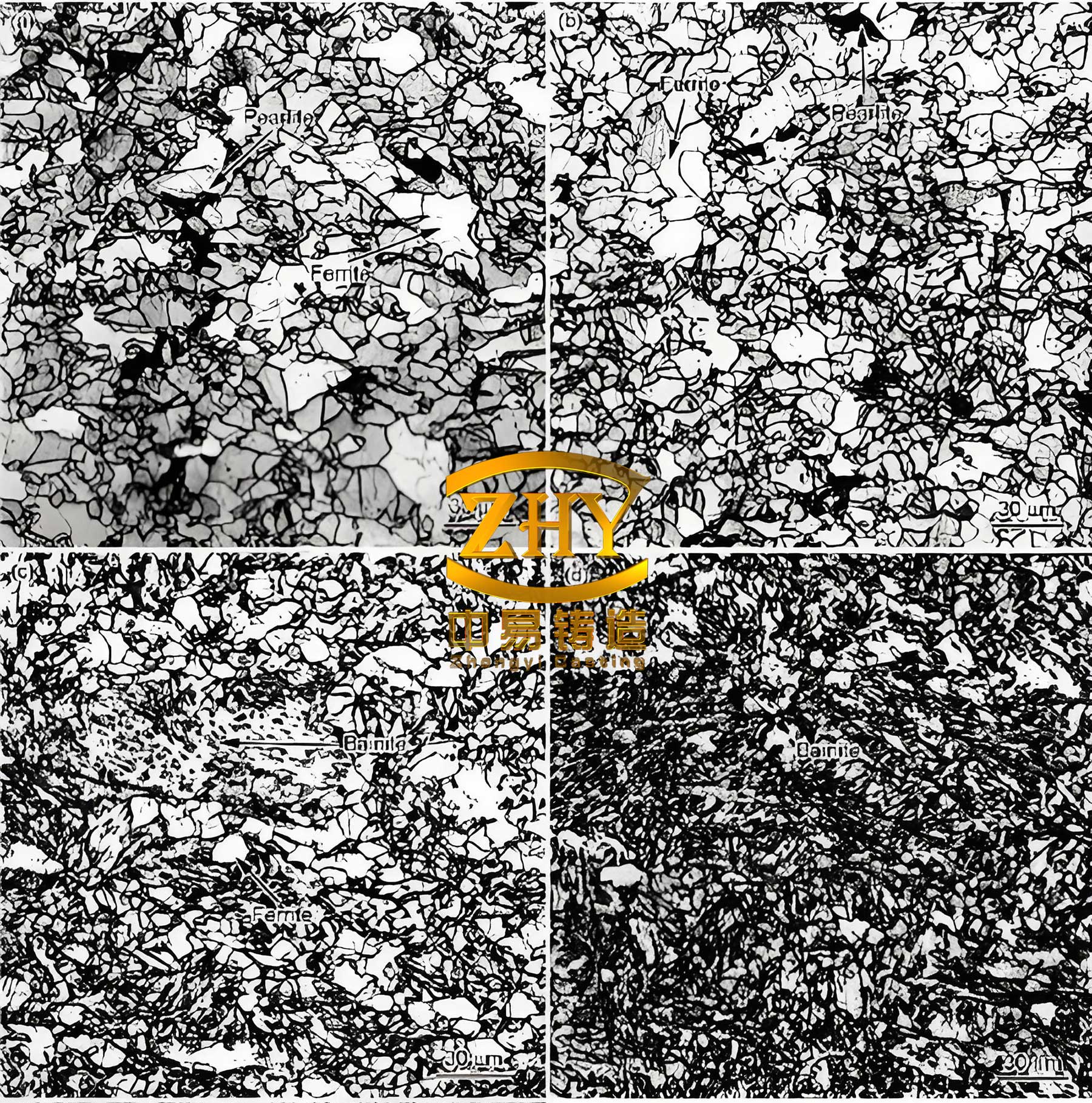
Samples from the three different Ni-content casts (C1, C2, C3) were prepared for metallographic examination. After standard grinding, polishing, and etching (typically with 2-4% nital), the microstructure was analyzed. All specimens exhibited a spheroidal graphite morphology with nodularity ≥ Grade 3 and a nodule size of approximately 6-7 on the standard scale, confirming the effectiveness of the treatment process.
The key variable was the matrix structure. The quantitative results of the matrix analysis are summarized in Table 3. The micrographs revealed a clear trend: as the nickel content increased, the volume fraction of pearlite in the matrix rose significantly. Sample C1 (1.0% Ni) showed a mixed matrix with approximately 60% pearlite. Sample C2 (1.5% Ni) exhibited a predominantly pearlitic matrix with about 70% pearlite. Crucially, Sample C3 (2.0% Ni) showed a matrix consisting of over 90% pearlite, and more importantly, the presence of ledeburite – a eutectic mixture of austenite (transforming to pearlite) and cementite – was observed. This indicates that the combined effect of 2.0% Ni and 0.65% Cr pushed the solidification path into the carbide-austenite eutectic region of the Fe-C-Ni-Cr system.
| Sample ID | Ni Content (wt.%) | Pearlite Fraction (%) | Carbide/Ledeburite Content | Graphite Nodularity |
|---|---|---|---|---|
| C1 | 1.0 | ~60 | < 1% (Isolated carbides) | ≥ Grade 3 |
| C2 | 1.5 | ~70 | < 1% (Negligible) | ≥ Grade 3 |
| C3 | 2.0 | ~90 | ~8% (Ledeburite network) | ≥ Grade 3 |
The formation of ledeburite in Sample C3 can be rationalized using the concept of the carbon equivalent (CE) adjusted for strong carbide formers like Cr. While Ni is graphitizing, its effect is weaker than Cr’s carbide-stabilizing power. At a critical combined level, the effective CE pushes the composition past the threshold for wholly graphitic solidification, leading to the formation of the metastable Fe-Fe3C eutectic (ledeburite) during the last stages of freezing.
3.2. Mechanical Properties and Their Correlation with Ni Content
Tensile test specimens were machined according to the relevant standard from the Y-blocks of each heat. The results of the tensile tests and hardness measurements are presented in Table 4. The data shows a clear and consistent trend: increasing nickel content monotonically increases tensile strength (Rm), yield strength (Rp0.2), and hardness (HBW). This is a direct consequence of the increased pearlite fraction and solid solution strengthening provided by Ni. The strengthening can be partially modeled by a linear mixture rule for the composite matrix (ferrite + pearlite):
$$Rm \approx V_\alpha \cdot Rm_\alpha + V_P \cdot Rm_P + \Delta \sigma_{ss}$$
where $V_\alpha$ and $V_P$ are the volume fractions of ferrite and pearlite, $Rm_\alpha$ and $Rm_P$ are their respective strengths, and $\Delta \sigma_{ss}$ is the solid solution strengthening contribution from Ni (and other solutes). As $V_P$ increases with Ni, $Rm$ increases.
The most critical finding concerns ductility. While Samples C1 and C2 met the elongation requirement (A ≥ 3%), Sample C3 failed dramatically, with elongation values around 2-2.5%. This severe embrittlement is directly attributable to the formation of the continuous or semi-continuous network of hard, brittle ledeburite (cementite-based eutectic) observed in its microstructure. Cementite has very limited capacity for plastic deformation. Its presence, especially in a interconnected morphology, provides easy paths for crack initiation and propagation, drastically reducing the overall ductility of the spheroidal graphite cast iron. The high hardness of Sample C3 further corroborates the presence of this large amount of hard phase.
| Sample ID | Ni (wt.%) | Rm (MPa) | Rp0.2 (MPa) | A (%) | Hardness (HBW) |
|---|---|---|---|---|---|
| C1 | 1.0 | 665 | 510 | 7.0 | 223 |
| 657 | 500 | 7.5 | 221 | ||
| 663 | 508 | 7.0 | 229 | ||
| C2 | 1.5 | 691 | 583 | 5.0 | 258 |
| 694 | 579 | 5.5 | 257 | ||
| 682 | 581 | 5.0 | 251 | ||
| C3 | 2.0 | 716 | 620 | 2.0 | 270 |
| 701 | 627 | 2.5 | 276 | ||
| 717 | 631 | 2.5 | 274 |
The relationship between Ni content and key mechanical properties is further illustrated by the following derived empirical trends from the data. The approximate linear increase in tensile strength with Ni content (up to 2.0%) can be expressed as:
$$Rm (\text{MPa}) \approx 640 + 38 \cdot C_{Ni} \quad (C_{Ni} \text{ in wt.%)$$
Similarly, the drastic drop in elongation upon ledeburite formation highlights a non-linear, threshold-dependent behavior. The data suggests that for this specific high-silicon, chromium-containing grade of spheroidal graphite cast iron, the Ni content must be kept below approximately 1.8 wt.% to avoid the catastrophic formation of ledeburite and the consequent loss of ductility.
4. Discussion: Optimizing the High-Silicon STQNiCr System
The development of high-performance spheroidal graphite cast iron for corrosive environments is a balancing act between alloying for corrosion resistance and maintaining adequate mechanical properties, particularly ductility. In the STQNiCr system, Ni and Cr are added for corrosion improvement, while high Si is used for both corrosion resistance and solid solution strengthening of the ferrite. However, both Cr and, to a lesser extent at higher levels, Ni promote pearlite and can stabilize carbides.
The results conclusively demonstrate that nickel is an effective alloying element for strengthening high-silicon spheroidal graphite cast iron. It refines and increases the pearlite content, leading to significant gains in strength and hardness. This makes Ni a valuable addition for applications requiring high load-bearing capacity and wear resistance in tandem with corrosion resistance. The optimal composition identified (Sample C2: ~1.5% Ni, 0.65% Cr, 3.4% Si, ~3.5% C) achieves a tensile strength above 680 MPa, a yield strength near 580 MPa, and an elongation of 5%, alongside a fully pearlitic matrix free of detrimental carbides. This combination satisfies typical specifications for demanding valve and pump components.
The catastrophic drop in ductility at 2.0% Ni serves as a critical process boundary. It underscores the importance of considering the synergistic effect of all alloying elements on the solidification structure. The presence of chromium lowers the maximum permissible nickel content before carbide eutectics form. For foundries producing this grade of spheroidal graphite cast iron, rigorous control of both Ni and Cr within narrow windows is essential. Furthermore, the use of powerful inoculation, as employed in this study, is non-negotiable to maximize graphite nucleation and offset the chilling tendency.
The corrosion performance, while not quantitatively measured here, is inferred to improve with increasing Ni content up to the point before ledeburite forms. Ledeburite, comprising a network of cementite and transformed austenite, can create galvanic couples with the surrounding matrix, potentially becoming preferential sites for pitting corrosion. Therefore, the composition that avoids ledeburite (Sample C2) is likely optimal for overall performance, offering the best compromise of strength, ductility, and projected corrosion resistance for this high-silicon solid solution spheroidal graphite cast iron.
5. Conclusion
- A high-silicon solid solution STQNiCr spheroidal graphite cast iron was successfully developed using a charge of 60% pig iron, 15% steel scrap, and 25% returns, followed by a carefully controlled magnesium nodularizing treatment (1.6% addition) and a dual-stage inoculation process (total 1.25%, including a bismuth-containing late-stream inoculant). The optimized chemical composition ranges are: 3.45-3.55 wt.% C, 3.30-3.50 wt.% Si, 0.65 wt.% Cr, and 1.5 wt.% Ni.
- Nickel content has a profound and systematic effect on the microstructure of this alloy. Increasing Ni from 1.0 wt.% to 1.5 wt.% to 2.0 wt.% raises the pearlite fraction from approximately 60% to 70% to over 90%, respectively. A critical threshold is reached at 2.0 wt.% Ni in combination with 0.65 wt.% Cr, leading to the formation of brittle ledeburite eutectic in the as-cast microstructure.
- The mechanical properties respond predictably to the microstructural changes. Tensile strength, yield strength, and hardness increase progressively with higher nickel content due to increased pearlite fraction and solid solution strengthening. However, ductility, as measured by elongation, remains acceptable (5-7.5%) only up to 1.5 wt.% Ni. At 2.0 wt.% Ni, the formation of ledeburite causes severe embrittlement, reducing elongation to about 2-2.5%, which fails to meet the minimum requirement for this grade of spheroidal graphite cast iron. Therefore, for this specific high-silicon, chromium-bearing alloy, the nickel content must be carefully controlled below approximately 1.8 wt.% to avoid carbide eutectic formation and ensure a viable combination of strength and ductility for engineering applications in corrosive environments.