
As a high-strength cast iron material developed in the mid-20th century, spheroidal graphite cast iron has seen its application spectrum expand dramatically due to its combination of properties that approach those of steel. The key to its performance lies in the spherical morphology of the graphite nodules, which effectively blunts stress concentrations that would otherwise be initiated by the sharp edges of flake graphite in conventional gray iron. This fundamental microstructural feature, combined with a matrix that can be manipulated through various heat treatment processes, grants spheroidal graphite cast iron an exceptional balance of strength, ductility, and toughness. Among the family of spheroidal graphite cast irons, the grade QT500-7, characterized by a ferritic-pearlitic matrix, offers a particularly favorable compromise of moderate strength and good machinability. This investigation delves into the influence of a critical heat treatment parameter—the normalizing temperature—on the resulting hardness of QT500-7 spheroidal graphite cast iron, exploring the underlying microstructural transformations that govern this property.
The versatility of spheroidal graphite cast iron stems from its remarkable response to thermal processing. Treatments such as annealing, normalizing, quenching and tempering, and austempering can be employed to tailor the matrix microstructure—and consequently the mechanical properties—for specific service conditions. Normalizing, a process involving austenitization followed by air cooling, is frequently used to refine the grain structure, increase strength and hardness, and improve structural homogeneity. For ferritic-pearlitic grades like QT500-7, normalizing primarily aims to control the volume fraction and morphology of pearlite within the matrix. The selection of the austenitizing temperature is paramount, as it dictates the extent of transformation from the initial ferrite-pearlite structure to austenite, which subsequently transforms upon cooling. This study systematically examines this relationship.
The material under investigation was a QT500-7 spheroidal graphite cast iron. Chemical composition analysis was conducted prior to heat treatment, with the results summarized in the table below. The carbon and silicon contents are typical for this grade, promoting graphite nodulization and influencing the transformation temperatures.
| Element | C | Si | Mn | S | P |
|---|---|---|---|---|---|
| Content (wt.%) | 3.40 | 2.98 | 0.30 | 0.005 | 0.030 |
A series of normalized specimens were prepared from the same casting batch to ensure consistency. The heat treatment regimen consisted of holding at the specified austenitizing temperature for 30 minutes, followed by forced air cooling (fan cooling) to room temperature. Subsequently, all specimens underwent a stress-relief tempering at 550°C for 1 hour, followed by air cooling. The austenitizing temperature was the sole variable, ranging from 820°C to 940°C in 20°C increments. The complete experimental matrix is detailed in the following table.
| Specimen ID | Normalizing Temperature (°C) | Holding Time (min) | Cooling Method | Tempering |
|---|---|---|---|---|
| N1 | 820 | 30 | Forced Air | 550°C x 1h, AC |
| N2 | 840 | |||
| N3 | 860 | |||
| N4 | 880 | |||
| N5 | 900 | |||
| N6 | 920 | |||
| N7 | 940 |
Following the heat treatments, the bulk hardness of each specimen was measured using the Brinell hardness test (HBW). The results, presented in the table below, reveal a clear and consistent trend: hardness increases monotonically with increasing normalizing temperature. This dependence, however, is not linear, indicating a change in the underlying strengthening mechanisms across the temperature range studied.
| Specimen ID | Normalizing Temperature (°C) | Hardness (HBW) |
|---|---|---|
| N1 | 820 | 240 |
| N2 | 840 | 251 |
| N3 | 860 | 254 |
| N4 | 880 | 266 |
| N5 | 900 | 269 |
| N6 | 920 | 289 |
| N7 | 940 | 296 |
The hardness increase from 820°C to 860°C is relatively modest (14 HBW), whereas a more pronounced increase is observed from 880°C onward. To understand this behavior, one must consider the nature of the austenitization process in spheroidal graphite cast iron. The transformation does not occur at a single temperature but over a range bounded by the lower critical temperature (Ac1) and the upper critical temperature (Ac3). For the given composition, Ac1 is approximately 800°C. Normalizing performed within the range of Ac1 + (30-50)°C, i.e., roughly 830-850°C, results in partial austenitization. In this regime, only the pearlitic regions and a limited portion of the ferrite transform to austenite. Upon cooling, this transformed austenite yields new, refined pearlite (and potentially some ferrite), while the original proeutectoid ferrite remains largely unchanged. This explains the gradual hardness increase in specimens N1 to N3.
When the normalizing temperature exceeds approximately 880°C, the process enters the regime of full austenitization. Here, the temperature is above Ac3 (estimated at ~850°C for this grade), resulting in the complete transformation of the ferrite-pearlite matrix into a homogeneous austenitic phase. Upon subsequent cooling, the entire matrix undergoes transformation, leading to a significantly higher volume fraction of transformation products. The relationship between hardness (HB) and the pearlite volume fraction (Vp) can be conceptually described by a rule of mixtures, where the hardness is a weighted average of the hardness of the constituent phases (ferrite and pearlite):
$$ HB = HB_{\alpha} \cdot (1 – V_p) + HB_p \cdot V_p $$
Since pearlite (HBp ≈ 300-400) is considerably harder than ferrite (HBα ≈ 150-200), an increase in Vp directly elevates the overall hardness. This principle underpins the sharper rise in hardness for specimens N4 to N7.
To quantitatively and qualitatively validate this mechanism, metallographic examination was performed on all specimens. The microstructural evolution is striking and correlates directly with the hardness data. The following table summarizes the estimated pearlite volume fraction determined according to standard metallographic practices for spheroidal graphite cast iron.
| Specimen ID | Normalizing Temp. (°C) | Estimated Pearlite Vol. Fraction (%) | Matrix Description |
|---|---|---|---|
| N1 | 820 | ~25 | Predominantly ferritic with networked pearlite at prior grain boundaries. |
| N2 | 840 | ~30 | Ferritic matrix, pearlite network becoming more continuous. |
| N3 | 860 | ~45 | Mixed ferrite-pearlite structure, pearlite starting to appear as short lamellae/particles. |
| N4 | 880 | ~50 | Near-balanced mix, pearlite is more uniformly dispersed as fine particles/lamellae. |
| N5 | 900 | ~80 | Predominantly pearlitic, fine lamellar structure (approaching sorbitic). |
| N6 | 920 | ~95 | Almost entirely pearlitic/sorbitic, very fine interlamellar spacing. |
| N7 | 940 | ~95 | Fully pearlitic/sorbitic matrix with the finest achievable spacing from air cooling. |
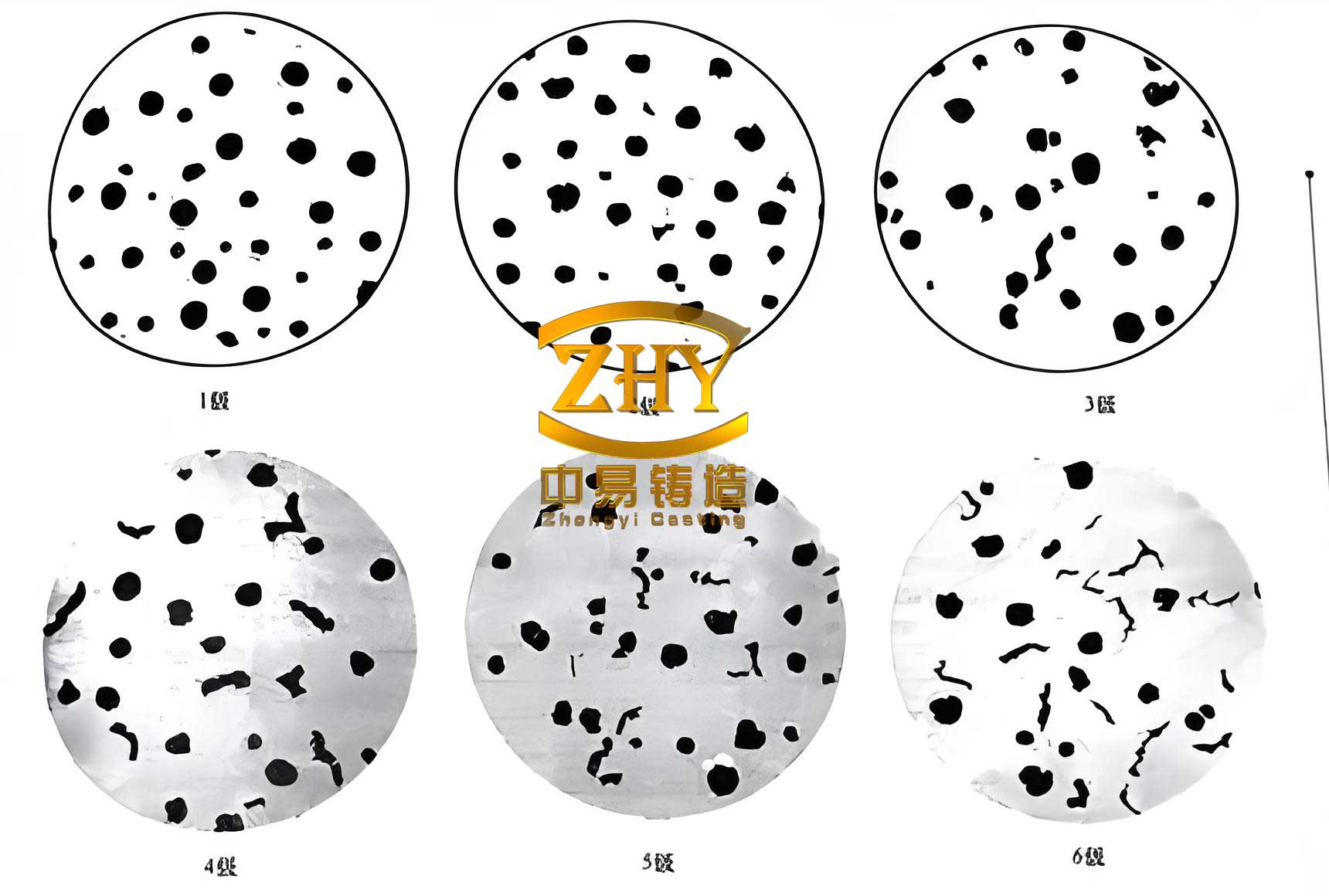
The microstructural analysis confirms the hypotheses derived from the hardness trends. At lower temperatures (820-860°C), the pearlite forms preferentially at prior austenite grain boundaries, creating a network. The majority of the matrix remains ferritic, leading to lower hardness. As the temperature increases into the full austenitization range, the pearlite volume fraction surges. Concurrently, its morphology evolves from a coarse, networked structure to a much finer, more uniformly dispersed arrangement. At the highest temperatures (920-940°C), the transformation product is so fine that it resembles sorbitte, a very fine form of pearlite. The interlamellar spacing (S) of pearlite is a critical factor controlling its strength and hardness, often related by a Hall-Petch type relationship:
$$ \sigma_y \propto HB \propto S^{-1/2} $$
Faster cooling from a higher austenitization temperature suppresses diffusion, leading to a finer pearlite lamellae spacing (smaller S), which directly contributes to the higher hardness values observed in specimens N6 and N7. Thus, the increase in hardness is not merely due to an increase in pearlite fraction but also to a refinement of the pearlite structure itself.
Furthermore, the role of the spheroidal graphite itself remains passive but crucial in this context. The spherical nodules do not directly contribute to strengthening but provide benign sites that do not severely disrupt the continuity of the metallic matrix. This allows the full effect of matrix strengthening through normalizing to be realized without the premature crack initiation associated with flake graphite. The heat treatment affects only the metallic matrix surrounding these stable graphite spheres.
In conclusion, this investigation demonstrates a definitive and technologically significant relationship between normalizing temperature and the hardness of QT500-7 spheroidal graphite cast iron. The increase in hardness is a direct consequence of microstructural evolution driven by the austenitization temperature. Lower temperatures induce partial austenitization, resulting in a modest increase in pearlite content and a corresponding slight increase in hardness. Temperatures exceeding the upper critical temperature (Ac3) promote full austenitization, leading to a substantial increase in the volume fraction of pearlite and a significant refinement of its lamellar structure. Both factors—increased phase fraction and decreased interlamellar spacing—synergistically contribute to the enhanced hardness. This understanding provides a practical framework for selecting normalizing parameters to achieve desired hardness and strength levels in ferritic-pearlitic spheroidal graphite cast iron components, enabling engineers to better tailor this versatile material for specific application requirements where a balance of strength, castability, and machinability is essential.