
In the manufacturing industry, casting processes are pivotal for producing complex metal components. Among these, sand casting is a traditional method widely used for creating sand casting parts due to its versatility and cost-effectiveness. However, lost foam casting (LFC) has emerged as an innovative alternative, offering advantages such as reduced machining and improved surface finish. A critical parameter in LFC is the pouring temperature, which must be higher than that in sand casting to compensate for the heat absorbed by the vaporizing foam. Historically, this increment has been determined empirically, leading to inconsistencies. In this article, I will derive a theoretical framework to calculate the required temperature increase, supported by formulas, tables, and practical insights, with a focus on applications for sand casting parts.
The core challenge lies in quantifying the additional heat needed to vaporize the foam pattern during pouring. Unlike sand casting, where the mold is inert, LFC involves the decomposition of a polystyrene foam, which absorbs significant energy. This process impacts the solidification kinetics and final properties of castings, particularly for sand casting parts that require precise dimensional accuracy. Through first-principles analysis, I aim to establish a reliable criterion for setting the pouring temperature in LFC, ensuring optimal results for various alloys and geometries.
Theoretical Analysis
To model the heat transfer, consider a mold cavity of volume $V_m$ (in m³) filled with a foam pattern of density $\rho_f$ (in kg/m³). The heat required to vaporize the foam per unit mass is denoted as $q$ (in J/kg), which comprises three components: the decomposition heat $q_d$, the gasification heat $q_g$, and the heating heat $q_h$ to raise the foam temperature to its vaporization point. Thus, the total heat $Q$ (in J) needed for vaporization is:
$$ Q = V_m \rho_f q = V_m \rho_f (q_d + q_g + q_h) $$
Meanwhile, the molten metal, with mass $m_m = V_m \rho_m$ (where $\rho_m$ is the metal density in kg/m³) and specific heat capacity $c$ (in J/(kg·K)), must supply this heat. Assuming adiabatic conditions, the temperature drop $\Delta T$ (in K or °C) of the metal due to foam vaporization is given by:
$$ Q = m_m c \Delta T = V_m \rho_m c \Delta T $$
Equating the two expressions for $Q$, we derive the theoretical temperature increment required in LFC compared to sand casting:
$$ \Delta T = \frac{\rho_f q}{\rho_m c} $$
This formula highlights that $\Delta T$ is independent of mold volume and depends solely on material properties. For sand casting parts, where no foam is present, $\Delta T = 0$, underscoring the need for adjustment in LFC. The value of $q$ varies with temperature, as $q_h$ increases with higher pouring temperatures, but for simplicity, I assume constant average values based on typical processing conditions.
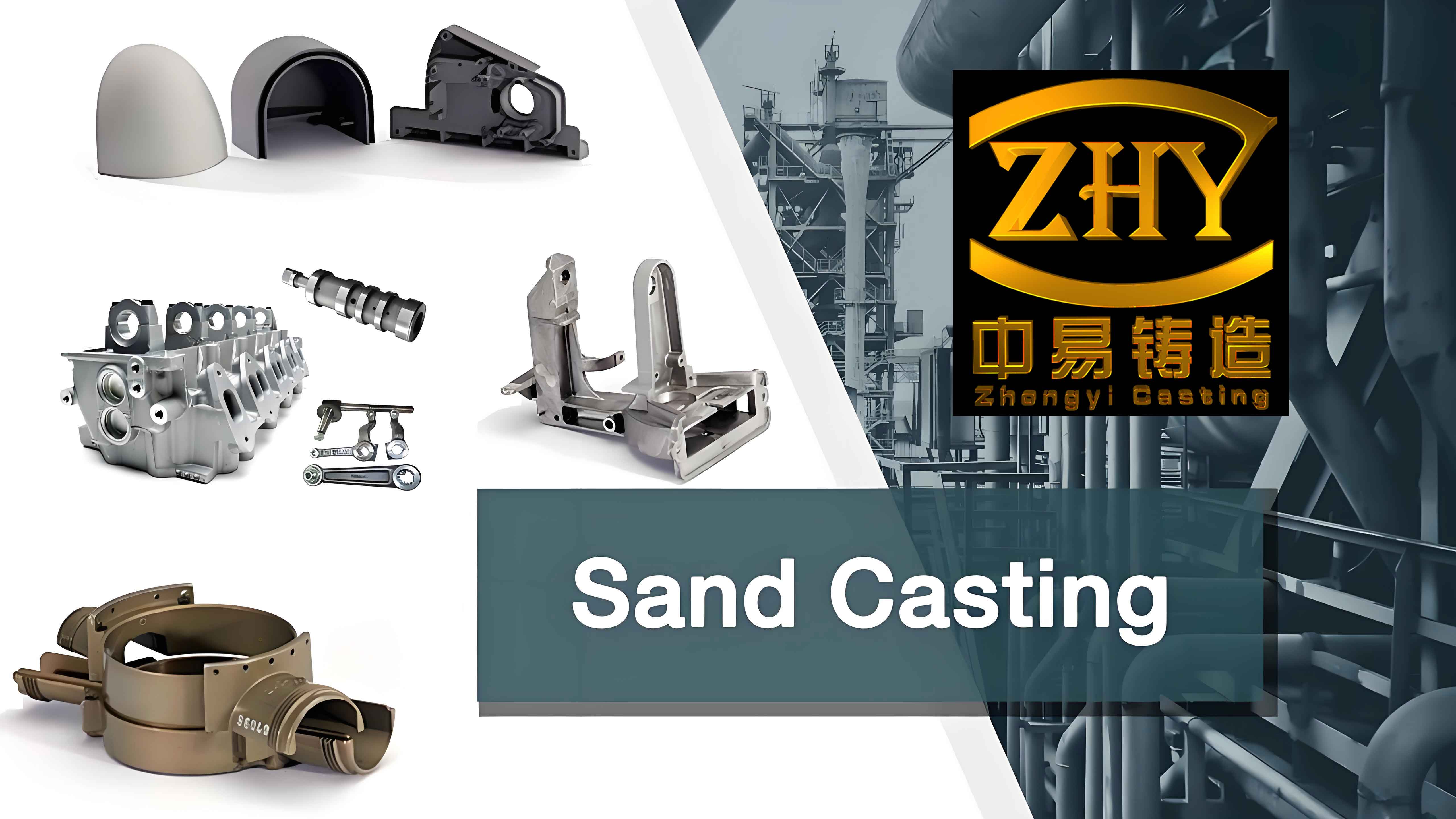
The above relationship serves as a foundation for practical calculations. To account for real-world complexities, such as non-uniform heat distribution or foam residue, empirical factors may be introduced. However, this theoretical approach provides a systematic basis for optimizing pouring parameters, especially when transitioning from sand casting parts to LFC equivalents.
Calculation Examples
To illustrate the application, I compute $\Delta T$ for two common alloys: cast iron and aluminum alloy. These are frequently used in sand casting parts, and their thermophysical properties are well-documented. The foam is assumed to be expanded polystyrene (EPS) with a density $\rho_f = 20 \, \text{kg/m}^3$, typical for LFC patterns. The heat requirements are derived from literature: $q_d = 5.7 \times 10^6 \, \text{J/kg}$, $q_g = 5.4 \times 10^5 \, \text{J/kg}$, and $q_h = 4.1 \times 10^4 \, \text{J/kg}$ for heating from room temperature to vaporization. Thus, $q = q_d + q_g + q_h = 6.281 \times 10^6 \, \text{J/kg}$.
For cast iron, common in heavy-duty sand casting parts, $\rho_m = 7800 \, \text{kg/m}^3$ and $c = 500 \, \text{J/(kg·K)}$. Substituting into the formula:
$$ \Delta T_{\text{cast iron}} = \frac{20 \times 6.281 \times 10^6}{7800 \times 500} = \frac{1.2562 \times 10^8}{3.9 \times 10^6} \approx 32.2 \, \text{K} $$
For aluminum alloy, often used in lightweight sand casting parts, $\rho_m = 2400 \, \text{kg/m}^3$ and $c = 880 \, \text{J/(kg·K)}$. Then:
$$ \Delta T_{\text{aluminum}} = \frac{20 \times 6.281 \times 10^6}{2400 \times 880} = \frac{1.2562 \times 10^8}{2.112 \times 10^6} \approx 59.5 \, \text{K} $$
These results indicate that LFC requires a pouring temperature increase of approximately 32°C for cast iron and 60°C for aluminum alloy compared to sand casting. To generalize, Table 1 summarizes $\Delta T$ values for various metals relevant to sand casting parts.
| Alloy Type | Density $\rho_m$ (kg/m³) | Specific Heat $c$ (J/(kg·K)) | $\Delta T$ (K) | Typical Use in Sand Casting Parts |
|---|---|---|---|---|
| Cast Iron | 7800 | 500 | 32.2 | Engine blocks, manifolds |
| Aluminum Alloy | 2400 | 880 | 59.5 | Aerospace components, automotive parts |
| Copper Alloy | 8900 | 385 | 36.7 | Valves, fittings |
| Steel | 7850 | 460 | 34.8 | Tools, structural elements |
| Zinc Alloy | 7100 | 390 | 45.4 | Die-casting prototypes |
The variability in $\Delta T$ underscores the importance of alloy-specific calculations. For sand casting parts, which often involve diverse materials, this table can guide process adjustments when switching to LFC. Note that these values are theoretical; practical factors may necessitate modifications, as discussed later.
Practical Considerations and Adjustments
In actual production, the theoretical $\Delta T$ may not suffice due to dynamic pouring conditions. For instance, the initial metal stream must displace the foam, leading to localized cooling and potential defects. To address this, practitioners often double the calculated $\Delta T$, but this can be energy-inefficient. A better approach involves designing the gating system with a “shock absorber” or cold-chamber section to trap cooler, contaminated metal, allowing subsequent metal to remain hotter and cleaner. This strategy is particularly beneficial for complex sand casting parts replicated via LFC.
Moreover, the effect of vacuum in LFC must be considered. Under negative pressure, the sand mold exhibits enhanced cooling due to gas expansion, which accelerates solidification. For thin-walled castings—common in precision sand casting parts—this rapid cooling can cause premature freezing, so the pouring temperature should be slightly higher than the theoretical $\Delta T$. Conversely, for thick-walled sand casting parts, the insulating effect of dry sand in the vacuum environment reduces heat dissipation, slowing cooling and permitting a lower pouring temperature. This dichotomy is summarized in Table 2.
| Casting Geometry | Typical Wall Thickness | Adjustment to $\Delta T$ | Rationale | Example Sand Casting Parts |
|---|---|---|---|---|
| Thin-walled | < 10 mm | Increase by 10–20% | Counteracts vacuum-induced rapid cooling | Electronic housings, thin panels |
| Medium-walled | 10–50 mm | Use theoretical $\Delta T$ | Balanced heat transfer conditions | Automotive brackets, pump casings |
| Thick-walled | > 50 mm | Decrease by 10–15% | Insulating dry sand slows cooling | Engine blocks, heavy machinery bases |
These adjustments depend on alloy type and mold materials. For example, aluminum alloys, with higher thermal conductivity, may require larger increments for thin walls than cast iron. Similarly, the thermal conductivity of the coating and sand layer influences heat flow; higher conductivity materials, like zircon-based coatings, demand closer adherence to theoretical $\Delta T$. In contrast, for silica sand with low conductivity, deviations may be more pronounced. Thus, when converting sand casting parts to LFC, a tailored approach is essential.
To quantify these effects, consider the heat transfer coefficient $h$ (in W/(m²·K)) at the metal-mold interface. In LFC, $h$ is affected by foam decomposition gases and vacuum level. A simplified model for the actual temperature increment $\Delta T_{\text{actual}}$ can be expressed as:
$$ \Delta T_{\text{actual}} = \Delta T_{\text{theoretical}} \times \left(1 + \alpha \frac{h_{\text{sand}} – h_{\text{LFC}}}{h_{\text{LFC}}}\right) $$
where $\alpha$ is a geometry-dependent factor (e.g., 0.1 for thin walls, -0.1 for thick walls), $h_{\text{sand}}$ is the interface coefficient for sand casting, and $h_{\text{LFC}}$ for LFC. For standard sand casting parts, $h_{\text{sand}} \approx 500 \, \text{W/(m²·K)}$, while for LFC under vacuum, $h_{\text{LFC}}$ can range from 300 to 700 W/(m²·K) based on process conditions. This formula aids in fine-tuning $\Delta T$ for specific applications.
Extended Discussion on Material Properties and Process Optimization
The theoretical framework hinges on accurate material properties. For foam, $\rho_f$ and $q$ vary with pattern density and polymer type. In practice, EPS foam densities range from 15 to 30 kg/m³, affecting $\Delta T$ linearly. For instance, if $\rho_f = 25 \, \text{kg/m³}$ for a dense pattern, $\Delta T$ increases by 25% compared to the base case. This is critical for sand casting parts with intricate details, where denser foam is used to improve surface finish. Additionally, alternative foams like polymethyl methacrylate (PMMA) have higher $q_d$ values, necessitating larger $\Delta T$ adjustments.
Metal properties also play a role. The density $\rho_m$ and specific heat $c$ are temperature-dependent, but for simplicity, average values near the pouring point are used. For sand casting parts, these properties are well-tabulated, but alloys with high latent heat of fusion (e.g., some aluminum alloys) may require additional considerations, as part of the metal heat is used for solidification. A more comprehensive formula incorporating latent heat $L$ (in J/kg) is:
$$ \Delta T = \frac{\rho_f q}{\rho_m (c + L / \Delta T_{\text{solid}})} $$
where $\Delta T_{\text{solid}}$ is the solidification temperature range. This nonlinear equation can be solved iteratively, but for most sand casting parts, the basic formula suffices.
Process parameters like pouring rate and vacuum level further influence $\Delta T$. A higher pouring rate reduces heat loss to the foam, potentially lowering $\Delta T$, while a stronger vacuum enhances cooling, increasing it for thin sections. Empirical studies suggest that for every 10% increase in pouring speed, $\Delta T$ can be reduced by 2–3%. Table 3 provides guidelines for modifying $\Delta T$ based on process variables.
| Parameter | Typical Range | Effect on $\Delta T$ | Recommended Adjustment |
|---|---|---|---|
| Pouring Rate | Low to High | Decreases $\Delta T$ | Reduce $\Delta T$ by 1% per 5% rate increase |
| Vacuum Pressure | 0.04 to 0.08 MPa | Increases $\Delta T$ for thin walls | Increase $\Delta T$ by 5% per 0.01 MPa rise |
| Foam Density | 15–30 kg/m³ | Linear increase with density | Scale $\Delta T$ proportionally |
| Coating Thickness | 0.5–2.0 mm | Decreases $\Delta T$ for thick coatings | Decrease $\Delta T$ by 3% per 0.5 mm increase |
Integrating these factors, an optimized $\Delta T$ can be derived for producing high-quality sand casting parts via LFC. For instance, a thin-walled aluminum sand casting part poured at high speed under moderate vacuum might have a final $\Delta T$ of 65°C (from a base of 60°C), ensuring complete filling and minimal defects.
Conclusion
In summary, the pouring temperature in lost foam casting must be elevated relative to sand casting to account for foam vaporization heat. Through theoretical analysis, I derived a fundamental formula: $\Delta T = \frac{\rho_f q}{\rho_m c}$, which provides a calculable increment based on material properties. For typical alloys like cast iron and aluminum, $\Delta T$ is approximately 32°C and 60°C, respectively. However, practical application requires adjustments based on casting geometry: thin-walled sand casting parts benefit from a higher $\Delta T$ to offset rapid cooling under vacuum, while thick-walled sand casting parts allow a lower $\Delta T$ due to insulating effects. Process variables such as pouring rate and foam density further modulate this increment.
This theoretical framework offers a scientific alternative to empirical rules, enhancing the reproducibility and quality of lost foam castings, especially when transitioning from traditional sand casting parts. By incorporating tabulated data and formulas, foundries can optimize pouring temperatures tailored to specific alloys and designs, improving efficiency and reducing defects. Future work could explore dynamic heat transfer models or machine learning approaches to refine $\Delta T$ predictions for complex sand casting parts.