
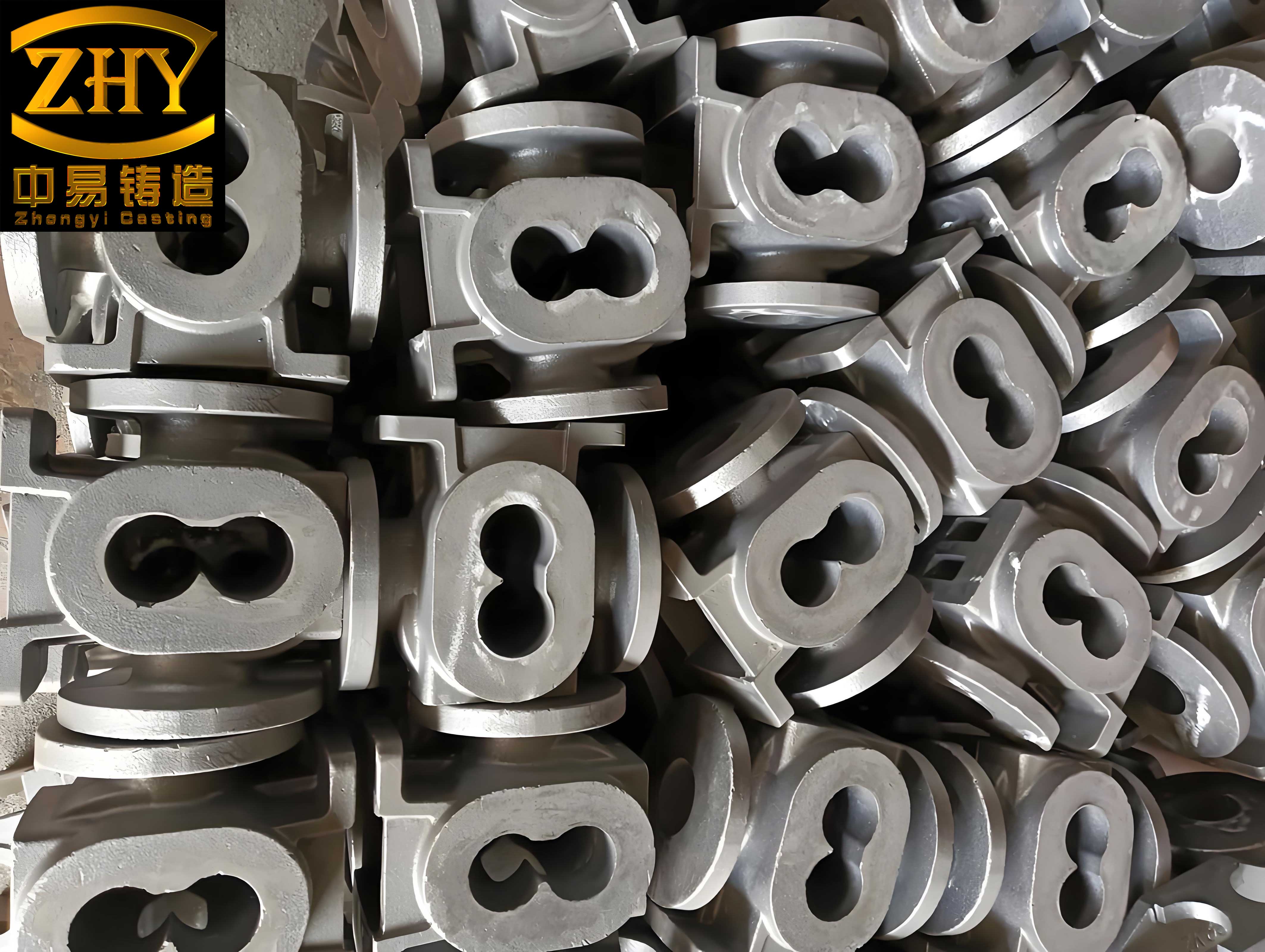
As a critical component in hydraulic systems, such as the cylinder block in piston pumps, the performance and longevity of the part are directly influenced by the material’s inherent strength and surface characteristics. Compared to medium-carbon steels, nodular cast iron offers a compelling combination of comparable strength and modulus of elasticity, alongside superior vibration damping, self-lubricating properties, and castability. The primary failure modes for these cylinder blocks are wear and deformation of the bore surface, which can lead to seizure of the piston. Therefore, enhancing surface wear resistance is paramount for reliability.
Surface modification techniques, particularly nitriding heat treatments, have been widely adopted to drastically improve the surface hardness and wear resistance of nodular cast iron components. This process involves the diffusion of nitrogen into the surface layer, forming hard nitrides. However, in industrial production, variations in casting and heat treatment processes can lead to significant differences in the matrix microstructure of the final nodular cast iron casting, most notably in the volume fraction of pearlite. This microstructural variance can, in turn, lead to inconsistent results after nitriding, affecting critical parameters such as case depth and surface hardness. This study systematically investigates the influence of pearlite content on the nitriding behavior of nodular cast iron to provide a foundation for optimizing both material selection and nitriding processes for high-demand applications.
1. Materials and Experimental Methods
1.1 Material Selection and Characterization
Test specimens with dimensions of 30 mm × 30 mm × 20 mm were machined from castings of three different grades of nodular cast iron. All surfaces were ground to ensure identical roughness prior to treatment. The materials corresponded to standard grades QT450-10, QT600-3, and QT700-2, representing a range of microstructures and mechanical properties. The key distinguishing feature was their pearlite content, which was quantitatively assessed through metallographic analysis.
The table below summarizes the base material properties and the measured pearlite content for each specimen set, designated here as Pearlite-20, Pearlite-65, and Pearlite-85 based on their approximate pearlite volume fraction.
| Material Designation | Standard Grade | Tensile Strength (MPa) | Hardness (HBW) | Elongation (%) | Pearlite Content (%) |
|---|---|---|---|---|---|
| Pearlite-20 | QT450-10 | 483 | 175 | 11 | 20 |
| Pearlite-65 | QT600-3 | 611 | 202 | 5 | 65 |
| Pearlite-85 | QT700-2 | 709 | 223 | 3 | 85 |
1.2 Nitriding Heat Treatment Process
A controlled gas soft-nitriding process was employed for all specimens. The process sequence involved several key stages: pre-oxidation of the loaded specimens, evacuation of the furnace chamber, controlled heating under specific atmospheric conditions, a sustained holding period at the nitriding temperature, and finally, slow cooling within the furnace. The specific thermal profile and gas composition (involving N₂ and NH₃-N₂ mixtures introduced at different stages) were kept constant for all specimens to isolate the effect of the base microstructure. The schematic of the nitriding cycle is represented by the following steps, where $T(t)$ denotes the temperature profile and $G(t)$ denotes the gas atmosphere profile over time $t$:
$$
\begin{aligned}
\text{Stage 1 (Pre-oxidation \& Evacuation)} &: T(t) = T_{\text{room}}, \quad G(t) = \text{Air then Vacuum} \\
\text{Stage 2 (Heating)} &: \frac{dT}{dt} = k_1, \quad G(t) = \text{N}_2 \\
\text{Stage 3 (Nitriding)} &: T(t) = T_{\text{nitride}} = \text{constant}, \quad G(t) = \text{NH}_3\text{-N}_2 \text{ mixture} \\
\text{Stage 4 (Cooling)} &: \frac{dT}{dt} = -k_2, \quad G(t) = \text{N}_2
\end{aligned}
$$
1.3 Analysis and Testing Methods
Following nitriding, the specimens were sectioned, mounted, and prepared using standard metallographic techniques. The etched cross-sections were examined using optical microscopy. The nitrided case depth was determined according to the standard method based on microhardness profiling. A Vickers microhardness tester was used to measure hardness from the surface into the core. The effective nitrided layer depth was defined as the distance from the surface to the point where the hardness dropped to a value equal to the core hardness plus a specified offset (typically 50 HV). The thickness of the white layer (the compound layer of iron nitrides) was also measured. The hardness of the white layer itself and the underlying diffusion zone were assessed separately.
2. Results and Analysis
2.1 Nitrided Case Depth Analysis
The cross-sectional microhardness profiles for the three types of nodular cast iron are shown conceptually in the figure below. The hardness is highest at the surface, remains elevated through the diffusion zone, and gradually decays to the core hardness value. The quantitative results for the effective case depth are summarized in the following table.
| Specimen | Pearlite Content (%) | Effective Nitrided Case Depth (mm) |
|---|---|---|
| Pearlite-85 | 85 | 0.23 |
| Pearlite-65 | 65 | 0.25 |
| Pearlite-20 | 20 | 0.32 |
The results clearly indicate an inverse relationship between pearlite content and nitrided case depth in this nodular cast iron. The Pearlite-85 specimen exhibited the shallowest case (0.23 mm), while the Pearlite-20 specimen had the deepest (0.32 mm). The Pearlite-65 specimen showed an intermediate depth of 0.25 mm, very close to that of the Pearlite-85 specimen.
This phenomenon can be explained by the diffusion kinetics of nitrogen in the ferritic and pearlitic phases. The pearlitic structure consists of alternating lamellae of ferrite (α-Fe) and cementite (Fe₃C). While nitrogen diffuses relatively easily in ferrite, the cementite lamellae act as barriers to nitrogen diffusion. The diffusion coefficient $D$ in a two-phase microstructure can be conceptually modeled as being inversely related to the tortuosity $\tau$ of the path, which increases with pearlite content. A simplified relation can be expressed as:
$$
D_{\text{eff}} \approx \frac{D_{\alpha}}{1 + \beta \cdot f_p}
$$
where $D_{\text{eff}}$ is the effective diffusion coefficient in the nodular cast iron matrix, $D_{\alpha}$ is the diffusion coefficient in pure ferrite, $f_p$ is the volume fraction of pearlite, and $\beta$ is a factor representing the impedance caused by cementite lamellae. According to Fick’s second law for a semi-infinite solid, the case depth $x$ after time $t$ is proportional to the square root of the diffusion coefficient:
$$
x \propto \sqrt{D_{\text{eff}} \cdot t}
$$
Therefore, a higher pearlite content ($f_p$), leading to a lower $D_{\text{eff}}$, results in a shallower case depth $x$ for the same nitriding time $t$, which aligns perfectly with our experimental observations on nodular cast iron.
2.2 White Layer (Compound Layer) Analysis
The white layer, primarily composed of ε-Fe₂₋₃N and γ’-Fe₄N nitrides, forms on the very surface. Its thickness was measured for all specimens, with the results presented below. The nitride morphology in the diffusion zone was also evaluated and was consistently rated as Level 1 (fine and dispersed) for all three types of nodular cast iron, indicating good nitriding quality.
| Specimen | Pearlite Content (%) | White Layer Thickness (μm) | Nitride Morphology Level |
|---|---|---|---|
| Pearlite-85 | 85 | 7.43 | 1 |
| Pearlite-65 | 65 | 7.97 | 1 |
| Pearlite-20 | 20 | 9.55 | 1 |
The trend in white layer thickness mirrors that of the case depth: it decreases with increasing pearlite content. The formation of the white layer is governed by the nitrogen concentration at the surface and its subsequent diffusion and reaction. Since a higher pearlite content impedes the inward diffusion of nitrogen (as explained above), more nitrogen accumulates and reacts at or near the surface, which might seem to promote a thicker white layer. However, the growth kinetics of the compound layer are complex. The hindered diffusion also limits the supply of iron from the substrate necessary for the growth of the nitride layer. Furthermore, the different thermodynamic activities of carbon in ferrite and pearlite can influence nitride nucleation and growth. In this specific process for nodular cast iron, the net result was a thinner white layer on the higher pearlite materials, suggesting that the diffusion-limited supply of iron or specific kinetic barriers in pearlite may dominate the compound layer growth under these conditions.
2.3 Surface Hardness Analysis
The surface hardness, measured on the nitrided surface, is a critical performance metric. The results for the surface microhardness (HV1) before and after nitriding are compiled in the following table.
| Specimen | Core Hardness (HV) | Surface Hardness after Nitriding (HV1) | Hardness Increase (HV1) |
|---|---|---|---|
| Pearlite-85 | ~223 | 657 | ~434 |
| Pearlite-65 | ~202 | 635 | ~433 |
| Pearlite-20 | ~175 | 621 | ~446 |
The nitriding treatment significantly enhanced the surface hardness of all nodular cast iron specimens, with all values exceeding 600 HV1. The absolute surface hardness after nitriding showed a positive correlation with the original pearlite content: Pearlite-85 had the highest hardness (657 HV1), followed by Pearlite-65 (635 HV1) and Pearlite-20 (621 HV1).
This can be attributed to two reinforcing factors. First, the hardness of the nitride compound layer itself is extremely high. Second, and more importantly for the diffusion zone just beneath the white layer, the hardening effect is due to the precipitation of fine alloy nitrides (from trace elements like Si, Mn) and the saturation of the ferrite lattice with nitrogen. In a pearlitic nodular cast iron, the pre-existing hard cementite lamellae in the pearlite colonies provide a harder starting matrix. The nitrogen diffusing into this region causes additional precipitation hardening within the ferrite lamellae, leading to a higher net hardness compared to a primarily ferritic matrix receiving the same nitrogen influx. The total hardness $H_{\text{surf}}$ can be considered a combination of the base matrix hardness $H_{\text{matrix}}$ and the hardness increment $\Delta H_{\text{nitride}}$ due to nitriding:
$$
H_{\text{surf}} = H_{\text{matrix}}(f_p) + \Delta H_{\text{nitride}}(C_N)
$$
where $H_{\text{matrix}}$ increases with pearlite fraction $f_p$, and $\Delta H_{\text{nitride}}$ is a function of the dissolved nitrogen concentration $C_N$. Since $C_N$ at a given depth may also be influenced by microstructure, the higher base hardness of the pearlitic matrix yields a higher final surface hardness in the nitrided nodular cast iron.
3. Discussion and Conclusions
This investigation systematically delineates the influence of matrix pearlite content on the gas nitriding response of nodular cast iron. The key findings can be summarized in the following comprehensive performance matrix, which provides a guide for material selection based on application needs.
| Performance Criterion | High Pearlite (e.g., 85%) | Medium Pearlite (e.g., 65%) | Low Pearlite (e.g., 20%) | Primary Influence Factor |
|---|---|---|---|---|
| Nitrided Case Depth | Shallowest | Moderate | Deepest | Diffusion barrier from cementite lamellae in pearlite. |
| White Layer Thickness | Thinnest | Moderate | Thickest | Complex kinetics related to nitrogen availability and iron supply. |
| Surface Hardness | Highest | High | High (but lowest of the set) | Combination of hard base matrix (pearlite) and nitride precipitation. |
| Core Toughness/Ductility | Lower | Moderate | Higher | Intrinsic property of the matrix; ferrite is more ductile. |
| Recommended Application Focus | Applications requiring maximum surface hardness and wear resistance, with less demand for deep case support (e.g., light to moderate wear under high contact pressure). | A balanced compromise, offering good surface hardness and moderate case depth for general-purpose wear components. | Applications requiring a deep, tough diffusion zone to support the hard surface, potentially better for components subjected to impact or high subsurface stress (e.g., heavily loaded components). | – |
In conclusion, the pearlite content in nodular cast iron is a decisive factor in its nitriding behavior. A higher pearlite content results in a shallower nitrided case and a thinner white layer but yields the highest surface hardness due to the synergy between a hard base matrix and nitride precipitation. Conversely, a lower pearlite content, rich in ferrite, allows for deeper nitrogen penetration, creating a thicker case and white layer, though with a slightly lower peak surface hardness.
These findings have direct practical implications. For the design and manufacturing of critical components like hydraulic cylinder bodies from nodular cast iron, the desired service performance should guide the choice of base material grade and its associated pearlite content. If maximum wear resistance under high contact stress is the priority, a higher pearlite grade like QT700-2 is advantageous. If resistance to spalling or high cyclic loading is critical, requiring a deeper, more gradual hardness gradient, a lower pearlite grade like QT450-10 might be optimal, even with a marginally lower surface hardness. The medium-pearlite grades offer a valuable compromise. Furthermore, this understanding allows for the adjustment of nitriding process parameters (time, temperature, atmosphere) to compensate for or capitalize on these microstructural effects, enabling the production of nodular cast iron components with highly reliable and tailored surface properties.
Future work should focus on quantitatively modeling the diffusion process in these multiphase nodular cast iron microstructures and correlating the findings with direct wear and fatigue tests to establish definitive performance-life relationships.