
In my research, I have extensively investigated the critical role of pouring temperature in the lost foam casting process for producing ductile iron components. The lost foam casting process is a near-net-shape manufacturing technique that utilizes foam patterns to create complex geometries with high dimensional accuracy. This method is particularly advantageous for applications such as automotive crankshafts and valve bodies, where traditional casting methods may involve繁琐工序 and lower precision. However, the success of the lost foam casting process heavily depends on various process parameters, among which pouring temperature is a key factor influencing the microstructural evolution and mechanical properties of ductile iron. In this article, I will delve into the experimental findings and analyses regarding how different pouring temperatures affect graphite morphology, matrix structure, and mechanical performance in ductile iron produced via the lost foam casting process.
The lost foam casting process begins with the creation of a foam pattern, typically made from expandable polystyrene (EPS), which is shaped into the desired component geometry. This pattern is then coated with a refractory coating, assembled with a gating system, and placed in a flask filled with unbonded sand. During pouring, the molten metal replaces the foam pattern as it vaporizes, leading to the formation of the cast part. Throughout this process, the pouring temperature plays a pivotal role in determining the quality of the final casting, as it affects fluidity, mold filling, and solidification behavior. In the context of ductile iron, which is known for its high strength, ductility, and wear resistance, maintaining optimal pouring temperature is essential to achieve desired graphite nodularity and matrix composition. The lost foam casting process, while offering design flexibility, introduces unique challenges such as carbon and silicon burning losses due to high temperatures, which can lead to carbide formation and reduced mechanical properties.
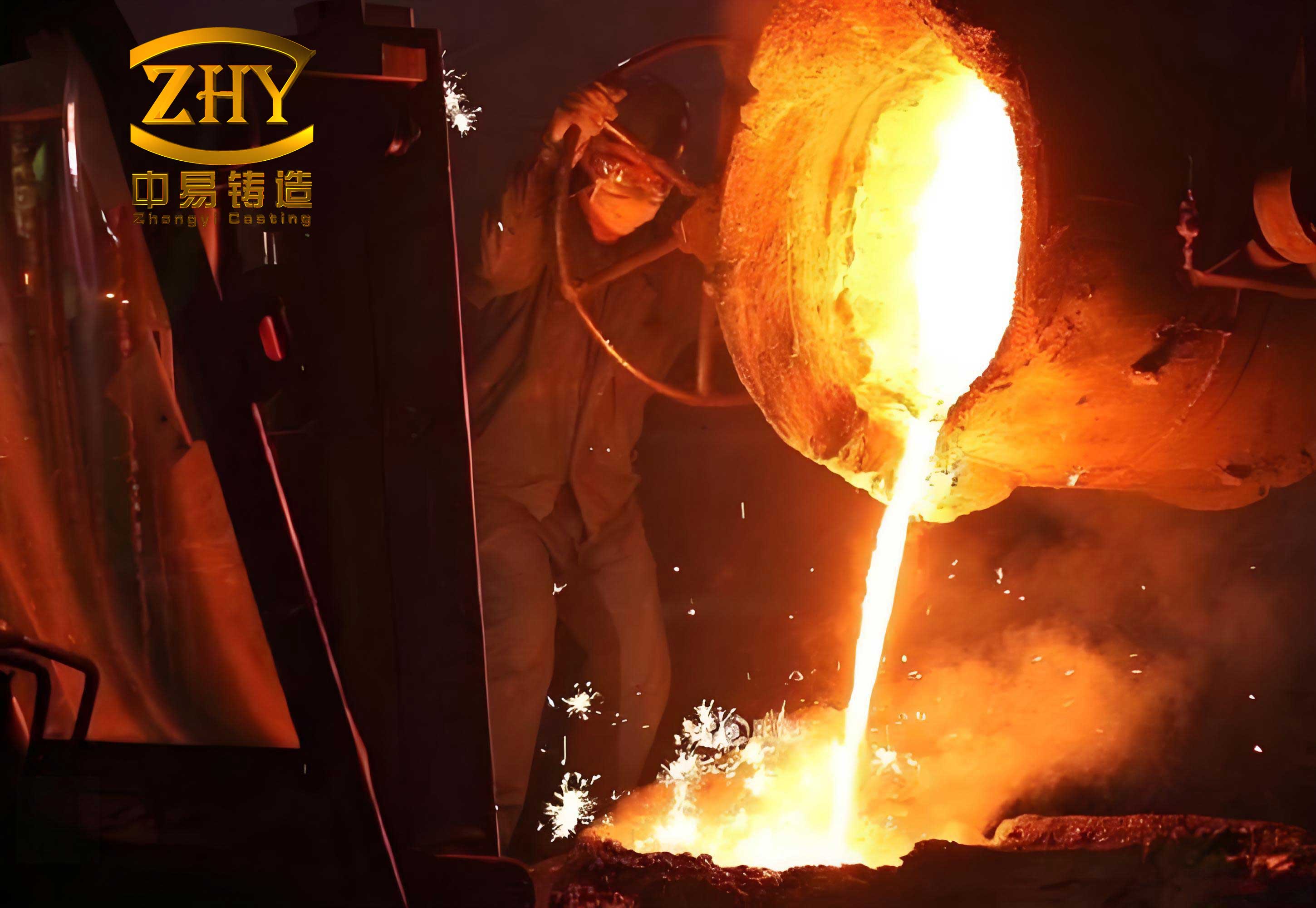
To systematically study the effect of pouring temperature, I designed experiments involving the production of Y-block castings using the lost foam casting process. The materials used included foundry pig iron, 45 steel, and alloying elements such as 75% ferrosilicon and rare-earth magnesium ferrosilicon. The chemical composition of the raw materials is summarized in Table 1, which provides a baseline for understanding the initial melt conditions. The melting was conducted in a medium-frequency induction furnace, and the pouring temperatures were set at three levels: 1510°C, 1460°C, and 1410°C. These temperatures were selected to represent high, optimal, and low ranges, respectively, based on industrial practices in the lost foam casting process. After melting, the iron was treated with inoculant and nodulizer using the sandwich method, and the melt was poured into the lost foam molds under vacuum conditions. The castings were allowed to cool naturally in the mold before sampling for microstructural and mechanical analysis.
| Material | C | Si | Mn | S | P | Fe |
|---|---|---|---|---|---|---|
| Foundry Pig Iron | 4.50 | 0.69 | 0.19 | 0.022 | 0.037 | Balance |
| 45 Steel | 0.45 | 0.25 | 0.65 | 0.035 | 0.035 | Balance |
The microstructural analysis focused on graphite morphology and matrix composition. Samples were taken from the lower section of the Y-blocks, polished, and examined using optical microscopy. Graphite nodularity was assessed according to standard GB/T 9441-1988, which involves evaluating the shape and distribution of graphite particles. The nodularity level is calculated using a formula that accounts for the proportion of spherical graphite relative to other forms. This formula is expressed as:
$$ \text{Nodularity} = \frac{1 \times n_{1.0} + 0.8 \times n_{0.8} + 0.6 \times n_{0.6} + 0.3 \times n_{0.3} + 0 \times n_{0}}{n_{1.0} + n_{0.8} + n_{0.6} + n_{0.3} + n_{0}} $$
where \( n_{1.0}, n_{0.8}, n_{0.6}, n_{0.3}, n_{0} \) represent the counts of graphite particles with spherical correction coefficients of 1.0, 0.8, 0.6, 0.3, and 0, respectively. This quantitative approach allows for a precise evaluation of graphite quality in ductile iron produced by the lost foam casting process. Additionally, the matrix structure was revealed by etching with 4% nital, and the volume fractions of phases such as pearlite, ferrite, and carbide were measured using image analysis software. The results for different pouring temperatures are compiled in Table 2, highlighting the variations in microstructural features.
| Pouring Temperature (°C) | Graphite Nodularity | Graphite Grade | Pearlite Content (%) | Ferrite Content (%) | Carbide Content (%) | Tensile Strength (MPa) | Elongation (%) |
|---|---|---|---|---|---|---|---|
| 1510 | 0.80 | 3 | Low | Low | High | N/A (白口化) | N/A (白口化) |
| 1460 | 0.90 | 2 | 83 | Moderate | Low | High | High |
| 1410 | 0.70 | 4 | 49 | High | None | Low | Low |
At a pouring temperature of 1510°C, the lost foam casting process led to severe burning losses of carbon and silicon due to the high thermal exposure. This resulted in a significant reduction in graphite-forming elements, promoting carbide formation and causing whitening of the ductile iron. The graphite morphology showed spherical graphite along with numerous compacted graphite particles, yielding a nodularity of 0.80 and a graphite grade of 3. The matrix was dominated by carbides and pearlite, with minimal ferrite, indicating a high tendency for chilling. In contrast, at 1460°C, the lost foam casting process achieved optimal conditions. Graphite nodules were predominantly spherical with few compacted forms, leading to a nodularity of 0.90 and a grade of 2. The matrix consisted of pearlite (83% volume fraction), ferrite in a “bull’s-eye” structure around graphite nodules, and negligible carbides. This microstructure contributed to enhanced mechanical properties. When the pouring temperature was lowered to 1410°C, the lost foam casting process suffered from insufficient nodulization time and reduced fluidity. Graphite particles included more compacted and vermicular forms, decreasing nodularity to 0.70 and grade to 4. The matrix exhibited increased ferrite content (49% pearlite) and no carbides, but the poor graphite shape adversely affected mechanical performance.
The mechanical properties were evaluated through tensile testing using standard specimens machined from the castings. The tensile strength and elongation values are summarized in Table 2, demonstrating a clear correlation with pouring temperature in the lost foam casting process. At 1460°C, the ductile iron exhibited high tensile strength and elongation, attributed to the well-formed spherical graphite and pearlitic matrix with dispersed ferrite. The presence of carbides at this temperature was minimal, but their slight occurrence may have contributed to strengthening by hindering dislocation movement. The relationship between microstructure and strength can be described by a simplified model:
$$ \sigma = \sigma_0 + k \cdot \sqrt{\frac{V_f}{d}} $$
where \( \sigma \) is the tensile strength, \( \sigma_0 \) is the base strength of the matrix, \( k \) is a constant, \( V_f \) is the volume fraction of reinforcing phases (e.g., carbides or pearlite), and \( d \) is the mean free path between obstacles. In the lost foam casting process, controlling pouring temperature helps optimize \( V_f \) and \( d \) through microstructural tuning. At 1410°C, the tensile strength and elongation decreased significantly due to the inferior graphite nodularity, which increased stress concentration and reduced the effective load-bearing capacity of the matrix. Fracture surface analysis via scanning electron microscopy (SEM) revealed brittle cleavage features at 1460°C, with river patterns indicating crack propagation resistance from graphite-matrix interfaces. At 1410°C, the fracture surface showed dimples but also numerous irregular graphite particles that acted as initiation sites for cracks, undermining ductility.
To further elucidate the effects, I considered the kinetics of graphite formation and matrix transformation in the lost foam casting process. The rate of graphite nucleation and growth is influenced by pouring temperature through factors such as melt superheat and cooling rate. A higher pouring temperature, like 1510°C, increases superheat but also enhances element burning, leading to a decrease in effective nuclei for graphite precipitation. This can be expressed using an Arrhenius-type equation for nucleation rate:
$$ I = I_0 \exp\left(-\frac{Q}{RT}\right) $$
where \( I \) is the nucleation rate, \( I_0 \) is a pre-exponential factor, \( Q \) is the activation energy, \( R \) is the gas constant, and \( T \) is the absolute pouring temperature. In the lost foam casting process, high temperatures may reduce \( I \) due to excessive burning of inoculants, whereas moderate temperatures promote optimal nucleation. Similarly, the growth of graphite spheres is governed by diffusion-controlled processes, where temperature affects the diffusion coefficients of carbon and silicon. At lower pouring temperatures, such as 1410°C, the reduced diffusion rates limit graphite spheroidization, resulting in compacted forms. The matrix formation is also temperature-dependent; for instance, the pearlite-to-ferrite ratio is influenced by cooling conditions, which are indirectly affected by pouring temperature in the lost foam casting process. A lower pouring temperature leads to faster cooling in the mold, promoting ferrite formation but compromising graphite quality.
The lost foam casting process introduces additional complexities compared to conventional casting methods. The decomposition of the foam pattern generates gaseous products that can interact with the molten metal, affecting composition and solidification. At high pouring temperatures, these interactions are intensified, leading to greater carbon loss and oxidation. This phenomenon can be quantified by considering the mass transfer of elements across the metal-foam interface. A simplified mass balance equation for carbon loss during the lost foam casting process is:
$$ \Delta C = k_c \cdot A \cdot t \cdot (C_{\text{melt}} – C_{\text{interface}}) $$
where \( \Delta C \) is the carbon loss, \( k_c \) is the mass transfer coefficient, \( A \) is the interfacial area, \( t \) is the exposure time, and \( C_{\text{melt}} \) and \( C_{\text{interface}} \) are carbon concentrations in the melt and at the interface, respectively. Higher pouring temperatures increase \( k_c \) and \( t \), exacerbating carbon loss and carbide formation. In contrast, at lower pouring temperatures, the reduced fluidity may cause incomplete mold filling in the lost foam casting process, but in my experiments, the Y-block design ensured adequate filling even at 1410°C. However, the shorter time available for nodulization and graphite growth led to deteriorated graphite morphology.
Beyond microstructural aspects, the mechanical performance of ductile iron in the lost foam casting process is critical for engineering applications. The tensile strength and elongation values obtained at 1460°C meet the requirements for many structural components, such as gears and brackets. To generalize these findings, I derived empirical relationships between pouring temperature (\( T_p \)) and mechanical properties. For tensile strength (\( \sigma_t \)):
$$ \sigma_t = a \cdot T_p^2 + b \cdot T_p + c $$
where \( a, b, c \) are constants determined from experimental data. Based on my results, \( \sigma_t \) peaks around 1460°C, indicating an optimal range for the lost foam casting process. Similarly, elongation (\( \epsilon \)) follows a parabolic trend with temperature, reflecting the balance between graphite quality and matrix composition. These relationships can guide process optimization in industrial settings using the lost foam casting process.
In summary, my research underscores the profound impact of pouring temperature on the microstructures and properties of ductile iron produced by the lost foam casting process. The lost foam casting process, while advantageous for complex geometries, demands precise control over pouring temperature to avoid defects such as carbides and poor graphite nodularity. Through systematic experimentation, I found that a pouring temperature of 1460°C yields optimal results, with high graphite nodularity, a pearlitic-ferritic matrix, and superior mechanical properties. In contrast, temperatures of 1510°C and 1410°C lead to detrimental effects like whitening and reduced nodularity, respectively. These insights contribute to the broader understanding of the lost foam casting process and its application in manufacturing high-performance ductile iron castings. Future work could explore the interplay between pouring temperature and other parameters, such as foam density or coating thickness, to further enhance the capabilities of the lost foam casting process.
The lost foam casting process continues to evolve as a key technology in foundry industries, and optimizing pouring temperature is just one aspect of achieving quality castings. By integrating advanced modeling techniques, such as computational fluid dynamics (CFD) for mold filling and finite element analysis (FEA) for stress prediction, the lost foam casting process can be refined for even greater efficiency and reliability. My experiments provide a foundational dataset for such models, highlighting the critical role of temperature in microstructural engineering. As industries seek sustainable and cost-effective manufacturing solutions, the lost foam casting process offers significant potential, and understanding parameters like pouring temperature will remain essential for success.
Throughout this study, the lost foam casting process has been central to every discussion, from pattern preparation to final property evaluation. The repeated emphasis on the lost foam casting process underscores its importance in modern casting practices. By controlling pouring temperature, foundries can leverage the benefits of the lost foam casting process to produce ductile iron components with tailored microstructures and enhanced performance. This aligns with the growing demand for lightweight and durable materials in sectors such as automotive and aerospace, where the lost foam casting process enables the production of intricate parts with minimal machining. As research progresses, further innovations in the lost foam casting process will likely emerge, driven by insights from studies like this one.