
In modern industrial applications, 45 steel is widely recognized for its balanced strength, toughness, and machinability, making it a preferred material in sectors such as shipbuilding and construction. However, the inherent challenges in casting processes, particularly the non-uniform microstructure resulting from variable cooling rates, often lead to inconsistent mechanical properties. This issue is especially pronounced in complex-shaped components, where localized stress concentrations can compromise performance. To address these limitations, researchers have explored various approaches, including cooling rate control and alloy modification, but these methods often face practical and economic constraints. Among the viable solutions, grain refinement through inoculants has emerged as a promising strategy. Rare earth elements, incorporated as silicoferrite alloys, have demonstrated significant potential in enhancing microstructural homogeneity and mechanical performance in cast steels. This study investigates the influence of rare earth silicoferrite additions on the microstructure and properties of 45 steel produced via the lost foam casting process, a method known for its ability to fabricate intricate geometries with minimal post-processing. The lost foam casting technique involves the use of expendable foam patterns, which are coated and embedded in sand before molten metal is poured, resulting in precise replication of complex designs. By systematically varying the rare earth silicoferrite content, we aim to elucidate its role in refining grain structure, improving stress distribution, and enhancing mechanical properties, thereby contributing to the development of high-performance, low-alloy steels.
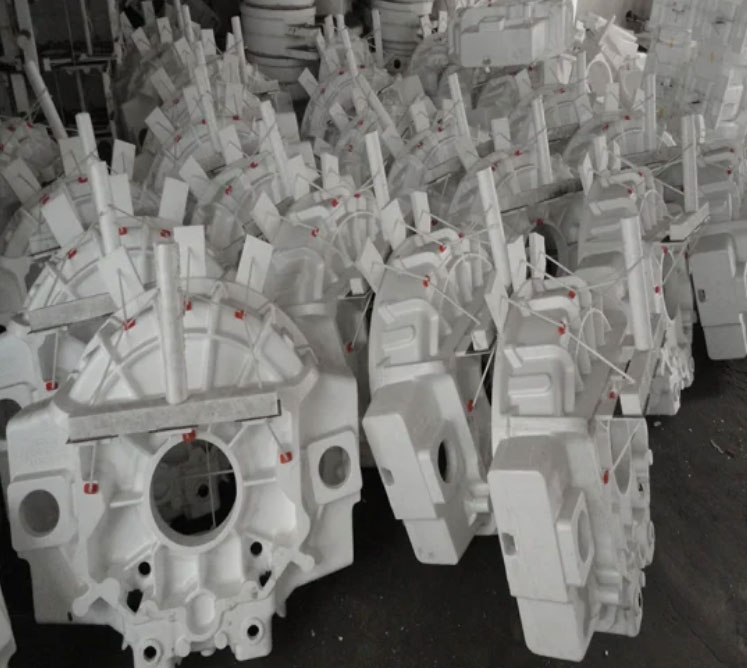
The experimental materials consisted of high-purity iron, carbon, and rare earth silicoferrite alloy, with compositions detailed in Table 1. Three distinct 45 steel variants were prepared with rare earth silicoferrite contents of 0%, 0.15%, and 0.35%, respectively. The lost foam casting process was employed to fabricate the castings, utilizing expandable polystyrene (EPS) foam patterns with a density of 25 kg/m³. These patterns were coated with an alumina-based refractory coating, applied to a thickness of 1.0–1.2 mm, and dried thoroughly. Subsequently, the coated patterns were placed in a molding box and surrounded by quartz sand, which was compacted via vibration to ensure dimensional stability. A bottom-gating system was designed to facilitate smooth metal flow, and the pouring temperature was maintained at 1600°C. The calculated shrinkage rate was approximately 5.2%, with a final casting mass of 32.44 kg. After pouring, the castings were allowed to cool naturally to room temperature before demolding. Sampling was conducted from three critical regions—core, center, and edge—to assess microstructural and mechanical variations across the castings.
Microstructural analysis involved sectioning samples using a DK7720 wire-cut electrical discharge machine, followed by mounting, grinding, and polishing. Etching was performed with aqua regia (a 3:1 volume ratio of hydrochloric acid to nitric acid), and observations were carried out using a BM-4XAI optical microscope (OM) and a Phenom XL scanning electron microscope (SEM) equipped with energy-dispersive X-ray spectroscopy (EDS). Grain size measurements were conducted via the intercept method using ImageJ software. Mechanical properties were evaluated through tensile testing on a DNS-100 universal testing machine at a strain rate of 0.001 s⁻¹, with specimen dimensions conforming to standard protocols. Hardness was measured using a Wilson 600MRD-DE834 Rockwell hardness tester under a load of 60 N and a dwell time of 12 s, with 12 repetitions per sample to ensure statistical reliability. The chemical compositions of the base steel and rare earth silicoferrite alloy are summarized in Tables 1 and 2, respectively.
| C | Si | Mn | Mo | Al | Cr | Ni | Cu | Fe |
|---|---|---|---|---|---|---|---|---|
| 0.46 | 0.199 | 0.606 | 0.001 | 0.0001 | 0.065 | 0.033 | 0.012 | 98.634 |
| Si | RE | Ca | Fe |
|---|---|---|---|
| 50.35 | 30.2 | 2.5 | 16.95 |
The microstructural evolution of the 45 steel castings, as influenced by rare earth silicoferrite additions, revealed significant refinements across all regions—core, center, and edge. In the untreated specimen (0% rare earth silicoferrite), coarse grains were prevalent, with average sizes of 232.62 μm in the core, 228.17 μm in the center, and 191.05 μm at the edge. The introduction of 0.15% rare earth silicoferrite reduced these values to 195.74 μm, 190.18 μm, and 173.07 μm, respectively. Further increasing the content to 0.35% resulted in even finer grains, measuring 153.97 μm in the core, 147.65 μm in the center, and 130.12 μm at the edge. This refinement is attributed to the multifaceted role of rare earth elements (e.g., La, Ce) during solidification in the lost foam casting process. Thermodynamically, rare earth additions alter the Fe-C phase diagram, lowering the liquidus temperature and expanding the solid-liquid two-phase region, which enhances the driving force for nucleation. The nucleation rate, I, can be expressed by the classical equation: $$I = I_0 \exp\left(-\frac{\Delta G^*}{kT}\right)$$ where ΔG* represents the nucleation barrier, and rare earth elements reduce this barrier by forming heterogeneous nucleation sites with existing inclusions. Kinetically, rare earths interact with alloying elements like Mn and Ti to form high-melting-point compounds such as (RE, M)C and (RE, M)N, which act as effective substrates for nucleation. Additionally, the segregation of rare earths at grain boundaries lowers interfacial energy, further inhibiting grain growth and promoting a uniform microstructure throughout the casting.
SEM examination of the core regions provided deeper insights into the microstructural changes. In the 0% rare earth silicoferrite sample, pearlite colonies exhibited an average interlamellar spacing of 0.96 ± 0.06 μm. With 0.15% addition, this spacing decreased to 0.68 ± 0.12 μm, and at 0.35%, it was further reduced to 0.24 ± 0.08 μm. EDS mapping confirmed the presence of Ce, with signal intensity increasing proportionally to the rare earth content, indicating higher solid solubility in the matrix. This refinement in pearlite morphology contributes to the enhanced mechanical properties observed. The role of lost foam casting in facilitating these improvements cannot be overstated; the process’s ability to maintain consistent cooling conditions and minimize turbulence during pouring helps in achieving a homogeneous distribution of rare earth elements, thereby optimizing their refining effects.
The mechanical properties of the castings were evaluated through hardness and tensile tests, with results demonstrating a clear correlation with rare earth silicoferrite content. Hardness measurements, expressed in HRA, showed that the core region’s hardness increased from 47.82 in the 0% sample to 49.6 with 0.15% addition and reached 53.43 at 0.35% rare earth silicoferrite. Similar trends were observed in the center and edge regions, as summarized in Table 3. This enhancement is primarily due to grain refinement, which increases grain boundary density and impedes dislocation motion according to the Hall-Petch relationship: $$\sigma_y = \sigma_0 + k_y d^{-1/2}$$ where σ_y is the yield strength, σ_0 is the lattice friction stress, k_y is the strengthening coefficient, and d is the average grain diameter. For instance, in the core region, the reduction in grain size from 195.74 μm to 153.97 μm between 0.15% and 0.35% samples contributed approximately 25.2 MPa to the yield strength. Additionally, rare earth elements purify the melt by reacting with oxygen and sulfur to form stable compounds like RE₂O₃ and RES, which float to the slag layer. Experimental data indicated that 0.35% rare earth silicoferrite reduced oxygen and sulfur contents by about 60% and 50%, respectively. The modification of inclusion morphology from elongated to spherical also reduces stress concentration factors, further bolstering hardness and strength.
| Sample | Tensile Strength (MPa) | Yield Strength (MPa) | Elongation (%) |
|---|---|---|---|
| 0% Core | 373 | 342 | 8.5 |
| 0% Center | 395 | 388 | 6.0 |
| 0% Edge | 380 | 376 | 7.0 |
| 0.15% Core | 380 | 367 | 15.17 |
| 0.15% Center | 434 | 410 | 19.83 |
| 0.15% Edge | 424 | 372 | 10.83 |
| 0.35% Core | 410 | 377 | 10.0 |
| 0.35% Center | 493 | 412 | 13.5 |
| 0.35% Edge | 424 | 391 | 9.5 |
Tensile testing revealed that the stress-strain curves exhibited typical elastoplastic behavior, with properties improving as rare earth silicoferrite content increased. In the core region, tensile strength rose from 373 MPa (0%) to 380 MPa (0.15%) and 410 MPa (0.35%), while yield strength increased from 342 MPa to 367 MPa and 377 MPa, respectively. Elongation, however, showed a non-linear trend, peaking at 15.17% with 0.15% addition before decreasing to 10% at 0.35%, indicating a trade-off between strength and ductility. The strengthening mechanisms can be quantified through a multi-mechanism model. Grain refinement contributed significantly, as per the Hall-Petch equation. Phase transformation strengthening, described by the Embury-Fisher model for pearlite spacing (λ), also played a role: $$\Delta \sigma_p = K \lambda^{-1}$$ where K is a material constant. For the core, reducing λ from 0.68 μm to 0.24 μm added about 4.1 MPa to the strength. Solid solution strengthening, accounting for Si and Ce additions, was evaluated using the Fleischer model: $$\Delta \sigma_{ss} = M \alpha G b \left( c_{Si} \epsilon_{Si}^{3/2} + c_{Ce} \epsilon_{Ce}^{3/2} \right)$$ where M is the Taylor factor, α is a constant, G is the shear modulus, b is the Burgers vector, c is the solute concentration, and ε is the mismatch parameter. Calculations indicated a contribution of approximately 18.4 MPa for the 0.35% sample. Combining these effects, the overall yield strength for the 0.35% core sample was estimated as 377 MPa, aligning closely with experimental values and validating the model. The lost foam casting process’s controlled solidification environment ensured that these strengthening mechanisms were uniformly activated across the casting, minimizing property gradients.
Fracture surface analysis via SEM provided insights into the failure mechanisms. Macroscopically, all specimens displayed fibrous zones and shear lips, characteristic of ductile fracture. Microscopically, dimples of varying sizes and depths were observed, along with tear ridges and localized cleavage facets, suggesting a mixed ductile-brittle fracture mode. In the 0.15% rare earth silicoferrite sample, dimples were more pronounced, correlating with higher elongation, whereas the 0.35% sample showed finer dimples and increased cleavage, consistent with its enhanced strength but reduced ductility. The presence of secondary cracks and river patterns indicated that stress concentration at inclusion-matrix interfaces initiated brittle fracture in localized areas. Rare earth treatment mitigated this by spheroidizing inclusions like MnS, reducing their aspect ratio and stress concentration factor, K_t, which is given by: $$K_t = 1 + 2(a/b)$$ where a/b is the aspect ratio. By promoting spherical inclusions (a/b ≈ 1), rare earths lowered K_t, thereby improving fracture toughness. The lost foam casting technique, with its minimal turbulence and uniform cooling, further aided in achieving a homogeneous distribution of these modified inclusions, enhancing overall mechanical integrity.
In conclusion, the addition of rare earth silicoferrite to 45 steel fabricated via lost foam casting profoundly influences microstructural and mechanical properties. Grain refinement is achieved throughout the casting, with average grain sizes decreasing by up to 35% at 0.35% rare earth content. This refinement, coupled with purification and inclusion modification, enhances hardness, tensile strength, and yield strength, though ductility may exhibit an optimum at intermediate additions. The strengthening mechanisms—grain refinement, phase transformation, and solid solution—are well-described by established models, confirming the efficacy of rare earths in optimizing performance. The lost foam casting process proves instrumental in realizing these benefits, providing a controlled environment for uniform microstructural development. These findings underscore the potential of rare earth microalloying in producing high-quality, low-alloy steels for demanding applications, with future work focused on optimizing rare earth ratios and processing parameters to further enhance property uniformity.