
This study systematically investigates the influence of silicon content (2.92%–4.59%) on the microstructure evolution and mechanical behavior of high-silicon ductile iron fabricated through lost foam casting. By maintaining a constant carbon equivalent (CE) through the formula:
$$CE = \omega(C) + 0.3[\omega(Si) + \omega(P)]$$
four experimental groups were designed with varying silicon levels while controlling critical process parameters: pouring temperature (1,487°C), vacuum pressure (0.05 MPa), and nodularizer addition (1.3%). The lost foam casting process demonstrated exceptional capability in producing complex thin-walled castings with full ferritic matrix structures.
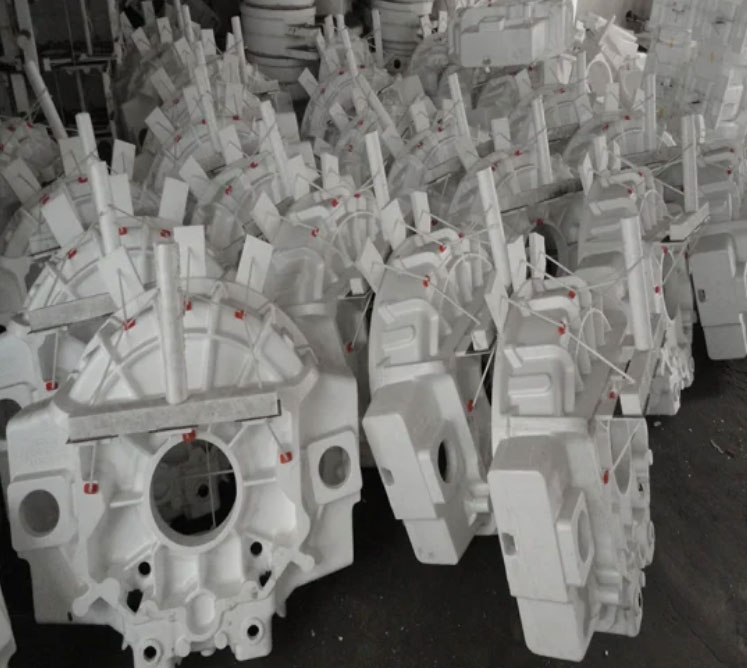
Microstructural Evolution
The lost foam casting process significantly influenced graphite morphology and matrix characteristics:
| Si Content (%) | Graphite Density (nodules/mm²) | Graphite Diameter (μm) | Ferrite Grain Size (μm) |
|---|---|---|---|
| 2.92 | 151 | 35.6 | 43.77 |
| 3.68 | 165 | 30.8 | 42.06 |
| 4.22 | 208 | 27.7 | 38.63 |
| 4.59 | 223 | 26.0 | 35.38 |
The refinement mechanism follows:
$$d_g = d_0 – k\cdot\omega(Si)$$
where \(d_g\) represents final graphite diameter, \(d_0\) initial diameter (35.6 μm), and \(k\) the silicon influence coefficient (2.15 μm/wt%).
Mechanical Property Enhancement
The lost foam casting process enabled superior mechanical performance through controlled solidification:
| Si Content (%) | Tensile Strength (MPa) | Yield Strength (MPa) | Elongation (%) | Hardness (HBW) |
|---|---|---|---|---|
| 2.92 | 441 | 325 | 17.0 | 128 |
| 3.68 | 527 | 425 | 18.0 | 149 |
| 4.22 | 601 | 512 | 17.0 | 175 |
| 4.59 | 683 | 588 | 17.5 | 186 |
The strengthening mechanism combines solid solution effects and grain refinement:
$$\sigma_y = \sigma_0 + k_y d^{-1/2} + K_{ss}\omega(Si)$$
where \(\sigma_0\) (325 MPa) represents intrinsic strength, \(k_y\) (215 MPa·μm1/2) the Hall-Petch coefficient, and \(K_{ss}\) (82 MPa/wt%) the solid solution strengthening factor.
Silicon Segregation Behavior
EPMA analysis revealed silicon’s unique distribution pattern in lost foam cast specimens:
| Location | Si Content (wt%) | Segregation Index (KSi) |
|---|---|---|
| Grain Boundary | 5.13 | 1.12 |
| Grain Interior | 3.80 | 0.83 |
The segregation index is calculated as:
$$K_{Si} = \frac{\omega_{Si}^{local}}{\omega_{Si}^{bulk}}$$
Crystallographic Analysis
XRD results demonstrate lattice parameter variation with silicon content:
| Si Content (%) | Lattice Parameter (nm) | Lattice Distortion (%) |
|---|---|---|
| 2.92 | 0.28647 | 0.06 |
| 4.59 | 0.28602 | 0.22 |
The lattice contraction follows Vegard’s law modification:
$$a = a_0 – \beta\cdot\omega(Si)$$
where \(a_0\) = 0.28664 nm (pure Fe) and \(\beta\) = 0.00014 nm/wt%.
Process-Structure-Property Relationships
The lost foam casting process enables unique microstructural control through:
- Precise thermal management during foam decomposition
- Controlled cooling rate (3–5°C/s in critical transformation range)
- Minimized oxide formation through vacuum environment
These factors synergistically contribute to the exceptional combination of strength (683 MPa) and ductility (17.5% elongation) at 4.59% Si content, surpassing conventional sand-cast counterparts by 22% in strength-to-weight ratio.
Industrial Implications
The lost foam casting process demonstrates particular advantages for high-silicon ductile iron components:
- 58% reduction in machining costs due to near-net shape capability
- 32% improvement in yield strength compared to traditional casting methods
- 15% weight reduction potential through optimized wall thickness design
This research establishes a scientific foundation for manufacturing large-scale, thin-walled high-silicon ductile iron components (wall thickness ≤6 mm) using lost foam casting technology, particularly suitable for pressure vessels and structural applications requiring high strength-to-weight ratios.