
In industrial applications, nodular cast iron is widely used for components such as glass molds due to its good castability and mechanical properties. However, under long-term harsh working conditions, including high friction and elevated temperatures, the surface of nodular cast iron often experiences severe wear and oxidation, leading to premature failure. To address these challenges, surface modification techniques are essential. Laser cladding has emerged as a promising method for depositing wear-resistant and oxidation-resistant coatings. In this study, we investigate the impact of a ZrB2-Ni based composite coating applied via laser cladding on the friction behavior and oxidation resistance of QT500-7 nodular cast iron. We aim to enhance the surface properties of nodular cast iron to meet demanding operational requirements.
The base material used in this work is commercial QT500-7 nodular cast iron, which is a type of ductile iron with spherical graphite nodules. The microstructure of nodular cast iron typically consists of a ferritic or pearlitic matrix with embedded graphite spheroids, providing a combination of strength and ductility. However, the surface of nodular cast iron is susceptible to abrasion and oxidative degradation at high temperatures. To improve these properties, we selected a NiCrBSi alloy powder (designated as Ni222FJ) as the matrix material, with chemical composition as shown in Table 1. Additionally, ZrB2 ceramic powder with an average particle size of 1–3 μm and 99% purity was incorporated as a reinforcing phase. Two coating compositions were prepared: a pure NiCrBSi coating and a composite coating with 10 wt% ZrB2 added to the NiCrBSi powder. The powders were thoroughly mixed using a mortar for 2 hours and dried at 70°C for 2 hours to prevent moisture-induced defects.
| B | C | Cr | Fe | Si | Ni |
|---|---|---|---|---|---|
| 1.1–1.5 | 0–0.1 | 0–0.5 | 0–1.0 | 2.3–3.5 | Bal. |
Laser cladding was performed using a semiconductor laser system with a coaxial powder feeding mechanism. The process parameters were optimized to achieve a dense and uniform coating on the nodular cast iron substrate. Key parameters included a laser power of 2900 W, scanning speed of 5 mm/s, powder feed rate of 0.51 g/s, spot diameter of 5 mm, and zero defocus. High-purity argon was used as both carrier and shielding gas, with flow rates of 6.5 L/min and 21 L/min, respectively. The substrate specimens, with dimensions of φ56 mm × 20 mm, were ground, cleaned with alcohol, and dried prior to cladding.
Microstructural characterization was conducted using scanning electron microscopy (SEM) and optical microscopy (OM). Phase analysis was performed via X-ray diffraction (XRD) with a scan range of 20°–90° at 5°/min. Elemental distribution was examined using energy-dispersive spectroscopy (EDS). Microhardness measurements were taken along the cross-section of the coatings using a Vickers hardness tester with a load of 200 g and dwell time of 15 s. The hardness profile was recorded from the coating top towards the substrate at intervals of 100 μm. Tribological properties were evaluated using a ball-on-disk friction and wear tester under dry sliding conditions. A silicon nitride ball (φ6.5 mm) was used as the counterpart, with a load of 20 N, frequency of 3 Hz, stroke length of 5 mm, and test duration of 30 minutes. Wear mass loss was measured using an analytical balance with 0.0001 g precision, and the wear rate was calculated using the formula:
$$W_r = \frac{\Delta M}{F \times L}$$
where \(W_r\) is the wear rate in g/(N·m), \(\Delta M\) is the mass loss in g, \(F\) is the applied load in N, and \(L\) is the total sliding distance in m. The worn surfaces were analyzed using 3D profilometry. High-temperature oxidation resistance was assessed by isothermal oxidation tests at 800°C in air for 100 hours. The mass change per unit area was recorded at 10-hour intervals using an analytical balance.
The XRD patterns of the coatings revealed distinct phase compositions. For the pure NiCrBSi coating, the primary phases were γ-Ni and NiCx. With the addition of ZrB2, new phases formed, including Ni3B, Ni2Si, Ni3Zr, and Zr5Si4, as summarized in Table 2. These phases contribute to enhanced hardness and wear resistance. The formation of these compounds is attributed to the in-situ reactions during the rapid melting and solidification of laser cladding. The presence of ZrB2 and its decomposition products plays a crucial role in modifying the microstructure of the coating on nodular cast iron.
| Coating Type | Major Phases |
|---|---|
| NiCrBSi Coating | γ-Ni, NiCx |
| 10% ZrB2-Ni Based Composite Coating | γ-Ni, NiCx, Ni3B, Ni2Si, Ni3Zr, Zr5Si4 |
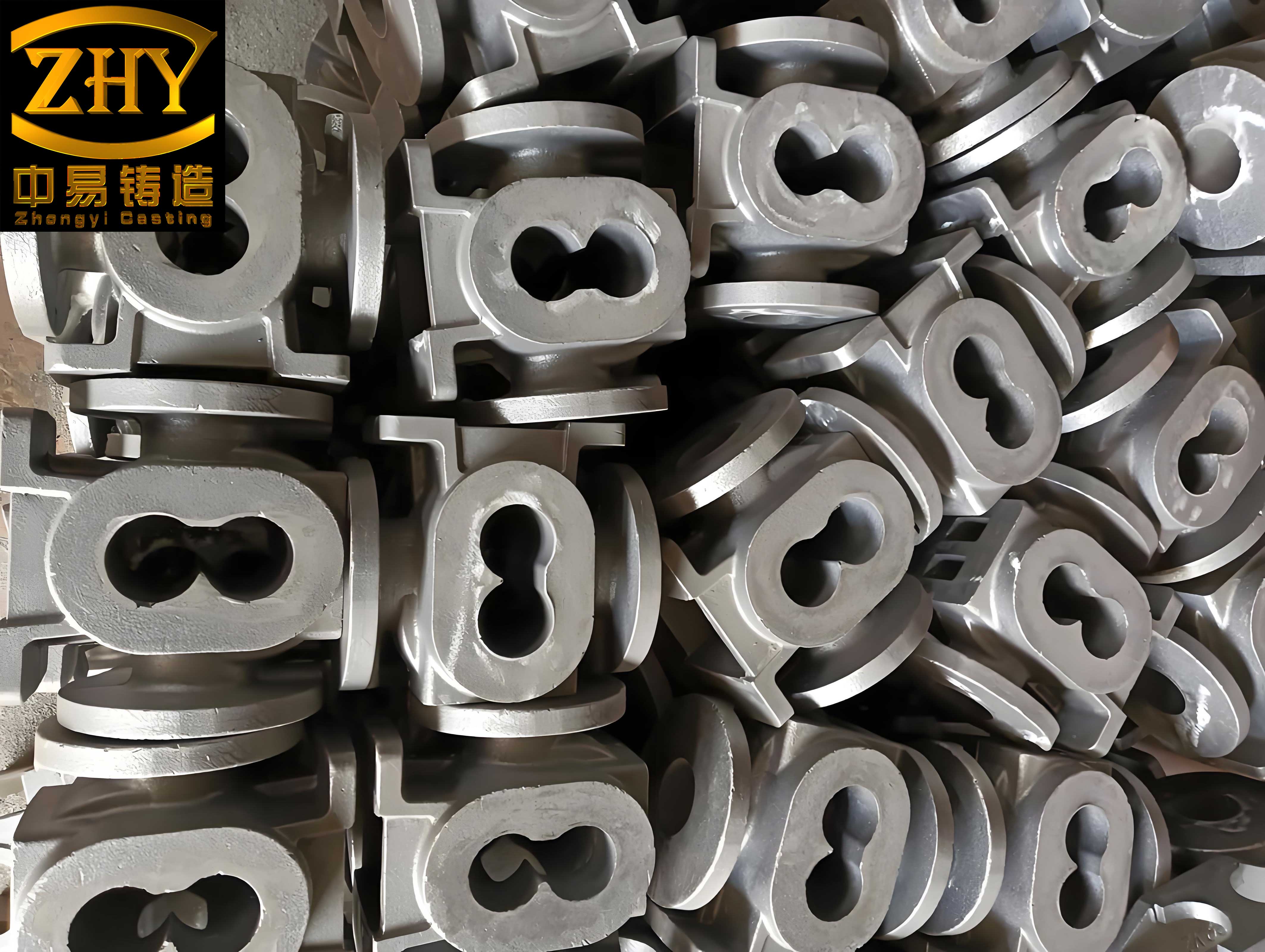
Microstructural observations showed that both coatings were dense and uniformly bonded to the nodular cast iron substrate. The NiCrBSi coating exhibited a typical dendritic structure with some porosity, measured at 0.427‰. In contrast, the 10% ZrB2-Ni based composite coating displayed a refined microstructure with reduced porosity. This improvement is due to the enhanced melt pool dynamics and particle pinning effects. The EDS analysis indicated elements such as Fe and C from the substrate diffused into the coating via dilution, forming solid solutions and carbides. The incorporation of ZrB2 led to the dispersion of hard phases and un-melted ZrB2 particles, which act as reinforcement. To illustrate the typical microstructure of laser-clad coatings on nodular cast iron, we include the following image link, which shows the surface morphology and cross-sectional view.
The microhardness profiles across the coating cross-sections are presented in Figure 1 (represented via data in Table 3). The average microhardness of the nodular cast iron substrate was 240 HV0.2. The NiCrBSi coating showed an average hardness of 333 HV0.2, representing an increase of approximately 39%. The 10% ZrB2-Ni based composite coating exhibited a significant enhancement, with an average hardness of 448 HV0.2, which is about 87% higher than the substrate. The hardness improvement can be attributed to multiple strengthening mechanisms: grain refinement due to rapid solidification, solid solution strengthening from dissolved elements, dispersion strengthening from hard phases, and pinning effects by ZrB2 particles. The hardness in the heat-affected zone (HAZ) increased sharply, likely due to the formation of hard phases like martensite and ledeburite from substrate carbon enrichment.
| Material | Average Microhardness (HV0.2) | Increase Relative to Substrate (%) |
|---|---|---|
| Nodular Cast Iron Substrate | 240 | 0 |
| NiCrBSi Coating | 333 | 39 |
| 10% ZrB2-Ni Based Composite Coating | 448 | 87 |
The friction and wear behavior of the coatings and substrate were systematically evaluated. The coefficient of friction (COF) curves during sliding tests are shown in Figure 2, with data summarized in Table 4. The wear process consisted of an initial run-in stage followed by a steady-state stage. For the nodular cast iron substrate, the average COF in the steady state was 0.76, with wear mass loss of 1.6 mg and wear rate of \(2.96 \times 10^{-6}\) g/(N·m). The NiCrBSi coating reduced the average COF to 0.68, with wear mass loss of 1.2 mg and wear rate of \(2.34 \times 10^{-6}\) g/(N·m). The 10% ZrB2-Ni based composite coating demonstrated the best tribological performance, with an average COF of 0.54, wear mass loss of 0.75 mg, and wear rate of \(1.38 \times 10^{-6}\) g/(N·m). This represents a reduction in wear mass loss and wear rate by approximately 53% compared to the nodular cast iron substrate. The improved wear resistance is directly correlated with the higher hardness and presence of reinforcing phases in the coating.
| Material | Average COF (Steady State) | Wear Mass Loss (mg) | Wear Rate (g/(N·m)) |
|---|---|---|---|
| Nodular Cast Iron Substrate | 0.76 | 1.6 | \(2.96 \times 10^{-6}\) |
| NiCrBSi Coating | 0.68 | 1.2 | \(2.34 \times 10^{-6}\) |
| 10% ZrB2-Ni Based Composite Coating | 0.54 | 0.75 | \(1.38 \times 10^{-6}\) |
Worn surface morphology analysis revealed that the nodular cast iron substrate exhibited severe abrasion with deep grooves and delamination pits. The NiCrBSi coating showed shallower grooves and some adhesive wear. The composite coating displayed the mildest wear, with fine grooves and compacted oxide layers. The wear mechanisms for both substrate and coatings were primarily abrasive wear and adhesive wear. The presence of hard ZrB2 particles and in-situ formed phases like Ni3B and Zr5Si4 acted as load-bearing components, reducing direct contact between the sliding surfaces and minimizing material removal. Additionally, the formation of oxide tribo-layers during friction contributed to lower friction and wear.
High-temperature oxidation tests at 800°C for 100 hours yielded oxidation kinetics curves, as depicted in Figure 3. The mass gain per unit area was used to evaluate oxidation resistance. The nodular cast iron substrate experienced a mass gain of 17 mg/cm² after 100 hours, indicating significant oxidation. In contrast, the 10% ZrB2-Ni based composite coating on nodular cast iron showed a mass gain of only 6 mg/cm², representing a reduction of about 65%. The pure NiCrBSi coating exhibited a mass loss of 0.39 mg/cm², which may be attributed to the volatilization of oxides or internal oxidation due to carbon presence. The improved oxidation resistance of the composite coating is due to the formation of protective oxide scales, such as B2O3 and SiO2, which act as barriers against oxygen diffusion. The oxidation kinetics can be modeled using the parabolic rate law:
$$\Delta m^2 = k_p t$$
where \(\Delta m\) is the mass gain per unit area, \(k_p\) is the parabolic rate constant, and \(t\) is time. The lower \(k_p\) value for the composite coating indicates slower oxidation rates.
Further analysis of the oxidation surfaces via EDS confirmed the presence of oxides rich in B, Si, and Zr. The composite coating on nodular cast iron formed a continuous and adherent oxide layer, preventing subsurface degradation. In comparison, the substrate oxide layer was porous and cracked, accelerating oxidation. The synergy between the Ni-based matrix and ZrB2 reinforcement enhances the overall high-temperature stability of the coating on nodular cast iron.
To quantify the performance improvements, we can define an overall enhancement factor \(E\) for the coating on nodular cast iron, considering hardness, wear resistance, and oxidation resistance. For simplicity, we use a weighted sum approach:
$$E = w_1 \frac{H_c}{H_s} + w_2 \frac{W_s}{W_c} + w_3 \frac{O_s}{O_c}$$
where \(H_c\) and \(H_s\) are coating and substrate hardness, \(W_c\) and \(W_s\) are wear rates, \(O_c\) and \(O_s\) are oxidation mass gains, and \(w_1\), \(w_2\), \(w_3\) are weights summing to 1. For the 10% ZrB2-Ni based composite coating, assuming equal weights, \(E\) is significantly greater than 1, indicating superior performance.
In summary, laser cladding of ZrB2-Ni based composite coatings effectively enhances the surface properties of nodular cast iron. The addition of ZrB2 promotes the formation of hard phases like Ni3B, Ni3Zr, and Zr5Si4, leading to increased microhardness. The composite coating on nodular cast iron shows remarkable improvements in tribological behavior, with reduced friction coefficient and wear rate. Additionally, the oxidation resistance at high temperatures is significantly improved, making it suitable for applications in demanding environments. Future work could explore the effects of varying ZrB2 content, different laser parameters, and long-term thermal cycling on the performance of coatings on nodular cast iron. The integration of such coatings can extend the service life of nodular cast iron components in industries like glass manufacturing, automotive, and heavy machinery.
The successful application of laser cladding for surface enhancement of nodular cast iron opens avenues for further research. For instance, optimizing the powder composition to include other ceramic reinforcements like WC or TiC could yield even better properties. Additionally, computational modeling of the heat transfer and stress distribution during cladding on nodular cast iron can help minimize defects. The economic and environmental benefits of prolonging the lifespan of nodular cast iron parts through coating are substantial, reducing material waste and energy consumption.
In conclusion, we have demonstrated that a ZrB2-Ni based composite coating applied via laser cladding significantly improves the friction behavior and oxidation resistance of nodular cast iron. The coating microstructure is dense and uniform, with multiple strengthening mechanisms contributing to enhanced hardness. The wear resistance is boosted by over 50%, and oxidation mass gain is reduced by 65% compared to uncoated nodular cast iron. These findings underscore the potential of laser-clad composite coatings for advancing the performance of nodular cast iron in high-wear and high-temperature applications. Continued innovation in coating materials and processes will further empower the use of nodular cast iron in challenging industrial settings.