
In modern foundry practices, the production of high-quality spheroidal graphite cast iron is critical for applications demanding superior strength, ductility, and toughness. The wire feeding nodularization process has emerged as a prominent technique due to its environmental benefits, reduced magnesium loss, and enhanced process control. This study investigates the impact of two distinct types of nodularizing cored wires—namely, mixture-cored wire and alloy-cored wire—with varying magnesium content in the core material on the magnesium absorptivity, microstructure, and mechanical properties of spheroidal graphite cast iron, specifically targeting the QT450-10 grade. The research aims to provide insights into optimizing cored wire design for efficient and consistent production of spheroidal graphite cast iron.
The experimental setup involved melting iron in a 1-ton medium-frequency induction furnace, with a charge composition of 35% pig iron, 40% steel scrap, 25% returns, and 1.75% carbon raiser. The base iron was treated using a wire feeding machine, with nodularizing cored wires of different core types and magnesium levels, followed by inoculation with a silicon-barium cored wire. The treatment was conducted in a ladle with a height-to-diameter ratio of 1:1.86, holding 1000 kg of molten iron at approximately 1520°C. The cored wires were fed at a constant speed of 24 m/min, and the lengths were adjusted based on standard practice to ensure consistent magnesium addition. The chemical composition of the molten iron before and after treatment adhered to the specifications for QT450-10 spheroidal graphite cast iron, as outlined in Table 1.
| State | C | Si | Mn | P | S | Mgres | REres |
|---|---|---|---|---|---|---|---|
| Base Iron | 3.75–3.95 | 1.0–1.5 | ≤0.4 | ≤0.05 | ≤0.03 | – | – |
| After Treatment | 3.65–3.85 | 2.65–2.95 | ≤0.4 | ≤0.05 | ≤0.03 | 0.025–0.065 | 0.015–0.04 |
Two categories of nodularizing cored wires were employed: mixture-cored wire, where the core consisted of mechanically blended passivated magnesium granules with other alloy powders, and alloy-cored wire, where the core was composed of crushed nodularizer alloy powder. The magnesium content in the core was varied at three levels: 15%, 24%, and 30%. The specifications and chemical composition of these cored wires, along with the inoculation cored wire, are detailed in Table 2. The wire feeding parameters, including feed length and speed, were kept constant across trials to isolate the effects of core type and magnesium content.
| Wire Type | Diameter (mm) | Si | Ca | Mg | Ba | La | Ce | Al | Linear Density (g/m) |
|---|---|---|---|---|---|---|---|---|---|
| Mixture-cored (15% Mg) | 13 | 46.1 | 2.614 | 15.21 | 0.233 | 0.548 | 1.377 | 0.809 | 280 |
| Mixture-cored (24% Mg) | 13 | 48.3 | 2.100 | 23.43 | 3.033 | 0.717 | 0.414 | 0.567 | 250 |
| Mixture-cored (30% Mg) | 13 | 43.9 | 2.544 | 30.04 | 0.420 | 0.791 | 2.190 | 0.708 | 222 |
| Alloy-cored (15% Mg) | 13 | 45.0 | 3.000 | 17.00 | 1.108 | 0.606 | 1.534 | 0.857 | 297 |
| Alloy-cored (24% Mg) | 13 | 48.9 | 2.988 | 24.45 | 7.5 | 0.764 | 0.513 | 0.818 | 230 |
| Alloy-cored (30% Mg) | 13 | 43.5 | 2.92 | 30.14 | 4.85 | 1.14 | 2.05 | 0.7 | 228 |
| Inoculation-cored (SiBa) | 13 | 63 | 1.4 | – | – | – | – | 1.01 | 260 |
The magnesium absorptivity was calculated using the following formula, which accounts for the sulfur change and residual magnesium in the treated iron:
$$ \varepsilon_{\text{Mg}} = \frac{(\Delta S \times 0.76 + \text{Mg}_{\text{res}}) \times W_L}{W_{\text{Mg}}} \times 100\% $$
where \( \varepsilon_{\text{Mg}} \) is the magnesium absorptivity in percent, \( \Delta S \) is the change in sulfur content after treatment, \( \text{Mg}_{\text{res}} \) is the residual magnesium content, \( W_L \) is the mass of molten iron in kg, and \( W_{\text{Mg}} \) is the total magnesium added via the cored wires. The magnesium addition was determined based on the cored wire length and core composition:
$$ W_{\text{Mg}} = (L_s \times \rho_s \times W_{s,\text{Mg}}) + (L_I \times \rho_I \times W_{I,\text{Mg}}) $$
with \( L_s \) and \( L_I \) as the lengths of nodularizing and inoculation cored wires, \( \rho_s \) and \( \rho_I \) as their linear densities, and \( W_{s,\text{Mg}} \) and \( W_{I,\text{Mg}} \) as the magnesium contents in their cores.
The results for magnesium absorptivity and residual magnesium across different cored wire types and magnesium levels are summarized in Table 3. It was observed that the alloy-cored wire consistently yielded slightly higher magnesium absorptivity compared to the mixture-cored wire, with relative differences ranging from 0.2% to 8.2%. This phenomenon can be attributed to the form of magnesium in the cores: in alloy-cored wires, magnesium is present as compounds with lower vapor pressure, leading to less violent reaction and better dissolution into the iron, whereas in mixture-cored wires, elemental magnesium vaporizes more rapidly, increasing escape losses. As the magnesium content in the core increased from 15% to 30%, the absorptivity decreased for both wire types, due to intensified reaction kinetics and reduced diffusion time. However, the residual magnesium levels remained relatively stable between 0.048% and 0.057%, indicating that core type and magnesium content did not significantly affect the final magnesium concentration in the spheroidal graphite cast iron.
| Run | Cored Wire Type | State | C (%) | Si (%) | Mn (%) | P (%) | S (%) | Mgres (%) | Ceres (%) | εMg (%) |
|---|---|---|---|---|---|---|---|---|---|---|
| 1 | Mixture-cored (15% Mg) | Base | 3.95 | 1.31 | 0.18 | 0.027 | 0.017 | – | – | – |
| Treated | 3.77 | 2.77 | 0.17 | 0.024 | 0.013 | 0.048 | 0.022 | 45.7 | ||
| 2 | Mixture-cored (24% Mg) | Base | 3.89 | 1.25 | 0.189 | 0.027 | 0.014 | – | – | – |
| Treated | 3.64 | 2.72 | 0.192 | 0.031 | 0.011 | 0.055 | 0.016 | 39.9 | ||
| 3 | Mixture-cored (30% Mg) | Base | 3.89 | 1.23 | 0.192 | 0.028 | 0.018 | – | – | – |
| Treated | 3.67 | 2.77 | 0.21 | 0.026 | 0.007 | 0.053 | 0.023 | 38.3 | ||
| 4 | Alloy-cored (15% Mg) | Base | 3.92 | 1.21 | 0.21 | 0.027 | 0.017 | – | – | – |
| Treated | 3.69 | 2.63 | 0.21 | 0.030 | 0.010 | 0.056 | 0.021 | 48.1 | ||
| 5 | Alloy-cored (24% Mg) | Base | 3.89 | 1.33 | 0.198 | 0.028 | 0.018 | – | – | – |
| Treated | 3.74 | 2.85 | 0.20 | 0.025 | 0.010 | 0.054 | 0.018 | 43.2 | ||
| 6 | Alloy-cored (30% Mg) | Base | 3.91 | 1.192 | 0.166 | 0.034 | 0.020 | – | – | – |
| Treated | 3.78 | 2.86 | 0.183 | 0.033 | 0.012 | 0.057 | 0.026 | 38.4 |
The microstructure of the spheroidal graphite cast iron was examined on samples taken from Y-block castings. Graphite nodularity, size, count, and distribution were assessed using optical microscopy and image analysis software. For all conditions, the nodularity exceeded 85%, with graphite sizes ranging from grade 6 to 7 according to standard classifications. The mixture-cored wire tended to produce a slightly lower nodularity but a higher graphite count with smaller nodules, whereas the alloy-cored wire resulted in higher nodularity with fewer but larger nodules. As the magnesium content increased, both wire types showed a decline in nodularity and graphite count, along with an increase in average nodule diameter. This trend is likely due to enhanced desulfurization and deoxidation at higher magnesium levels, which reduces effective nucleation sites for graphite precipitation. The quantitative data for microstructure parameters are presented in Table 4.
| Run | Cored Wire Type | Nodularity (%) | Graphite Size (Grade) | Graphite Count (per mm²) | Average Nodule Diameter (μm) | Graphite Area Fraction (%) |
|---|---|---|---|---|---|---|
| 1 | Mixture-cored (15% Mg) | 88.5 | 6.5 | 152 | 24.3 | 10.2 |
| 2 | Mixture-cored (24% Mg) | 86.2 | 6.8 | 138 | 25.8 | 10.5 |
| 3 | Mixture-cored (30% Mg) | 85.1 | 7.0 | 125 | 27.4 | 10.0 |
| 4 | Alloy-cored (15% Mg) | 90.3 | 6.3 | 145 | 23.8 | 10.8 |
| 5 | Alloy-cored (24% Mg) | 88.7 | 6.6 | 132 | 25.1 | 10.3 |
| 6 | Alloy-cored (30% Mg) | 87.4 | 6.9 | 120 | 26.9 | 10.1 |
The matrix structure of the spheroidal graphite cast iron consisted primarily of ferrite and pearlite, with ferrite being the dominant phase. The pearlite content varied slightly across conditions, but no consistent correlation with core type or magnesium content was evident, as shown in Table 5. The matrix characteristics are crucial for determining the mechanical properties of spheroidal graphite cast iron, as they influence strength, hardness, and ductility.
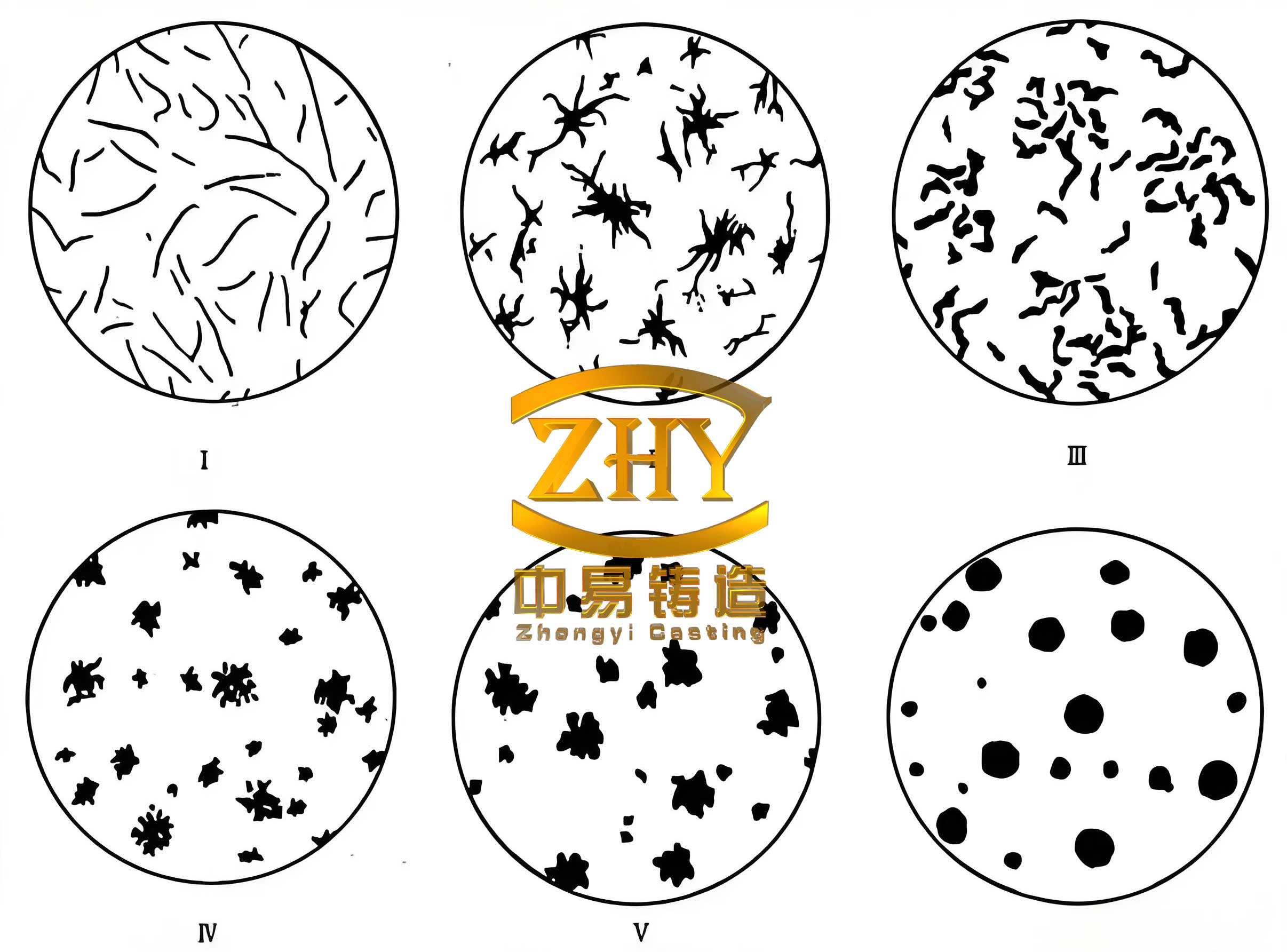
The mechanical properties of the spheroidal graphite cast iron were evaluated through tensile, hardness, and impact tests. The results, summarized in Table 6, indicate that all samples met the requirements for QT450-10 grade, with tensile strengths ranging from 474.17 to 541.30 MPa, yield strengths from 329.08 to 356.58 MPa, elongations from 14.6% to 21.2%, and hardness values between 162 and 192 HB. In general, the mixture-cored wire produced spheroidal graphite cast iron with higher strength and hardness but lower ductility and impact toughness compared to the alloy-cored wire. This behavior can be linked to the microstructure: the mixture-cored wire led to finer graphite nodules and potentially higher pearlite content in some cases, enhancing strength but reducing toughness. The alloy-cored wire, with its superior nodularity and slightly coarser graphite, promoted better ductility. The yield-to-tensile ratio remained within 0.66–0.70, consistent with typical spheroidal graphite cast iron.
| Run | Cored Wire Type | Pearlite Content (%) |
|---|---|---|
| 1 | Mixture-cored (15% Mg) | 25.8 |
| 2 | Mixture-cored (24% Mg) | 36.8 |
| 3 | Mixture-cored (30% Mg) | 24.2 |
| 4 | Alloy-cored (15% Mg) | 18.4 |
| 5 | Alloy-cored (24% Mg) | 10.1 |
| 6 | Alloy-cored (30% Mg) | 24.5 |
| Run | Cored Wire Type | Tensile Strength, Rm (MPa) | Yield Strength, Rp0.2 (MPa) | Rp0.2/Rm | Elongation, A (%) | Hardness (HB) | Impact Energy, Ak (J) |
|---|---|---|---|---|---|---|---|
| 1 | Mixture-cored (15% Mg) | 527.30 | 354.55 | 0.67 | 14.6 | 187 | 4.4 |
| 2 | Mixture-cored (24% Mg) | 541.30 | 356.58 | 0.66 | 15.2 | 192 | 9.8 |
| 3 | Mixture-cored (30% Mg) | 489.53 | 331.44 | 0.68 | 20.9 | 174 | 9.0 |
| 4 | Alloy-cored (15% Mg) | 515.25 | 343.78 | 0.67 | 16.6 | 170 | 12.0 |
| 5 | Alloy-cored (24% Mg) | 474.17 | 329.08 | 0.69 | 20.3 | 162 | 13.2 |
| 6 | Alloy-cored (30% Mg) | 497.73 | 348.57 | 0.70 | 21.2 | 180 | 11.1 |
The relationship between magnesium content and key performance metrics can be expressed through empirical equations derived from the data. For instance, the magnesium absorptivity (\( \varepsilon_{\text{Mg}} \)) as a function of core magnesium content (\( \text{Mg}_{\text{core}} \)) for mixture-cored wire is approximated by:
$$ \varepsilon_{\text{Mg, mixture}} = 52.5 – 0.48 \times \text{Mg}_{\text{core}} $$
and for alloy-cored wire by:
$$ \varepsilon_{\text{Mg, alloy}} = 55.2 – 0.52 \times \text{Mg}_{\text{core}} $$
Similarly, the nodularity (\( N \)) shows a linear decrease with increasing magnesium content:
$$ N_{\text{mixture}} = 91.2 – 0.20 \times \text{Mg}_{\text{core}} $$
$$ N_{\text{alloy}} = 93.0 – 0.18 \times \text{Mg}_{\text{core}} $$
These equations highlight the consistent trends observed in the spheroidal graphite cast iron, underscoring the importance of controlling magnesium content in cored wires for desired microstructure and properties.
The discussion extends to the implications for industrial production of spheroidal graphite cast iron. The wire feeding process, with its adjustable cored wire parameters, offers a versatile approach to tailor the characteristics of spheroidal graphite cast iron. The choice between mixture-cored and alloy-cored wires should consider the specific requirements: if higher strength and hardness are prioritized, mixture-cored wires may be preferable, whereas alloy-cored wires are advantageous for applications demanding enhanced ductility and toughness. At a core magnesium content of 15%, both wire types yielded spheroidal graphite cast iron with satisfactory microstructure and mechanical properties, suggesting this level as a balanced option for QT450-10 grade. However, practical adjustments in wire feeding length may be necessary to compensate for lower magnesium content, ensuring adequate residual magnesium for effective nodularization.
Further analysis reveals that the spheroidal graphite cast iron produced via wire feeding exhibits reduced casting defects and improved consistency, attributed to the controlled reaction environment. The desulfurization efficiency, represented by the sulfur change (\( \Delta S \)), correlated positively with magnesium content, following the equation:
$$ \Delta S = 0.012 – 0.0003 \times \text{Mg}_{\text{core}} $$
This indicates that higher magnesium levels enhance sulfur removal, contributing to cleaner iron and better graphite formation. The interplay between magnesium absorptivity, graphite nucleation, and matrix development is complex, involving thermodynamics and kinetics of molten iron treatment. Future studies could explore the effects of other core elements, such as rare earths or calcium, on the spheroidal graphite cast iron properties, potentially optimizing wire formulations for specialized grades.
In conclusion, this research demonstrates that both mixture-cored and alloy-cored wires are viable for producing high-quality spheroidal graphite cast iron, with alloy-cored wires offering marginally better magnesium absorptivity and ductility. The magnesium content in the core inversely affects absorptivity and nodularity, while residual magnesium remains stable. For the QT450-10 grade, a core magnesium content of 15% using either wire type achieves the desired balance of microstructure and mechanical performance. These findings support the adoption of wire feeding nodularization as a sustainable and efficient method for spheroidal graphite cast iron production, with cored wire design playing a pivotal role in material optimization. The continued advancement in cored wire technology will further enhance the capabilities of spheroidal graphite cast iron in demanding engineering applications.