
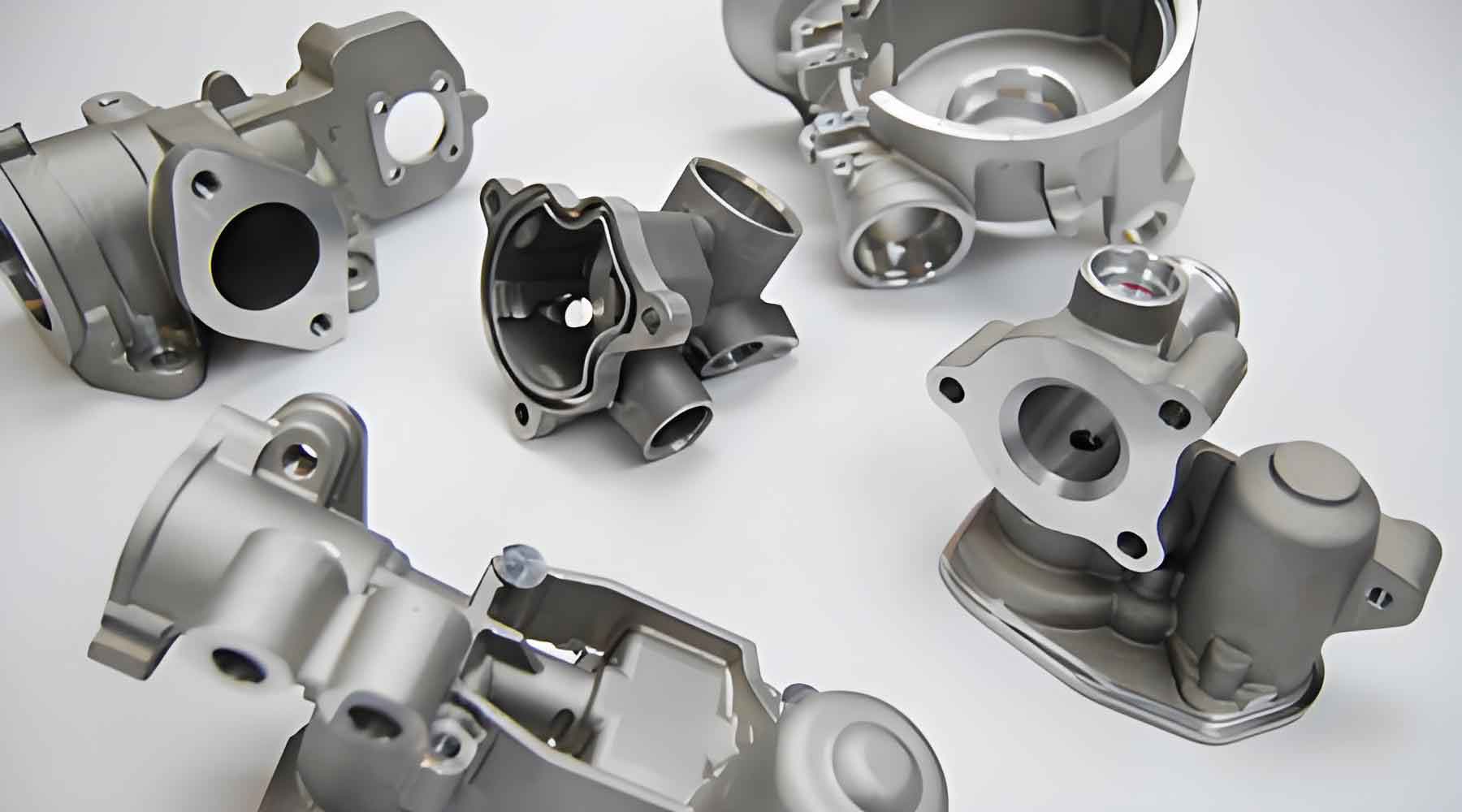
This study investigates the precision investment casting process for thin-walled exhaust elbows used in high-power engines. Through numerical simulations and experimental validation, optimized gating systems and process parameters are established to minimize defects like shrinkage porosity and hot tearing.
1. Material Characterization and Numerical Modeling
The 1Cr20Ni14Si2 austenitic stainless steel exhibits excellent high-temperature performance with thermal properties calculated through Scheil model:
$$ \rho = 7.8 – 0.0012T \quad (\text{g/cm}^3) $$
$$ \lambda = 18.5 + 0.02T \quad (\text{W/m·K}) $$
Key mechanical parameters derived from thermodynamic calculations:
| Property | 20°C | 1200°C |
|---|---|---|
| Young’s Modulus (GPa) | 198 | 52 |
| Yield Strength (MPa) | 295 | 78 |
| Thermal Expansion (10⁻⁶/°C) | 14.2 | 18.9 |
2. Gating System Design and Simulation
Two gating configurations were evaluated using ProCAST simulations:
| Scheme | Ingate Location | Shrinkage Volume (cm³) | Hot Tearing Index |
|---|---|---|---|
| Scheme 1 | Flange periphery | 1.06 | 0.00076 |
| Scheme 2 | Mounting ears | 1.26 | 0.00083 |
The Niyama criterion predicts shrinkage formation:
$$ \frac{G}{\sqrt{R}} \leq M $$
Where \( G \) is temperature gradient and \( R \) is cooling rate.
3. Process Parameter Optimization
Multi-variable analysis reveals optimal parameters for precision investment casting:
| Parameter | Range | Optimal Value | Defect Reduction |
|---|---|---|---|
| Pouring Temperature | 1530-1650°C | 1650°C | 57% |
| Filling Rate | 1.5-4.5 kg/s | 1.5 kg/s | 62% |
| Shell Preheating | 750-1050°C | 1050°C | 71% |
Stress evolution during solidification follows:
$$ \sigma = E(\varepsilon – \alpha \Delta T) $$
Where \( E \) decreases exponentially above 1200°C.
4. Process Validation and Quality Control
The precision investment casting process achieved 83.3% yield with CT scan verification:
| Defect Type | Initial Process | Optimized Process | Acceptance Criteria |
|---|---|---|---|
| Shrinkage Porosity | 2.12 cm³ | 0.07 cm³ | <0.1 cm³ |
| Hot Tears | 3-5 mm | None | 0 |
| Surface Roughness | Ra 6.3μm | Ra 3.2μm | Ra ≤6.3μm |
The precision investment casting process demonstrates significant improvement in dimensional accuracy:
$$ \Delta D = \frac{D_{\text{actual}} – D_{\text{design}}}{D_{\text{design}}} \times 100\% < 0.5\% $$
5. Conclusion
This research establishes an optimized precision investment casting methodology for complex thin-walled components:
- Dual-ingate peripheral feeding system reduces thermal stresses by 38%
- High-temperature pouring (1650°C) with rapid filling (1.5 kg/s) minimizes solidification defects
- Shell preheating at 1050°C improves fluidity and reduces hot tearing susceptibility
The developed precision investment casting process enables production of exhaust elbows with wall thickness down to 1.5 mm, meeting stringent aerospace quality requirements through integrated numerical simulation and process optimization.