
The utilization of low-carbon white cast iron in the as-cast condition has emerged as a viable pathway for developing effective wear-resistant materials. While its matrix is typically pearlitic, it has demonstrated satisfactory wear resistance under specific service conditions. Manganese plays a specialized role in austenite transformation, facilitating the attainment of diverse matrix microstructures tailored to different operational demands. This work investigates the influence of manganese alloying on the microstructure and properties of low-carbon white cast iron, exploring the potential for deploying manganese-alloyed grades in their as-cast state.
1. Experimental Methodology
Low-carbon white cast iron was prepared using pig iron, steel scrap, and ferromanganese. Melting was conducted in a medium-frequency induction furnace. After the charge was fully melted, ferromanganese was added. The melt was tapped at approximately 1500°C following deoxidation with aluminum. Rare-earth silicon-iron alloy was placed at the bottom of the ladle and melted by the incoming stream. The chemical compositions of the produced heats are summarized in Table 1.
| Sample ID | C | Si | Mn | S | P | RE (residual) |
|---|---|---|---|---|---|---|
| Series A (Charpy) | 2.0-2.2 | 0.6-0.8 | 1.5-9.0 | <0.05 | <0.10 | 0.03-0.05 |
| Series B (Bend) | 2.0-2.2 | 0.6-0.8 | 2.0-9.0 | <0.05 | <0.10 | 0.03-0.05 |
| Series C (Grinding Balls) | 2.0-2.2 | 0.8-1.2 | 3.0-9.0 | <0.05 | <0.10 | 0.03-0.05 |
The melts were poured into green sand molds to produce three types of specimens with different moduli (size-to-surface-area ratio):
- Charpy impact specimens (Modulus ~0.45 cm)
- Three-point bend test specimens (Modulus ~0.65 cm)
- Grinding balls, φ50 mm (Modulus ~0.83 cm)
Post-casting, the specimens were heat treated: Charpy and bend specimens were tempered at 300°C for 2 hours and 4 hours, respectively, while grinding balls were tempered at 250°C for 8 hours, all followed by air cooling. Mechanical properties, including impact toughness, transverse rupture strength (TRS), and deflection, were measured from three specimens per condition, with hardness values averaged from at least nine indentations. Wear tests were performed using a laboratory-scale ball mill simulator. Resistance to repeated impact fracture (multi-impact shatter resistance) was evaluated via a drop-weight test on φ50 mm balls, with groups of 10 balls tested per composition.
2. Results and Analysis
2.1 Influence of Manganese on Microstructure
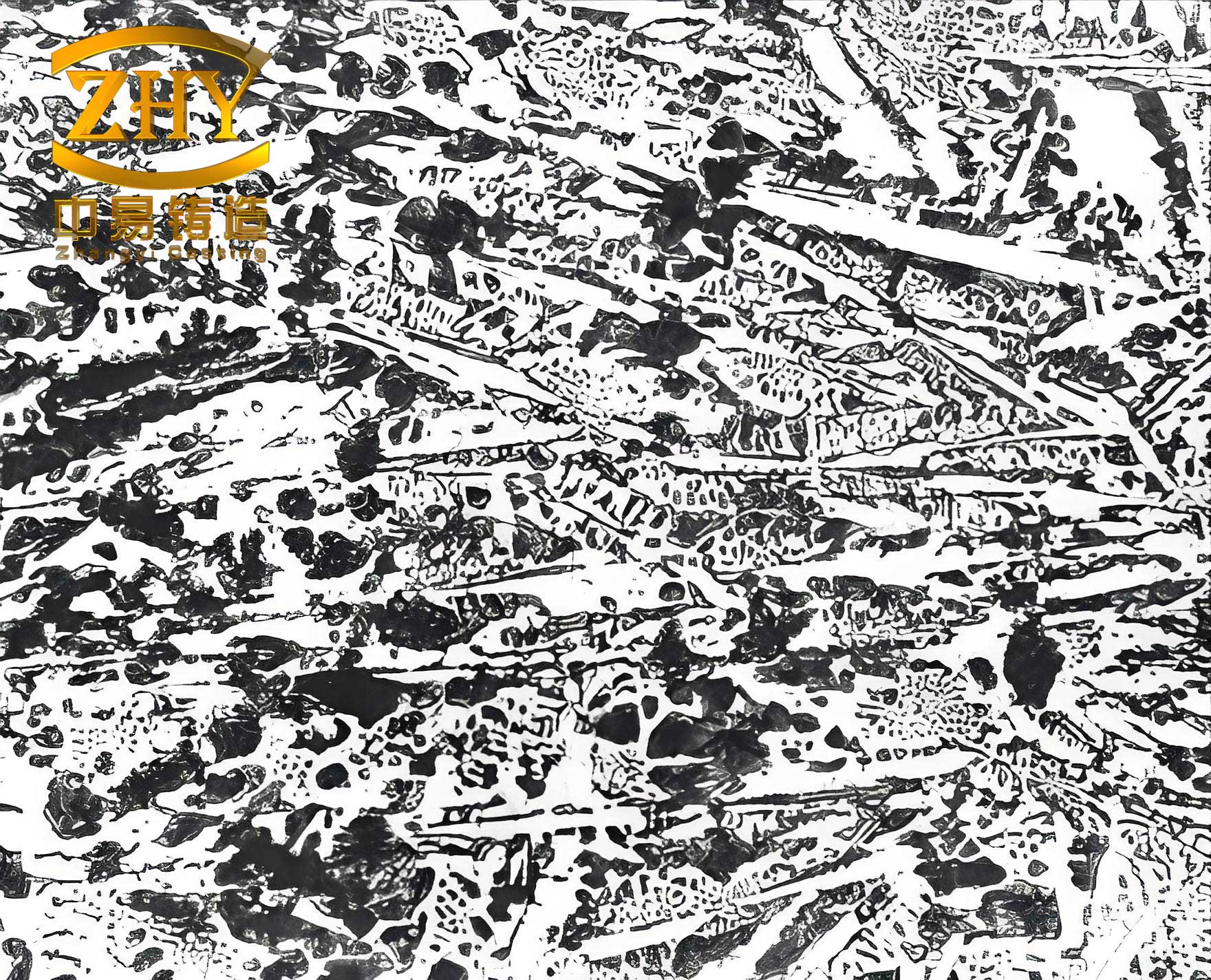
Microstructural analysis revealed that the volume fraction of carbides in this low-carbon white cast iron increased monotonically with manganese content. Below approximately 4.0 wt.% Mn, the matrix consisted predominantly of pearlitic-type structures with minimal retained austenite. Increasing manganese within this range refined the interlamellar spacing, promoting transitions from pearlite to sorbitic and troostitic structures. At a critical manganese level, which depended on the specimen modulus, martensite appeared in the matrix. For instance, in the faster-cooling Charpy specimens (lower modulus), martensite was observed around 5.5-6.0 wt.% Mn. Beyond this optimal range, further increases in manganese led to a significant rise in the volume fraction of retained austenite and a corresponding decrease in transformed products like troostite. At very high manganese contents (>7.0 wt.%), the matrix of Charpy and bend specimens became fully austenitic, although the grinding balls (higher modulus, slower cooling) still contained some troostite even at 9.0 wt.% Mn. This indicates that excessively low manganese cannot suppress high-temperature transformation of austenite, while excessively high manganese excessively depresses the martensite start (Ms) temperature, both being detrimental to martensite formation. Under the sand-casting conditions of this study, the suitable manganese content for obtaining a martensitic matrix was found to be between 5.0 and 7.0 wt.%, varying with section size.
2.2 Influence of Manganese on Mechanical Properties
The effect of manganese on key mechanical properties is summarized in Table 2 and illustrated by derived relationships.
| Property | Trend with Increasing Mn (up to ~7%) | Peak/Turning Point | Trend with Mn >7% |
|---|---|---|---|
| Macrohardness (HB) | Increases to a peak | Peak position shifts: ~6% Mn (Charpy), ~7% Mn (Bend), >7% Mn (Balls) | Decreases past peak, then slight increase |
| Impact Toughness (ak, J/cm²) | Initially decreases, then increases significantly | Minimum around 4-5% Mn | Continues to increase |
| Transverse Rupture Strength (TRS, MPa) | Mirrors hardness trend; increases to a peak | Corresponds to hardness peak for each series | Decreases |
| Relative Toughness (TRS×f/HB, MPa·mm) | Mirrors hardness/TRS trend | Corresponds to hardness peak | Decreases |
| Resistance to Abrasive Wear | Generally improves with hardness | Best wear resistance near but not exactly at hardness peak | Deteriorates despite hardness increase |
| Multi-Impact Shatter Resistance | Continuously deteriorates | N/A – No peak observed | Continues to deteriorate |
The macrohardness (H) as a function of manganese content and microstructure can be conceptually described by a rule-of-mixtures formula considering the major phases:
$$H \approx V_{carbide} \cdot H_{carbide} + V_{matrix} \cdot H_{matrix}(C_{Mn}, S)$$
Where $V_{carbide}$ and $V_{matrix}$ are the volume fractions of carbide and matrix, $H_{carbide}$ is the hardness of M3C carbides (relatively insensitive to Mn), and $H_{matrix}$ is the hardness of the matrix, which is a function of manganese content ($C_{Mn}$) and the interlamellar spacing or transformation product ($S$). The initial rise in hardness is primarily due to pearlite refinement. The subsequent peak and decline are governed by the increasing fraction of softer retained austenite. The final slight hardness回升 at very high Mn is attributed to increased carbide volume fraction and, for slower-cooled specimens, increased troostite.
The differential peak hardness positions for the three specimen series highlight the interaction between composition and cooling rate. The relationship can be approximated as requiring a higher $C_{Mn}$ to achieve an equivalent matrix transformation (e.g., martensite formation) at a slower cooling rate (higher modulus $M$):
$$C_{Mn, peak} \propto \frac{1}{M^n}$$
where $n$ is a positive exponent. Thus, increasing manganese content and increasing cooling rate have analogous effects on promoting hard matrix phases in this white cast iron system.
2.3 Influence of Manganese on Wear and Fracture Resistance
The abrasive wear resistance of the grinding balls generally improved with increasing macrohardness, as expected. However, the optimum wear resistance did not coincide precisely with the peak hardness. More critically, for manganese contents exceeding ~7.0 wt.%, wear resistance deteriorated despite a slight increase in hardness. This paradox can be explained by considering the wear mechanism and the role of individual phases. In low-stress abrasive wear against hard silica (Hv ≈ 1100-1300), the M3C carbides (Hv ≈ 900-1100) are less resistant than the abrasive and cannot effectively protect the matrix. An increase in the volume fraction of these brittle carbides can accelerate cutting wear and promote deformation wear by matrix tearing, thus being detrimental. Furthermore, the significant amount of soft, untransformed austenite present at high Mn levels, which does not work-harden significantly under the test conditions, offers poor resistance to micro-cutting. Therefore, the overall abrasion resistance of this white cast iron is not solely dictated by macrohardness but is a complex function of the abrasive environment and the specific properties of the constituent phases.
The influence of manganese on fracture resistance revealed a critical distinction. While impact toughness ($a_k$) showed a significant recovery and increase at high manganese levels due to the toughening effect of retained austenite, the multi-impact shatter resistance (drop test performance) deteriorated continuously with increasing manganese. This dichotomy arises from the different physical meanings of the two metrics. Impact toughness measures the total energy absorbed until fracture, encompassing elastic, plastic, and fracture work. In contrast, multi-impact failure, akin to fatigue, is governed predominantly by crack initiation and propagation. The brittle, interconnected M3C carbides act as pre-existing crack nuclei. Under repeated impact, cracks initiate readily at the carbide/matrix interfaces and propagate easily through this network. Consequently, the multi-impact shatter resistance is far more sensitive to the volume fraction and morphology of carbides than the one-time impact toughness. This finding underscores that for components like grinding balls subjected to repeated impacts, the drop-weight test is a more reliable and relevant measure of practical “toughness” than standard Charpy impact tests. For the low-carbon white cast iron studied, tempering to relieve casting stresses improved the shatter resistance of low-manganese balls but was detrimental for high-manganese balls, likely due to the transformation of some metastable austenite into less tough constituents.
3. Discussion: Phase-Specific Contributions and Alloy Design Implications
The performance of manganese-alloyed low-carbon white cast iron is a direct consequence of the evolving balance between its microstructural constituents. The phase-specific contributions can be summarized as follows:
- M3C Carbides: Provide baseline hardness but are brittle and prone to cracking. Their increasing volume fraction generally degrades ductility, fracture toughness, and multi-impact resistance. In abrasive environments where they are softer than the abrasive, their net effect on wear resistance can be negative.
- Pearlite/Troostite: Provides good combination of strength and moderate toughness. Refinement of this structure via manganese addition enhances hardness and wear resistance up to a point.
- Martensite: Offers the highest matrix hardness, leading to peak macrohardness and excellent wear resistance when combined with an optimal carbide fraction.
- Retained Austenite: Dramatically improves conventional impact toughness due to its ability to absorb energy through transformation and plastic deformation. However, it lowers macrohardness and can reduce wear resistance if it does not work-harden. It has a less pronounced positive effect on multi-impact shatter resistance compared to its severe negative effect from associated high carbide content.
This interplay suggests that alloy design for specific applications must prioritize different microstructural goals. For applications dominated by pure abrasion with minimal impact, targeting a martensitic matrix with a moderate, well-dispersed carbide fraction (achieved with Mn in the 5-7% range and controlled cooling) is optimal. The governing equation for target hardness could be:
$$H_{target} = H_{martensite} – \Delta H_{austenite} + k \cdot V_{carbide}^{m}$$
where $H_{martensite}$ is the potential hardness of a fully martensitic matrix, $\Delta H_{austenite}$ is the hardness penalty from retained austenite, $V_{carbide}$ is the carbide volume fraction, and $k$, $m$ are material constants.
For applications involving significant repeated impact, such as grinding balls in larger mills, minimizing the volume and interconnectivity of M3C carbides is paramount, even if it sacrifices some macrohardness. This might involve lower carbon contents or the use of other alloying elements to modify carbide morphology. In such cases, a bainitic or lower-carbon martensitic matrix with high toughness is desirable. The shatter resistance ($N_f$, number of drops to failure) can be modeled as being inversely proportional to a function of the carbide network characteristics:
$$N_f \propto \frac{1}{(V_{carbide})^p \cdot (\lambda)^{q}}$$
where $\lambda$ is a parameter describing the connectivity or mean free path of the carbide network, and $p$ and $q$ are positive exponents. This white cast iron, with its inherent M3C network, faces inherent limitations in high-impact duty compared to grades with isolated, hard carbides like high-chromium white cast iron.
4. Conclusion
The investigation into manganese-alloyed low-carbon white cast iron yields several key conclusions for the design and application of this material class:
- Under sand-casting conditions, there exists an optimal manganese range (approximately 5.0-7.0 wt.%) for obtaining a martensitic matrix in sections with moduli between 0.45 cm and 0.83 cm. Manganese contents that are too low or too high promote pearlitic/ troostitic or predominantly austenitic matrices, respectively.
- The macrohardness of this white cast iron exhibits a peak with increasing manganese content. The position of this peak is sensitive to cooling rate (specimen modulus), with slower cooling requiring higher manganese to achieve an equivalent hardenability effect.
- Increasing manganese content significantly enhances the impact toughness of low-carbon white cast iron, primarily through the stabilization of retained austenite. However, it concurrently and continuously degrades the resistance to repeated impact fracture (shatter resistance), as this property is critically dominated by the increasing volume fraction of brittle M3C carbides. Therefore, Charpy impact toughness is an insufficient metric for assessing the suitability of such white cast iron for repeated impact loading.
- Abrasive wear resistance generally correlates with macrohardness but is also strongly influenced by the nature of the microstructural phases. A high volume fraction of M3C carbides and/or large amounts of non-work-hardening retained austenite can be detrimental even when macrohardness is relatively high.
- For components like grinding balls, performance-based tests such as repeated drop-weight tests are essential for reliably evaluating service-relevant fracture resistance. Post-casting tempering can improve the shatter resistance of low-manganese white cast iron by relieving stresses but may be detrimental for high-manganese grades by altering the metastable austenite.
In summary, manganese is a potent alloying element for tailoring the matrix structure of low-carbon white cast iron. Successful application requires a careful balance, prioritizing a martensitic matrix for hardness and wear resistance in low-impact settings, or deliberately limiting carbide content for improved fracture resistance in more demanding impact-abrasion environments, even if this means accepting a lower macrohardness in the white cast iron.