
In the field of wind energy component manufacturing, components like hubs, base frames, and bearing housings are predominantly cast from spheroidal graphite iron grades such as QT400-18AL and QT350-22AL. This preference stems from their exceptional combination of toughness and superior low-temperature impact properties. As the wind power industry advances rapidly towards larger, more structurally complex, and lightweight megawatt-class turbines, the demands on material quality intensify. There is a growing need for enhanced tensile strength while maintaining the critical ductility and low-temperature toughness. This has led to the emergence of non-standard material specifications, such as dual-grade QT420-18AL. Achieving such performance breakthroughs through adjustments in carbon and silicon content alone is challenging. Consequently, micro-alloying has become the preferred technical pathway. Nickel, as a graphitizing element, presents a promising candidate for enhancing the properties of spheroidal graphite iron used in these demanding applications.
The fundamental rationale for using nickel lies in its atomic interaction with iron. Both nickel and γ-iron (austenite) possess a face-centered cubic (FCC) crystal lattice. Given their proximity on the periodic table, nickel and iron form a continuous series of solid solutions. Nickel atoms can randomly substitute for iron atoms within the FCC lattice. Unlike silicon, which also dissolves substitutionally in ferrite and strengthens it, increasing the strength and hardness, nickel can expand the austenite phase field. When added in sufficiently high amounts, nickel can stabilize austenite down to room temperature, resulting in an austenitic matrix. In spheroidal graphite iron, nickel dissolves unlimitedly in both the liquid and solid states without forming carbides. This characteristic helps reduce or eliminate the formation of free carbides, lowers the chill tendency and the brittle transition temperature, while simultaneously strengthening the matrix. This unique combination of effects makes nickel a highly attractive alloying element for improving both the strength and low-temperature impact toughness of heavy-section spheroidal graphite iron castings.
This investigation focuses on systematically evaluating the influence of increasing nickel content on the mechanical and low-temperature impact properties of a base material equivalent to QT400-18AL, specifically designed for thick-section castings. The core objective is to identify optimal nickel addition ranges that enhance strength without compromising the essential ductility and toughness required for critical wind power components.
1. Experimental Methodology
1.1 Casting Design and Simulation
Recognizing that wind turbine castings feature substantial wall thicknesses and consequently slow cooling rates, the experimental setup was designed to simulate high modulus conditions. The test geometry comprised a primary 250 mm cube block (250 mm x 250 mm x 250 mm) accompanied by a standard attached D-type test block (70 mm x 70 mm x 180 mm). MAGMA solidification simulation software was employed to calculate the modulus of this configuration. The results confirmed a high modulus environment, with the maximum modulus reaching approximately 9 for the heavy cube, while the attached D-block had a modulus of about 3. This setup effectively replicates the thermal conditions encountered in the thickest sections of actual wind power castings.
1.2 Material Preparation and Chemical Composition
The melting process was conducted in a medium-frequency induction furnace. The charge consisted of 50% pig iron, 20% returns, and 30% steel scrap. Additions of ferrosilicon, recarburizer, and ferromanganese were made to adjust the base composition. To ensure consistency and isolate the effect of nickel, a single master heat of base iron was prepared. Nickel additions were then made in the ladle. For each experiment, 1000 kg of iron was tapped. The chemical composition of the base iron, as measured by a carbon equivalent analyzer, is shown below:
The base iron exhibited a carbon content of approximately 3.80% and a silicon content of about 1.29%, providing a consistent starting point for all trials.
| Element | Content (wt.%) |
|---|---|
| C | 3.85 |
| Si | 1.35 |
| Mn | 0.20 |
| S | 0.015 |
| P | 0.025 |
| Ni | 0.0039 |
The spheroidizing treatment was performed using the “sandwich” method. For each 1000 kg ladle, 1.2% of a specialized wind-power spheroidizing alloy was placed at the bottom, covered by 0.4% calcium-barium inoculant and 0.8% steel punchings to moderate the reaction. A post-inoculation of 0.15% sulfur-oxygen inoculant was added during pouring. The treatment temperature was tightly controlled at (1480 ± 10)°C. Six separate ladles were prepared from the same base iron, with targeted nickel additions of 0.1%, 0.2%, 0.3%, 0.4%, 0.5%, and 0.6% by weight. The final chemical compositions after spheroidization and inoculation are presented in the following table, confirming minimal variation in key elements and successful achievement of the target nickel levels.
| Element | 0.1% Ni | 0.2% Ni | 0.3% Ni | 0.4% Ni | 0.5% Ni | 0.6% Ni |
|---|---|---|---|---|---|---|
| C | 3.75 | 3.73 | 3.70 | 3.70 | 3.74 | 3.75 |
| Si | 2.08 | 2.05 | 2.04 | 2.06 | 2.05 | 2.08 |
| Mn | 0.20 | 0.19 | 0.18 | 0.21 | 0.19 | 0.17 |
| S | 0.009 | 0.008 | 0.010 | 0.007 | 0.007 | 0.009 |
| Mg | 0.045 | 0.042 | 0.043 | 0.040 | 0.046 | 0.043 | Ni | 0.11 | 0.20 | 0.32 | 0.41 | 0.49 | 0.62 |
2. Results and Analysis
Test specimens for tensile, hardness, impact, and metallographic analysis were extracted from standardized locations on both the attached D-blocks and the heavy 250 mm cubes. For each nickel content, four samples were tested to ensure statistical reliability.
2.1 Mechanical Properties of Attached D-Type Test Blocks
The results from the D-type test blocks, which represent properties from a moderate section thickness, are summarized below. All six compositions met the requirements for QT400-18AL spheroidal graphite iron. Notably, compositions with nickel content exceeding 0.3% also satisfied the proposed dual-grade (e.g., QT420-18AL) strength criteria.
| Ni (wt.%) | Tensile Strength (MPa) | Yield Strength (MPa) | Elongation (%) | Hardness (HBW) |
|---|---|---|---|---|
| 0.10 | 367 | 226 | 22.0 | 132 |
| 0.20 | 374 | 238 | 21.5 | 135 |
| 0.30 | 381 | 241 | 20.5 | 136 |
| 0.40 | 390 | 250 | 22.5 | 145 |
| 0.50 | 385 | 247 | 21.6 | 140 |
| 0.60 | 393 | 252 | 21.2 | 149 |
The data reveals a clear trend: with increasing nickel content, tensile strength, yield strength, and hardness show a consistent upward trajectory. This is a direct manifestation of the solid solution strengthening imparted by nickel atoms in the ferritic matrix of the spheroidal graphite iron. The elongation values, however, remain relatively stable between 20.5% and 22.5%, indicating that nickel additions within this range do not significantly impair the ductility of the spheroidal graphite iron in this section size.
2.2 Low-Temperature Impact Properties of Attached D-Type Test Blocks
The low-temperature impact toughness is a critical parameter for wind energy spheroidal graphite iron. Charpy V-notch tests were conducted at temperatures from -20°C down to -60°C. The results are detailed in the following table and analyzed thereafter.
| Ni (wt.%) | -20°C (J) | -30°C (J) | -40°C (J) | -50°C (J) | -60°C (J) |
|---|---|---|---|---|---|
| 0.10 | 13.3 | 11.1 | 9.0 | 7.6 | 5.0 |
| 0.20 | 13.5 | 10.5 | 8.6 | 7.0 | 5.3 |
| 0.30 | 14.5 | 11.7 | 9.7 | 7.3 | 6.0 |
| 0.40 | 15.3 | 13.0 | 10.5 | 8.0 | 6.3 |
| 0.50 | 15.0 | 12.3 | 9.9 | 7.0 | 5.1 |
| 0.60 | 14.1 | 12.5 | 9.5 | 6.9 | 4.8 |
Two primary trends are evident. First, for any given nickel content, the impact energy decreases significantly as the test temperature drops, which is a typical behavior for ferritic materials. Second, and more importantly, at a constant test temperature, the impact energy initially increases with nickel content, reaches an optimum, and then begins to decline. The peak low-temperature toughness across the entire temperature spectrum was consistently achieved at a nickel content of 0.4%. This suggests that up to this level, nickel effectively suppresses the ductile-to-brittle transition temperature in this spheroidal graphite iron. The subsequent decline indicates that other microstructural factors may become detrimental beyond this optimum point.
2.3 Properties of Heavy 250 mm Section Castings
The behavior in the heavy 250 mm section, representing the thermal center of a very thick spheroidal graphite iron casting, provides crucial insight for real-world applications. The test results, including metallographic data, are consolidated below.
| Ni (wt.%) | Tensile Strength (MPa) | Yield Strength (MPa) | Elongation (%) | Hardness (HBW) | -20°C Impact (J) | Pearlite (%) |
|---|---|---|---|---|---|---|
| 0.10 | 370 | 223 | 20.0 | 141 | 11.0 | <5 |
| 0.20 | 375 | 229 | 19.4 | 143 | 11.5 | <5 |
| 0.30 | 386 | 240 | 20.5 | 145 | 12.5 | <5 |
| 0.40 | 391 | 243 | 21.5 | 147 | 13.0 | <5 |
| 0.50 | 395 | 250 | 19.3 | 143 | 10.5 | ~15 |
| 0.60 | 402 | 260 | 17.0 | 152 | 10.0 | ~20 |
The trends in tensile and yield strength mirror those in the D-blocks, showing a consistent increase with nickel due to solid solution strengthening. However, the ductility and impact properties tell a different story. Both elongation and -20°C impact energy increase up to 0.4% Ni, then exhibit a clear downward trend at 0.5% and 0.6% Ni. This decline correlates directly with the metallographic observation: at nickel levels above 0.4%, a small but significant amount of pearlite was detected in the microstructure of the heavy section. The slower cooling rate of the 250 mm block promotes pearlite formation at higher nickel contents, whereas it is suppressed in the faster-cooling D-block. Pearlite, being a harder and more brittle constituent than ferrite, detrimentally affects both ductility and toughness. The hardness also shows a more pronounced increase at 0.6% Ni, further corroborating the microstructural change.
2.4 Metallographic and Theoretical Analysis
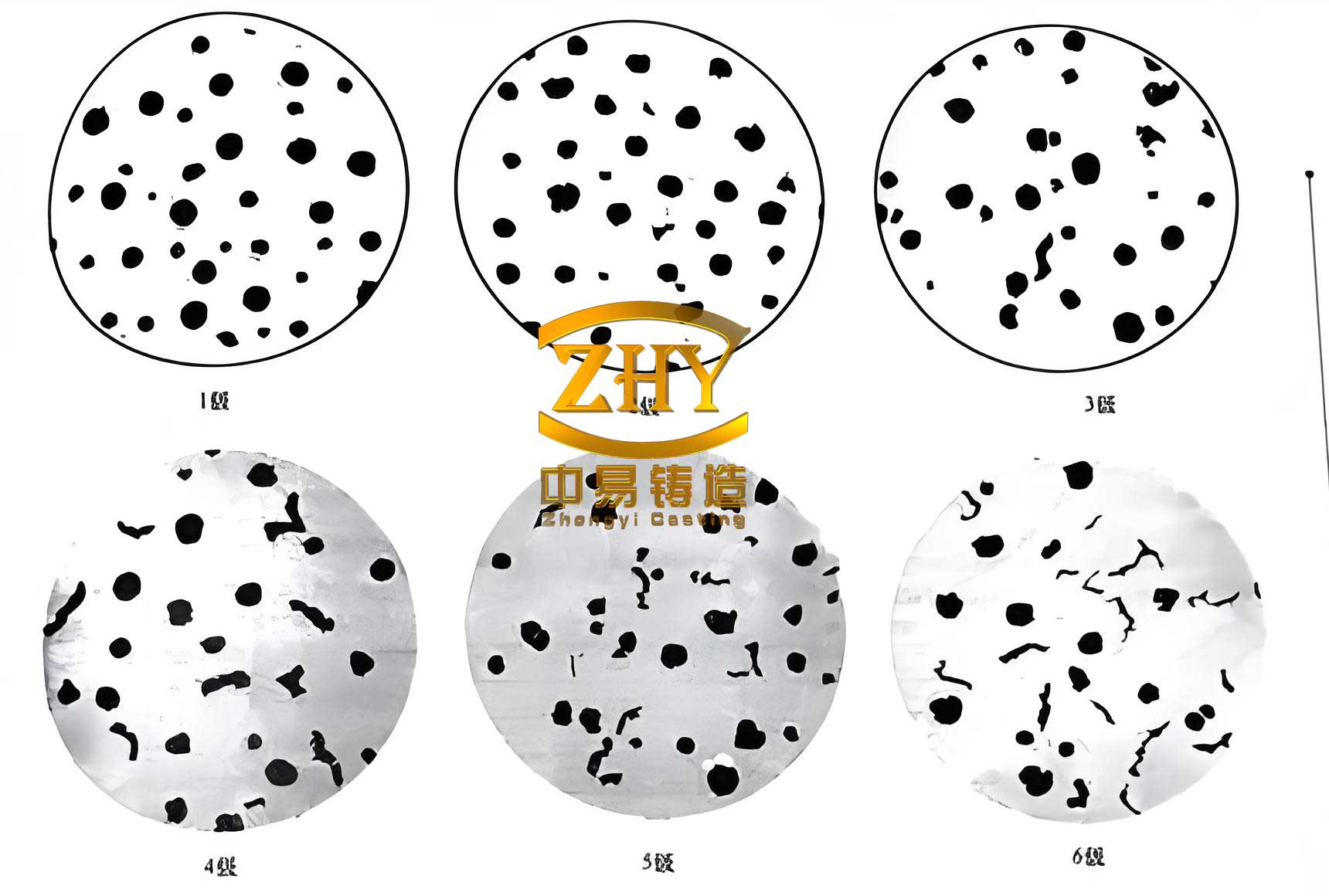
Metallographic examination of the attached blocks confirmed good graphite spheroidization for all nickel levels, with no significant degeneration. The graphite nodule count appeared highest at the 0.4% Ni level. In the heavy 250 mm sections, the nodule count was generally lower than in the D-blocks, and intercellular micro-inclusions were more prominent, both being common features in very slowly cooled spheroidal graphite iron.
The formation of pearlite at higher nickel contents in heavy sections can be understood through the interplay of nickel’s influence on the transformation kinetics and the continuous cooling transformation (CCT) diagram. Nickel is an austenite stabilizer. It lowers the temperature at which austenite begins to transform to ferrite (the $$A_{r3}$$ temperature) and can also slow down the diffusion-controlled growth of ferrite. In heavy sections, the extended time in the critical transformation temperature range allows for the austenite between the graphite nodules to partially transform to pearlite, especially when the nickel content is high enough to retard ferrite formation sufficiently. This can be conceptually represented by a shift in the CCT curves, where the pearlite “nose” is encountered during the slower cooling of the heavy section.
The strengthening effect of nickel can be quantified by a solid solution strengthening contribution to the yield strength, often expressed in a form like:
$$\Delta \sigma_{ss} = k_{Ni} \cdot (C_{Ni})^{n}$$
where $$k_{Ni}$$ is a strengthening coefficient for nickel in ferritic spheroidal graphite iron, $$C_{Ni}$$ is the nickel concentration, and $$n$$ is an exponent typically near 1 for interstitial-free solid solutions. The overall yield strength of the spheroidal graphite iron can be modeled as a sum of contributions from the ferrite matrix, graphite nodules, and other phases:
$$\sigma_y = \sigma_0 + \Delta \sigma_{ss} + \Delta \sigma_{disl} + \Delta \sigma_{pearlite} + \Delta \sigma_{graphite}$$
where $$\sigma_0$$ is the intrinsic strength of pure iron, $$\Delta \sigma_{disl}$$ is dislocation strengthening, $$\Delta \sigma_{pearlite}$$ is the contribution from pearlite (significant at >0.4% Ni in heavy sections), and $$\Delta \sigma_{graphite}$$ accounts for the effect of the graphite phase. The decline in toughness with pearlite formation can be related to its role as a barrier to plastic flow and a potential site for crack initiation.
3. Conclusions and Implications
This comprehensive study on the micro-alloying of spheroidal graphite iron with nickel for heavy-section, low-temperature applications leads to several key conclusions:
- Solid Solution Strengthening: Nickel consistently enhances the tensile strength, yield strength, and hardness of spheroidal graphite iron across all section sizes studied. This effect is attributed to the substitutional solid solution strengthening of the ferritic matrix.
- Optimum Nickel Content for Toughness: There exists an optimum nickel content for maximizing low-temperature impact toughness. For the base chemistry studied, this optimum lies at approximately 0.4% Ni. At this level, the spheroidal graphite iron exhibits the best combination of strength and low-temperature toughness, with impact properties superior to the base material across a range from -20°C to -60°C.
- Section Sensitivity and Pearlite Formation: The benefits of nickel addition are highly sensitive to casting section size. In heavy sections (simulated by the 250 mm block), nickel additions exceeding 0.4% promote the formation of pearlite due to the slower cooling rate. This pearlite formation, while further increasing strength, leads to a marked reduction in both elongation and impact toughness.
- Ductility Retention: Within the optimal range (up to ~0.4% Ni), the elongation of the spheroidal graphite iron remains largely unaffected or may even show slight improvement, indicating that the strengthening mechanism does not come at the cost of ductility until pearlite appears.
The practical implication for foundries producing heavy-section spheroidal graphite iron castings for demanding applications like wind energy is clear. Nickel is a highly effective alloying element for developing enhanced grades such as QT420-18AL. However, the nickel content must be carefully balanced against the expected cooling rate of the casting. For very thick sections, the nickel content should be limited to approximately 0.4% to avoid the detrimental formation of pearlite and the consequent trade-off in toughness. For moderately thick sections or with process modifications that accelerate cooling (e.g., chilling), slightly higher nickel levels might be tolerable. Therefore, the successful application of nickel in heavy-section spheroidal graphite iron requires an integrated approach considering both alloy design and casting process parameters to achieve the desired microstructure and property profile.